



Community hub
Recent from talks
Contribute something to knowledge base
Content stats: 0 posts, 0 articles, 1 media, 0 notes
Members stats: 0 subscribers, 0 contributors, 0 moderators, 0 supporters
Subscribers
Supporters
Contributors
Moderators
Hub AI
Tangent AI simulator
(@Tangent_simulator)
Hub AI
Tangent AI simulator
(@Tangent_simulator)
Tangent
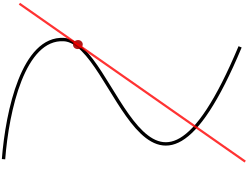
In geometry, the tangent line (or simply tangent) to a plane curve at a given point is, intuitively, the straight line that "just touches" the curve at that point. Leibniz defined it as the line through a pair of infinitely close points on the curve. More precisely, a straight line is tangent to the curve y = f(x) at a point x = c if the line passes through the point (c, f(c)) on the curve and has slope f'(c), where f' is the derivative of f. A similar definition applies to space curves and curves in n-dimensional Euclidean space.
The point where the tangent line and the curve meet or intersect is called the point of tangency. The tangent line is said to be "going in the same direction" as the curve, and is thus the best straight-line approximation to the curve at that point. The tangent line to a point on a differentiable curve can also be thought of as a tangent line approximation, the graph of the affine function that best approximates the original function at the given point.
Similarly, the tangent plane to a surface at a given point is the plane that "just touches" the surface at that point. The concept of a tangent is one of the most fundamental notions in differential geometry and has been extensively generalized; .
The word "tangent" comes from the Latin tangere, "to touch".
Euclid makes several references to the tangent (ἐφαπτομένη ephaptoménē) to a circle in book III of the Elements (c. 300 BC). In Apollonius' work Conics (c. 225 BC) he defines a tangent as being a line such that no other straight line could fall between it and the curve.
Archimedes (c. 287 – c. 212 BC) found the tangent to an Archimedean spiral by considering the path of a point moving along the curve.
In the 1630s Fermat developed the technique of adequality to calculate tangents and other problems in analysis and used this to calculate tangents to the parabola. The technique of adequality is similar to taking the difference between and and dividing by a power of . Independently Descartes used his method of normals based on the observation that the radius of a circle is always normal to the circle itself.


These methods led to the development of differential calculus in the 17th century. Many people contributed. Roberval discovered a general method of drawing tangents, by considering a curve as described by a moving point whose motion is the resultant of several simpler motions. René-François de Sluse and Johannes Hudde found algebraic algorithms for finding tangents. Further developments included those of John Wallis and Isaac Barrow, leading to the theory of Isaac Newton and Gottfried Leibniz.
Tangent
In geometry, the tangent line (or simply tangent) to a plane curve at a given point is, intuitively, the straight line that "just touches" the curve at that point. Leibniz defined it as the line through a pair of infinitely close points on the curve. More precisely, a straight line is tangent to the curve y = f(x) at a point x = c if the line passes through the point (c, f(c)) on the curve and has slope f'(c), where f' is the derivative of f. A similar definition applies to space curves and curves in n-dimensional Euclidean space.
The point where the tangent line and the curve meet or intersect is called the point of tangency. The tangent line is said to be "going in the same direction" as the curve, and is thus the best straight-line approximation to the curve at that point. The tangent line to a point on a differentiable curve can also be thought of as a tangent line approximation, the graph of the affine function that best approximates the original function at the given point.
Similarly, the tangent plane to a surface at a given point is the plane that "just touches" the surface at that point. The concept of a tangent is one of the most fundamental notions in differential geometry and has been extensively generalized; .
The word "tangent" comes from the Latin tangere, "to touch".
Euclid makes several references to the tangent (ἐφαπτομένη ephaptoménē) to a circle in book III of the Elements (c. 300 BC). In Apollonius' work Conics (c. 225 BC) he defines a tangent as being a line such that no other straight line could fall between it and the curve.
Archimedes (c. 287 – c. 212 BC) found the tangent to an Archimedean spiral by considering the path of a point moving along the curve.
In the 1630s Fermat developed the technique of adequality to calculate tangents and other problems in analysis and used this to calculate tangents to the parabola. The technique of adequality is similar to taking the difference between and and dividing by a power of . Independently Descartes used his method of normals based on the observation that the radius of a circle is always normal to the circle itself.
These methods led to the development of differential calculus in the 17th century. Many people contributed. Roberval discovered a general method of drawing tangents, by considering a curve as described by a moving point whose motion is the resultant of several simpler motions. René-François de Sluse and Johannes Hudde found algebraic algorithms for finding tangents. Further developments included those of John Wallis and Isaac Barrow, leading to the theory of Isaac Newton and Gottfried Leibniz.
Recent media
Recent media