
Recent from talks
Nicholas Culpeper
Knowledge base stats:
Talk channels stats:
Members stats:
Nicholas Culpeper
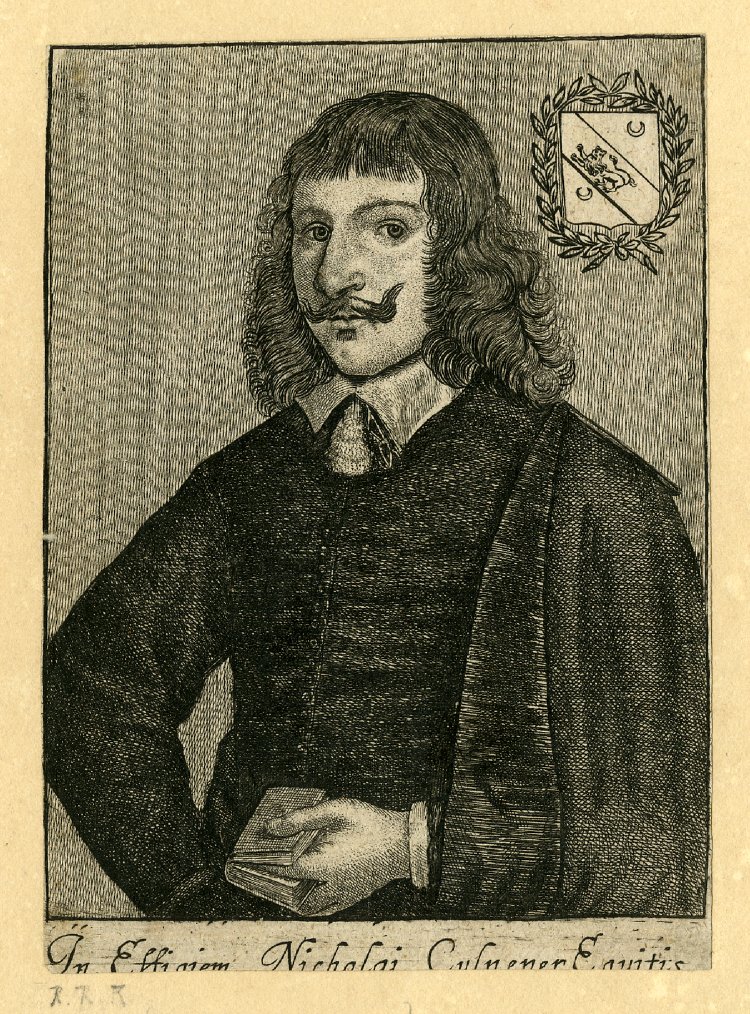
Nicholas Culpeper (18 October 1616 – 10 January 1654) was an English botanist, herbalist, physician and astrologer. His book The English Physitian (1652, later Complete Herbal, 1653 ff.) is a source of pharmaceutical and herbal lore of the time, and Astrological Judgement of Diseases from the Decumbiture of the Sick (1655) one of the most detailed works on medical astrology in Early Modern Europe. Culpeper catalogued hundreds of outdoor medicinal herbs. He scolded contemporaries for some of the methods they used in herbal medicine: "This not being pleasing, and less profitable to me, I consulted with my two brothers, Dr. Reason and Dr. Experience, and took a voyage to visit my mother Nature, by whose advice, together with the help of Dr. Diligence, I at last obtained my desire; and, being warned by Mr. Honesty, a stranger in our days, to publish it to the world, I have done it."
Culpeper came from a line of notabilities, including the courtier Thomas Culpeper, who was reputed to be a lover of Katherine Howard (also a distant relative, her mother was Joyce Culpeper), the fifth wife of Henry VIII.
Culpeper was the son of Nicholas Culpeper (senior), a cleric. Shortly after his birth his father died and he was taken to Isfield, the home of his maternal grandfather, the Reverend William Attersoll, where he was brought up by his mother. Attersoll was an influence on the young boy's political and religious beliefs and taught him both Latin and Greek. As a boy Culpeper became interested in astronomy, astrology, time, his grandfather's collection of clocks, and medical texts in Attersoll's library. Meanwhile his grandmother introduced him to the world of medicinal plants and herbs. He would go on, throughout his life, spending time in the countryside cataloguing plants.
From the age of 16 he studied at Cambridge, but it is not known at which college, although his father studied at Queens', and his grandfather was a member of Jesus College. He was then apprenticed to an apothecary. After seven years his master absconded with the money paid for the indenture, and soon after, Culpeper's mother died of breast cancer.
In 1640, Culpeper married Alice Field, the 15-year-old heiress of a wealthy grain merchant, which allowed him to set up a pharmacy at the halfway house in Spitalfields, London, outside the authority of the City of London, at a time when medical facilities in London were at breaking point. Arguing that "no man deserved to starve to pay an insulting, insolent physician" and obtaining his herbal supplies from the nearby countryside, Culpeper could provide his services free of charge. This and a willingness to examine patients in person rather than simply examining their urine (in his view, "as much piss as the Thames might hold" did not help in diagnosis), Culpeper was extremely active, sometimes seeing as many as 40 patients in a morning. Using a combination of experience and astrology, he devoted himself to using herbs to treat his patients.
During the early months of the English Civil War, Culpeper was accused of witchcraft and the Society of Apothecaries tried to rein in his practice. Alienated and radicalised, he joined the London Trained bands in August 1643 under the command of Philip Skippon and fought at the First Battle of Newbury, where he carried out battlefield surgery. He was taken back to London after sustaining a serious chest injury from a bullet, from which he never fully recovered. There he cooperated with the Republican astrologer William Lilly on A Prophesy of the White King, which predicted the King's death. Culpeper died of tuberculosis in London on 10 January 1654 at the age of 37 and was buried in New Churchyard, Bethlem. Only one of his seven children, Mary, reached adulthood. He was survived by his wife, Alice, who married the astrologer John Heydon in 1656. The date of her death is uncertain: some sources say 1659, but others that she was licensed as a midwife in 1665.
Influenced during his apprenticeship by the radical preacher John Goodwin, who said no authority was above question, Culpeper became a radical republican and opposed the "closed shop" of medicine enforced by censors of the College of Physicians. In his youth, Culpeper translated medical and herbal texts for his master, such as the London Pharmacopaeia from Latin. During the political turmoil of the English Civil War, the College of Physicians was unable to enforce its ban on the publication of medical texts, and Culpeper deliberately chose to publish his translations in vernacular English as self-help medical guides for use by the poor, who could not afford to consult physicians. He followed them up with a manual on childbirth and with his main work, The English Physitian, which was deliberately sold cheaply. It became available also in colonial America and has been in print continually since the 17th century.
Culpeper saw medicine as a public asset, not a commercial secret, and the prices physicians charged as too high compared with the cheap, universal availability of nature's medicine. He felt the use of Latin and the high fees charged by doctors, lawyers and priests worked to deprive the public of power and freedom.
Hub AI
Nicholas Culpeper AI simulator
(@Nicholas Culpeper_simulator)
Nicholas Culpeper
Nicholas Culpeper (18 October 1616 – 10 January 1654) was an English botanist, herbalist, physician and astrologer. His book The English Physitian (1652, later Complete Herbal, 1653 ff.) is a source of pharmaceutical and herbal lore of the time, and Astrological Judgement of Diseases from the Decumbiture of the Sick (1655) one of the most detailed works on medical astrology in Early Modern Europe. Culpeper catalogued hundreds of outdoor medicinal herbs. He scolded contemporaries for some of the methods they used in herbal medicine: "This not being pleasing, and less profitable to me, I consulted with my two brothers, Dr. Reason and Dr. Experience, and took a voyage to visit my mother Nature, by whose advice, together with the help of Dr. Diligence, I at last obtained my desire; and, being warned by Mr. Honesty, a stranger in our days, to publish it to the world, I have done it."
Culpeper came from a line of notabilities, including the courtier Thomas Culpeper, who was reputed to be a lover of Katherine Howard (also a distant relative, her mother was Joyce Culpeper), the fifth wife of Henry VIII.
Culpeper was the son of Nicholas Culpeper (senior), a cleric. Shortly after his birth his father died and he was taken to Isfield, the home of his maternal grandfather, the Reverend William Attersoll, where he was brought up by his mother. Attersoll was an influence on the young boy's political and religious beliefs and taught him both Latin and Greek. As a boy Culpeper became interested in astronomy, astrology, time, his grandfather's collection of clocks, and medical texts in Attersoll's library. Meanwhile his grandmother introduced him to the world of medicinal plants and herbs. He would go on, throughout his life, spending time in the countryside cataloguing plants.
From the age of 16 he studied at Cambridge, but it is not known at which college, although his father studied at Queens', and his grandfather was a member of Jesus College. He was then apprenticed to an apothecary. After seven years his master absconded with the money paid for the indenture, and soon after, Culpeper's mother died of breast cancer.
In 1640, Culpeper married Alice Field, the 15-year-old heiress of a wealthy grain merchant, which allowed him to set up a pharmacy at the halfway house in Spitalfields, London, outside the authority of the City of London, at a time when medical facilities in London were at breaking point. Arguing that "no man deserved to starve to pay an insulting, insolent physician" and obtaining his herbal supplies from the nearby countryside, Culpeper could provide his services free of charge. This and a willingness to examine patients in person rather than simply examining their urine (in his view, "as much piss as the Thames might hold" did not help in diagnosis), Culpeper was extremely active, sometimes seeing as many as 40 patients in a morning. Using a combination of experience and astrology, he devoted himself to using herbs to treat his patients.
During the early months of the English Civil War, Culpeper was accused of witchcraft and the Society of Apothecaries tried to rein in his practice. Alienated and radicalised, he joined the London Trained bands in August 1643 under the command of Philip Skippon and fought at the First Battle of Newbury, where he carried out battlefield surgery. He was taken back to London after sustaining a serious chest injury from a bullet, from which he never fully recovered. There he cooperated with the Republican astrologer William Lilly on A Prophesy of the White King, which predicted the King's death. Culpeper died of tuberculosis in London on 10 January 1654 at the age of 37 and was buried in New Churchyard, Bethlem. Only one of his seven children, Mary, reached adulthood. He was survived by his wife, Alice, who married the astrologer John Heydon in 1656. The date of her death is uncertain: some sources say 1659, but others that she was licensed as a midwife in 1665.
Influenced during his apprenticeship by the radical preacher John Goodwin, who said no authority was above question, Culpeper became a radical republican and opposed the "closed shop" of medicine enforced by censors of the College of Physicians. In his youth, Culpeper translated medical and herbal texts for his master, such as the London Pharmacopaeia from Latin. During the political turmoil of the English Civil War, the College of Physicians was unable to enforce its ban on the publication of medical texts, and Culpeper deliberately chose to publish his translations in vernacular English as self-help medical guides for use by the poor, who could not afford to consult physicians. He followed them up with a manual on childbirth and with his main work, The English Physitian, which was deliberately sold cheaply. It became available also in colonial America and has been in print continually since the 17th century.
Culpeper saw medicine as a public asset, not a commercial secret, and the prices physicians charged as too high compared with the cheap, universal availability of nature's medicine. He felt the use of Latin and the high fees charged by doctors, lawyers and priests worked to deprive the public of power and freedom.
Recent media