


Community hub
Recent from talks
Contribute something
Nothing was collected or created yet.
Nilai
View on Wikipedia | This article needs additional citations for verification. (March 2007) |
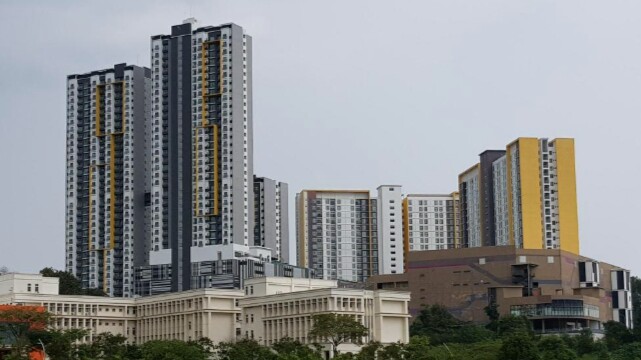
Nilai is a city located in the Seremban District of the state of Negeri Sembilan, Malaysia, located close to the border with Selangor. It is the northern suburb within the Seremban metropolitan area, as well as part of the Greater Kuala Lumpur metropolitan area.
Key Information


Due to its proximity to the Kuala Lumpur International Airport, it is a rapidly growing city. Nilai is almost halfway between the state capital Seremban and Kajang, Selangor, and lies on the railway linking these two cities. It is also the southern terminus of MSC Malaysia and the northern anchor of the Malaysia Vision Valley corridor.
Development projects can be seen as one drive around Nilai. Some of Malaysia's most well-known colleges and two universities are located in Nilai: Nilai University, INTI International University, Manipal International University, Universiti Sains Islam Malaysia and Islamic University College of Malaysia. As a result, the town is occupied by students from all over the world.
Nilai has become a popular shopping town with the establishment of several major shopping malls such as the Nilai 3 Wholesale Centre, Nilai Square, Giant Hypermarket, 9Avenue, Lotus's and Econsave. MesaMall and AEON Mall Nilai are the newest additions, having been opened in 2017 and 2019 respectively.
Nilai also has several activity-oriented attractions such as Dataran Nilai, Taman Awam Nilai, GEMBOX, and Melati Hill around the city center area, as well as Taman Tasik Ujana and TheParc in Nilai Impian.
Etymology
[edit]The word Nilai means value in Malay. During the British colonial rule, it was known as Sepang Road.[1]
History
[edit]Founding
[edit]Nilai has its own unique origin and history. Historically, Nilai was under luak Sungai Ujong administered by waris di Darat or waris di Air. Under Dato’ Johan from waris di Darat three Dato’ Lingkungan controls the 3 corak suku Batu Hampar concentrated in a few villages. Other lines including those from Bentan that are not based on suku, but are based on the village where they live. As a Lembaga waris Perut Hulu, Waris Telaga Undang Dato’ Johan is not a titian balai because Dato’ Andika is more senior. However, the power endowed by Dato’ Kelana Putera to collect tax until the year 1894 shows that the Dato’ Johan position concerning balai Undang is important.
The third Dato’ Johan, Dato’ Maamor is the Dato’ Kelana Putra, the 8th Undang Luak Sungai Ujong. Even while being appointed as Pesaka Dato' Kelana Putera, Dato’ Maamor is still a child. At that time, Pesaka Dato' Kelana Putera position is left vacant since 1887 when Dato' Mohd Yusof, the Undang Luak Sungai Ujong is relieved from duty. Because waris Perut Hulu does not have a son to hold the pesaka, the anak-anak buah unanimously appointed Dato’ Maamor who was still a child hold the pesaka Dato' Johan and then titled Dato’ Kelana.
Dato’ Johan's jurisdiction also covers Lenggeng Mukim which includes Mendum Village, Lenggeng Village, Sungai Jai Village, Hulu Beranang Village and Dacing Village. All these villages have their own ketua adat called ‘Tua Waris’. There are also suku of Minangkabau people concentrated on other luak in Negeri Sembilan before settling in Lenggeng Village. To ensure their welfare in Luak Sungai Ujong, all suku was given ‘Tua Waris’ to be their representative in matters relating to tradition and administration in Balai Undang Luak.[2]
Climate
[edit]The Köppen-Geiger climate classification system classifies its climate as tropical rainforest (Af).[3]
| Climate data for Nilai | |||||||||||||
|---|---|---|---|---|---|---|---|---|---|---|---|---|---|
| Month | Jan | Feb | Mar | Apr | May | Jun | Jul | Aug | Sep | Oct | Nov | Dec | Year |
| Mean daily maximum °C (°F) | 31 (88) |
31.7 (89.1) |
32.3 (90.1) |
32.1 (89.8) |
31.7 (89.1) |
31.5 (88.7) |
31.2 (88.2) |
31.1 (88.0) |
31.3 (88.3) |
31.2 (88.2) |
31.1 (88.0) |
31 (88) |
31.4 (88.6) |
| Daily mean °C (°F) | 26.5 (79.7) |
27.1 (80.8) |
27.4 (81.3) |
27.6 (81.7) |
27.5 (81.5) |
27.2 (81.0) |
26.9 (80.4) |
26.9 (80.4) |
27 (81) |
27 (81) |
27 (81) |
26.7 (80.1) |
27.1 (80.8) |
| Mean daily minimum °C (°F) | 22.1 (71.8) |
22.5 (72.5) |
22.6 (72.7) |
23.2 (73.8) |
23.4 (74.1) |
23 (73) |
22.7 (72.9) |
22.8 (73.0) |
22.7 (72.9) |
22.8 (73.0) |
22.9 (73.2) |
22.5 (72.5) |
22.8 (73.0) |
| Average precipitation mm (inches) | 149 (5.9) |
137 (5.4) |
213 (8.4) |
246 (9.7) |
184 (7.2) |
119 (4.7) |
123 (4.8) |
152 (6.0) |
169 (6.7) |
249 (9.8) |
263 (10.4) |
219 (8.6) |
2,223 (87.6) |
| Source: Climate-Data.org (altitude: 50m)[3] | |||||||||||||
Demographics
[edit]Chinese make up the majority of the population at 46%, followed by the Malays at 31%, and Indians at 22%.[4]
Education
[edit]
The state government's initiative to turn Negeri Sembilan into an educational hub [citation needed] has also borne fruit as several foreign and local institutions of higher education have agreed to set up operations here.
Among them are Britain's Epsom College which has acquired land in Bandar Enstek to set up its first institute outside England, Epsom College in Malaysia and the City University College of Science and Technology which signed an agreement to acquire a 40 ha parcel of land here recently.[citation needed] Another offshore campus is the MILA University (known as the Manipal International University prior to 2023).
The state would also benefit from the construction of the RM1.2B Education Ministry complex which would, among others, house the Aminuddin Baki Institute, Institut Pendidikan Guru Kampus Pendidikan Teknik, English Language Institute, Tunku Kurshiah College and Nilai Polytechnic as well as the International Islamic University Malaysia’s medical faculty and the International University College of Nursing.
Several institutions of higher learning that have been built in the area include Nilai University, INTI International University and Universiti Sains Islam Malaysia.
Transportation
[edit]_01.jpg)
_01.jpg)
Car
[edit]PLUS Expressway exit 214 serves Nilai. Nilai is also the southern end of ELITE which connects it to Shah Alam, the capital of Selangor. Motorists from western Selangor are thus able to get to Negeri Sembilan, Malacca or Johor while bypassing Kuala Lumpur.
Rail
[edit]KTM Komuter has two stations serving Nilai constituency: Batang Benar and Nilai.
Buses are available from Nilai Komuter station to the nearby KLIA.
Transportation provided by INTI International University and Nilai University
[edit]Bus service will be provided to INTI International University students and Nilai University students for free to different destinations according to the universities' timetable. Students can go to Giant, Tesco or KTM station by referring to the timetable.
Politics
[edit]Nilai is part of the Seremban constituency of the Dewan Rakyat of the Malaysian Parliament, currently represented by Anthony Loke Siew Fook of the Democratic Action Party.[5]
On the provincial level, Nilai is represented in the Negeri Sembilan State Legislative Assembly by Arul Kumar a/l Jambunathan, also from the Democratic Action Party.[6]
References
[edit]

- ^ "1929 F.M.S. Wall Map of Selangor (Kuala Lumpur)". Geographicus Rare Antique Maps. Retrieved 16 June 2023.
- ^ "Official Portal Nilai Municipal Council - Nilai Background". Archived from the original on 2013-08-08. Retrieved 2025-05-25.
- ^ a b "Climate: Nilai - Climate graph, Temperature graph, Climate table". Climate-Data.org. Retrieved 2013-12-14.
- ^ "Undi.info". Archived from the original on 2015-05-08. Retrieved 2015-07-21.
- ^ "Ahli Parlimen". Portal Rasmi Parlimen Malaysia. Retrieved 6 March 2016.
- ^ [in the Negeri Sembilan State Legislative Assembly "Ahli Dewan Undangan Negeri Negeri Sembilan"]. DAPMalaysia.org. Retrieved 6 March 2016.
{{cite web}}: Check|url=value (help)
Capital: Seremban, Royal town: Seri Menanti | |||||||||||
| Topics |
| ||||||||||
| Society | |||||||||||
| Administrative divisions |
| ||||||||||


Nilai
View on GrokipediaEtymology
Name derivation
The name "Nilai" derives from the Malay word nilai, which translates literally to "value" or "worth."[5][6] This standard term in the Malay lexicon, rooted in Austronesian linguistic patterns common to the Malay Peninsula, carries connotations of economic or intrinsic merit without deeper archaic variants documented in regional philology.[7] Local accounts attribute the place name to the area's historically recognized land value, likely tied to its fertile terrain and proximity to trade routes, though no primary historical records specify alternative dialectal influences from Negeri Sembilan's Minangkabau-Malay substrate.[8]Geography
Location and boundaries
Nilai is situated in the Seremban District of Negeri Sembilan, Malaysia, at geographical coordinates approximately 2°50′N 101°48′E.[9] The town lies adjacent to the border with Selangor state, positioning it within the broader Klang Valley region. Its administrative boundaries fall under the Seremban municipal area, encompassing urban and semi-rural zones integrated into the district's framework. To the north, Nilai connects via routes like Jalan Labu to nearby areas including Labu, while southward extensions approach regions toward Rembau, approximately 45 km distant.[10] The western proximity to Selangor includes adjacency to Sepang, home to Kuala Lumpur International Airport (KLIA), situated about 23 km northwest of Nilai's center.[11] Nilai's location places it roughly 50 km south of Kuala Lumpur city center, facilitating its integration as a southern suburban extension of the Greater Kuala Lumpur metropolitan area.[12] This strategic positioning underscores its role in regional connectivity, bounded by federal routes and highways linking it to surrounding districts.[13]Topography and environment
Nilai occupies flat to gently undulating terrain typical of Peninsular Malaysia's interior lowlands, with elevations averaging 58 meters above sea level and ranging from approximately 43 to 60 meters in surrounding areas such as Dataran Nilai and Kampung Seri Nilai.[14][15] This low-relief landscape, formed by alluvial deposits, supports extensive flat plains conducive to agriculture and development, lacking significant hills or escarpments within municipal boundaries.[16] The area's land use reflects a historical predominance of agricultural fields, including palm oil plantations, interspersed with remnants of secondary vegetation on the peripheries. Over the past four decades, urban and industrial expansion has transformed substantial portions of farmland into built environments, with remote sensing analyses of the broader Seremban district—encompassing Nilai—revealing a decline in dense vegetation cover due to infrastructure growth. This shift has resulted in fragmented green spaces amid expanding residential and commercial zones, altering the original agrarian mosaic.[17] Environmental pressures in Nilai stem primarily from land conversion, where urban sprawl encroaches on arable soils, diminishing habitat connectivity and increasing impervious surfaces that affect soil permeability and local hydrology.[18] Satellite-derived land-use surveys highlight accelerated loss of agricultural land to development, prompting concerns over long-term sustainability of the remaining open areas without compensatory reforestation or zoning measures.Climate
Nilai features an equatorial climate typical of Peninsular Malaysia, with consistently high temperatures averaging between 23°C and 32°C year-round, minimal seasonal variation, and relative humidity often exceeding 80%. Daily highs typically range from 30°C to 32°C, while lows hover around 23°C to 24°C, reflecting the region's proximity to the equator and stable atmospheric conditions.[19][20][21] Annual precipitation in Nilai surpasses 2,000 mm, aligning with national patterns of 2,000 to 2,500 mm across much of Malaysia, though localized totals in Negeri Sembilan can reach approximately 2,500 mm. Rainfall is distributed throughout the year but peaks during the northeast monsoon from November to February, when monthly accumulations often exceed 200-250 mm, driven by persistent cloud cover and frontal systems. This period sees the highest incidence of heavy downpours, with November recording averages around 260 mm near Nilai, comparable to nearby Seremban.[22][23][24] Extreme events include occasional flash flooding from intense rainfall, as evidenced by incidents in December 2024 triggered by over two hours of continuous heavy precipitation, which inundated low-lying areas. Such risks are consistent with broader Peninsular Malaysia trends, where northeast monsoon influences amplify downpours without deviating significantly from equatorial norms; temperature extremes rarely fall below 20°C or exceed 35°C. No pronounced dry season occurs, though relative lulls in May to September see fewer rainy days, underscoring Nilai's climatic uniformity with national averages.[25][19][26]History
Pre-colonial and colonial periods
The territory of modern Nilai lay within the luak (district) of Sungai Ujong, a core component of the Negeri Sembilan confederation, which originated from migrations of Minangkabau people from Sumatra beginning in the 15th century under the influence of the Melaka Sultanate.[27] These settlers introduced matrilineal customs known as Adat Perpatih, shaping social structures around agriculture and village-based governance, though specific settlements in the Nilai area remain undocumented in primary sources beyond general references to scattered Malay kampungs (villages) along riverine trade paths.[28] Archaeological evidence from nearby sites, such as the Pasoh Caves, indicates prehistoric human activity dating back millennia, but no distinct pre-colonial artifacts or structures have been attributed directly to Nilai, underscoring its role as peripheral agrarian land rather than a focal point of early state activity.[29] In the colonial era, British influence reached Sungai Ujong following military intervention in 1874 to resolve succession disputes among local chiefs, leading to the appointment of a British resident to oversee administration and protect tin mining and trade interests.[30] Nilai's vicinity saw the gradual establishment of minor agricultural outposts in the late 19th century, focused on rice paddy expansion and early rubber planting to support export economies, as noted in colonial gazetteers emphasizing rural Malay subsistence farming under indirect rule.[31] By the formation of the Federated Malay States in 1895, which incorporated Negeri Sembilan, the area maintained its character as low-density rural holdings with limited infrastructure, reflecting continuity in small-scale cultivation without significant urban or extractive developments until the early 20th century.[27] This period lacked major conflicts or events specific to Nilai, preserving a causal lineage of agrarian stability amid broader colonial economic reorientation toward plantation commodities.Founding and early 20th century
Nilai developed as a small settlement during the British colonial period in the early 20th century, building upon earlier Minangkabau administrative structures under the Luak Sungai Ujong, where local leaders such as Dato' Kelana Putera managed taxation and village affairs until at least 1894.[1] The town's early growth was linked to the expansion of rubber plantations across Negeri Sembilan, mirroring the broader Malayan trend where commercial rubber cultivation proliferated after initial plantings in the late 1890s, with the first exports from the state occurring in the early 1900s from estates near Seremban.[32] The West Coast railway line, constructed by the Federated Malay States Railways between the late 19th and early 20th centuries to transport commodities like rubber and tin, passed through the Nilai area, establishing it as a logistical point for agricultural output.[33] By the mid-20th century, Nilai functioned primarily as a rural agricultural hub with rudimentary infrastructure, setting the stage for post-independence enhancements in roads and basic schooling amid Malaya's transition to sovereignty in 1957.[34]Post-independence expansion
Following Malaysia's independence in 1957, Nilai underwent initial administrative formalization with the establishment of the Nilai Local Council (Lembaga Bandaran Nilai) in 1959, enabling structured local governance and basic urban planning.[1] This step aligned with broader national efforts to decentralize administration and support rural-town transitions in states like Negeri Sembilan. By 1979, Nilai's local authority was integrated into the newly formed Seremban District Council (Majlis Daerah Seremban), reflecting ongoing consolidation of administrative boundaries to facilitate coordinated development.[1] The New Economic Policy (NEP), launched in 1971 and spanning to 1990, drove much of Nilai's mid-20th-century expansion by prioritizing poverty reduction, bumiputera economic participation, and industrialization to diversify from agriculture. Federal initiatives under the NEP and successive Malaysia Plans encouraged the creation of industrial estates nationwide during the 1970s, drawing manufacturing investments to semi-rural areas with access to highways and labor pools; Nilai benefited from its strategic location near the North-South Expressway corridor.[35] Local estates, such as precursors to the Nilai Industrial Estate, began attracting factories for light manufacturing, supported by subsidized land and incentives aimed at export-oriented growth. Population influx accelerated during the 1960s-1980s due to rural-to-urban migration spurred by these policies, with Nilai's residents swelling to approximately 10,000 by 1990 amid job opportunities in emerging industries.[36] Early growth faced infrastructure constraints, including inadequate roads, water supply, and utilities typical of NEP-era peripheral towns, but these were mitigated through targeted federal allocations under the Second and Third Malaysia Plans (1971-1980), which funded connectivity improvements and basic amenities to sustain industrial momentum.[37] This period laid the groundwork for Nilai's shift from agrarian roots to a burgeoning industrial hub without overreliance on urban centers like Seremban.Recent economic developments
The establishment of Kuala Lumpur International Airport (KLIA) in 1998 positioned Nilai as a key logistics node, spurring economic activity through enhanced air cargo handling and highway connectivity, with spillover effects into manufacturing and warehousing in the subsequent decades.[38] In November 2024, Transport Minister Anthony Loke proposed a dedicated logistics hub in Nilai to alleviate congestion at existing facilities, improve multimodal connectivity, and support halal industry growth, potentially drawing foreign direct investment amid Malaysia's trade-oriented recovery.[39][40] Negeri Sembilan's economy, encompassing Nilai, recorded 4.6% GDP growth as of mid-2025, propelled by services (4.3%) and manufacturing (3.9%), reflecting broader infrastructure-led expansion including airport-related logistics.[41] This growth has fueled property demand, evidenced by Sime Darby Property's Emilia 1 & 2 residential phases in Nilai Impian achieving full take-up at preview in February 2023, and commercial launches like XME Boulevard shop offices underscoring investor confidence in the area's transit-oriented potential.[42][43] Integration into the Malaysia Vision Valley corridor has further accelerated developments, prioritizing high-value sectors like aviation services and education-linked innovation, with sustained annual expansions aligning with national trade liberalization efforts post-2020.[13]Demographics
Population statistics
The 2020 Population and Housing Census of Malaysia, conducted by the Department of Statistics Malaysia (DOSM), recorded a population of 119,613 residents in the Nilai state constituency, comprising 32,084 households.[44] This marked Nilai as the most populous state constituency in Negeri Sembilan, which overall had 1.19 million residents in the same census.[44][45] Nilai's population growth has outpaced the state average, with expansion primarily attributed to net in-migration rather than natural increase. Between the 2010 and 2020 censuses, Negeri Sembilan's total population rose from approximately 1.017 million to 1.194 million, yielding an average annual growth rate of about 1.6%.[46] In contrast, Nilai's constituency-level figures reflect a compounded annual growth rate exceeding 4% over the decade, underscoring its role as a suburban outlier amid the state's more moderate demographic trends.[47] Urbanization in Nilai has accelerated from a historically rural base, contributing to a rising share of urban residents relative to Negeri Sembilan's statewide urbanization rate, which aligns closely with Malaysia's national figure of 75.1% in 2020.[48] Linear projections based on census trends indicate continued moderate expansion through 2025, assuming sustained migration patterns without external disruptions.[49]Ethnic composition
The ethnic composition of Nilai reflects Malaysia's multi-ethnic society, with Bumiputera (predominantly Malays and other indigenous groups) forming the largest segment at 62.5% of the population in the encompassing Seremban parliamentary constituency per 2020 census data from the Department of Statistics Malaysia (DOSM).[50] Chinese residents account for 23.9%, Indians for 13.1%, and other ethnicities for 0.5%.[50] These figures capture citizen residents and align with urban demographic patterns in Negeri Sembilan, where proximity to Kuala Lumpur and industrial zones has drawn non-Bumiputera settlement since the mid-20th century. Bumiputera affirmative action policies under Article 153 of the Malaysian Constitution, including quotas for public housing and land allocation, have shaped residential distributions by prioritizing indigenous access in developing areas like Nilai, countering potential displacement from rapid urbanization. This has sustained Malay-majority status amid inflows from education hubs such as Nilai University, which enrolled over 5,000 students by 2020, though census ethnic data focuses on permanent domiciles rather than transient populations. Comparisons with the 2010 census for Seremban district show relative stability, with Bumiputera shares hovering around 60-65% and non-Bumiputera minorities consistent at 35-40%, despite a 25% overall population increase to approximately 119,000 in Nilai by 2022.[51] Economic divisions persist empirically: Chinese communities dominate small-scale commerce and manufacturing supply chains, handling an estimated 70% of retail outlets in similar Negeri Sembilan urban pockets, while Indians concentrate in transportation and professional services, and Bumiputera in public sector and agriculture-linked logistics. These roles stem from historical specialization post-colonial era, reinforced by network effects rather than policy mandates alone.Religious and linguistic profiles
In Seremban District, which encompasses Nilai, the 2020 Population and Housing Census recorded Islam as the predominant religion, adhered to by 411,915 residents or approximately 60.5% of the total population of 681,541.[52] Buddhism followed at 21.8% (148,411 adherents), Hinduism at 14.5% (98,714), and Christianity at 3.4% (23,152), with smaller numbers practicing other faiths or none.[52] These figures align closely with state-level data for Negeri Sembilan, where Muslims comprised 62.7% of the population, reflecting Malaysia's constitutional provision that all ethnic Malays are Muslim and broader ethnic-religious correlations: Islam among Bumiputera groups, Buddhism primarily among ethnic Chinese, Hinduism among Indians, and Christianity across Chinese, Indian, and indigenous communities.[53] Religious adherence in Nilai mirrors these district patterns but shows localized influences from its semi-urban setting and proximity to Kuala Lumpur, with industrial zones and educational hubs attracting migrant workers and students who introduce minor variations in non-Islamic practices.[54] The 2020 census for the Nilai state constituency, with a population of 119,613, underscores this stability, though granular mukim-level breakdowns are not publicly detailed beyond district aggregates.[54] Bahasa Malaysia serves as the primary language in Nilai, consistent with its status as the national language and the lingua franca for official, educational, and daily interactions among the predominantly Malay population. English functions as a key second language, particularly in commerce, higher education, and administration, owing to Malaysia's colonial history and ongoing economic integration; proficiency is high in urbanizing areas like Nilai, where it facilitates interactions in multinational firms and universities.[55] Among ethnic Chinese residents, Mandarin and dialects such as Hokkien, Cantonese, and Hakka are commonly spoken in familial and community settings, while Tamil predominates among the Indian community.[55] Multilingualism is a hallmark of Nilai's linguistic profile, with surveys of Malaysian undergraduates indicating widespread trilingual capability—typically Bahasa Malaysia, English, and an ethnic tongue—driven by national education policies mandating bilingual (Malay-English) instruction and optional vernacular schooling in Chinese or Tamil. In Nilai, the concentration of institutions like Nilai University amplifies this, as student demographics include diverse domestic and international enrollees, fostering use of additional languages such as Arabic in Islamic studies programs or regional dialects among migrant workers, though no localized linguistic census quantifies exact proficiency rates beyond national estimates of over 80% bilingualism in urban contexts.[56]Economy
Sectoral composition
The economy of Nilai aligns with Negeri Sembilan's sectoral structure, where services and manufacturing together comprised 90.7% of the state's gross domestic product (GDP) in 2023, underscoring a shift away from agriculture toward value-added activities.[57] Services form the dominant sector, supported by logistics and trade subcomponents that leverage Nilai's adjacency to Kuala Lumpur International Airport (KLIA), which directly drives demand for warehousing and distribution hubs in the locality. Manufacturing follows as the second pillar, drawing on industrial estates that amplify state-level output through economies of scale and export orientation. Agriculture, once more prominent, has contracted in relative terms, contributing a diminishing share amid urbanization and sectoral reallocation. Negeri Sembilan's GDP reached RM51.9 billion in 2023, equating to roughly 2.8% of Malaysia's national total, with Nilai functioning as a key growth node via localized multipliers from transportation infrastructure.[58] The state's overall expansion averaged approximately 4% annually in the early 2020s, propelled by services (4.3% growth) and manufacturing (3.9%) in recent years, though these figures mask Nilai-specific accelerations in logistics tied to KLIA's cargo throughput exceeding 1 million tonnes annually.[41] Employment distribution, per Department of Statistics Malaysia (DOSM) metrics, concentrates in these sectors, with services and manufacturing absorbing the bulk of the state's 491,800-strong labor force as of 2022.[59] This composition reflects causal efficiencies from Nilai's positioning, where reduced transport frictions enhance sectoral productivity over broader state averages.Manufacturing and logistics
Nilai's manufacturing sector features facilities in bearings, textiles, galvanizing, and food processing, with establishments dating to the 1990s. SKF Bearing Industries (M) Sdn. Bhd. operates one of the company's most advanced global plants in Nilai, initiated in 1990 and expanded to support high-precision bearing production for industrial applications.[60][61] Recron Malaysia runs integrated polyester and textile manufacturing operations in Nilai, focusing on world-class production for medical fabrics and related products.[62] Nilai Galvanizing Services maintains Malaysia's largest galvanizing facility, emphasizing environmentally efficient processes for large-scale industrial coatings.[63] Food processing includes plants like Million Miles Food Manufacturing Sdn. Bhd., which produces consumer goods from a base in Nilai Utama.[64] Electronics and semiconductor-related activities occur in areas such as Nilai Industrial Estate Phase II, where Euratech Malaysia handles front-end and assembly processes for electronic components.[65] These operations benefit from private-sector developments in industrial parks, including the Arab Malaysian Industrial Park (established as one of Negeri Sembilan's earliest zones), Hamilton Industrial Park (an 892-acre freehold site by Sime Darby Property), and Univale Light Industrial Park, which prioritize connectivity to highways and export routes over government subsidies.[66][67][68] Such investments have enabled output tied to global supply chains, with Nilai's proximity to Kuala Lumpur International Airport (KLIA), located about 10 km away, facilitating electronics and processed goods exports. Logistics in Nilai leverages this geographic advantage, positioning the area as a supply chain node for air freight. Industrial parks like Arab Malaysian support warehousing and transit for exports, with direct links to KLIA's cargo terminals.[66] In November 2024, Malaysia's Transport Ministry proposed a dedicated national logistics hub in Nilai (or nearby Enstek) to capitalize on KLIA adjacency and highway access, aiming to attract investments in air cargo handling and distribution.[69][70] KLIA's cargo volumes have grown, exemplified by the Kuala Lumpur-Zhengzhou route rising from 437 tonnes in 2023 to 1,812 tonnes in 2024, underscoring potential for Nilai-based manufacturers to contribute to Malaysia's air freight trade surplus through efficient private-led hubs.[71][72] Overall Malaysian air cargo is projected at 20.8 to 21.2 billion freight tonne-kilometers in 2024, with KLIA as the primary gateway.[73]Services and education-driven growth
The service sector in Nilai has expanded through higher education's role as an economic driver, with private universities attracting students who stimulate local commerce. INTI International University enrolls approximately 4,200 students, while Nilai University hosts over 5,000, including significant international contingents that increase spending on retail, food services, and housing.[74][75] This influx supports hospitality and consumer-oriented businesses, as student expenditures create demand multipliers observed in Malaysia's higher education sector, where each ringgit spent generates additional local economic activity through re-circulation.[76] Nilai's designation as an education hub by government initiatives further amplifies these effects, positioning it to draw global talent and export educational services via tuition fees from foreign enrollees.[77] Unlike heavily subsidized public models in other regions, Nilai's private institutions operate on market principles, relying on competitive programs and international recruitment to sustain growth without equivalent state funding dependency.[78] Complementing education-led services, proximity to Kuala Lumpur International Airport facilitates transit-related tourism, bolstering hotel occupancy and ancillary offerings for passengers. Nilai hosts multiple accommodations catering to airport transits, contributing to service sector resilience amid air travel volumes exceeding 60 million annually at KLIA.[79] This integration of education and airport adjacency underscores causal pathways to service expansion, distinct from manufacturing dominance elsewhere in Negeri Sembilan.[13]Education
Higher education institutions
Nilai serves as a hub for private higher education in Negeri Sembilan, with key institutions including INTI International University and Nilai University, both accredited by the Malaysian Qualifications Agency (MQA). These universities attract local and international students through programs aligned with industry needs, supported by proximity to Kuala Lumpur International Airport.[3][4] INTI International University originated as INTI College in 1986 and achieved full university status on May 31, 2010. The Nilai campus, its flagship, enrolls 4,202 students as of 2025, offering degrees in engineering, business, and related disciplines. It maintains partnerships with institutions in the United States, United Kingdom, and Australia for credit transfer and dual-degree programs.[74][80][81] Nilai University was established in 1998 and focuses on vocational-oriented fields such as hospitality management, aviation, and business administration. It has produced 12,566 graduates cumulatively and features a high ratio of international to Malaysian students. The university holds a 'Competitive' rating in the 2022 SETARA assessment by Malaysia's Ministry of Higher Education and participates in international mobility programs, including exchanges with Chinese institutions.[4][82][83]