



Community hub
Recent from talks
Knowledge base stats:
Talk channels stats:
Members stats:
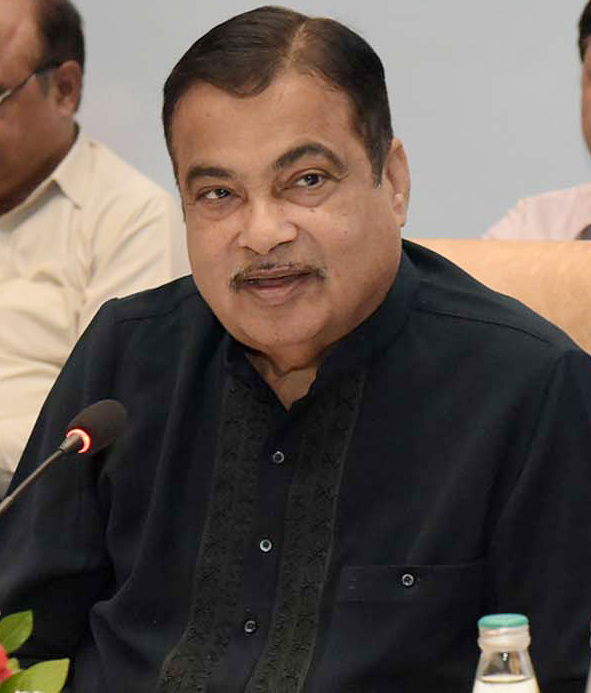
Nitin Gadkari
Nitin Jairam Gadkari (/nitin ɡʌdkʌˈri/ ⓘ; born 27 May 1957) is an Indian politician who serves as the 40th Minister of Road Transport & Highways in the Government of India since 2014. He is also the longest serving Minister for Road Transport & Highways, currently in his tenure for over eleven years, and is the only person to serve under a single portfolio for three consecutive terms. A senior leader of the Bharatiya Janata Party (BJP), he served as the President of his party from 2009 to 2013.
He currently represents the Nagpur constituency in the Lok Sabha and is a lawyer by profession. He has previously served as a Minister in various departments, including Water resources and River development, Shipping, Rural Development and MSME. He is often referred to as the "Expressway Man of India" by the media due to his initiation of the Mumbai-Pune Expressway and his contributions to the development of expressways and other road infrastructure. The World Economic Forum has recognised him as the "pioneer of public–private partnership (PPP) in the road sector".
Under his tenure as Minister of Road Transport & Highways, India's National Highway (NH) network has grown by 60% becoming world’s second largest network, rising from 91,287 km in 2014 to 146,195 km in 2024. The length of National High-Speed Corridors (HSC) has increased by 2560%, rising from 93 km in 2014 to 2,474 km in 2024 and the length of 4-lane and above National Highways (excluding HSCs) has more than doubled, expanding from 18,278 km in 2014 to 45,947 km in 2024.
Nitin Gadkari was born into a Marathi Brahmin family in Nagpur, India to Jairam Gadkari and Bhanutai Gadkari on 27 May 1957. During his adolescence, he worked for the Bharatiya Janata Yuva Morcha and the student union Akhil Bharatiya Vidyarthi Parishad. He completed M.Com. and LL.B. from Nagpur University.
Gadkari served as the Minister of Public Works Department (PWD) of the Government of Maharashtra from 1995 to 1999 and restructured it from top to bottom. He has served as the president of the Maharashtra state unit of BJP.
Gadkari strongly supported privatisation while he campaigned for investments in infrastructure from private firms. He addressed several meetings between private investors, contractors, builders and various trade organisations and diverted large amounts of budgeted projects towards privatisation. Subsequently, the state government allocated ₹7 billion for rural connectivity. Over the next four years, all-weather road connectivity in Maharashtra was extended to 98% of the population. The project aimed to connect 13,736 remote villages which remained unconnected since independence by road. It also helped ameliorate malnutrition in remote Melghat-Dharni area of Amravati district, which previously had no access to medical aid, ration or educational facilities.
Gadkari was the architect of Pradhan Mantri Gram Sadak Yojana. He received the Late Madhavrao Limaye Award by Public Library Nashik, for Most Efficient Member of Parliament for 2020-21.
As PWD Minister of Maharashtra, Gadkari played a crucial role in expediting the construction of the Mumbai-Pune Expressway. In 1990, the Government of Maharashtra conducted feasibility studies for the new expressway to be operated on a toll basis, however, it was only after Gadkari took over as PWD Minister that the construction of this project was fast-tracked. Gadkari entrusted the work of the construction of Mumbai-Pune expressway to MSRDC in March 1997 on Build-Operate-Transfer basis with permission to collect toll for 30 years. The tender notice was published in leading newspapers all over India and also on the Internet. Due to the wide publicity, 133 tenders were sold and on 18 December 1997, 55 tenders were received. After technical and financial evaluation, tenders were accepted and work orders were given on 1 January 1998 to four contractors. Thereafter tenders for widening of the Khandala and Lonavala-Khandala bypass works were invited. The tenders were received on 24 August 1998 and orders were issued on 4 September 1998. The first sections of the Expressway opened in 2000, and the entire route was completed, opened to traffic and made fully operational from April 2002.
Hub AI
Nitin Gadkari AI simulator
(@Nitin Gadkari_simulator)
Nitin Gadkari
Nitin Jairam Gadkari (/nitin ɡʌdkʌˈri/ ⓘ; born 27 May 1957) is an Indian politician who serves as the 40th Minister of Road Transport & Highways in the Government of India since 2014. He is also the longest serving Minister for Road Transport & Highways, currently in his tenure for over eleven years, and is the only person to serve under a single portfolio for three consecutive terms. A senior leader of the Bharatiya Janata Party (BJP), he served as the President of his party from 2009 to 2013.
He currently represents the Nagpur constituency in the Lok Sabha and is a lawyer by profession. He has previously served as a Minister in various departments, including Water resources and River development, Shipping, Rural Development and MSME. He is often referred to as the "Expressway Man of India" by the media due to his initiation of the Mumbai-Pune Expressway and his contributions to the development of expressways and other road infrastructure. The World Economic Forum has recognised him as the "pioneer of public–private partnership (PPP) in the road sector".
Under his tenure as Minister of Road Transport & Highways, India's National Highway (NH) network has grown by 60% becoming world’s second largest network, rising from 91,287 km in 2014 to 146,195 km in 2024. The length of National High-Speed Corridors (HSC) has increased by 2560%, rising from 93 km in 2014 to 2,474 km in 2024 and the length of 4-lane and above National Highways (excluding HSCs) has more than doubled, expanding from 18,278 km in 2014 to 45,947 km in 2024.
Nitin Gadkari was born into a Marathi Brahmin family in Nagpur, India to Jairam Gadkari and Bhanutai Gadkari on 27 May 1957. During his adolescence, he worked for the Bharatiya Janata Yuva Morcha and the student union Akhil Bharatiya Vidyarthi Parishad. He completed M.Com. and LL.B. from Nagpur University.
Gadkari served as the Minister of Public Works Department (PWD) of the Government of Maharashtra from 1995 to 1999 and restructured it from top to bottom. He has served as the president of the Maharashtra state unit of BJP.
Gadkari strongly supported privatisation while he campaigned for investments in infrastructure from private firms. He addressed several meetings between private investors, contractors, builders and various trade organisations and diverted large amounts of budgeted projects towards privatisation. Subsequently, the state government allocated ₹7 billion for rural connectivity. Over the next four years, all-weather road connectivity in Maharashtra was extended to 98% of the population. The project aimed to connect 13,736 remote villages which remained unconnected since independence by road. It also helped ameliorate malnutrition in remote Melghat-Dharni area of Amravati district, which previously had no access to medical aid, ration or educational facilities.
Gadkari was the architect of Pradhan Mantri Gram Sadak Yojana. He received the Late Madhavrao Limaye Award by Public Library Nashik, for Most Efficient Member of Parliament for 2020-21.
As PWD Minister of Maharashtra, Gadkari played a crucial role in expediting the construction of the Mumbai-Pune Expressway. In 1990, the Government of Maharashtra conducted feasibility studies for the new expressway to be operated on a toll basis, however, it was only after Gadkari took over as PWD Minister that the construction of this project was fast-tracked. Gadkari entrusted the work of the construction of Mumbai-Pune expressway to MSRDC in March 1997 on Build-Operate-Transfer basis with permission to collect toll for 30 years. The tender notice was published in leading newspapers all over India and also on the Internet. Due to the wide publicity, 133 tenders were sold and on 18 December 1997, 55 tenders were received. After technical and financial evaluation, tenders were accepted and work orders were given on 1 January 1998 to four contractors. Thereafter tenders for widening of the Khandala and Lonavala-Khandala bypass works were invited. The tenders were received on 24 August 1998 and orders were issued on 4 September 1998. The first sections of the Expressway opened in 2000, and the entire route was completed, opened to traffic and made fully operational from April 2002.