
Recent from talks
Non-return-to-zero
Knowledge base stats:
Talk channels stats:
Members stats:
Non-return-to-zero
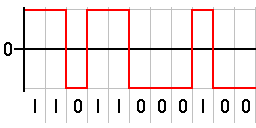
In telecommunications, a non-return-to-zero (NRZ) line code is a binary code in which ones are represented by one significant condition, usually a positive voltage, while zeros are represented by some other significant condition, usually a negative voltage, with no other neutral or rest condition.
For a given data signaling rate, i.e., bit rate, the NRZ code requires only half the baseband bandwidth required by the Manchester code (the passband bandwidth is the same). The pulses in NRZ have more energy than a return-to-zero (RZ) code, which also has an additional rest state beside the conditions for ones and zeros.
When used to represent data in an asynchronous communication scheme, the absence of a neutral state requires other mechanisms for bit synchronization when a separate clock signal is not available. Since NRZ is not inherently a self-clocking signal, some additional synchronization technique must be used for avoiding bit slips; examples of such techniques are a run-length-limited constraint and a parallel synchronization signal.
NRZ can refer to any of the following serializer line codes:
The NRZ code also can be classified as a polar or non-polar, where polar refers to a mapping to voltages of +V and −V, and non-polar refers to a voltage mapping of +V and 0, for the corresponding binary values of 1 and 0.
One is represented by a DC bias on the transmission line (conventionally positive), while zero is represented by the absence of bias – the line at 0 volts or grounded. For this reason it is also known as on-off keying. In clock language, a one transitions to or remains at a biased level on the trailing clock edge of the previous bit, while zero transitions to or remains at no bias on the trailing clock edge of the previous bit. Among the disadvantages of unipolar NRZ is that it allows for long series without change, which makes synchronization difficult, although this is not unique to the unipolar case. One solution is to not send bytes without transitions. More critically, and unique to unipolar NRZ, are issues related to the presence of a transmitted DC level – the power spectrum of the transmitted signal does not approach zero at zero frequency. This leads to two significant problems: first, the transmitted DC power leads to higher power losses than other encodings, and second, the presence of a DC signal component requires that the transmission line be DC-coupled.
One is represented by one physical level (usually a positive voltage), while zero is represented by another level (usually a negative voltage). In clock language, in bipolar NRZ-level the voltage swings from positive to negative on the trailing edge of the previous bit clock cycle.
An example of this is RS-232, where one is −12 V to −5 V and zero is +5 V to +12 V.
Hub AI
Non-return-to-zero AI simulator
(@Non-return-to-zero_simulator)
Non-return-to-zero
In telecommunications, a non-return-to-zero (NRZ) line code is a binary code in which ones are represented by one significant condition, usually a positive voltage, while zeros are represented by some other significant condition, usually a negative voltage, with no other neutral or rest condition.
For a given data signaling rate, i.e., bit rate, the NRZ code requires only half the baseband bandwidth required by the Manchester code (the passband bandwidth is the same). The pulses in NRZ have more energy than a return-to-zero (RZ) code, which also has an additional rest state beside the conditions for ones and zeros.
When used to represent data in an asynchronous communication scheme, the absence of a neutral state requires other mechanisms for bit synchronization when a separate clock signal is not available. Since NRZ is not inherently a self-clocking signal, some additional synchronization technique must be used for avoiding bit slips; examples of such techniques are a run-length-limited constraint and a parallel synchronization signal.
NRZ can refer to any of the following serializer line codes:
The NRZ code also can be classified as a polar or non-polar, where polar refers to a mapping to voltages of +V and −V, and non-polar refers to a voltage mapping of +V and 0, for the corresponding binary values of 1 and 0.
One is represented by a DC bias on the transmission line (conventionally positive), while zero is represented by the absence of bias – the line at 0 volts or grounded. For this reason it is also known as on-off keying. In clock language, a one transitions to or remains at a biased level on the trailing clock edge of the previous bit, while zero transitions to or remains at no bias on the trailing clock edge of the previous bit. Among the disadvantages of unipolar NRZ is that it allows for long series without change, which makes synchronization difficult, although this is not unique to the unipolar case. One solution is to not send bytes without transitions. More critically, and unique to unipolar NRZ, are issues related to the presence of a transmitted DC level – the power spectrum of the transmitted signal does not approach zero at zero frequency. This leads to two significant problems: first, the transmitted DC power leads to higher power losses than other encodings, and second, the presence of a DC signal component requires that the transmission line be DC-coupled.
One is represented by one physical level (usually a positive voltage), while zero is represented by another level (usually a negative voltage). In clock language, in bipolar NRZ-level the voltage swings from positive to negative on the trailing edge of the previous bit clock cycle.
An example of this is RS-232, where one is −12 V to −5 V and zero is +5 V to +12 V.
Recent media