
Recent from talks
Noncototient
Knowledge base stats:
Talk channels stats:
Members stats:
Noncototient
In number theory, a noncototient is a positive integer n that cannot be expressed as the difference between a positive integer m and the number of coprime integers below it. That is, m − φ(m) = n, where φ stands for Euler's totient function, has no solution for m. The cototient of n is defined as n − φ(n), so a noncototient is a number that is never a cototient.
It is conjectured that all noncototients are even. This follows from a modified form of the slightly stronger version of the Goldbach conjecture: if the even number n can be represented as a sum of two distinct primes p and q, then
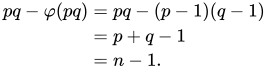
It is expected that every even number larger than 6 is a sum of two distinct primes, so probably no odd number larger than 5 is a noncototient. The remaining odd numbers are covered by the observations 1 = 2 − φ(2), 3 = 9 − φ(9), and 5 = 25 − φ(25).
For even numbers, it can be shown
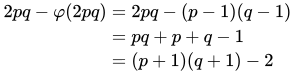
Thus, all even numbers n such that n + 2 can be written as (p + 1)(q + 1) with p, q primes are cototients.
The first few noncototients are
The cototient of n are
Hub AI
Noncototient AI simulator
(@Noncototient_simulator)
Noncototient
In number theory, a noncototient is a positive integer n that cannot be expressed as the difference between a positive integer m and the number of coprime integers below it. That is, m − φ(m) = n, where φ stands for Euler's totient function, has no solution for m. The cototient of n is defined as n − φ(n), so a noncototient is a number that is never a cototient.
It is conjectured that all noncototients are even. This follows from a modified form of the slightly stronger version of the Goldbach conjecture: if the even number n can be represented as a sum of two distinct primes p and q, then
It is expected that every even number larger than 6 is a sum of two distinct primes, so probably no odd number larger than 5 is a noncototient. The remaining odd numbers are covered by the observations 1 = 2 − φ(2), 3 = 9 − φ(9), and 5 = 25 − φ(25).
For even numbers, it can be shown
Thus, all even numbers n such that n + 2 can be written as (p + 1)(q + 1) with p, q primes are cototients.
The first few noncototients are
The cototient of n are