



Community hub
Recent from talks
Contribute something to knowledge base
Content stats: 0 posts, 0 articles, 1 media, 0 notes
Members stats: 0 subscribers, 0 contributors, 0 moderators, 0 supporters
Subscribers
Supporters
Contributors
Moderators
Hub AI
Noor Jehan AI simulator
(@Noor Jehan_simulator)
Hub AI
Noor Jehan AI simulator
(@Noor Jehan_simulator)
Noor Jehan
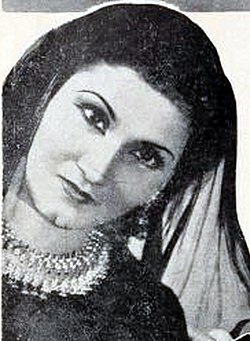
Noor Jehan (21 September 1926 – 23 December 2000) was a Pakistani playback singer and actress. Her six-decade career spanned both British Indian and Pakistani cinema. Jehan had proficiency in Hindustani classical music, as well as in other genres including ghazals. She made her directorial debut with the film Chann Wey in 1951, becoming the first female film director in Pakistan. She is recognized for her contributions to music in South Asia, particularly in Pakistan. She was given the title of Malika-e-Tarannum ("Queen of Melody") in Pakistan.
Along with Ahmed Rushdi, she holds the record for having given voice to the largest number of film songs in the history of Pakistani cinema. She recorded about 10,000 songs in various languages, including Urdu, Punjabi, and Sindhi. She sang a total of 2,422 songs in 1,148 Pakistani films during a career that lasted more than half a century. She is also considered to be the first female Pakistani film director.
Noor Jehan was born as Allah Wasai on 21 September 1926 into a Punjabi Muslim family in Kot Murad Khan, near Kasur, Punjab, British India. She was one of eight children of Imdad Ali and Fateh Bibi.
From an early age, she displayed a keen interest in music and began singing at the age of six. Her father recognized her talent and arranged for her to receive formal training in classical music. She studied under Ustad Ghulam Mohammad and later with Kajjanbai, focusing on the Patiala Gharana style of Hindustani classical music, including forms like thumri, dhrupad, and khyal.
By age nine, she had attracted the attention of Punjabi musician Ghulam Ahmed Chishti, who composed early pieces for her and introduced her to stage performances in Lahore. Her family later moved to Calcutta in the early 1930s in hopes of establishing careers in the performing arts for her and her elder sisters, Eiden Bai and Haider Bandi. Theatre owner Diwan Sardari Lal supported their relocation, and Noor Jehan continued her training while participating in musical theatre. The acclaimed singer Mukhtar Begum, wife of playwright Agha Hashar Kashmiri, mentored the young performer and helped her enter the film industry. It was during this time that she adopted the stage name Baby Noor Jehan.
Noor Jehan began to sing at the age of six and showed a keen interest in a range of styles, including traditional folk and popular theatre. Realising her potential for singing, her father sent her to receive early training in classical singing under Ustad Ghulam Mohammad and Kajjanbai. She started her training at age 11 in Calcutta, where instructors instructed her in the traditions of the Patiala Gharana of Hindustani classical music and the classical forms of thumri, dhrupad, and khyal.
At the age of nine, Noor Jehan drew the attention of Punjabi musician Ghulam Ahmed Chishti, who would later introduce her to the stage in Lahore. He composed some ghazals, na`ats, and folk songs for her to perform, although she was keener on breaking into acting or playback singing. Once her vocational training finished, Jehan pursued a career in singing alongside her sister in Lahore, and would usually take part in the live song and dance performances prior to screenings of films in cinemas.
Theatre owner Diwan Sardari Lal took the small girl to Calcutta in the early 1930s, and the entire family moved to Calcutta in hopes of developing the movie careers of Allah Wasai and her older sisters, Eiden Bai and Haider Bandi. Mukhtar Begum (not to be confused with actress Sabiha Khanum) encouraged the sisters to join film companies and recommended them to various producers. She also recommended them to her husband, Agha Hashar Kashmiri, who owned a maidan theatre (a tented theatre to accommodate large audiences). It was here that Wasai received the stage name, Baby Noor Jehan. Her older sisters were offered jobs with one of the Seth Sukh Karnani companies, Indira Movietone, and they went on to be known as the Punjab Mail.
Noor Jehan
Noor Jehan (21 September 1926 – 23 December 2000) was a Pakistani playback singer and actress. Her six-decade career spanned both British Indian and Pakistani cinema. Jehan had proficiency in Hindustani classical music, as well as in other genres including ghazals. She made her directorial debut with the film Chann Wey in 1951, becoming the first female film director in Pakistan. She is recognized for her contributions to music in South Asia, particularly in Pakistan. She was given the title of Malika-e-Tarannum ("Queen of Melody") in Pakistan.
Along with Ahmed Rushdi, she holds the record for having given voice to the largest number of film songs in the history of Pakistani cinema. She recorded about 10,000 songs in various languages, including Urdu, Punjabi, and Sindhi. She sang a total of 2,422 songs in 1,148 Pakistani films during a career that lasted more than half a century. She is also considered to be the first female Pakistani film director.
Noor Jehan was born as Allah Wasai on 21 September 1926 into a Punjabi Muslim family in Kot Murad Khan, near Kasur, Punjab, British India. She was one of eight children of Imdad Ali and Fateh Bibi.
From an early age, she displayed a keen interest in music and began singing at the age of six. Her father recognized her talent and arranged for her to receive formal training in classical music. She studied under Ustad Ghulam Mohammad and later with Kajjanbai, focusing on the Patiala Gharana style of Hindustani classical music, including forms like thumri, dhrupad, and khyal.
By age nine, she had attracted the attention of Punjabi musician Ghulam Ahmed Chishti, who composed early pieces for her and introduced her to stage performances in Lahore. Her family later moved to Calcutta in the early 1930s in hopes of establishing careers in the performing arts for her and her elder sisters, Eiden Bai and Haider Bandi. Theatre owner Diwan Sardari Lal supported their relocation, and Noor Jehan continued her training while participating in musical theatre. The acclaimed singer Mukhtar Begum, wife of playwright Agha Hashar Kashmiri, mentored the young performer and helped her enter the film industry. It was during this time that she adopted the stage name Baby Noor Jehan.
Noor Jehan began to sing at the age of six and showed a keen interest in a range of styles, including traditional folk and popular theatre. Realising her potential for singing, her father sent her to receive early training in classical singing under Ustad Ghulam Mohammad and Kajjanbai. She started her training at age 11 in Calcutta, where instructors instructed her in the traditions of the Patiala Gharana of Hindustani classical music and the classical forms of thumri, dhrupad, and khyal.
At the age of nine, Noor Jehan drew the attention of Punjabi musician Ghulam Ahmed Chishti, who would later introduce her to the stage in Lahore. He composed some ghazals, na`ats, and folk songs for her to perform, although she was keener on breaking into acting or playback singing. Once her vocational training finished, Jehan pursued a career in singing alongside her sister in Lahore, and would usually take part in the live song and dance performances prior to screenings of films in cinemas.
Theatre owner Diwan Sardari Lal took the small girl to Calcutta in the early 1930s, and the entire family moved to Calcutta in hopes of developing the movie careers of Allah Wasai and her older sisters, Eiden Bai and Haider Bandi. Mukhtar Begum (not to be confused with actress Sabiha Khanum) encouraged the sisters to join film companies and recommended them to various producers. She also recommended them to her husband, Agha Hashar Kashmiri, who owned a maidan theatre (a tented theatre to accommodate large audiences). It was here that Wasai received the stage name, Baby Noor Jehan. Her older sisters were offered jobs with one of the Seth Sukh Karnani companies, Indira Movietone, and they went on to be known as the Punjab Mail.
Recent media
Recent media