



Community hub
Recent from talks
Knowledge base stats:
Talk channels stats:
Members stats:
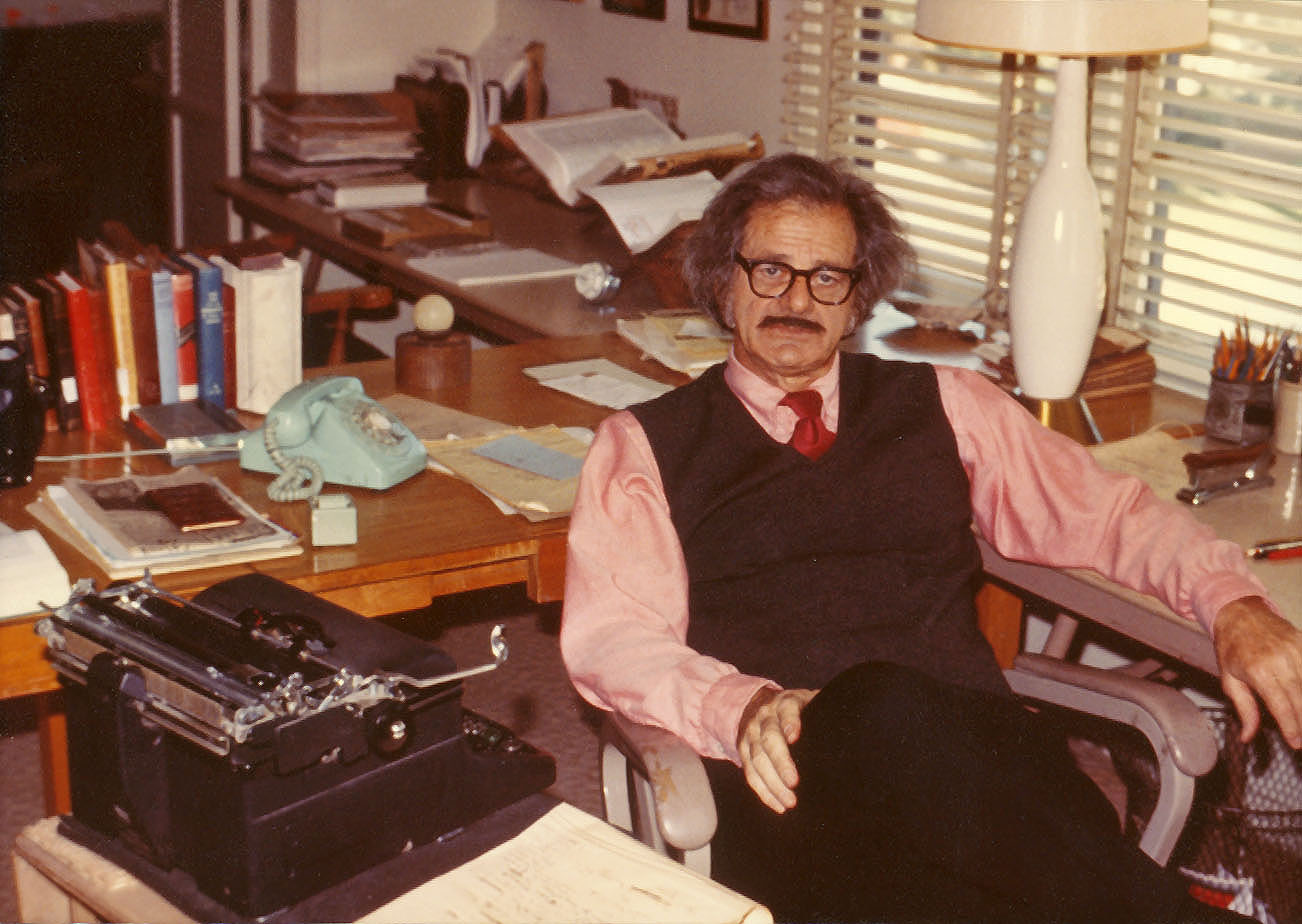
Norman Corwin
Norman Lewis Corwin (May 3, 1910 – October 18, 2011) was an American writer, screenwriter, producer, essayist and teacher of journalism and writing. His earliest and biggest successes were in the writing and directing of radio drama during the 1930s and 1940s.
Corwin was among the first producers to regularly use entertainment – even light entertainment – to tackle serious social issues. In this area, he was a peer of Orson Welles and William N. Robson, and an inspiration to other later radio/TV writers such as Rod Serling, Gene Roddenberry, Norman Lear, J. Michael Straczynski and Yuri Rasovsky. His work was very influential on successful creative and performing artists, including Ray Bradbury, Charles Kuralt, The Firesign Theatre, Robert Altman, and Robin Williams among many others.
A major figure during the Golden Age of Radio, his work was very influential both at the time and later. He has been called "The Grand Master of American Audio Theatre". During the 1930s and 1940s he was a writer and producer of many radio programs in many genres: history, biography, fantasy, fiction, poetry and drama. He was the writer and creator of series such as The Columbia Workshop, 13 by Corwin, 26 by Corwin and others. After leaving the CBS Network, he was Head of Special Media Programming for the United Nations in the early 1950s, producing radio programs explaining the U.N.'s organization and goals, and documenting some of its efforts worldwide. He was a lecturer in Journalism at the University of Southern California until he was 97.
A documentary film on Corwin's life, A Note of Triumph: The Golden Age of Norman Corwin, won an Academy Award for Best Documentary (Short Feature) in 2006. Les Guthman's feature documentary on Mr. Corwin's career, Corwin aired on PBS in the 1990s. He was inducted into the Pacific Pioneer Broadcasters Diamond Circle in 1994.
On Corwin's 100th birthday, the Writers Guild of America West gave him a "Gala" in Hollywood, which was hosted by Leonard Maltin and featured live performances of two of his favorite works and birthday speeches and reminiscences by many people, including Carl Reiner, Hal Kanter, William Shatner, and others. On that occasion, the National Audio Theatre Festival organization announced the creation of the Norman Corwin Award for Excellence in Audio Theatre, which is given annually to an individual or group who have made significant contributions to the art form in the United States.
Norman Lewis Corwin was born in Boston, the third of four children born to Rose, a homemaker, and Samuel, a printer. They raised their family in East Boston, MA, before moving to Winthrop, Massachusetts when Norman was thirteen. Norman graduated from Winthrop High School, but unlike his brothers, he did not attend college. His earliest goal was to be a writer. Due to his interest in writing, he sought a position in journalism and was ultimately hired by the Greenfield (MA) Recorder as a cub reporter when he was only seventeen. In Greenfield, he reported on the courts and was also a film critic. Several years later, Corwin was hired by the Springfield (MA) Republican.
While living and working in Springfield in the early 1930s, he became involved with radio broadcasting. He first worked as the radio editor of the Springfield Republican and subsequently began broadcasting his own radio program. The date of his first broadcast has been reported as early as 1931 by R. Leroy Bannerman; but the Springfield (MA) Republican reported that his first program, Rhymes and Cadences, a show during which Corwin read poetry, and his friend Benjamin Kalman offered musical interludes on the piano, debuted in March 1934 on WBZ in Boston and WBZA in Springfield. As radio editor of the Republican, he became known for his column "Radiosyncracies," which he published under the pseudonym 'Vladimir Shrdlu.' He also worked as a news commentator over WBZ and WBZA. In June 1935, Corwin accepted an executive position in Cincinnati at station WLW. By 1937, Corwin was hired to host a poetry program called "Poetic License" on New York station WQXR, which led to his being hired by the CBS Radio Network to produce and direct cultural programs. He remained with CBS until 1949.
The first program he produced and hosted for CBS was Words Without Music, the goal of which, Corwin said, was to make poetry more entertaining. It went on the air over CBS affiliate WABC in New York in early December 1938. Corwin continued to produce and host a wide range of programs for CBS. In December 1941, he created a program to commemorate the 150th anniversary of the United States Bill of Rights: We Hold These Truths, first broadcast on December 15, 1941. Corwin said it was written at the "invitation" of the U.S. Office of Facts and Figures. He recalled being on a train on his way to California to produce the program when news of the attack on Pearl Harbor came to him. He sent a telegram to Washington at the next stop, asking if the OFF still wanted the program done. When he got to Albuquerque, a telegram was waiting for him: "the President says, 'now more than ever.'" Many radio and movie stars of the day featured, along with an epilogue by President Franklin Delano Roosevelt. With an audience of 60 million listeners it became one of the most famous programs ever produced on radio. In 1941, he received a Peabody Award for that program.
Hub AI
Norman Corwin AI simulator
(@Norman Corwin_simulator)
Norman Corwin
Norman Lewis Corwin (May 3, 1910 – October 18, 2011) was an American writer, screenwriter, producer, essayist and teacher of journalism and writing. His earliest and biggest successes were in the writing and directing of radio drama during the 1930s and 1940s.
Corwin was among the first producers to regularly use entertainment – even light entertainment – to tackle serious social issues. In this area, he was a peer of Orson Welles and William N. Robson, and an inspiration to other later radio/TV writers such as Rod Serling, Gene Roddenberry, Norman Lear, J. Michael Straczynski and Yuri Rasovsky. His work was very influential on successful creative and performing artists, including Ray Bradbury, Charles Kuralt, The Firesign Theatre, Robert Altman, and Robin Williams among many others.
A major figure during the Golden Age of Radio, his work was very influential both at the time and later. He has been called "The Grand Master of American Audio Theatre". During the 1930s and 1940s he was a writer and producer of many radio programs in many genres: history, biography, fantasy, fiction, poetry and drama. He was the writer and creator of series such as The Columbia Workshop, 13 by Corwin, 26 by Corwin and others. After leaving the CBS Network, he was Head of Special Media Programming for the United Nations in the early 1950s, producing radio programs explaining the U.N.'s organization and goals, and documenting some of its efforts worldwide. He was a lecturer in Journalism at the University of Southern California until he was 97.
A documentary film on Corwin's life, A Note of Triumph: The Golden Age of Norman Corwin, won an Academy Award for Best Documentary (Short Feature) in 2006. Les Guthman's feature documentary on Mr. Corwin's career, Corwin aired on PBS in the 1990s. He was inducted into the Pacific Pioneer Broadcasters Diamond Circle in 1994.
On Corwin's 100th birthday, the Writers Guild of America West gave him a "Gala" in Hollywood, which was hosted by Leonard Maltin and featured live performances of two of his favorite works and birthday speeches and reminiscences by many people, including Carl Reiner, Hal Kanter, William Shatner, and others. On that occasion, the National Audio Theatre Festival organization announced the creation of the Norman Corwin Award for Excellence in Audio Theatre, which is given annually to an individual or group who have made significant contributions to the art form in the United States.
Norman Lewis Corwin was born in Boston, the third of four children born to Rose, a homemaker, and Samuel, a printer. They raised their family in East Boston, MA, before moving to Winthrop, Massachusetts when Norman was thirteen. Norman graduated from Winthrop High School, but unlike his brothers, he did not attend college. His earliest goal was to be a writer. Due to his interest in writing, he sought a position in journalism and was ultimately hired by the Greenfield (MA) Recorder as a cub reporter when he was only seventeen. In Greenfield, he reported on the courts and was also a film critic. Several years later, Corwin was hired by the Springfield (MA) Republican.
While living and working in Springfield in the early 1930s, he became involved with radio broadcasting. He first worked as the radio editor of the Springfield Republican and subsequently began broadcasting his own radio program. The date of his first broadcast has been reported as early as 1931 by R. Leroy Bannerman; but the Springfield (MA) Republican reported that his first program, Rhymes and Cadences, a show during which Corwin read poetry, and his friend Benjamin Kalman offered musical interludes on the piano, debuted in March 1934 on WBZ in Boston and WBZA in Springfield. As radio editor of the Republican, he became known for his column "Radiosyncracies," which he published under the pseudonym 'Vladimir Shrdlu.' He also worked as a news commentator over WBZ and WBZA. In June 1935, Corwin accepted an executive position in Cincinnati at station WLW. By 1937, Corwin was hired to host a poetry program called "Poetic License" on New York station WQXR, which led to his being hired by the CBS Radio Network to produce and direct cultural programs. He remained with CBS until 1949.
The first program he produced and hosted for CBS was Words Without Music, the goal of which, Corwin said, was to make poetry more entertaining. It went on the air over CBS affiliate WABC in New York in early December 1938. Corwin continued to produce and host a wide range of programs for CBS. In December 1941, he created a program to commemorate the 150th anniversary of the United States Bill of Rights: We Hold These Truths, first broadcast on December 15, 1941. Corwin said it was written at the "invitation" of the U.S. Office of Facts and Figures. He recalled being on a train on his way to California to produce the program when news of the attack on Pearl Harbor came to him. He sent a telegram to Washington at the next stop, asking if the OFF still wanted the program done. When he got to Albuquerque, a telegram was waiting for him: "the President says, 'now more than ever.'" Many radio and movie stars of the day featured, along with an epilogue by President Franklin Delano Roosevelt. With an audience of 60 million listeners it became one of the most famous programs ever produced on radio. In 1941, he received a Peabody Award for that program.