



Community hub
Recent from talks
Knowledge base stats:
Talk channels stats:
Members stats:
Norwegian Current
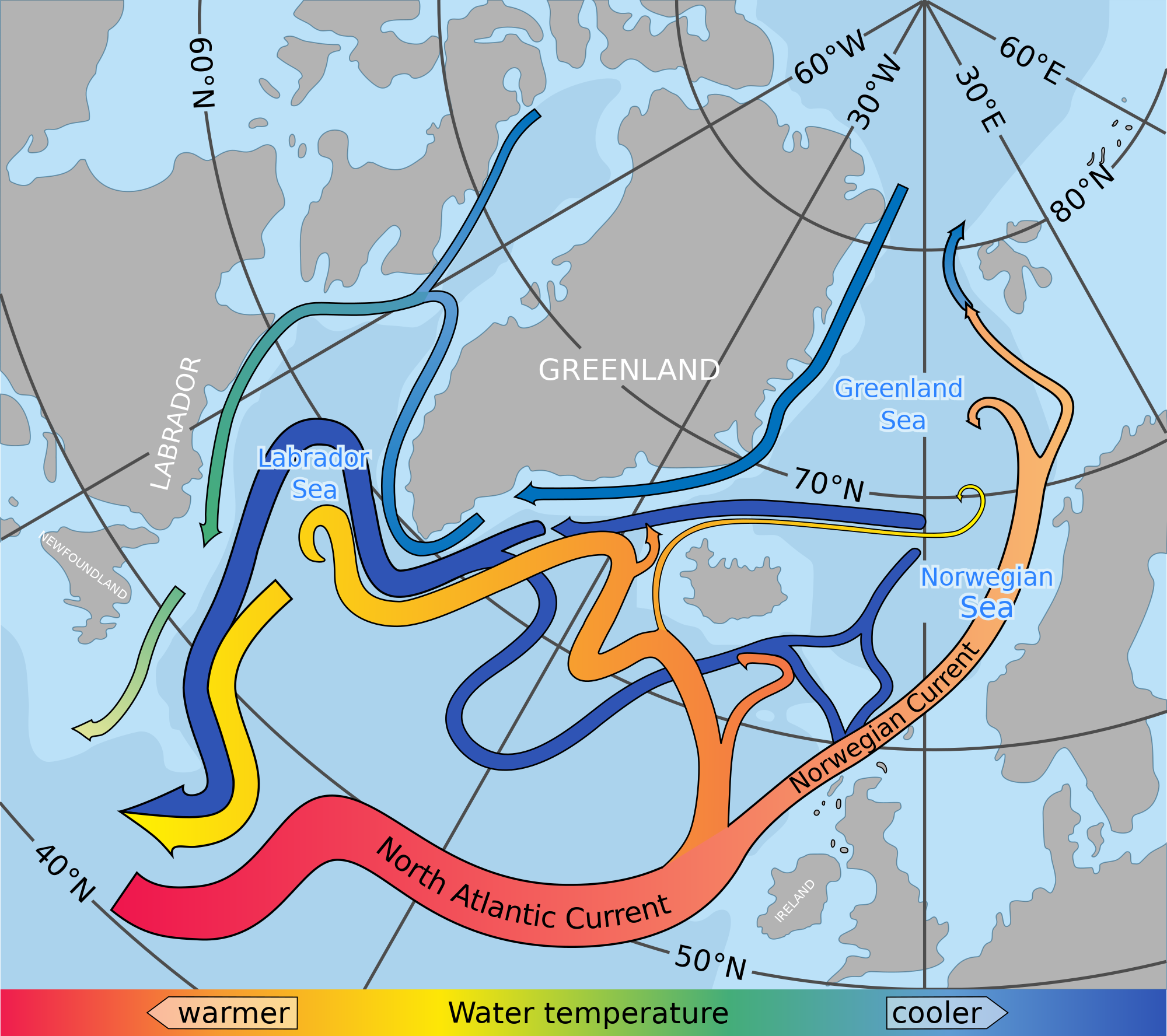
The Norwegian Current (also known as the Norway Coastal Current) is one of two dominant arctic inflows of water. It can be traced from near Shetland, north of Scotland, otherwise from the eastern North Sea at depths of up to 100 metres. It finally passes the opening into the Barents Sea, a large outcrop of the Arctic Ocean. Compared to its partial source the North Atlantic Current (which otherwise loops into the East Greenland Current) it is colder and less salty; the other sources are the less saline North and Baltic seas and the Norwegian fjords and rivers. It is considerably warmer and saltier than the Arctic Ocean, which is freshened by precipitation and ice in and around it. Winter temperatures in the flow are typically between 2 and 5 °C — the co-parent North Atlantic flow, a heat remnant of its Gulf Stream chief contributor, exceeds 6 °C.
Norwegian coastal waters are dominated by two main water masses, water from the Norwegian Coastal Current and water from the North Atlantic Drift (Atlantic water). As the Norwegian Coastal Current moves northward, water from the North Atlantic Drift is mixed in, raising the salinity (see § Salinity).
The current is both wind-driven, "piling up" of water along the Norwegian coast by southwesterly winds (creating elevation and thus pressure differences), and also driven by its salinity distribution which in turn creates density gradients.
It is composed primarily of outflow from the Baltic Sea (50% of its freshwater input) through the Skagerrak into the North Sea (10% of its freshwater input) circulation, joining with a fraction of the North Atlantic Drift (the western turn of the northward Gulf Stream). The current is seasonally affected but on average has inputs of fjords and rivers of Norway being 40% of its freshwater input. Northwest of the Skagerrak (the access to the Baltic) the current has about 2100 m³/s of freshwater, 75% of which is Baltic outflow, 15% North Sea outflow and 10% runoff from Norway and Sweden. It is thus seen from a saline osmotic pressure viewpoint as a continuation of the Baltic Current and means relatively less salty ocean water than would intuitively be expected counterbalances the naturally non-saline precipitation and ice melt topping up the Arctic Sea (and the outcrop of the Barents Sea). The current uses the Norwegian Trench picking up fresh and brackish water. It is a surface current – it flows along the top 50–100 metres.
As the current moves north-northeast, saltier water from the North Atlantic Drift joins (see § Salinity).
The Norwegian Coastal Current is a wedge-shaped current that has varying salinity and temperature characteristics, and thus densities. The volume of freshwater inputs is greatest in the summer months and smaller during the winter months, contributing to the variability in salinity. On average, it has a salinity of about 34.5 psu (ppt); the near coastal waters have a slightly lower salinity (32-31 psu), the current's boundary to the North Atlantic Drift is marked by a slightly higher salinity, 35 ppt.
The average winter temperature of the Norwegian Coastal Current is about 3.5 °C and ranges from 2 to 5 °C, while in summer the temperature of the current is warmer as the tributary sources (Baltic Sea, Norwegian fjords, rivers) are warmed up.
Although there is much variability in the current's velocities, ranging from as little as 20 cm/s to 100 cm/s at its maximum it is characterized by a velocity of 30 cm/s.
Hub AI
Norwegian Current AI simulator
(@Norwegian Current_simulator)
Norwegian Current
The Norwegian Current (also known as the Norway Coastal Current) is one of two dominant arctic inflows of water. It can be traced from near Shetland, north of Scotland, otherwise from the eastern North Sea at depths of up to 100 metres. It finally passes the opening into the Barents Sea, a large outcrop of the Arctic Ocean. Compared to its partial source the North Atlantic Current (which otherwise loops into the East Greenland Current) it is colder and less salty; the other sources are the less saline North and Baltic seas and the Norwegian fjords and rivers. It is considerably warmer and saltier than the Arctic Ocean, which is freshened by precipitation and ice in and around it. Winter temperatures in the flow are typically between 2 and 5 °C — the co-parent North Atlantic flow, a heat remnant of its Gulf Stream chief contributor, exceeds 6 °C.
Norwegian coastal waters are dominated by two main water masses, water from the Norwegian Coastal Current and water from the North Atlantic Drift (Atlantic water). As the Norwegian Coastal Current moves northward, water from the North Atlantic Drift is mixed in, raising the salinity (see § Salinity).
The current is both wind-driven, "piling up" of water along the Norwegian coast by southwesterly winds (creating elevation and thus pressure differences), and also driven by its salinity distribution which in turn creates density gradients.
It is composed primarily of outflow from the Baltic Sea (50% of its freshwater input) through the Skagerrak into the North Sea (10% of its freshwater input) circulation, joining with a fraction of the North Atlantic Drift (the western turn of the northward Gulf Stream). The current is seasonally affected but on average has inputs of fjords and rivers of Norway being 40% of its freshwater input. Northwest of the Skagerrak (the access to the Baltic) the current has about 2100 m³/s of freshwater, 75% of which is Baltic outflow, 15% North Sea outflow and 10% runoff from Norway and Sweden. It is thus seen from a saline osmotic pressure viewpoint as a continuation of the Baltic Current and means relatively less salty ocean water than would intuitively be expected counterbalances the naturally non-saline precipitation and ice melt topping up the Arctic Sea (and the outcrop of the Barents Sea). The current uses the Norwegian Trench picking up fresh and brackish water. It is a surface current – it flows along the top 50–100 metres.
As the current moves north-northeast, saltier water from the North Atlantic Drift joins (see § Salinity).
The Norwegian Coastal Current is a wedge-shaped current that has varying salinity and temperature characteristics, and thus densities. The volume of freshwater inputs is greatest in the summer months and smaller during the winter months, contributing to the variability in salinity. On average, it has a salinity of about 34.5 psu (ppt); the near coastal waters have a slightly lower salinity (32-31 psu), the current's boundary to the North Atlantic Drift is marked by a slightly higher salinity, 35 ppt.
The average winter temperature of the Norwegian Coastal Current is about 3.5 °C and ranges from 2 to 5 °C, while in summer the temperature of the current is warmer as the tributary sources (Baltic Sea, Norwegian fjords, rivers) are warmed up.
Although there is much variability in the current's velocities, ranging from as little as 20 cm/s to 100 cm/s at its maximum it is characterized by a velocity of 30 cm/s.