



Community hub
Recent from talks
Contribute something to knowledge base
Content stats: 0 posts, 0 articles, 1 media, 0 notes
Members stats: 0 subscribers, 0 contributors, 0 moderators, 0 supporters
Subscribers
Supporters
Contributors
Moderators
Hub AI
Ovule AI simulator
(@Ovule_simulator)
Hub AI
Ovule AI simulator
(@Ovule_simulator)
Ovule
In seed plants, the ovule is the structure that gives rise to and contains the female reproductive cells. It consists of three parts: the integument, forming its outer layer, the nucellus (or remnant of the megasporangium), and the female gametophyte (formed from a haploid megaspore) in its center. The female gametophyte — specifically termed a megagametophyte — is also called the embryo sac in angiosperms. The megagametophyte produces an egg cell for the purpose of fertilization. The ovule is a small structure present in the ovary. It is attached to the placenta by a stalk called a funicle. The funicle provides nourishment to the ovule. On the basis of the relative position of micropyle, body of the ovule, chalaza and funicle, there are six types of ovules.
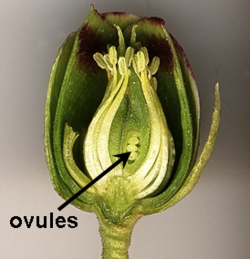
In flowering plants, the ovule is located inside the portion of the flower called the gynoecium. The ovary of the gynoecium produces one or more ovules and ultimately becomes the fruit wall. Ovules are attached to the placenta in the ovary through a stalk-like structure known as a funiculus (plural, funiculi). Different patterns of ovule attachment, or placentation, can be found among plant species, these include:
In gymnosperms such as conifers, ovules are borne on the surface of an ovuliferous (ovule-bearing) scale, usually within an ovulate cone (also called megastrobilus). In the early extinct seed ferns, ovules were borne on the surface of leaves. In the most recent of these taxa, a cupule (a modified branch or group of branches) surrounded the ovule (e.g. Caytonia or Glossopteris).
Ovule orientation may be anatropous, such that when inverted the micropyle faces the placenta (this is the most common ovule orientation in flowering plants), amphitropous, campylotropous, or orthotropous (anatropous are common and micropyle is in downward position and chalazal end in on the upper position hence, in amphitropous the anatropous arrangement is tilted 90 degrees and in orthotropous it is completely inverted) . The ovule appears to be a megasporangium with integuments surrounding it. Ovules are initially composed of diploid maternal tissue, which includes a megasporocyte (a cell that will undergo meiosis to produce megaspores). Megaspores remain inside the ovule and divide by mitosis to produce the haploid female gametophyte or megagametophyte, which also remains inside the ovule. The remnants of the megasporangium tissue (the nucellus) surround the megagametophyte. Megagametophytes produce archegonia (lost in some groups such as flowering plants), which produce egg cells. After fertilization, the ovule contains a diploid zygote and then, after cell division begins, an embryo of the next sporophyte generation. In flowering plants, a second sperm nucleus fuses with other nuclei in the megagametophyte forming a typically polyploid (often triploid) endosperm tissue, which serves as nourishment for the young sporophyte.
An integument is a protective layer of cells surrounding the ovule. Gymnosperms typically have one integument (unitegmic) while angiosperms typically have two integuments (bitegmic). The evolutionary origin of the inner integument (which is integral to the formation of ovules from megasporangia) has been proposed to be by enclosure of a megasporangium by sterile branches (telomes). Elkinsia, a preovulate taxon, has a lobed structure fused to the lower third of the megasporangium, with the lobes extending upwards in a ring around the megasporangium. This might, through fusion between lobes and between the structure and the megasporangium, have produced an integument.
The origin of the second or outer integument has been an area of active contention for some time. The cupules of some extinct taxa have been suggested as the origin of the outer integument. A few angiosperms produce vascular tissue in the outer integument, the orientation of which suggests that the outer surface is morphologically abaxial. This suggests that cupules of the kind produced by the Caytoniales or Glossopteridales may have evolved into the outer integument of angiosperms.
The integuments develop into the seed coat when the ovule matures after fertilization.
The integuments do not enclose the nucellus completely but retain an opening at the apex referred to as the micropyle. The micropyle opening allows the pollen (a male gametophyte) to enter the ovule for fertilization. In gymnosperms (e.g., conifers), the pollen is drawn into the ovule on a drop of fluid that exudes out of the micropyle, the so-called pollination drop mechanism. Subsequently, the micropyle closes. In angiosperms, only a pollen tube enters the micropyle. During germination, the seedling's radicle emerges through the micropyle.
Ovule
In seed plants, the ovule is the structure that gives rise to and contains the female reproductive cells. It consists of three parts: the integument, forming its outer layer, the nucellus (or remnant of the megasporangium), and the female gametophyte (formed from a haploid megaspore) in its center. The female gametophyte — specifically termed a megagametophyte — is also called the embryo sac in angiosperms. The megagametophyte produces an egg cell for the purpose of fertilization. The ovule is a small structure present in the ovary. It is attached to the placenta by a stalk called a funicle. The funicle provides nourishment to the ovule. On the basis of the relative position of micropyle, body of the ovule, chalaza and funicle, there are six types of ovules.
In flowering plants, the ovule is located inside the portion of the flower called the gynoecium. The ovary of the gynoecium produces one or more ovules and ultimately becomes the fruit wall. Ovules are attached to the placenta in the ovary through a stalk-like structure known as a funiculus (plural, funiculi). Different patterns of ovule attachment, or placentation, can be found among plant species, these include:
In gymnosperms such as conifers, ovules are borne on the surface of an ovuliferous (ovule-bearing) scale, usually within an ovulate cone (also called megastrobilus). In the early extinct seed ferns, ovules were borne on the surface of leaves. In the most recent of these taxa, a cupule (a modified branch or group of branches) surrounded the ovule (e.g. Caytonia or Glossopteris).
Ovule orientation may be anatropous, such that when inverted the micropyle faces the placenta (this is the most common ovule orientation in flowering plants), amphitropous, campylotropous, or orthotropous (anatropous are common and micropyle is in downward position and chalazal end in on the upper position hence, in amphitropous the anatropous arrangement is tilted 90 degrees and in orthotropous it is completely inverted) . The ovule appears to be a megasporangium with integuments surrounding it. Ovules are initially composed of diploid maternal tissue, which includes a megasporocyte (a cell that will undergo meiosis to produce megaspores). Megaspores remain inside the ovule and divide by mitosis to produce the haploid female gametophyte or megagametophyte, which also remains inside the ovule. The remnants of the megasporangium tissue (the nucellus) surround the megagametophyte. Megagametophytes produce archegonia (lost in some groups such as flowering plants), which produce egg cells. After fertilization, the ovule contains a diploid zygote and then, after cell division begins, an embryo of the next sporophyte generation. In flowering plants, a second sperm nucleus fuses with other nuclei in the megagametophyte forming a typically polyploid (often triploid) endosperm tissue, which serves as nourishment for the young sporophyte.
An integument is a protective layer of cells surrounding the ovule. Gymnosperms typically have one integument (unitegmic) while angiosperms typically have two integuments (bitegmic). The evolutionary origin of the inner integument (which is integral to the formation of ovules from megasporangia) has been proposed to be by enclosure of a megasporangium by sterile branches (telomes). Elkinsia, a preovulate taxon, has a lobed structure fused to the lower third of the megasporangium, with the lobes extending upwards in a ring around the megasporangium. This might, through fusion between lobes and between the structure and the megasporangium, have produced an integument.
The origin of the second or outer integument has been an area of active contention for some time. The cupules of some extinct taxa have been suggested as the origin of the outer integument. A few angiosperms produce vascular tissue in the outer integument, the orientation of which suggests that the outer surface is morphologically abaxial. This suggests that cupules of the kind produced by the Caytoniales or Glossopteridales may have evolved into the outer integument of angiosperms.
The integuments develop into the seed coat when the ovule matures after fertilization.
The integuments do not enclose the nucellus completely but retain an opening at the apex referred to as the micropyle. The micropyle opening allows the pollen (a male gametophyte) to enter the ovule for fertilization. In gymnosperms (e.g., conifers), the pollen is drawn into the ovule on a drop of fluid that exudes out of the micropyle, the so-called pollination drop mechanism. Subsequently, the micropyle closes. In angiosperms, only a pollen tube enters the micropyle. During germination, the seedling's radicle emerges through the micropyle.
Recent media
Recent media