Hubbry Logo
logo
Ovule
Community hub

Ovule

logo
0 subscribers
Read side by side
from Wikipedia
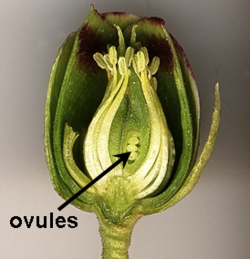
Location of ovules inside a Helleborus foetidus flower

In seed plants, the ovule is the structure that gives rise to and contains the female reproductive cells. It consists of three parts: the integument, forming its outer layer, the nucellus (or remnant of the megasporangium), and the female gametophyte (formed from a haploid megaspore) in its center. The female gametophyte — specifically termed a megagametophyte — is also called the embryo sac in angiosperms. The megagametophyte produces an egg cell for the purpose of fertilization. The ovule is a small structure present in the ovary. It is attached to the placenta by a stalk called a funicle. The funicle provides nourishment to the ovule. On the basis of the relative position of micropyle, body of the ovule, chalaza and funicle, there are six types of ovules.

Location within the plant

[edit]

In flowering plants, the ovule is located inside the portion of the flower called the gynoecium. The ovary of the gynoecium produces one or more ovules and ultimately becomes the fruit wall. Ovules are attached to the placenta in the ovary through a stalk-like structure known as a funiculus (plural, funiculi). Different patterns of ovule attachment, or placentation, can be found among plant species, these include:[1]

  • Apical placentation: The placenta is at the apex (top) of the ovary. Simple or compound ovary.
  • Axile placentation: The ovary is divided into radial segments, with placentas in separate locules. Ventral sutures of carpels meet at the centre of the ovary. Placentae are along fused margins of carpels. Two or more carpels. (e.g. Hibiscus, Citrus, Solanum)
  • Basal placentation: The placenta is at the base (bottom) of the ovary on a protrusion of the thalamus (receptacle). Simple or compound carpel, unilocular ovary. (e.g. Sonchus, Helianthus, Asteraceae)
  • Free-central placentation: Derived from axile as partitions are absorbed, leaving ovules at the central axis. Compound unilocular ovary. (e.g. Stellaria, Dianthus)
  • Marginal placentation: Simplest type. There is only one elongated placenta on one side of the ovary, as ovules are attached at the fusion line of the carpel's margins . This is conspicuous in legumes. Simple carpel, unilocular ovary. (e.g. Pisum)
  • Parietal placentation: Placentae on inner ovary wall within a non-sectioned ovary, corresponding to fused carpel margins. Two or more carpels, unilocular ovary. (e.g. Brassica)
  • Superficial placentation: Similar to axile, but placentae are on inner surfaces of multilocular ovary (e.g. Nymphaea)

In gymnosperms such as conifers, ovules are borne on the surface of an ovuliferous (ovule-bearing) scale, usually within an ovulate cone (also called megastrobilus). In the early extinct seed ferns, ovules were borne on the surface of leaves. In the most recent of these taxa, a cupule (a modified branch or group of branches) surrounded the ovule (e.g. Caytonia or Glossopteris).

Parts and development

[edit]
Ovule structure (anatropous) 1: nucellus 2: chalaza 3: funiculus 4: raphe

Ovule orientation may be anatropous, such that when inverted the micropyle faces the placenta (this is the most common ovule orientation in flowering plants), amphitropous, campylotropous, or orthotropous (anatropous are common and micropyle is in downward position and chalazal end in on the upper position hence, in amphitropous the anatropous arrangement is tilted 90 degrees and in orthotropous it is completely inverted) . The ovule appears to be a megasporangium with integuments surrounding it. Ovules are initially composed of diploid maternal tissue, which includes a megasporocyte (a cell that will undergo meiosis to produce megaspores). Megaspores remain inside the ovule and divide by mitosis to produce the haploid female gametophyte or megagametophyte, which also remains inside the ovule. The remnants of the megasporangium tissue (the nucellus) surround the megagametophyte. Megagametophytes produce archegonia (lost in some groups such as flowering plants), which produce egg cells. After fertilization, the ovule contains a diploid zygote and then, after cell division begins, an embryo of the next sporophyte generation. In flowering plants, a second sperm nucleus fuses with other nuclei in the megagametophyte forming a typically polyploid (often triploid) endosperm tissue, which serves as nourishment for the young sporophyte.

Integuments, micropyle, chalaza and hilum

[edit]

Plant ovules: Gymnosperm ovule on left, angiosperm ovule (inside ovary) on right
Models of different ovules, Botanical Museum Greifswald

An integument is a protective layer of cells surrounding the ovule. Gymnosperms typically have one integument (unitegmic) while angiosperms typically have two integuments (bitegmic). The evolutionary origin of the inner integument (which is integral to the formation of ovules from megasporangia) has been proposed to be by enclosure of a megasporangium by sterile branches (telomes).[2] Elkinsia, a preovulate taxon, has a lobed structure fused to the lower third of the megasporangium, with the lobes extending upwards in a ring around the megasporangium. This might, through fusion between lobes and between the structure and the megasporangium, have produced an integument.[3]

The origin of the second or outer integument has been an area of active contention for some time. The cupules of some extinct taxa have been suggested as the origin of the outer integument. A few angiosperms produce vascular tissue in the outer integument, the orientation of which suggests that the outer surface is morphologically abaxial. This suggests that cupules of the kind produced by the Caytoniales or Glossopteridales may have evolved into the outer integument of angiosperms.[4]

The integuments develop into the seed coat when the ovule matures after fertilization.

The integuments do not enclose the nucellus completely but retain an opening at the apex referred to as the micropyle. The micropyle opening allows the pollen (a male gametophyte) to enter the ovule for fertilization. In gymnosperms (e.g., conifers), the pollen is drawn into the ovule on a drop of fluid that exudes out of the micropyle, the so-called pollination drop mechanism.[3] Subsequently, the micropyle closes. In angiosperms, only a pollen tube enters the micropyle. During germination, the seedling's radicle emerges through the micropyle.

Located opposite from the micropyle is the chalaza where the nucellus is joined to the integuments. Nutrients from the plant travel through the phloem of the vascular system to the funiculus and outer integument and from there apoplastically and symplastically through the chalaza to the nucellus inside the ovule. In chalazogamous plants, the pollen tubes enter the ovule through the chalaza instead of the micropyle opening.

Nucellus, megaspore and perisperm

[edit]

The nucellus (plural: nucelli) is part of the inner structure of the ovule, forming a layer of diploid (sporophytic) cells immediately inside the integuments. It is structurally and functionally equivalent to the megasporangium. In immature ovules, the nucellus contains a megasporocyte (megaspore mother cell), which undergoes sporogenesis via meiosis. In the megasporocyte of Arabidopsis thaliana, meiosis depends on the expression of genes that facilitate DNA repair and homologous recombination.[5]

In gymnosperms, three of the four haploid spores produced in meiosis typically degenerate, leaving one surviving megaspore inside the nucellus. Among angiosperms, however, a wide range of variation exists in what happens next. The number (and position) of surviving megaspores, the total number of cell divisions, whether nuclear fusions occur, and the final number, position and ploidy of the cells or nuclei all vary. A common pattern of embryo sac development (the Polygonum type maturation pattern) includes a single functional megaspore followed by three rounds of mitosis. In some cases, however, two megaspores survive (for example, in Allium and Endymion). In some cases all four megaspores survive, for example in the Fritillaria type of development (illustrated by Lilium in the figure) there is no separation of the megaspores following meiosis, then the nuclei fuse to form a triploid nucleus and a haploid nucleus. The subsequent arrangement of cells is similar to the Polygonum pattern, but the ploidy of the nuclei is different.[6]

After fertilization, the nucellus may develop into the perisperm that feeds the embryo. In some plants, the diploid tissue of the nucellus can give rise to the embryo within the seed through a mechanism of asexual reproduction called nucellar embryony.

Megagametophyte

[edit]
Megagametophyte formation of the genera Polygonum and Lilium. Triploid nuclei are shown as ellipses with three white dots. The first three columns show the meiosis of the megaspore, followed by 1–2 mitoses.
Ovule with megagametophyte: egg cell (yellow), synergids (orange), central cell with two polar nuclei (bright green), and antipodals (dark green)

The haploid megaspore inside the nucellus gives rise to the female gametophyte, called the megagametophyte.

In gymnosperms, the megagametophyte consists of around 2000 nuclei and forms archegonia, which produce egg cells for fertilization.

In flowering plants, the megagametophyte (also referred to as the embryo sac) is much smaller and typically consists of only seven cells and eight nuclei. This type of megagametophyte develops from the megaspore through three rounds of mitotic divisions. The cell closest to the micropyle opening of the integuments differentiates into the egg cell, with two synergid cells by its side that are involved in the production of signals that guide the pollen tube. Three antipodal cells form on the opposite (chalazal) end of the ovule and later degenerate. The large central cell of the embryo sac contains two polar nuclei.

Zygote, embryo and endosperm

[edit]

The pollen tube releases two sperm nuclei into the ovule. In gymnosperms, fertilization occurs within the archegonia produced by the female gametophyte. While it is possible that several egg cells are present and fertilized, typically only one zygote will develop into a mature embryo as the resources within the seed are limited.[citation needed]

In flowering plants, one sperm nucleus fuses with the egg cell to produce a zygote, the other fuses with the two polar nuclei of the central cell to give rise to the polyploid (typically triploid) endosperm. This double fertilization is unique to flowering plants, although in some other groups the second sperm cell does fuse with another cell in the megagametophyte to produce a second embryo. The plant stores nutrients such as starch, proteins, and oils in the endosperm as a food source for the developing embryo and seedling, serving a similar function to the yolk of animal eggs. The endosperm is also called the albumen of the seed. [citation needed] The zygote then develops into a megasporophyte, which in turn produces one or more megasporangia. The ovule, with the developing megasporophyte, may be described as either tenuinucellate or crassinucellate. The former has either no cells or a single cell layer between the megasporophyte and the epidermal cells, while the latter has multiple cell layers between.[7]

Embryos may be described by a number of terms including Linear (embryos have axile placentation and are longer than broad), or rudimentary (embryos are basal in which the embryo is tiny in relation to the endosperm).[8]

Types of gametophytes

[edit]

Megagametophytes of flowering plants may be described according to the number of megaspores developing, as either monosporic, bisporic, or tetrasporic. [citation needed](RF)

See also

[edit]

References

[edit]

Bibliography

[edit]
[edit]
Revisions and contributorsEdit on WikipediaRead on Wikipedia
from Grokipedia
An ovule is a female reproductive structure in seed plants that develops into a seed after fertilization, serving as the site for the female gametophyte and embryo formation.[1] It consists of a central nucellus (megasporangium) surrounded by one or more protective integuments, attached to the placenta by a funiculus, with a micropyle providing access for pollen tubes.[2] In angiosperms, ovules are typically enclosed within the ovary of the flower and exhibit diverse orientations, such as anatropous (curved toward the placenta) or orthotropous (straight), with most featuring two integuments (bitegmic).[1] The nucellus houses the megasporocyte, which undergoes meiosis to produce megaspores; one develops into the embryo sac containing the egg cell, synergids, central cell, and antipodals.[2] Upon double fertilization—one sperm uniting with the egg to form the zygote and another with the central cell to produce endosperm—the ovule matures into a seed, with integuments forming the seed coat.[2] Ovules trace their evolutionary origins to early seed plants around 400 million years ago, evolving from gymnosperm precursors with adaptations like bitegmy and curvature enhancing protection and pollination efficiency in angiosperms.[1] Diversity in ovule morphology, including nucellus thickness (crassinucellar or tenuinucellar) and integument number (unitegmic in some lineages), reflects phylogenetic trends and ecological adaptations across seed plant groups.[1]

Overview

Definition and Characteristics

In seed plants, the ovule is defined as a megasporangium enclosed by one or more protective integuments, within which the nucellus houses the developing female gametophyte that produces the egg cell; following fertilization, this structure matures into a seed.[3] The ovule represents a key synapomorphy of seed plants, distinguishing them from earlier vascular plants by providing enclosure and protection for the female reproductive process.[3] Key characteristics of the ovule include its typical possession of one or two integuments that surround the nucellus—a mass of diploid maternal tissue—and form a small opening called the micropyle, through which pollen can access the interior.[4] Ovules arise from placental tissue, a meristematic region within the reproductive organ, ensuring their attachment and nutrient supply during development.[5] These features set ovules apart from other plant reproductive structures, such as free spores or pollen grains, by their integumentary protection and role in containing the haploid female gametophyte within a diploid sporophytic framework.[6] The basic anatomy of the ovule, including its integuments and internal tissues, was first systematically described by the English botanist Nehemiah Grew in his 1672 work The Anatomy of Vegetables Begun, where he observed microscopic details such as the micropyle in young seeds using early compound microscopes.[7] This foundational observation laid the groundwork for later understandings of ovule structure across gymnosperms and angiosperms.[7]

Role in Reproduction

The ovule serves as the primary site for female gamete production and fertilization in seed plants, housing the development of the megagametophyte, which contains the egg cell and central cell essential for sexual reproduction.[8] In angiosperms, the ovule facilitates double fertilization, a unique process where two sperm cells from the pollen tube participate: one fuses with the egg cell to form the diploid zygote that develops into the embryo, while the other fuses with the central cell to produce the triploid endosperm, providing nourishment for the embryo.[9] This mechanism ensures efficient resource allocation, as endosperm development is triggered only upon successful egg fertilization.[10] Post-fertilization, the ovule's tissues encase and protect the developing embryo, transforming into the seed coat to shield it from environmental stresses.[11] The evolutionary significance of the ovule lies in its role in enabling seed plants to thrive in terrestrial environments by decoupling reproduction from water dependence. Unlike earlier plant groups, ovules allow for pollen-mediated sperm delivery, eliminating the need for free-swimming sperm and permitting fertilization in dry conditions, which facilitated the colonization of diverse habitats and the dominance of seed plants over non-seed lineages.[12] Additionally, ovules support embryo dormancy within protective structures, enhancing survival during adverse periods and enabling long-distance dispersal via seeds, a key adaptation that contributed to the ecological success of gymnosperms and angiosperms.[13] In contrast to non-seed plants such as ferns and mosses, where female gametophytes are free-living and vulnerable to desiccation due to external exposure and reliance on water for sperm motility, ovules in seed plants enclose and nourish the reduced female gametophyte internally, minimizing water loss and predation risks.[2] This internalized protection represents a pivotal evolutionary innovation that reduced desiccation threats and supported the transition to fully terrestrial reproduction.[14]

Location and Arrangement

In Flowering Plants

In flowering plants, ovules are located within the ovary of the carpel, the female reproductive organ, where they are attached to the placenta, a specialized tissue on the inner ovary wall that nourishes and anchors them.[1] This positioning integrates ovules into the flower's reproductive system, allowing pollen tubes to reach them post-pollination for fertilization. The number of ovules per ovary varies widely among species; for instance, mango (Mangifera indica) typically has a single ovule, while tomato (Solanum lycopersicum) features hundreds, influencing potential seed yield.[15][16] Ovules arise developmentally from meristematic tissue on the placenta during early flower initiation, emerging laterally as primordia that differentiate into mature structures.[15] Their arrangement, known as placentation, follows several patterns that determine spatial organization within the ovary. In parietal placentation, ovules attach directly to the ovary wall in a unilocular or multilocular ovary, as seen in mustard (Brassica). Axile placentation positions ovules along a central axis in a multilocular ovary, common in tomato. Free central placentation features ovules on a free-standing central column without septa, exemplified by carnations (Dianthus). Basal placentation confines ovules to the ovary base, as in sunflowers (Helianthus).[1][1] These placentation types significantly affect fruit and seed development by dictating seed distribution and dispersal mechanisms; for example, axile placentation in tomato leads to centrally clustered seeds in the mature berry, enhancing uniform ripening and seed packing.[1] The enclosing ovary further protects ovules from desiccation and herbivores until fertilization.[15]

In Non-Flowering Seed Plants

In non-flowering seed plants, collectively known as gymnosperms, ovules are located on specialized structures called megasporophylls or modified scales, which are arranged within ovulate cones or strobili, and they remain exposed without enclosure by an ovary, unlike the protected position within carpels in flowering plants.[17] In conifers such as Pinus species, ovules are borne exposed on the adaxial (upper) surface of ovuliferous scales that form part of the megasporophylls in female cones, with typically two ovules per scale positioned for direct wind pollination.[18] By contrast, in Ginkgo biloba, ovules develop in pairs at the tips of elongated stalks (peduncles) arising from leaf axils on short shoots, providing a degree of enclosure by surrounding tissues during maturation, though they lack a compact cone structure.[19] The arrangement of ovules in gymnosperms varies by group but generally occurs in compact ovulate cones or strobili that facilitate pollination and seed dispersal. In cycads, such as species of Cycas and Zamia, megasporophylls are loosely or tightly arranged in large, often massive cones, with multiple ovules (up to six pairs per megasporophyll) that develop into large, fleshy seeds attractive to animal dispersers.[14] Conifers, including pines and firs, feature tightly packed ovulate cones where ovules on seed scales mature into smaller, often winged seeds adapted for wind dispersal, enhancing their spread across diverse habitats.[20] Evolutionarily, the ovules of modern gymnosperms originated from heterosporous megasporangia in progymnosperms during the Late Devonian, with the earliest known ovules appearing in primitive seed plants such as Elkinsia around 360 million years ago. These structures, often on fern-like fronds and partially enclosed by cupules, represented a key transitional stage toward fully enclosed seeds that provided enhanced protection and nutrition for embryos.[21] This shift marked a key innovation in seed plant evolution, allowing survival in terrestrial environments without reliance on water for fertilization.[21]

External Structure

Integuments and Associated Features

The integuments of an ovule consist of one or more layers of sterile tissue that enclose and protect the nucellus, originating from the dermal layer of the ovule primordium through periclinal divisions in the epidermal cells.[22] In gymnosperms, ovules are typically unitegmic, featuring a single integument that surrounds the nucellus and contributes to the protective seed coat after fertilization.[23] Angiosperms, by contrast, possess bitegmic ovules with two integuments—an inner one homologous to the gymnosperm integument and an outer one that enhances enclosure and curvature.[1] These integuments develop from the chalazal region of the ovule and provide mechanical protection against desiccation and pathogens while facilitating the transformation into the seed coat post-fertilization.[1] The micropyle represents a critical opening at the apex of the ovule, formed by the incomplete enclosure of the nucellus by the integument(s), which allows the pollen tube to enter during fertilization.[1] In gymnosperms, the single integument creates a simple micropylar canal that also serves for pollen capture via a pollination drop.[23] Angiosperm micropyles vary: endostomic types form solely from the inner integument, amphistomic from both, and exostomic rarely from the outer alone, with the configuration influencing pollen tube guidance and ovule orientation.[1] This pore ensures targeted delivery of male gametes to the female gametophyte while minimizing exposure.[1] In anatropous or curved ovules, common in many angiosperms, the funicle attaches along the ovule's side, forming a raphe—a ridge-like structure through which the vascular bundle extends from the funicle to the chalaza. The raphe arises from the adnate fusion of the funicle and outer integument, providing structural support and nutrient conduction without altering the primary protective role of the integuments.[1] This feature is absent in orthotropous ovules but enhances stability in inverted orientations.[24]

Hilum and Funicle

The funicle, or funiculus, is a stalk-like structure that attaches the ovule to the placenta on the inner wall of the ovary in angiosperms. It consists of a multicellular filament containing one or more vascular bundles composed of xylem and phloem, which transport water, minerals, and organic nutrients from the parent plant to support ovule development and maturation. This vascular supply is essential for sustaining the energy demands of megasporogenesis and female gametophyte formation within the ovule.[25] The hilum represents the junction where the funicle merges with the ovule body, typically near the chalazal region. In the mature seed, the hilum manifests as a distinct scar on the seed coat (testa), indicating the former attachment site and remnants of vascular tissue that facilitated nutrient influx during embryogenesis. This scar serves as a key morphological marker for seed identification and is critical for post-fertilization nutrient exchange between the seed and the developing fruit. Variations in funicle and hilum morphology occur across plant species, reflecting adaptations to ovule orientation and environmental pressures. In sessile ovules, the funicle is greatly shortened or absent, enabling direct placental attachment and minimal vascular extension. Conversely, pendulous ovules feature an elongated funicle, which suspends the ovule within the ovarian locule and may incorporate multiple or twisted vascular bundles for enhanced transport efficiency. In curved ovule types, such as anatropous forms common in angiosperms, the funicle aids in the inversion of the ovule body relative to the micropyle. Vascular configurations in the funicle, including collateral or amphicribral arrangements, further diversify to optimize nutrient delivery in families like Leguminosae.[26][25]

Internal Structure

Nucellus and Megasporangium

The nucellus constitutes the central, multi-layered tissue within the ovule, derived from the sporophyte and maintaining a diploid (2n) chromosome complement. It forms as part of the ovule primordium and typically consists of several cell layers that surround and enclose the megaspore mother cell, providing structural support during early developmental stages.[1] This tissue is essential for housing reproductive processes and varies in thickness across plant groups, such as being more robust (crassinucellar) in basal angiosperms like Magnoliids compared to thinner (tenuinucellar) forms in derived groups like Asterids.[1] Functionally, the nucellus serves as the megasporangium, an indehiscent structure where the diploid megaspore mother cell undergoes meiosis to produce four haploid megaspores, one of which typically develops further.[1] Unlike dehiscent sporangia in ferns, the nucellus retains the megaspores internally, facilitating the subsequent formation of the female gametophyte without dispersal.[27] This role underscores its evolutionary adaptation in seed plants for protected spore production. In addition to its sporogenic function, the nucellus acts as a nutritive tissue, supplying essential nutrients and substances to the developing female gametophyte through direct cellular contact or specialized layers like the endothelium in certain ovules.[1] In some angiosperm seeds, particularly within the Caryophyllales, the nucellus persists post-fertilization as perisperm, a starchy storage tissue that accumulates reserves from the maternal sporophyte; for example, in sugar beet (Beta vulgaris), the undigested nucellus forms the central perisperm, serving as a primary food reserve for the embryo.[28][29]

Megaspore and Functional Megaspore

Megasporogenesis is the process by which a diploid megaspore mother cell, located within the nucellus of the ovule, undergoes meiosis to produce a tetrad of four haploid megaspores.[30] This reduction division halves the chromosome number, ensuring that the resulting megaspores are haploid and capable of giving rise to a haploid female gametophyte.[31] The meiotic divisions typically occur in a linear sequence, but the arrangement of the tetrad can vary across seed plants, including linear, T-shaped, or tetrahedral configurations depending on the orientation of the meiotic spindles.[32] These variations are observed in both angiosperms and gymnosperms, with linear tetrads being most common in many angiosperm species, while T-shaped and tetrahedral forms appear in specific taxa such as certain gymnosperms like Taxus.[33] Among the four megaspores in the tetrad, typically only one survives to become the functional megaspore, while the other three degenerate.[30] In most cases, the chalazal-most megaspore—the one farthest from the micropyle and closest to the chalaza—is selected as the functional one due to its advantageous position for nutrient uptake from the surrounding nucellus.[34] This selection process ensures that the surviving haploid megaspore can proceed to develop into the female gametophyte, maintaining the genetic reduction necessary for sexual reproduction in seed plants.[35] The degeneration of the micropylar megaspores often involves programmed cell death, preventing competition and conserving resources within the ovule.[36]

Female Gametophyte Development

Formation of the Embryo Sac

The formation of the embryo sac, also known as megagametogenesis, begins with the functional megaspore in angiosperms and involves a series of mitotic divisions that develop the female gametophyte within the ovule.[30] In the most common pattern, the Polygonum type or monosporic development, which occurs in approximately 70% of angiosperm species, the process starts immediately after meiosis when the chalazal megaspore survives and the others degenerate.[37] The functional megaspore first undergoes two rounds of mitosis without cytokinesis, resulting in a binucleate stage followed by a tetranucleate coenocyte during the free nuclear phase.[30] This coenocytic stage features free nuclei divided by a large central vacuole, with two nuclei migrating to the micropylar pole and two to the chalazal pole.[38] A third mitosis then produces eight nuclei, after which cellularization occurs through the formation of cell walls, yielding the mature seven-celled, eight-nucleate embryo sac.[30] During cellularization, the nuclei organize into specific domains: at the micropylar end, the egg apparatus forms, consisting of one egg cell and two synergid cells; centrally, the two polar nuclei define the binucleate central cell; and at the chalazal end, three antipodal cells develop.[39] The polar nuclei in the central cell often fuse to form a secondary nucleus before fertilization, though this varies slightly among species.[30] Throughout development, the embryo sac depends on the surrounding nucellus for nutrients and structural support, with antipodal cells sometimes enlarging to facilitate nutrient transfer in certain taxa.[38] This process is highly conserved in angiosperms but contrasts with gymnosperm variations, where multiple archegonia may form instead of a single embryo sac.[40]

Cellular Organization in Angiosperms

In angiosperms, the mature embryo sac typically exhibits a cellular organization consisting of seven cells and eight nuclei, known as the Polygonum-type, which is the most common configuration. This structure includes the egg apparatus at the micropylar end, comprising the egg cell and two synergid cells, as well as three antipodal cells at the chalazal end and a large central cell containing two polar nuclei. The egg cell is positioned adjacent to the synergids, featuring a polarized structure with a prominent vacuole and its nucleus located toward the chalazal side. The synergid cells play crucial roles in facilitating fertilization by secreting chemical attractants that guide the pollen tube toward the embryo sac and by controlling the pollen tube's arrest and discharge of sperm cells.[41] The antipodal cells, often highly active and sometimes proliferating, are involved in nutrient absorption and transport from surrounding nucellar tissue to support the developing embryo sac.[42] The central cell serves as the precursor to the endosperm, where its two polar nuclei fuse with one sperm nucleus during double fertilization to form the triploid endosperm that nourishes the embryo.[43] While the Polygonum-type dominates, rarer bisporic and tetrasporic embryo sacs occur in certain angiosperm lineages, characterized by modified nuclear arrangements derived from two or four megaspores, respectively, leading to variations such as shared cytoplasm or altered cell numbers without the standard three mitoses.[44] For instance, bisporic types like the Allium pattern involve two contributing megaspores with three free nuclear divisions, while tetrasporic types, such as the Adoxa pattern, incorporate all four megaspores and feature two mitotic divisions. These atypical organizations highlight evolutionary diversity in female gametophyte development among angiosperms.[44]

Ovule Development and Maturation

Pre-Fertilization Stages

During ovule maturation in angiosperms, the integuments undergo progressive thickening to form protective layers around the nucellus, typically consisting of 2-3 cell layers for the inner integument and varying thickness for the outer, which can exceed two layers in groups like Magnoliids and certain monocots.[45] This development ensures structural integrity while allowing space for internal gametophyte maturation. Concurrently, the micropyle, formed primarily by the inner integument (endostomic) or both integuments (amphistomic), opens as a narrow canal to facilitate pollen tube entry, though it may remain partially sealed by secretions in some species until pollination.[45] The embryo sac matures alongside pollen development in the anthers, reaching a 7-celled, 8-nucleate stage in most angiosperms, with synergids producing attractants that prepare the ovule for sperm reception.[46] Pollination initiates the entry phase, where germinated pollen tubes from the stigma traverse the style's transmitting tract before reaching the ovule's micropyle.[46] Upon arrival, the pollen tube navigates the micropyle, guided toward the embryo sac's synergids, where it bursts to release the two sperm cells without penetrating the egg apparatus.[46] This process is highly precise, often resulting in one-to-one pollen tube-ovule interactions to prevent polyspermy.[47] Pre-fertilization guidance relies on chemotropism, where diffusible signals from the synergids and nucellus apex direct pollen tube growth.[48] Key attractants include cysteine-rich peptides like LUREs secreted by synergids, which bind to receptors on the pollen tube tip to reorient growth toward the micropyle.[49] Additional cues, such as regulated GABA levels and FERONIA-dependent signaling from the ovule's outer integument, enhance attraction and adhesion along the funiculus before micropylar entry.[50] These mechanisms ensure efficient sperm delivery, with pollen tube progression typically completing within hours to days post-pollination depending on the species.[51]

Post-Fertilization Changes

Following double fertilization in angiosperms, one sperm cell fuses with the egg cell to form a diploid zygote, which undergoes mitotic divisions to develop into the embryo, while the second sperm cell fuses with the central cell to produce a triploid primary endosperm nucleus that proliferates into the nutritive endosperm tissue.[9] This process, unique to angiosperms, ensures coordinated development of both embryonic and storage tissues within the ovule.[52] As the embryo and endosperm develop, the ovule undergoes structural transformations to form the seed; the diploid maternal integuments differentiate and lignify to create the protective seed coat, consisting of an outer testa and inner tegmen in species with two integuments.[9] The nucellus, the central tissue surrounding the embryo sac, often partially or fully degenerates but may persist as perisperm in certain angiosperms, such as those in the Caryophyllales, providing additional nutrient reserves.[53] Post-fertilization, the accessory cells of the embryo sac degenerate to support seed maturation; the two synergids, which guide the pollen tube, undergo programmed cell death triggered by pollen tube arrival and discharge, ensuring no further fertilization attempts.[54] Similarly, the three antipodal cells at the chalazal end break down shortly after fertilization, often through autophagic processes, freeing space for endosperm expansion.[9] In some taxa, such as Sapindaceae, the funicle enlarges post-fertilization to form an aril, a fleshy outgrowth that aids seed dispersal by attracting animals.[55]

Variations Across Plant Groups

Gymnosperm Ovules

Gymnosperm ovules are typically unitegmic, featuring a single integument that forms a protective layer around the nucellus, distinguishing them from the bitegmic structure common in many angiosperms.[23] However, Gnetales, such as Gnetum and Ephedra, possess bitegmic ovules.[56] This single integument often develops into a fleshy or woody seed coat post-fertilization, while the ovule itself remains exposed on megasporophylls or cone scales rather than being enclosed in an ovary.[17] A prominent feature is the large, multicellular female gametophyte, which develops within the ovule and serves as the primary nutritive tissue for the embryo, replacing the endosperm found in angiosperms.[17] This gametophyte contains multiple archegonia, each housing an egg cell, allowing for potential polyspermy or multiple fertilization events in some species.[17] The development of the female gametophyte in gymnosperms begins with meiosis in the megaspore mother cell within the nucellus, producing four megaspores, of which typically one survives and undergoes free nuclear divisions.[57] These divisions can yield thousands of nuclei—often 2,000 to 6,000 in conifers—without immediate cell wall formation, creating a coenocytic stage that expands the gametophyte volume.[58] Cellularization follows, forming a multicellular structure with distinct tissue regions, including a nutritive corpus and peripheral layers, after which archegonia differentiate at the micropylar end.[57] This process contrasts with the more compact, cellularized embryo sac in angiosperms, emphasizing the gymnosperm gametophyte's role in provisioning resources directly.[58] In conifers, such as pines and spruces, ovules are borne on the upper surface of ovuliferous scales within female cones, often accompanied by resin canals that secrete protective resins to deter herbivores and pathogens.[59] These canals run through the scale tissue, enhancing ovule defense during the extended maturation period. In cycads, like Cycas species, ovules are large and borne in pairs on modified leaves, featuring pollination drops exuded from the micropyle to capture pollen; fertilization involves motile, multiflagellated sperm delivered via pollen tubes, a primitive trait retained from earlier seed plants.[60][61]

Angiosperm Ovule Types

In angiosperms, ovules exhibit diverse orientations and curvatures determined primarily by the configuration of the integuments and funicle, which influence their position relative to the placenta and the path of pollen tube growth. These variations are classified into several main types based on the degree of bending or inversion of the ovule body.[1] The orthotropous ovule is characterized by a straight, upright orientation where the micropyle, chalaza, and funicle attachment (hilum) are aligned in a single axis, with no curvature present. This type maintains radial symmetry and is typical in more primitive or basal angiosperm lineages.[1] In contrast, the anatropous ovule, the most prevalent type, features a complete 180-degree inversion of the ovule body, positioning the micropyle adjacent to the hilum and close to the placenta. This curvature arises from differential growth of the funicle and outer integument, resulting in the nucellus lying parallel to the funicle. Anatropous ovules predominate across angiosperm clades, occurring in the majority of families and considered the ancestral condition.[1] The campylotropous ovule displays a partial curvature of the integuments, with the nucellus bent but the micropyle and chalaza remaining somewhat aligned, often leading to a zig-zag orientation of the micropyle. This type is more common in derived eudicot groups, such as those in Ranunculales and Fabales.[1] Amphitropous ovules exhibit a more pronounced bend, where the ovule body forms nearly a right angle with the funicle, and the embryo sac adopts a horseshoe shape due to the curvature of both integuments and nucellus. This configuration is relatively rare and occurs sporadically in certain monocot and eudicot families, such as Alismataceae.[1] A variant, hemianatropous (or hemitropous), represents an intermediate form with partial inversion, where the ovule bends about 90 degrees; it is observed in legumes (Fabaceae), contributing to compact seed arrangements.[1] These ovule orientations have functional implications, particularly in pollination and seed development. The anatropous form aligns the micropyle toward the base of the ovary, facilitating direct entry of the pollen tube from the style and stigma for efficient fertilization. Such curvatures also influence post-fertilization seed shape, with anatropous ovules often yielding elongated or curved seeds due to the raphe formation along the funicle. The funicle plays a key role in mediating these curvatures through its elongation and attachment.[1]

References

User Avatar
No comments yet.