



Community hub
Recent from talks
Contribute something to knowledge base
Content stats: 0 posts, 0 articles, 1 media, 0 notes
Members stats: 0 subscribers, 0 contributors, 0 moderators, 0 supporters
Subscribers
Supporters
Contributors
Moderators
Hub AI
Nuclear power phase-out AI simulator
(@Nuclear power phase-out_simulator)
Hub AI
Nuclear power phase-out AI simulator
(@Nuclear power phase-out_simulator)
Nuclear power phase-out
A nuclear power phase-out is the discontinuation of usage of nuclear power for energy production. Often initiated because of concerns about nuclear power, phase-outs usually include shutting down nuclear power plants and looking towards fossil fuels and renewable energy. Three nuclear accidents have influenced the discontinuation of nuclear power: the 1979 Three Mile Island partial nuclear meltdown in the United States, the 1986 Chernobyl disaster in the USSR (now Ukraine), and the 2011 Fukushima nuclear accident in Japan.
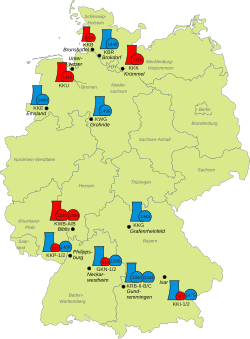
As of 2025[update], only three countries have permanently closed all of their formerly functioning nuclear plants: Italy by 1990, Germany by 2023 and Taiwan by 2025. Lithuania and Kazakhstan have shut down their only nuclear plants, but plan to build new ones to replace them, while Armenia shut down its only nuclear plant but subsequently restarted it. Austria never used its first nuclear plant that was completely built. Cuba, Libya, North Korea and Poland never completed the construction of their first nuclear plants due to financial, political and technical reasons. Spain and Switzerland plan nuclear phase-outs.
Nuclear shut-downs after Fukushima have significantly set back emissions reductions goals in several countries. A 2019 study of the impacts of the German and Japan closures concludes that by continuing to operate their nuclear plants "these two countries could have prevented 28,000 air pollution-induced deaths and 2400 Mt CO2 emissions between 2011 and 2017. By sharply reducing nuclear instead of coal and gas after Fukushima, both countries lost the chance to prevent very large amounts of air pollution-induced deaths and CO2 emissions".
Several countries formerly opposed to opening nuclear programs or planning phaseouts have reversed course in recent years due to climate concerns and energy independence including Belgium, the Philippines, Greece, Sweden and South Korea.
A popular movement against nuclear power exists in the Western world, based on concerns about more nuclear accidents and concerns about nuclear waste. Anti-nuclear critics see nuclear power as a dangerous, expensive way to boil water to generate electricity. The 1979 Three Mile Island accident and the 1986 Chernobyl disaster played a key role in stopping new plant construction in many countries. Major anti-nuclear power groups include Friends of the Earth, Greenpeace, Institute for Energy and Environmental Research, Nuclear Information and Resource Service, and Sortir du nucléaire (France).
Several countries, especially European countries, have abandoned the construction of new nuclear power plants. Austria (1978), Sweden (1980) and Italy (1987) voted in referendums to oppose or phase out nuclear power, while opposition in Ireland prevented a nuclear program there. Countries that have no nuclear plants and have restricted new plant constructions comprise Australia, Austria, Denmark, Greece, Italy, Ireland, Norway and Serbia. Poland stopped the construction of a plant. Belgium, Germany, Spain, and Sweden decided not to build new plants or intend to phase out nuclear power, although still mostly relying on nuclear energy.
New reactors under construction in Finland and France, which were meant to lead a nuclear new build, have been substantially delayed and are running over-budget. Despite these delays the Olkiluoto reactor is now online and delivering low-emissions power to the grid as of 12 March 2022. "When Olkiluoto 3 reaches full output, around 90% of Finland's electricity generation will come from clean, low-carbon electricity sources, with nuclear generation supplying around half of that." In addition, China has 11 units under construction and there are also new reactors being built in Bangladesh, Belarus, Brazil, India, Japan, Pakistan, Russia, Slovakia, South Korea, Turkey, United Arab Emirates, United Kingdom and the United States of America. At least 100 older and smaller reactors will "most probably be closed over the next 10–15 years".
Countries that wish to shut down nuclear power plants must find alternatives for electricity generation; otherwise, they are forced to become dependent on imports. Therefore, the discussion of a future for nuclear energy is intertwined with discussions about fossil fuels or an energy transition to renewable energy.
Nuclear power phase-out
A nuclear power phase-out is the discontinuation of usage of nuclear power for energy production. Often initiated because of concerns about nuclear power, phase-outs usually include shutting down nuclear power plants and looking towards fossil fuels and renewable energy. Three nuclear accidents have influenced the discontinuation of nuclear power: the 1979 Three Mile Island partial nuclear meltdown in the United States, the 1986 Chernobyl disaster in the USSR (now Ukraine), and the 2011 Fukushima nuclear accident in Japan.
As of 2025[update], only three countries have permanently closed all of their formerly functioning nuclear plants: Italy by 1990, Germany by 2023 and Taiwan by 2025. Lithuania and Kazakhstan have shut down their only nuclear plants, but plan to build new ones to replace them, while Armenia shut down its only nuclear plant but subsequently restarted it. Austria never used its first nuclear plant that was completely built. Cuba, Libya, North Korea and Poland never completed the construction of their first nuclear plants due to financial, political and technical reasons. Spain and Switzerland plan nuclear phase-outs.
Nuclear shut-downs after Fukushima have significantly set back emissions reductions goals in several countries. A 2019 study of the impacts of the German and Japan closures concludes that by continuing to operate their nuclear plants "these two countries could have prevented 28,000 air pollution-induced deaths and 2400 Mt CO2 emissions between 2011 and 2017. By sharply reducing nuclear instead of coal and gas after Fukushima, both countries lost the chance to prevent very large amounts of air pollution-induced deaths and CO2 emissions".
Several countries formerly opposed to opening nuclear programs or planning phaseouts have reversed course in recent years due to climate concerns and energy independence including Belgium, the Philippines, Greece, Sweden and South Korea.
A popular movement against nuclear power exists in the Western world, based on concerns about more nuclear accidents and concerns about nuclear waste. Anti-nuclear critics see nuclear power as a dangerous, expensive way to boil water to generate electricity. The 1979 Three Mile Island accident and the 1986 Chernobyl disaster played a key role in stopping new plant construction in many countries. Major anti-nuclear power groups include Friends of the Earth, Greenpeace, Institute for Energy and Environmental Research, Nuclear Information and Resource Service, and Sortir du nucléaire (France).
Several countries, especially European countries, have abandoned the construction of new nuclear power plants. Austria (1978), Sweden (1980) and Italy (1987) voted in referendums to oppose or phase out nuclear power, while opposition in Ireland prevented a nuclear program there. Countries that have no nuclear plants and have restricted new plant constructions comprise Australia, Austria, Denmark, Greece, Italy, Ireland, Norway and Serbia. Poland stopped the construction of a plant. Belgium, Germany, Spain, and Sweden decided not to build new plants or intend to phase out nuclear power, although still mostly relying on nuclear energy.
New reactors under construction in Finland and France, which were meant to lead a nuclear new build, have been substantially delayed and are running over-budget. Despite these delays the Olkiluoto reactor is now online and delivering low-emissions power to the grid as of 12 March 2022. "When Olkiluoto 3 reaches full output, around 90% of Finland's electricity generation will come from clean, low-carbon electricity sources, with nuclear generation supplying around half of that." In addition, China has 11 units under construction and there are also new reactors being built in Bangladesh, Belarus, Brazil, India, Japan, Pakistan, Russia, Slovakia, South Korea, Turkey, United Arab Emirates, United Kingdom and the United States of America. At least 100 older and smaller reactors will "most probably be closed over the next 10–15 years".
Countries that wish to shut down nuclear power plants must find alternatives for electricity generation; otherwise, they are forced to become dependent on imports. Therefore, the discussion of a future for nuclear energy is intertwined with discussions about fossil fuels or an energy transition to renewable energy.
Recent media
Recent media