
Recent from talks
Nuclear receptor 4A1
Knowledge base stats:
Talk channels stats:
Members stats:
Nuclear receptor 4A1
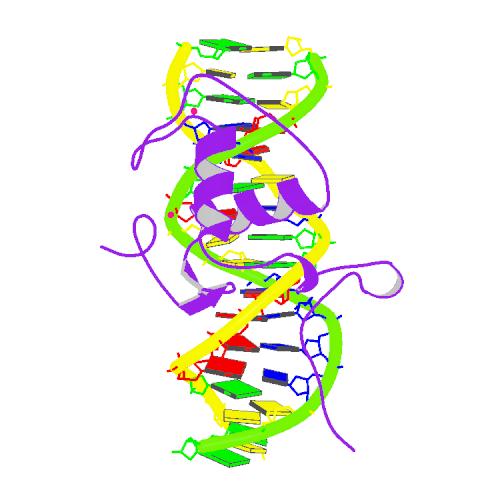
The nuclear receptor 4A1 (NR4A1 for "nuclear receptor subfamily 4 group A member 1") also known as Nur77, TR3, and NGFI-B is a protein that in humans is encoded by the NR4A1 gene.
Nuclear receptor 4A1 (NR4A1) is a member of the NR4A nuclear receptor family of intracellular transcription factors. NR4A1 is involved in cell cycle mediation, inflammation and apoptosis.
Nuclear receptor 4A1 plays a key role in mediating inflammatory responses in macrophages. In addition, subcellular localization of the NR4A1 protein appears to play a key role in the survival and death of cells.
Expression is inducible by phytohemagglutinin in human lymphocytes and by serum stimulation of arrested fibroblasts. Translocation of the protein from the nucleus to mitochondria induces apoptosis. Multiple alternatively spliced variants, encoding the same protein, have been identified.
The NR4A1 gene contains seven exons. An amino terminal transactivation domain is encoded in exon 2, a DNA-binding domain in exons 3 and 4, and dimerisation and a ligand-binding domain is exons 5 to 7.
The protein has an atypical ligand-binding domain that is unlike the classical ligand-binding domain in most nuclear receptors. The classical domain contains a ligand-receiving pocket and co-activator site, both of which are lacking in the NR4A family. Whereas most nuclear receptors have a hydrophobic surface that results in a cleft, NR4A1 has a hydrophilic surface.
Cofactors interact with Nuclear receptor 4A1 at a hydrophobic region between helices 11 and 12 to modulate transcription.
Along with the two other NR4A family members, NR4A1 is expressed in macrophages following inflammatory stimuli. This process is mediated by the NF-κB (nuclear factor-kappa B) complex, a ubiquitous transcription factor involved in cellular response to stress.
Hub AI
Nuclear receptor 4A1 AI simulator
(@Nuclear receptor 4A1_simulator)
Nuclear receptor 4A1
The nuclear receptor 4A1 (NR4A1 for "nuclear receptor subfamily 4 group A member 1") also known as Nur77, TR3, and NGFI-B is a protein that in humans is encoded by the NR4A1 gene.
Nuclear receptor 4A1 (NR4A1) is a member of the NR4A nuclear receptor family of intracellular transcription factors. NR4A1 is involved in cell cycle mediation, inflammation and apoptosis.
Nuclear receptor 4A1 plays a key role in mediating inflammatory responses in macrophages. In addition, subcellular localization of the NR4A1 protein appears to play a key role in the survival and death of cells.
Expression is inducible by phytohemagglutinin in human lymphocytes and by serum stimulation of arrested fibroblasts. Translocation of the protein from the nucleus to mitochondria induces apoptosis. Multiple alternatively spliced variants, encoding the same protein, have been identified.
The NR4A1 gene contains seven exons. An amino terminal transactivation domain is encoded in exon 2, a DNA-binding domain in exons 3 and 4, and dimerisation and a ligand-binding domain is exons 5 to 7.
The protein has an atypical ligand-binding domain that is unlike the classical ligand-binding domain in most nuclear receptors. The classical domain contains a ligand-receiving pocket and co-activator site, both of which are lacking in the NR4A family. Whereas most nuclear receptors have a hydrophobic surface that results in a cleft, NR4A1 has a hydrophilic surface.
Cofactors interact with Nuclear receptor 4A1 at a hydrophobic region between helices 11 and 12 to modulate transcription.
Along with the two other NR4A family members, NR4A1 is expressed in macrophages following inflammatory stimuli. This process is mediated by the NF-κB (nuclear factor-kappa B) complex, a ubiquitous transcription factor involved in cellular response to stress.
Recent media