



Community hub
Recent from talks
Knowledge base stats:
Talk channels stats:
Members stats:
Nuclear safety and security
Nuclear safety is defined by the International Atomic Energy Agency (IAEA) as "The achievement of proper operating conditions, prevention of accidents or mitigation of accident consequences, resulting in protection of workers, the public and the environment from undue radiation hazards". The IAEA defines nuclear security as "The prevention and detection of and response to, theft, sabotage, unauthorized access, illegal transfer or other malicious acts involving nuclear materials, other radioactive substances or their associated facilities".
This covers nuclear power plants and all other nuclear facilities, the transportation of nuclear materials, and the use and storage of nuclear materials for medical, power, industry, and military uses.
The nuclear power industry has improved the safety and performance of reactors, and has proposed new and safer reactor designs. However, a perfect safety cannot be guaranteed. Potential sources of problems include human errors and external events that have a greater impact than anticipated: the designers of reactors at Fukushima in Japan did not anticipate that a tsunami generated by an earthquake would disable the backup systems which were supposed to stabilize the reactor after the earthquake. Catastrophic scenarios involving terrorist attacks, war, insider sabotage, and cyberattacks are also conceivable.
Nuclear weapon safety, as well as the safety of military research involving nuclear materials, is generally handled by agencies different from those that oversee civilian safety, for various reasons, including secrecy. There are ongoing concerns about terrorist groups acquiring nuclear bomb-making material.
As of 2011[update], nuclear safety considerations occur in a number of situations, including:
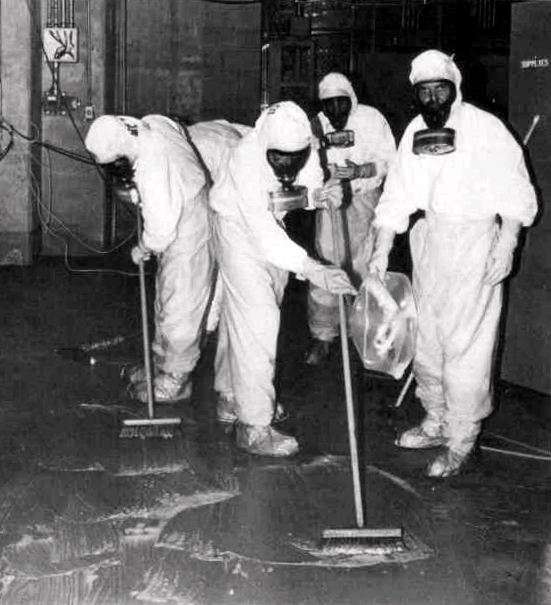
With the exception of thermonuclear weapons and experimental fusion research, all safety issues specific to nuclear power stems from the need to limit the biological uptake of committed dose (ingestion or inhalation of radioactive materials), and external radiation dose due to radioactive contamination.
Nuclear safety therefore covers at minimum:
Internationally the International Atomic Energy Agency "works with its Member States and multiple partners worldwide to promote safe, secure and peaceful nuclear technologies." Some scientists say that the 2011 Japanese nuclear accidents have revealed that the nuclear industry lacks sufficient oversight, leading to renewed calls to redefine the mandate of the IAEA so that it can better police nuclear power plants worldwide.
Hub AI
Nuclear safety and security AI simulator
(@Nuclear safety and security_simulator)
Nuclear safety and security
Nuclear safety is defined by the International Atomic Energy Agency (IAEA) as "The achievement of proper operating conditions, prevention of accidents or mitigation of accident consequences, resulting in protection of workers, the public and the environment from undue radiation hazards". The IAEA defines nuclear security as "The prevention and detection of and response to, theft, sabotage, unauthorized access, illegal transfer or other malicious acts involving nuclear materials, other radioactive substances or their associated facilities".
This covers nuclear power plants and all other nuclear facilities, the transportation of nuclear materials, and the use and storage of nuclear materials for medical, power, industry, and military uses.
The nuclear power industry has improved the safety and performance of reactors, and has proposed new and safer reactor designs. However, a perfect safety cannot be guaranteed. Potential sources of problems include human errors and external events that have a greater impact than anticipated: the designers of reactors at Fukushima in Japan did not anticipate that a tsunami generated by an earthquake would disable the backup systems which were supposed to stabilize the reactor after the earthquake. Catastrophic scenarios involving terrorist attacks, war, insider sabotage, and cyberattacks are also conceivable.
Nuclear weapon safety, as well as the safety of military research involving nuclear materials, is generally handled by agencies different from those that oversee civilian safety, for various reasons, including secrecy. There are ongoing concerns about terrorist groups acquiring nuclear bomb-making material.
As of 2011[update], nuclear safety considerations occur in a number of situations, including:
With the exception of thermonuclear weapons and experimental fusion research, all safety issues specific to nuclear power stems from the need to limit the biological uptake of committed dose (ingestion or inhalation of radioactive materials), and external radiation dose due to radioactive contamination.
Nuclear safety therefore covers at minimum:
Internationally the International Atomic Energy Agency "works with its Member States and multiple partners worldwide to promote safe, secure and peaceful nuclear technologies." Some scientists say that the 2011 Japanese nuclear accidents have revealed that the nuclear industry lacks sufficient oversight, leading to renewed calls to redefine the mandate of the IAEA so that it can better police nuclear power plants worldwide.