



Community hub
Recent from talks
Knowledge base stats:
Talk channels stats:
Members stats:
Nucleic acid analogue
Nucleic acid analogues are compounds which are structurally analogous to naturally occurring RNA and DNA, through substitutions of any of its sugar, phosphate, and nucleobase components. They are used in medicine and in molecular biology research.
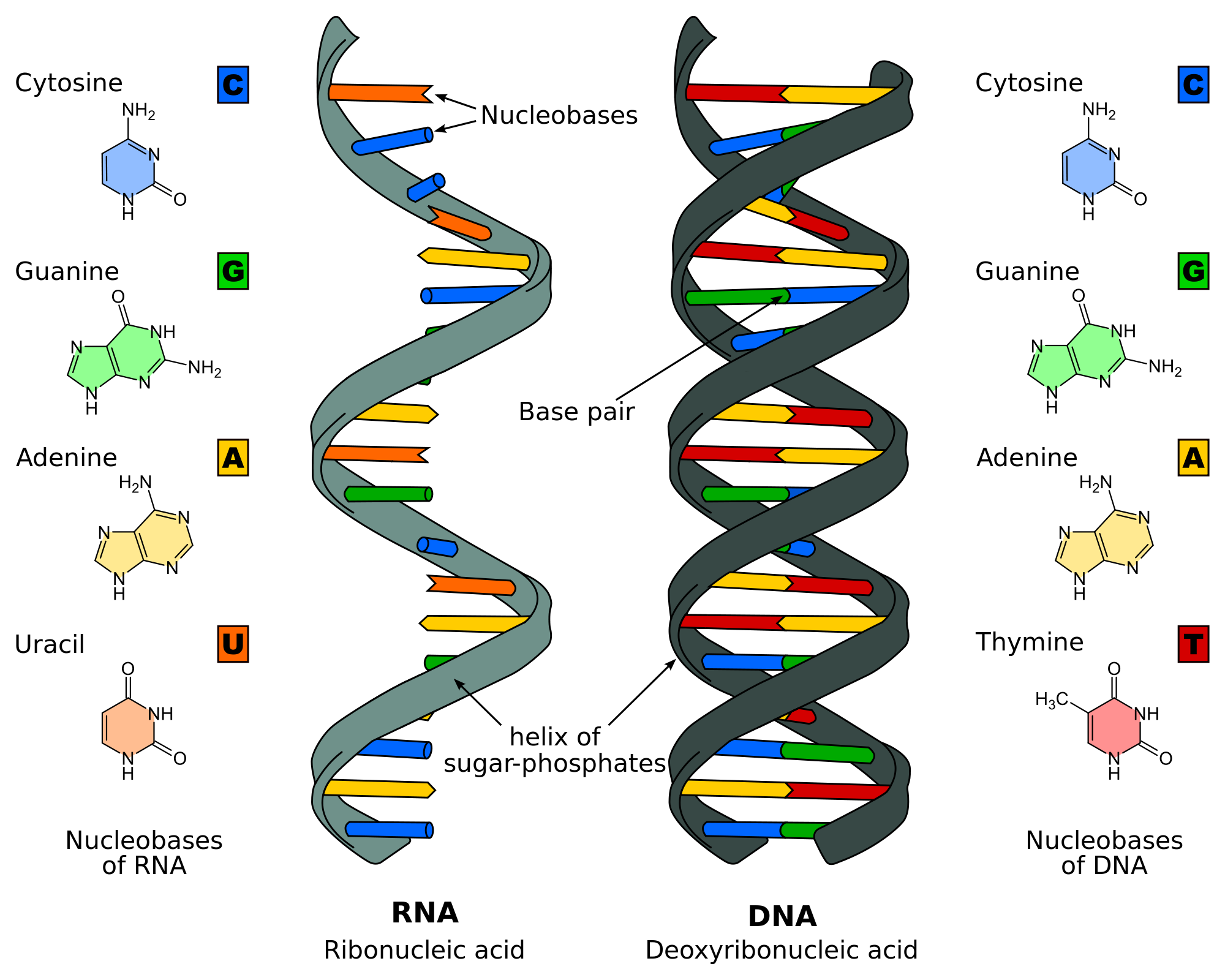
Nucleic acids are chains of nucleotides, which are composed of three parts: a backbone consisting of a pentose sugar of either ribose or deoxyribose, linked by phosphate groups; and one of four nucleobases. An analogue may have any of these altered. Typically the analogue nucleobases confer, among other things, different base pairing and base stacking properties. Examples include universal bases, which can pair with all four canonical bases, and phosphate-sugar backbone analogues such as PNA, which affect the properties of the chain (PNA can even form a triple helix).
Nucleic acid analogues may have backbone substitutions to the sugar or phosphate components, or to both.
The polyelectrolyte theory of the gene proposes that a genetic molecule require a charged backbone to function.
Ribose's 2' hydroxy group reacts with the phosphate linked 3' hydroxy group, making RNA too unstable to be used or synthesized reliably. To overcome this, a ribose analogue can be used. The most common RNA analogues are 2'-O-methyl-substituted RNA, locked nucleic acid (LNA) or bridged nucleic acid (BNA), and peptide nucleic acid (PNA), as well as glycol nucleic acids (GNA), threose nucleic acids (TNA), and hexitol nucleic acids (HNA).
Although these oligonucleotides have a different backbone sugar—or, in the case of PNA, an amino acid residue in place of the ribose phosphate—they still bind to RNA or DNA according to Watson and Crick pairing while being immune to nuclease activity. They cannot be synthesized enzymatically and can only be obtained synthetically using the phosphoramidite strategy or, for PNA, other methods of peptide synthesis.[citation needed]
Dideoxynucleotides are used in sequencing. These nucleoside triphosphates possess a non-canonical sugar, dideoxyribose, which lacks the 3' hydroxyl group normally present in DNA and therefore cannot bond with the next base. The lack of the 3' hydroxyl group terminates the chain reaction as the DNA polymerases mistake it for a regular deoxyribonucleotide.
Another chain-terminating analogue that lacks a 3' hydroxyl and mimics adenosine is called cordycepin. Cordycepin is an anticancer drug that targets RNA replication. Another analogue in sequencing is a nucleobase analogue, 7-deaza-GTP and is used to sequence CG rich regions, instead 7-deaza-ATP is called tubercidin, an antibiotic.[citation needed]
Hub AI
Nucleic acid analogue AI simulator
(@Nucleic acid analogue_simulator)
Nucleic acid analogue
Nucleic acid analogues are compounds which are structurally analogous to naturally occurring RNA and DNA, through substitutions of any of its sugar, phosphate, and nucleobase components. They are used in medicine and in molecular biology research.
Nucleic acids are chains of nucleotides, which are composed of three parts: a backbone consisting of a pentose sugar of either ribose or deoxyribose, linked by phosphate groups; and one of four nucleobases. An analogue may have any of these altered. Typically the analogue nucleobases confer, among other things, different base pairing and base stacking properties. Examples include universal bases, which can pair with all four canonical bases, and phosphate-sugar backbone analogues such as PNA, which affect the properties of the chain (PNA can even form a triple helix).
Nucleic acid analogues may have backbone substitutions to the sugar or phosphate components, or to both.
The polyelectrolyte theory of the gene proposes that a genetic molecule require a charged backbone to function.
Ribose's 2' hydroxy group reacts with the phosphate linked 3' hydroxy group, making RNA too unstable to be used or synthesized reliably. To overcome this, a ribose analogue can be used. The most common RNA analogues are 2'-O-methyl-substituted RNA, locked nucleic acid (LNA) or bridged nucleic acid (BNA), and peptide nucleic acid (PNA), as well as glycol nucleic acids (GNA), threose nucleic acids (TNA), and hexitol nucleic acids (HNA).
Although these oligonucleotides have a different backbone sugar—or, in the case of PNA, an amino acid residue in place of the ribose phosphate—they still bind to RNA or DNA according to Watson and Crick pairing while being immune to nuclease activity. They cannot be synthesized enzymatically and can only be obtained synthetically using the phosphoramidite strategy or, for PNA, other methods of peptide synthesis.[citation needed]
Dideoxynucleotides are used in sequencing. These nucleoside triphosphates possess a non-canonical sugar, dideoxyribose, which lacks the 3' hydroxyl group normally present in DNA and therefore cannot bond with the next base. The lack of the 3' hydroxyl group terminates the chain reaction as the DNA polymerases mistake it for a regular deoxyribonucleotide.
Another chain-terminating analogue that lacks a 3' hydroxyl and mimics adenosine is called cordycepin. Cordycepin is an anticancer drug that targets RNA replication. Another analogue in sequencing is a nucleobase analogue, 7-deaza-GTP and is used to sequence CG rich regions, instead 7-deaza-ATP is called tubercidin, an antibiotic.[citation needed]