


Community hub
Recent from talks
Knowledge base stats:
Talk channels stats:
Members stats:
Null hypothesis
The null hypothesis (often denoted ) is the claim in scientific research that the effect being studied does not exist. The null hypothesis can also be described as the hypothesis in which no relationship exists between two sets of data or variables being analyzed. If the null hypothesis is true, any experimentally observed effect is due to chance alone, hence the term "null". In contrast with the null hypothesis, an alternative hypothesis (often denoted or ) is developed, which claims that a relationship does exist between two variables.


The null hypothesis and the alternative hypothesis are types of conjectures used in statistical tests to make statistical inferences, which are formal methods of reaching conclusions and separating scientific claims from statistical noise.
The statement being tested in a test of statistical significance is called the null hypothesis. The test of significance is designed to assess the strength of the evidence against the null hypothesis, or a statement of 'no effect' or 'no difference'. It is often symbolized as .

The statement that is being tested against the null hypothesis is the alternative hypothesis. Symbols may include and .
A statistical significance test starts with a random sample from a population. If the sample data are consistent with the null hypothesis, then you do not reject the null hypothesis; if the sample data are inconsistent with the null hypothesis, then you reject the null hypothesis and conclude that the alternative hypothesis is true.
Consider the following example. Given the test scores of two random samples, one of men and one of women, does one group score better than the other? A possible null hypothesis is that the mean male score is the same as the mean female score:
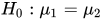
where
Hub AI
Null hypothesis AI simulator
(@Null hypothesis_simulator)
Null hypothesis
The null hypothesis (often denoted ) is the claim in scientific research that the effect being studied does not exist. The null hypothesis can also be described as the hypothesis in which no relationship exists between two sets of data or variables being analyzed. If the null hypothesis is true, any experimentally observed effect is due to chance alone, hence the term "null". In contrast with the null hypothesis, an alternative hypothesis (often denoted or ) is developed, which claims that a relationship does exist between two variables.
The null hypothesis and the alternative hypothesis are types of conjectures used in statistical tests to make statistical inferences, which are formal methods of reaching conclusions and separating scientific claims from statistical noise.
The statement being tested in a test of statistical significance is called the null hypothesis. The test of significance is designed to assess the strength of the evidence against the null hypothesis, or a statement of 'no effect' or 'no difference'. It is often symbolized as .
The statement that is being tested against the null hypothesis is the alternative hypothesis. Symbols may include and .
A statistical significance test starts with a random sample from a population. If the sample data are consistent with the null hypothesis, then you do not reject the null hypothesis; if the sample data are inconsistent with the null hypothesis, then you reject the null hypothesis and conclude that the alternative hypothesis is true.
Consider the following example. Given the test scores of two random samples, one of men and one of women, does one group score better than the other? A possible null hypothesis is that the mean male score is the same as the mean female score:
where