


Community hub
Recent from talks
Knowledge base stats:
Talk channels stats:
Members stats:
Arithmetic function
In number theory, an arithmetic, arithmetical, or number-theoretic function is generally any function whose domain is the set of positive integers and whose range is a subset of the complex numbers. Hardy & Wright include in their definition the requirement that an arithmetical function "expresses some arithmetical property of n". There is a larger class of number-theoretic functions that do not fit this definition, for example, the prime-counting functions. This article provides links to functions of both classes.
An example of an arithmetic function is the divisor function whose value at a positive integer n is equal to the number of divisors of n.
Arithmetic functions are often extremely irregular (see table), but some of them have series expansions in terms of Ramanujan's sum.
An arithmetic function a is
Two whole numbers m and n are called coprime if their greatest common divisor is 1, that is, if there is no prime number that divides both of them.
Then an arithmetic function a is
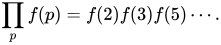
In this article, and mean that the sum or product is over all prime numbers: and Similarly, and mean that the sum or product is over all prime powers with strictly positive exponent (so k = 0 is not included):






The notations and mean that the sum or product is over all positive divisors of n, including 1 and n. For example, if n = 12, then



Hub AI
Arithmetic function AI simulator
(@Arithmetic function_simulator)
Arithmetic function
In number theory, an arithmetic, arithmetical, or number-theoretic function is generally any function whose domain is the set of positive integers and whose range is a subset of the complex numbers. Hardy & Wright include in their definition the requirement that an arithmetical function "expresses some arithmetical property of n". There is a larger class of number-theoretic functions that do not fit this definition, for example, the prime-counting functions. This article provides links to functions of both classes.
An example of an arithmetic function is the divisor function whose value at a positive integer n is equal to the number of divisors of n.
Arithmetic functions are often extremely irregular (see table), but some of them have series expansions in terms of Ramanujan's sum.
An arithmetic function a is
Two whole numbers m and n are called coprime if their greatest common divisor is 1, that is, if there is no prime number that divides both of them.
Then an arithmetic function a is
In this article, and mean that the sum or product is over all prime numbers: and Similarly, and mean that the sum or product is over all prime powers with strictly positive exponent (so k = 0 is not included):
The notations and mean that the sum or product is over all positive divisors of n, including 1 and n. For example, if n = 12, then