Recent from talks
Nothing was collected or created yet.
Arithmetic function
View on WikipediaIn number theory, an arithmetic, arithmetical, or number-theoretic function[1][2] is generally any function whose domain is the set of positive integers and whose range is a subset of the complex numbers.[3][4][5] Hardy & Wright include in their definition the requirement that an arithmetical function "expresses some arithmetical property of n".[6] There is a larger class of number-theoretic functions that do not fit this definition, for example, the prime-counting functions. This article provides links to functions of both classes.
An example of an arithmetic function is the divisor function whose value at a positive integer n is equal to the number of divisors of n.
Arithmetic functions are often extremely irregular (see table), but some of them have series expansions in terms of Ramanujan's sum.
Multiplicative and additive functions
[edit]An arithmetic function a is
- completely additive if a(mn) = a(m) + a(n) for all natural numbers m and n;
- completely multiplicative if a(1) = 1 and a(mn) = a(m)a(n) for all natural numbers m and n;
Two whole numbers m and n are called coprime if their greatest common divisor is 1, that is, if there is no prime number that divides both of them.
Then an arithmetic function a is
- additive if a(mn) = a(m) + a(n) for all coprime natural numbers m and n;
- multiplicative if a(1) = 1 and a(mn) = a(m)a(n) for all coprime natural numbers m and n.
Notation
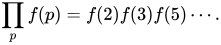
[edit]In this article, and mean that the sum or product is over all prime numbers: and Similarly, and mean that the sum or product is over all prime powers with strictly positive exponent (so k = 0 is not included):
The notations and mean that the sum or product is over all positive divisors of n, including 1 and n. For example, if n = 12, then
The notations can be combined: and mean that the sum or product is over all prime divisors of n. For example, if n = 18, then and similarly and mean that the sum or product is over all prime powers dividing n. For example, if n = 24, then
Ω(n), ω(n), νp(n) – prime power decomposition
[edit]The fundamental theorem of arithmetic states that any positive integer n can be represented uniquely as a product of powers of primes: where p1 < p2 < ... < pk are primes and the aj are positive integers. (1 is given by the empty product.)
It is often convenient to write this as an infinite product over all the primes, where all but a finite number have a zero exponent. Define the p-adic valuation νp(n) to be the exponent of the highest power of the prime p that divides n. That is, if p is one of the pi then νp(n) = ai, otherwise it is zero. Then
In terms of the above the prime omega functions ω and Ω are defined by
To avoid repetition, formulas for the functions listed in this article are, whenever possible, given in terms of n and the corresponding pi, ai, ω, and Ω.
Multiplicative functions
[edit]σk(n), τ(n), d(n) – divisor sums
[edit]σk(n) is the sum of the kth powers of the positive divisors of n, including 1 and n, where k is a complex number.
σ1(n), the sum of the (positive) divisors of n, is usually denoted by σ(n).
Since a positive number to the zero power is one, σ0(n) is therefore the number of (positive) divisors of n; it is usually denoted by d(n) or τ(n) (for the German Teiler = divisors).
Setting k = 0 in the second product gives
φ(n) – Euler totient function
[edit]φ(n), the Euler totient function, is the number of positive integers not greater than n that are coprime to n.
Jk(n) – Jordan totient function
[edit]Jk(n), the Jordan totient function, is the number of k-tuples of positive integers all less than or equal to n that form a coprime (k + 1)-tuple together with n. It is a generalization of Euler's totient, φ(n) = J1(n).
μ(n) – Möbius function
[edit]μ(n), the Möbius function, is important because of the Möbius inversion formula. See § Dirichlet convolution, below.
This implies that μ(1) = 1. (Because Ω(1) = ω(1) = 0.)
τ(n) – Ramanujan tau function
[edit]τ(n), the Ramanujan tau function, is defined by its generating function identity:
Although it is hard to say exactly what "arithmetical property of n" it "expresses",[7] (τ(n) is (2π)−12 times the nth Fourier coefficient in the q-expansion of the modular discriminant function)[8] it is included among the arithmetical functions because it is multiplicative and it occurs in identities involving certain σk(n) and rk(n) functions (because these are also coefficients in the expansion of modular forms).
cq(n) – Ramanujan's sum
[edit]cq(n), Ramanujan's sum, is the sum of the nth powers of the primitive qth roots of unity:
Even though it is defined as a sum of complex numbers (irrational for most values of q), it is an integer. For a fixed value of n it is multiplicative in q:
- If q and r are coprime, then
ψ(n) – Dedekind psi function
[edit]The Dedekind psi function, used in the theory of modular functions, is defined by the formula
Completely multiplicative functions
[edit]λ(n) – Liouville function
[edit]λ(n), the Liouville function, is defined by
χ(n) – characters
[edit]All Dirichlet characters χ(n) are completely multiplicative. Two characters have special notations:
The principal character (mod n) is denoted by χ0(a) (or χ1(a)). It is defined as
The quadratic character (mod n) is denoted by the Jacobi symbol for odd n (it is not defined for even n):
In this formula is the Legendre symbol, defined for all integers a and all odd primes p by
Following the normal convention for the empty product,
Additive functions
[edit]ω(n) – distinct prime divisors
[edit]ω(n), defined above as the number of distinct primes dividing n, is additive (see Prime omega function).
Completely additive functions
[edit]Ω(n) – prime divisors
[edit]Ω(n), defined above as the number of prime factors of n counted with multiplicities, is completely additive (see Prime omega function).
νp(n) – p-adic valuation of an integer n
[edit]For a fixed prime p, νp(n), defined above as the exponent of the largest power of p dividing n, is completely additive.
Logarithmic derivative
[edit], where is the arithmetic derivative.
Neither multiplicative nor additive
[edit]π(x), Π(x), ϑ(x), ψ(x) – prime-counting functions
[edit]These important functions (which are not arithmetic functions) are defined for non-negative real arguments, and are used in the various statements and proofs of the prime number theorem. They are summation functions (see the main section just below) of arithmetic functions which are neither multiplicative nor additive.
π(x), the prime-counting function, is the number of primes not exceeding x. It is the summation function of the characteristic function of the prime numbers.
A related function counts prime powers with weight 1 for primes, 1/2 for their squares, 1/3 for cubes, etc. It is the summation function of the arithmetic function which takes the value 1/k on integers which are the kth power of some prime number, and the value 0 on other integers.
ϑ(x) and ψ(x), the Chebyshev functions, are defined as sums of the natural logarithms of the primes not exceeding x.
The second Chebyshev function ψ(x) is the summation function of the von Mangoldt function just below.
Λ(n) – von Mangoldt function
[edit]Λ(n), the von Mangoldt function, is 0 unless the argument n is a prime power pk, in which case it is the natural logarithm of the prime p:
p(n) – partition function
[edit]p(n), the partition function, is the number of ways of representing n as a sum of positive integers, where two representations with the same summands in a different order are not counted as being different:
λ(n) – Carmichael function
[edit]λ(n), the Carmichael function, is the smallest positive number such that for all a coprime to n. Equivalently, it is the least common multiple of the orders of the elements of the multiplicative group of integers modulo n.
For powers of odd primes and for 2 and 4, λ(n) is equal to the Euler totient function of n; for powers of 2 greater than 4 it is equal to one half of the Euler totient function of n: and for general n it is the least common multiple of λ of each of the prime power factors of n:
h(n) – class number
[edit]h(n), the class number function, is the order of the ideal class group of an algebraic extension of the rationals with discriminant n. The notation is ambiguous, as there are in general many extensions with the same discriminant. See quadratic field and cyclotomic field for classical examples.
rk(n) – sum of k squares
[edit]rk(n) is the number of ways n can be represented as the sum of k squares, where representations that differ only in the order of the summands or in the signs of the square roots are counted as different.
D(n) – Arithmetic derivative
[edit]Using the Heaviside notation for the derivative, the arithmetic derivative D(n) is a function such that
- if n prime, and
- (the product rule)
Summation functions
[edit]Given an arithmetic function a(n), its summation function A(x) is defined by A can be regarded as a function of a real variable. Given a positive integer m, A is constant along open intervals m < x < m + 1, and has a jump discontinuity at each integer for which a(m) ≠ 0.
Since such functions are often represented by series and integrals, to achieve pointwise convergence it is usual to define the value at the discontinuities as the average of the values to the left and right:
Individual values of arithmetic functions may fluctuate wildly – as in most of the above examples. Summation functions "smooth out" these fluctuations. In some cases it may be possible to find asymptotic behaviour for the summation function for large x.
A classical example of this phenomenon[9] is given by the divisor summatory function, the summation function of d(n), the number of divisors of n:
An average order of an arithmetic function is some simpler or better-understood function which has the same summation function asymptotically, and hence takes the same values "on average". We say that g is an average order of f if
as x tends to infinity. The example above shows that d(n) has the average order log(n).[10]
Dirichlet convolution
[edit]Given an arithmetic function a(n), let Fa(s), for complex s, be the function defined by the corresponding Dirichlet series (where it converges):[11] Fa(s) is called a generating function of a(n). The simplest such series, corresponding to the constant function a(n) = 1 for all n, is ζ(s) the Riemann zeta function.
The generating function of the Möbius function is the inverse of the zeta function:
Consider two arithmetic functions a and b and their respective generating functions Fa(s) and Fb(s). The product Fa(s)Fb(s) can be computed as follows:
It is a straightforward exercise to show that if c(n) is defined by then
This function c is called the Dirichlet convolution of a and b, and is denoted by .
A particularly important case is convolution with the constant function a(n) = 1 for all n, corresponding to multiplying the generating function by the zeta function:
Multiplying by the inverse of the zeta function gives the Möbius inversion formula:
If f is multiplicative, then so is g. If f is completely multiplicative, then g is multiplicative, but may or may not be completely multiplicative.
Relations among the functions
[edit]There are a great many formulas connecting arithmetical functions with each other and with the functions of analysis, especially powers, roots, and the exponential and log functions. The page divisor sum identities contains many more generalized and related examples of identities involving arithmetic functions.
Here are a few examples:
Dirichlet convolutions
[edit]- where λ is the Liouville function.[12]
- [13]
- Möbius inversion
- [14]
- Möbius inversion
- [15]
- [16][17]
- [18]
- Möbius inversion
-
- Möbius inversion
-
- Möbius inversion
- where λ is the Liouville function.
- [19]
- Möbius inversion
Sums of squares
[edit]For all (Lagrange's four-square theorem).
where the Kronecker symbol has the values
There is a formula for r3 in the section on class numbers below. where ν = ν2(n). [21][22][23] where [24]
Define the function σk*(n) as[25]
That is, if n is odd, σk*(n) is the sum of the kth powers of the divisors of n, that is, σk(n), and if n is even it is the sum of the kth powers of the even divisors of n minus the sum of the kth powers of the odd divisors of n.
Adopt the convention that Ramanujan's τ(x) = 0 if x is not an integer.
Divisor sum convolutions
[edit]Here "convolution" does not mean "Dirichlet convolution" but instead refers to the formula for the coefficients of the product of two power series:
The sequence is called the convolution or the Cauchy product of the sequences an and bn.
These formulas may be proved analytically (see Eisenstein series) or by elementary methods.[28]
Since σk(n) (for natural number k) and τ(n) are integers, the above formulas can be used to prove congruences[35] for the functions. See Ramanujan tau function for some examples.
Extend the domain of the partition function by setting p(0) = 1.
- [36] This recurrence can be used to compute p(n).
Class number related
[edit]Peter Gustav Lejeune Dirichlet discovered formulas that relate the class number h of quadratic number fields to the Jacobi symbol.[37]
An integer D is called a fundamental discriminant if it is the discriminant of a quadratic number field. This is equivalent to D ≠ 1 and either a) D is squarefree and D ≡ 1 (mod 4) or b) D ≡ 0 (mod 4), D/4 is squarefree, and D/4 ≡ 2 or 3 (mod 4).[38]
Extend the Jacobi symbol to accept even numbers in the "denominator" by defining the Kronecker symbol:
Then if D < −4 is a fundamental discriminant[39][40]
There is also a formula relating r3 and h. Again, let D be a fundamental discriminant, D < −4. Then[41]
Prime-count related
[edit]Let be the nth harmonic number. Then
- is true for every natural number n if and only if the Riemann hypothesis is true. [42]
The Riemann hypothesis is also equivalent to the statement that, for all n > 5040, (where γ is the Euler–Mascheroni constant). This is Robin's theorem.
Menon's identity
[edit]In 1965 P Kesava Menon proved[47]
This has been generalized by a number of mathematicians. For example,
- B. Sury[48]
- N. Rao[49] where a1, a2, ..., as are integers, gcd(a1, a2, ..., as, n) = 1.
- László Fejes Tóth[50] where m1 and m2 are odd, m = lcm(m1, m2).
In fact, if f is any arithmetical function[51][52] where stands for Dirichlet convolution.
Miscellaneous
[edit]Let m and n be distinct, odd, and positive. Then the Jacobi symbol satisfies the law of quadratic reciprocity:
Let D(n) be the arithmetic derivative. Then the logarithmic derivative See Arithmetic derivative for details.
Let λ(n) be Liouville's function. Then
- and
Let λ(n) be Carmichael's function. Then
- Further,
See Multiplicative group of integers modulo n and Primitive root modulo n.
First 100 values of some arithmetic functions
[edit]| n | factorization | φ(n) | ω(n) | Ω(n) | λ(n) | μ(n) | Λ(n) | π(n) | σ0(n) | σ1(n) | σ2(n) | r2(n) | r3(n) | r4(n) |
|---|---|---|---|---|---|---|---|---|---|---|---|---|---|---|
| 1 | 1 | 1 | 0 | 0 | 1 | 1 | 0 | 0 | 1 | 1 | 1 | 4 | 6 | 8 |
| 2 | 2 | 1 | 1 | 1 | −1 | −1 | 0.69 | 1 | 2 | 3 | 5 | 4 | 12 | 24 |
| 3 | 3 | 2 | 1 | 1 | −1 | −1 | 1.10 | 2 | 2 | 4 | 10 | 0 | 8 | 32 |
| 4 | 22 | 2 | 1 | 2 | 1 | 0 | 0.69 | 2 | 3 | 7 | 21 | 4 | 6 | 24 |
| 5 | 5 | 4 | 1 | 1 | −1 | −1 | 1.61 | 3 | 2 | 6 | 26 | 8 | 24 | 48 |
| 6 | 2 · 3 | 2 | 2 | 2 | 1 | 1 | 0 | 3 | 4 | 12 | 50 | 0 | 24 | 96 |
| 7 | 7 | 6 | 1 | 1 | −1 | −1 | 1.95 | 4 | 2 | 8 | 50 | 0 | 0 | 64 |
| 8 | 23 | 4 | 1 | 3 | −1 | 0 | 0.69 | 4 | 4 | 15 | 85 | 4 | 12 | 24 |
| 9 | 32 | 6 | 1 | 2 | 1 | 0 | 1.10 | 4 | 3 | 13 | 91 | 4 | 30 | 104 |
| 10 | 2 · 5 | 4 | 2 | 2 | 1 | 1 | 0 | 4 | 4 | 18 | 130 | 8 | 24 | 144 |
| 11 | 11 | 10 | 1 | 1 | −1 | −1 | 2.40 | 5 | 2 | 12 | 122 | 0 | 24 | 96 |
| 12 | 22 · 3 | 4 | 2 | 3 | −1 | 0 | 0 | 5 | 6 | 28 | 210 | 0 | 8 | 96 |
| 13 | 13 | 12 | 1 | 1 | −1 | −1 | 2.56 | 6 | 2 | 14 | 170 | 8 | 24 | 112 |
| 14 | 2 · 7 | 6 | 2 | 2 | 1 | 1 | 0 | 6 | 4 | 24 | 250 | 0 | 48 | 192 |
| 15 | 3 · 5 | 8 | 2 | 2 | 1 | 1 | 0 | 6 | 4 | 24 | 260 | 0 | 0 | 192 |
| 16 | 24 | 8 | 1 | 4 | 1 | 0 | 0.69 | 6 | 5 | 31 | 341 | 4 | 6 | 24 |
| 17 | 17 | 16 | 1 | 1 | −1 | −1 | 2.83 | 7 | 2 | 18 | 290 | 8 | 48 | 144 |
| 18 | 2 · 32 | 6 | 2 | 3 | −1 | 0 | 0 | 7 | 6 | 39 | 455 | 4 | 36 | 312 |
| 19 | 19 | 18 | 1 | 1 | −1 | −1 | 2.94 | 8 | 2 | 20 | 362 | 0 | 24 | 160 |
| 20 | 22 · 5 | 8 | 2 | 3 | −1 | 0 | 0 | 8 | 6 | 42 | 546 | 8 | 24 | 144 |
| 21 | 3 · 7 | 12 | 2 | 2 | 1 | 1 | 0 | 8 | 4 | 32 | 500 | 0 | 48 | 256 |
| 22 | 2 · 11 | 10 | 2 | 2 | 1 | 1 | 0 | 8 | 4 | 36 | 610 | 0 | 24 | 288 |
| 23 | 23 | 22 | 1 | 1 | −1 | −1 | 3.14 | 9 | 2 | 24 | 530 | 0 | 0 | 192 |
| 24 | 23 · 3 | 8 | 2 | 4 | 1 | 0 | 0 | 9 | 8 | 60 | 850 | 0 | 24 | 96 |
| 25 | 52 | 20 | 1 | 2 | 1 | 0 | 1.61 | 9 | 3 | 31 | 651 | 12 | 30 | 248 |
| 26 | 2 · 13 | 12 | 2 | 2 | 1 | 1 | 0 | 9 | 4 | 42 | 850 | 8 | 72 | 336 |
| 27 | 33 | 18 | 1 | 3 | −1 | 0 | 1.10 | 9 | 4 | 40 | 820 | 0 | 32 | 320 |
| 28 | 22 · 7 | 12 | 2 | 3 | −1 | 0 | 0 | 9 | 6 | 56 | 1050 | 0 | 0 | 192 |
| 29 | 29 | 28 | 1 | 1 | −1 | −1 | 3.37 | 10 | 2 | 30 | 842 | 8 | 72 | 240 |
| 30 | 2 · 3 · 5 | 8 | 3 | 3 | −1 | −1 | 0 | 10 | 8 | 72 | 1300 | 0 | 48 | 576 |
| 31 | 31 | 30 | 1 | 1 | −1 | −1 | 3.43 | 11 | 2 | 32 | 962 | 0 | 0 | 256 |
| 32 | 25 | 16 | 1 | 5 | −1 | 0 | 0.69 | 11 | 6 | 63 | 1365 | 4 | 12 | 24 |
| 33 | 3 · 11 | 20 | 2 | 2 | 1 | 1 | 0 | 11 | 4 | 48 | 1220 | 0 | 48 | 384 |
| 34 | 2 · 17 | 16 | 2 | 2 | 1 | 1 | 0 | 11 | 4 | 54 | 1450 | 8 | 48 | 432 |
| 35 | 5 · 7 | 24 | 2 | 2 | 1 | 1 | 0 | 11 | 4 | 48 | 1300 | 0 | 48 | 384 |
| 36 | 22 · 32 | 12 | 2 | 4 | 1 | 0 | 0 | 11 | 9 | 91 | 1911 | 4 | 30 | 312 |
| 37 | 37 | 36 | 1 | 1 | −1 | −1 | 3.61 | 12 | 2 | 38 | 1370 | 8 | 24 | 304 |
| 38 | 2 · 19 | 18 | 2 | 2 | 1 | 1 | 0 | 12 | 4 | 60 | 1810 | 0 | 72 | 480 |
| 39 | 3 · 13 | 24 | 2 | 2 | 1 | 1 | 0 | 12 | 4 | 56 | 1700 | 0 | 0 | 448 |
| 40 | 23 · 5 | 16 | 2 | 4 | 1 | 0 | 0 | 12 | 8 | 90 | 2210 | 8 | 24 | 144 |
| 41 | 41 | 40 | 1 | 1 | −1 | −1 | 3.71 | 13 | 2 | 42 | 1682 | 8 | 96 | 336 |
| 42 | 2 · 3 · 7 | 12 | 3 | 3 | −1 | −1 | 0 | 13 | 8 | 96 | 2500 | 0 | 48 | 768 |
| 43 | 43 | 42 | 1 | 1 | −1 | −1 | 3.76 | 14 | 2 | 44 | 1850 | 0 | 24 | 352 |
| 44 | 22 · 11 | 20 | 2 | 3 | −1 | 0 | 0 | 14 | 6 | 84 | 2562 | 0 | 24 | 288 |
| 45 | 32 · 5 | 24 | 2 | 3 | −1 | 0 | 0 | 14 | 6 | 78 | 2366 | 8 | 72 | 624 |
| 46 | 2 · 23 | 22 | 2 | 2 | 1 | 1 | 0 | 14 | 4 | 72 | 2650 | 0 | 48 | 576 |
| 47 | 47 | 46 | 1 | 1 | −1 | −1 | 3.85 | 15 | 2 | 48 | 2210 | 0 | 0 | 384 |
| 48 | 24 · 3 | 16 | 2 | 5 | −1 | 0 | 0 | 15 | 10 | 124 | 3410 | 0 | 8 | 96 |
| 49 | 72 | 42 | 1 | 2 | 1 | 0 | 1.95 | 15 | 3 | 57 | 2451 | 4 | 54 | 456 |
| 50 | 2 · 52 | 20 | 2 | 3 | −1 | 0 | 0 | 15 | 6 | 93 | 3255 | 12 | 84 | 744 |
| 51 | 3 · 17 | 32 | 2 | 2 | 1 | 1 | 0 | 15 | 4 | 72 | 2900 | 0 | 48 | 576 |
| 52 | 22 · 13 | 24 | 2 | 3 | −1 | 0 | 0 | 15 | 6 | 98 | 3570 | 8 | 24 | 336 |
| 53 | 53 | 52 | 1 | 1 | −1 | −1 | 3.97 | 16 | 2 | 54 | 2810 | 8 | 72 | 432 |
| 54 | 2 · 33 | 18 | 2 | 4 | 1 | 0 | 0 | 16 | 8 | 120 | 4100 | 0 | 96 | 960 |
| 55 | 5 · 11 | 40 | 2 | 2 | 1 | 1 | 0 | 16 | 4 | 72 | 3172 | 0 | 0 | 576 |
| 56 | 23 · 7 | 24 | 2 | 4 | 1 | 0 | 0 | 16 | 8 | 120 | 4250 | 0 | 48 | 192 |
| 57 | 3 · 19 | 36 | 2 | 2 | 1 | 1 | 0 | 16 | 4 | 80 | 3620 | 0 | 48 | 640 |
| 58 | 2 · 29 | 28 | 2 | 2 | 1 | 1 | 0 | 16 | 4 | 90 | 4210 | 8 | 24 | 720 |
| 59 | 59 | 58 | 1 | 1 | −1 | −1 | 4.08 | 17 | 2 | 60 | 3482 | 0 | 72 | 480 |
| 60 | 22 · 3 · 5 | 16 | 3 | 4 | 1 | 0 | 0 | 17 | 12 | 168 | 5460 | 0 | 0 | 576 |
| 61 | 61 | 60 | 1 | 1 | −1 | −1 | 4.11 | 18 | 2 | 62 | 3722 | 8 | 72 | 496 |
| 62 | 2 · 31 | 30 | 2 | 2 | 1 | 1 | 0 | 18 | 4 | 96 | 4810 | 0 | 96 | 768 |
| 63 | 32 · 7 | 36 | 2 | 3 | −1 | 0 | 0 | 18 | 6 | 104 | 4550 | 0 | 0 | 832 |
| 64 | 26 | 32 | 1 | 6 | 1 | 0 | 0.69 | 18 | 7 | 127 | 5461 | 4 | 6 | 24 |
| 65 | 5 · 13 | 48 | 2 | 2 | 1 | 1 | 0 | 18 | 4 | 84 | 4420 | 16 | 96 | 672 |
| 66 | 2 · 3 · 11 | 20 | 3 | 3 | −1 | −1 | 0 | 18 | 8 | 144 | 6100 | 0 | 96 | 1152 |
| 67 | 67 | 66 | 1 | 1 | −1 | −1 | 4.20 | 19 | 2 | 68 | 4490 | 0 | 24 | 544 |
| 68 | 22 · 17 | 32 | 2 | 3 | −1 | 0 | 0 | 19 | 6 | 126 | 6090 | 8 | 48 | 432 |
| 69 | 3 · 23 | 44 | 2 | 2 | 1 | 1 | 0 | 19 | 4 | 96 | 5300 | 0 | 96 | 768 |
| 70 | 2 · 5 · 7 | 24 | 3 | 3 | −1 | −1 | 0 | 19 | 8 | 144 | 6500 | 0 | 48 | 1152 |
| 71 | 71 | 70 | 1 | 1 | −1 | −1 | 4.26 | 20 | 2 | 72 | 5042 | 0 | 0 | 576 |
| 72 | 23 · 32 | 24 | 2 | 5 | −1 | 0 | 0 | 20 | 12 | 195 | 7735 | 4 | 36 | 312 |
| 73 | 73 | 72 | 1 | 1 | −1 | −1 | 4.29 | 21 | 2 | 74 | 5330 | 8 | 48 | 592 |
| 74 | 2 · 37 | 36 | 2 | 2 | 1 | 1 | 0 | 21 | 4 | 114 | 6850 | 8 | 120 | 912 |
| 75 | 3 · 52 | 40 | 2 | 3 | −1 | 0 | 0 | 21 | 6 | 124 | 6510 | 0 | 56 | 992 |
| 76 | 22 · 19 | 36 | 2 | 3 | −1 | 0 | 0 | 21 | 6 | 140 | 7602 | 0 | 24 | 480 |
| 77 | 7 · 11 | 60 | 2 | 2 | 1 | 1 | 0 | 21 | 4 | 96 | 6100 | 0 | 96 | 768 |
| 78 | 2 · 3 · 13 | 24 | 3 | 3 | −1 | −1 | 0 | 21 | 8 | 168 | 8500 | 0 | 48 | 1344 |
| 79 | 79 | 78 | 1 | 1 | −1 | −1 | 4.37 | 22 | 2 | 80 | 6242 | 0 | 0 | 640 |
| 80 | 24 · 5 | 32 | 2 | 5 | −1 | 0 | 0 | 22 | 10 | 186 | 8866 | 8 | 24 | 144 |
| 81 | 34 | 54 | 1 | 4 | 1 | 0 | 1.10 | 22 | 5 | 121 | 7381 | 4 | 102 | 968 |
| 82 | 2 · 41 | 40 | 2 | 2 | 1 | 1 | 0 | 22 | 4 | 126 | 8410 | 8 | 48 | 1008 |
| 83 | 83 | 82 | 1 | 1 | −1 | −1 | 4.42 | 23 | 2 | 84 | 6890 | 0 | 72 | 672 |
| 84 | 22 · 3 · 7 | 24 | 3 | 4 | 1 | 0 | 0 | 23 | 12 | 224 | 10500 | 0 | 48 | 768 |
| 85 | 5 · 17 | 64 | 2 | 2 | 1 | 1 | 0 | 23 | 4 | 108 | 7540 | 16 | 48 | 864 |
| 86 | 2 · 43 | 42 | 2 | 2 | 1 | 1 | 0 | 23 | 4 | 132 | 9250 | 0 | 120 | 1056 |
| 87 | 3 · 29 | 56 | 2 | 2 | 1 | 1 | 0 | 23 | 4 | 120 | 8420 | 0 | 0 | 960 |
| 88 | 23 · 11 | 40 | 2 | 4 | 1 | 0 | 0 | 23 | 8 | 180 | 10370 | 0 | 24 | 288 |
| 89 | 89 | 88 | 1 | 1 | −1 | −1 | 4.49 | 24 | 2 | 90 | 7922 | 8 | 144 | 720 |
| 90 | 2 · 32 · 5 | 24 | 3 | 4 | 1 | 0 | 0 | 24 | 12 | 234 | 11830 | 8 | 120 | 1872 |
| 91 | 7 · 13 | 72 | 2 | 2 | 1 | 1 | 0 | 24 | 4 | 112 | 8500 | 0 | 48 | 896 |
| 92 | 22 · 23 | 44 | 2 | 3 | −1 | 0 | 0 | 24 | 6 | 168 | 11130 | 0 | 0 | 576 |
| 93 | 3 · 31 | 60 | 2 | 2 | 1 | 1 | 0 | 24 | 4 | 128 | 9620 | 0 | 48 | 1024 |
| 94 | 2 · 47 | 46 | 2 | 2 | 1 | 1 | 0 | 24 | 4 | 144 | 11050 | 0 | 96 | 1152 |
| 95 | 5 · 19 | 72 | 2 | 2 | 1 | 1 | 0 | 24 | 4 | 120 | 9412 | 0 | 0 | 960 |
| 96 | 25 · 3 | 32 | 2 | 6 | 1 | 0 | 0 | 24 | 12 | 252 | 13650 | 0 | 24 | 96 |
| 97 | 97 | 96 | 1 | 1 | −1 | −1 | 4.57 | 25 | 2 | 98 | 9410 | 8 | 48 | 784 |
| 98 | 2 · 72 | 42 | 2 | 3 | −1 | 0 | 0 | 25 | 6 | 171 | 12255 | 4 | 108 | 1368 |
| 99 | 32 · 11 | 60 | 2 | 3 | −1 | 0 | 0 | 25 | 6 | 156 | 11102 | 0 | 72 | 1248 |
| 100 | 22 · 52 | 40 | 2 | 4 | 1 | 0 | 0 | 25 | 9 | 217 | 13671 | 12 | 30 | 744 |
| n | factorization | φ(n) | ω(n) | Ω(n) | 𝜆(n) | 𝜇(n) | Λ(n) | π(n) | σ0(n) | σ1(n) | σ2(n) | r2(n) | r3(n) | r4(n) |
Notes
[edit]- ^ Long (1972, p. 151)
- ^ Pettofrezzo & Byrkit (1970, p. 58)
- ^ Niven & Zuckerman, 4.2.
- ^ Nagell, I.9.
- ^ Bateman & Diamond, 2.1.
- ^ Hardy & Wright, intro. to Ch. XVI
- ^ Hardy, Ramanujan, § 10.2
- ^ Apostol, Modular Functions ..., § 1.15, Ch. 4, and ch. 6
- ^ Hardy & Wright, §§ 18.1–18.2
- ^ Gérald Tenenbaum (1995). Introduction to Analytic and Probabilistic Number Theory. Cambridge studies in advanced mathematics. Vol. 46. Cambridge University Press. pp. 36–55. ISBN 0-521-41261-7.
- ^ Hardy & Wright, § 17.6, show how the theory of generating functions can be constructed in a purely formal manner with no attention paid to convergence.
- ^ Hardy & Wright, Thm. 263
- ^ Hardy & Wright, Thm. 63
- ^ see references at Jordan's totient function
- ^ Holden et al. in external links The formula is Gegenbauer's
- ^ Hardy & Wright, Thm. 288–290
- ^ Dineva in external links, prop. 4
- ^ Hardy & Wright, Thm. 264
- ^ Hardy & Wright, Thm. 296
- ^ Hardy & Wright, Thm. 278
- ^ Hardy & Wright, Thm. 386
- ^ Hardy, Ramanujan, eqs 9.1.2, 9.1.3
- ^ Koblitz, Ex. III.5.2
- ^ a b Hardy & Wright, § 20.13
- ^ Hardy, Ramanujan, § 9.7
- ^ Hardy, Ramanujan, § 9.13
- ^ Hardy, Ramanujan, § 9.17
- ^ Williams, ch. 13; Huard, et al. (external links).
- ^ a b Ramanujan, On Certain Arithmetical Functions, Table IV; Papers, p. 146
- ^ a b Koblitz, ex. III.2.8
- ^ Koblitz, ex. III.2.3
- ^ Koblitz, ex. III.2.2
- ^ Koblitz, ex. III.2.4
- ^ Apostol, Modular Functions ..., Ex. 6.10
- ^ Apostol, Modular Functions..., Ch. 6 Ex. 10
- ^ G.H. Hardy, S. Ramannujan, Asymptotic Formulæ in Combinatory Analysis, § 1.3; in Ramannujan, Papers p. 279
- ^ Landau, p. 168, credits Gauss as well as Dirichlet
- ^ Cohen, Def. 5.1.2
- ^ Cohen, Corr. 5.3.13
- ^ see Edwards, § 9.5 exercises for more complicated formulas.
- ^ Cohen, Prop 5.3.10
- ^ See Divisor function.
- ^ Hardy & Wright, eq. 22.1.2
- ^ See prime-counting functions.
- ^ Hardy & Wright, eq. 22.1.1
- ^ Hardy & Wright, eq. 22.1.3
- ^ László Tóth, Menon's Identity and Arithmetical Sums ..., eq. 1
- ^ Tóth, eq. 5
- ^ Tóth, eq. 3
- ^ Tóth, eq. 35
- ^ Tóth, eq. 2
- ^ Tóth states that Menon proved this for multiplicative f in 1965 and V. Sita Ramaiah for general f.
- ^ Hardy Ramanujan, eq. 3.10.3
- ^ Hardy & Wright, § 22.13
- ^ Hardy & Wright, Thm. 329
- ^ Hardy & Wright, Thms. 271, 272
- ^ Hardy & Wright, eq. 16.3.1
- ^ Ramanujan, Some Formulæ in the Analytic Theory of Numbers, eq. (C); Papers p. 133. A footnote says that Hardy told Ramanujan it also appears in an 1857 paper by Liouville.
- ^ Ramanujan, Some Formulæ in the Analytic Theory of Numbers, eq. (F); Papers p. 134
- ^ Apostol, Modular Functions ..., ch. 6 eq. 4
- ^ Apostol, Modular Functions ..., ch. 6 eq. 3
References
[edit]- Tom M. Apostol (1976), Introduction to Analytic Number Theory, Springer Undergraduate Texts in Mathematics, ISBN 0-387-90163-9
- Apostol, Tom M. (1989), Modular Functions and Dirichlet Series in Number Theory (2nd Edition), New York: Springer, ISBN 0-387-97127-0
- Bateman, Paul T.; Diamond, Harold G. (2004), Analytic number theory, an introduction, World Scientific, ISBN 978-981-238-938-1
- Cohen, Henri (1993), A Course in Computational Algebraic Number Theory, Berlin: Springer, ISBN 3-540-55640-0
- Edwards, Harold (1977). Fermat's Last Theorem. New York: Springer. ISBN 0-387-90230-9.
- Hardy, G. H. (1999), Ramanujan: Twelve Lectures on Subjects Suggested by his Life and work, Providence RI: AMS / Chelsea, hdl:10115/1436, ISBN 978-0-8218-2023-0
- Hardy, G. H.; Wright, E. M. (1979) [1938]. An Introduction to the Theory of Numbers (5th ed.). Oxford: Clarendon Press. ISBN 0-19-853171-0. MR 0568909. Zbl 0423.10001.
- Jameson, G. J. O. (2003), The Prime Number Theorem, Cambridge University Press, ISBN 0-521-89110-8
- Koblitz, Neal (1984), Introduction to Elliptic Curves and Modular Forms, New York: Springer, ISBN 0-387-97966-2
- Landau, Edmund (1966), Elementary Number Theory, New York: Chelsea
- William J. LeVeque (1996), Fundamentals of Number Theory, Courier Dover Publications, ISBN 0-486-68906-9
- Long, Calvin T. (1972), Elementary Introduction to Number Theory (2nd ed.), Lexington: D. C. Heath and Company, LCCN 77-171950
- Elliott Mendelson (1987), Introduction to Mathematical Logic, CRC Press, ISBN 0-412-80830-7
- Nagell, Trygve (1964), Introduction to number theory (2nd Edition), Chelsea, ISBN 978-0-8218-2833-5
{{citation}}: ISBN / Date incompatibility (help) - Niven, Ivan M.; Zuckerman, Herbert S. (1972), An introduction to the theory of numbers (3rd Edition), John Wiley & Sons, ISBN 0-471-64154-5
- Pettofrezzo, Anthony J.; Byrkit, Donald R. (1970), Elements of Number Theory, Englewood Cliffs: Prentice Hall, LCCN 77-81766
- Ramanujan, Srinivasa (2000), Collected Papers, Providence RI: AMS / Chelsea, ISBN 978-0-8218-2076-6
- Williams, Kenneth S. (2011), Number theory in the spirit of Liouville, London Mathematical Society Student Texts, vol. 76, Cambridge: Cambridge University Press, ISBN 978-0-521-17562-3, Zbl 1227.11002
Further reading
[edit]- Schwarz, Wolfgang; Spilker, Jürgen (1994), Arithmetical Functions. An introduction to elementary and analytic properties of arithmetic functions and to some of their almost-periodic properties, London Mathematical Society Lecture Note Series, vol. 184, Cambridge University Press, ISBN 0-521-42725-8, Zbl 0807.11001
External links
[edit]- "Arithmetic function", Encyclopedia of Mathematics, EMS Press, 2001 [1994]
- Matthew Holden, Michael Orrison, Michael Varble Yet another Generalization of Euler's Totient Function
- Huard, Ou, Spearman, and Williams. Elementary Evaluation of Certain Convolution Sums Involving Divisor Functions
- Dineva, Rosica, The Euler Totient, the Möbius, and the Divisor Functions Archived 2021-01-16 at the Wayback Machine
- László Tóth, Menon's Identity and arithmetical sums representing functions of several variables
Arithmetic function
View on GrokipediaFundamentals
Definition
An arithmetic function is a function , where denotes the set of positive integers and the complex numbers, though such functions often take real or non-negative real values in applications within number theory.[2][3][1] The term "arithmetic function" was introduced in the early 20th century by number theorists, notably G. H. Hardy and E. M. Wright, to provide a unified framework for studying various functions arising in analytic number theory, such as those related to divisors and primes.[4] Basic examples include the identity function , which maps each positive integer to itself, and the constant function for all .[2][5] Unlike sequences, which are typically ordered lists indexed by integers, arithmetic functions are defined pointwise on the positive integers, emphasizing their role as mappings that encode arithmetic properties of each input individually rather than relational or sequential behavior.[3][1]Notation
Arithmetic functions are typically denoted by lowercase letters such as , where is a positive integer and represents the value of the function at .[6] This notation facilitates the study of properties like multiplicativity and growth rates in number theory.[7] Specific arithmetic functions employ standardized symbols for clarity. For instance, the sum of the -th powers of the positive divisors of is denoted by , where is a real or complex number, defined as .[6] Euler's totient function, which counts the number of positive integers up to that are relatively prime to , is denoted by .[7] Asymptotic behaviors of arithmetic functions are described using notations that capture limiting ratios and growth bounds. The symbol indicates asymptotic equivalence: as if .[6] For bounding growth, Big O notation is used: if there exists a constant such that for sufficiently large .[7] The little o notation provides a stricter bound: if as .[6] A common application is the bound for any , where is the number of divisors of , indicating subpolynomial growth.[7] Generalizations of Euler's totient function use multi-index notation, such as the Jordan totient , which counts the number of -tuples of integers from 1 to relatively prime to in each component and is given by for positive integer .[8] This notation extends to higher dimensions while preserving multiplicative properties.[9]Prime Power Decomposition
The fundamental theorem of arithmetic asserts that every integer greater than 1 can be expressed uniquely as a product of one or more primes, disregarding order. Specifically, for any integer , there exist distinct prime numbers and positive integers such that ./06:_New_Page/6.01:_New_Page) This unique prime power decomposition forms the cornerstone of analytic number theory, enabling the systematic study of arithmetic functions through their behavior on prime powers.[10] This factorization underpins several key arithmetic functions that quantify the prime structure of . The function counts the number of distinct prime factors of , so if , then .[11] In contrast, the big omega function tallies the total number of prime factors counting multiplicity, given by .[12] For a fixed prime , the -adic valuation is the exponent of in this decomposition, so if and otherwise.[13] These functions capture essential aspects of the prime factorization: measures diversity among primes, accounts for overall complexity including repetitions, and isolates the contribution of a single prime. For example, for , we have , , and while and . In number theory, the prime power decomposition serves as the foundation for Dirichlet series and the multiplicativity of arithmetic functions. Dirichlet series, such as for a multiplicative function , often factor into Euler products over primes , leveraging the unique factorization to separate contributions from each prime power.[14] This structure simplifies analysis, as evaluating on general reduces to its values on prime powers via the decomposition.[15]Classifications
Multiplicative Functions
In number theory, an arithmetic function is said to be multiplicative if and whenever and are coprime positive integers.[16][17] This condition distinguishes multiplicative functions from the stricter class of completely multiplicative functions, which satisfy the equality for all positive integers and , regardless of coprimality.[16] A fundamental property of multiplicative functions is that they are completely determined by their values at prime powers , where is prime and . For any positive integer with prime factorization , it follows that .[16][17] This arises directly from the unique prime factorization of integers and the multiplicativity condition.[17] Prominent examples of multiplicative functions include the divisor sum function , which sums the -th powers of the positive divisors of ; the divisor function or , which counts the number of positive divisors of ; the Euler totient function , which counts the number of integers up to coprime to ; and the Jordan totient function , a generalization of that appears in lattice point counting problems.[16][18] The Dirichlet series associated with a multiplicative function , given by , admits an Euler product representation for sufficiently large, where the product runs over all primes .[16][17] This factorization leverages the multiplicativity to decompose the series into local factors at each prime.[16] Multiplicative functions play a central role in applications such as the inclusion-exclusion principle for counting divisors and the Möbius inversion formula, which inverts convolutions involving the constant function 1 to recover original functions from their summatory versions.[16][17] For instance, Möbius inversion states that if , then , where is the Möbius function, enabling the recovery of multiplicative structures in divisor problems.[16]Completely Multiplicative Functions
A completely multiplicative function is an arithmetic function satisfying for all positive integers and .[19] This property is stricter than mere multiplicativity, as it holds without requiring . Consequently, the values on prime powers are determined by powers of the value at primes: for any prime and positive integer ./04%3A_Number_Theoretic_Functions/4.01%3A_Multiplicative_Functions) Prominent examples include the Liouville function , where counts the total number of prime factors of with multiplicity; this is completely multiplicative because for all .[20] Another key class consists of Dirichlet characters modulo , which are completely multiplicative homomorphisms from the multiplicative group of integers modulo extended to all integers (vanishing when not coprime to ), satisfying universally.[21] The Ramanujan sum , defined for fixed modulus as , can be expressed using all Dirichlet characters modulo as , where is the Gauss sum; this leverages the complete multiplicativity of these characters to exhibit multiplicative behavior in .[22] These functions admit simpler Euler product representations for their associated Dirichlet series due to the power structure at primes. For a completely multiplicative , the series factors as for under suitable convergence conditions.[23] Dirichlet characters, in particular, underpin Dirichlet -functions , which play a central role in analytic number theory, such as proving Dirichlet's theorem on primes in arithmetic progressions.[24] In contrast, the Möbius function is multiplicative but not completely multiplicative, as .[20]Additive Functions
In number theory, an additive arithmetic function is defined on the positive integers such that and whenever .[25] This property distinguishes additive functions from multiplicative ones, as it preserves addition rather than multiplication under coprimality.[6] A key property of additive functions is that their values are fully determined by their behavior on prime powers. Specifically, if is the prime factorization of , then , where the sum is over the distinct prime powers dividing .[6] This decomposition allows additive functions to be constructed by specifying arbitrary values for each prime and exponent , reflecting the additive structure across coprime factors.[25] Such functions often relate to the prime factorization of integers, where the natural logarithm exemplifies an additive form, approximately capturing the cumulative contribution of prime factors for square-free .[6] A prominent example is the function , which counts the number of distinct prime factors of . For a prime power , if , so over the distinct primes dividing ; for instance, .[25] This makes strictly additive, as the count adds over coprime components.[6] Additive functions are frequently analyzed for their asymptotic behavior, particularly their average orders over integers up to . For , the sum as , indicating that the typical value of grows like .[6] This logarithmic growth underscores the role of additive functions in probabilistic number theory, where distributions like the Erdős–Kac theorem describe fluctuations around the mean.[26]Completely Additive Functions
A completely additive arithmetic function is an arithmetic function defined on the positive integers such that for all positive integers and .[27] This property implies that and, for any prime and positive integer , , allowing the function to be fully determined by its values on primes.[28] Consequently, for the prime factorization , .[29] Prominent examples include the total prime factor counting function , which counts the prime factors of with multiplicity, so . This satisfies for all , making it completely additive.[25] Another example is the -adic valuation , which gives the highest exponent such that divides ; it is completely additive in the sense that for fixed prime and all positive integers .[30] The natural logarithm function also exemplifies this class, as holds universally, and in terms of prime factors, .[31] These functions find applications in analytic number theory, particularly in proofs of the prime number theorem, where helps analyze the average distribution of prime factors and establish asymptotic behaviors for sums involving prime counts.[32] In valuation theory, the -adic valuations underpin the construction of -adic numbers and metrics, enabling the study of congruences and local properties in number fields.[30] Additionally, the completely additive nature of connects to the von Mangoldt function through Dirichlet convolution, as .[31]Other Notable Functions
Prime-Counting Functions
Prime-counting functions are arithmetic functions that quantify the distribution of prime numbers up to a given real number , playing a central role in analytic number theory for studying prime density and related asymptotic behaviors. These functions often involve sums or products over primes and their powers, providing cumulative measures essential for theorems on prime gaps and densities. The prime-counting function, denoted , counts the number of prime numbers less than or equal to . For example, since there are four primes (2, 3, 5, 7) up to 10.[33] The primorial function, denoted , is the product of all primes less than or equal to , analogous to the factorial but restricted to primes; for instance, .[34] The first Chebyshev function, , is defined as the sum of the natural logarithms of all primes up to : where the sum is over primes . This weighted sum captures the logarithmic contribution of primes to the growth of arithmetic structures.[35] The second Chebyshev function, , extends this by summing over prime powers: summing for each prime power , with . This function is particularly useful in proofs involving the Riemann zeta function due to its relation to the von Mangoldt function.[35] A key asymptotic result for these functions arises from the prime number theorem, which states that as , meaning the ratio approaches 1; this implies primes are distributed with density approximately . Equivalent forms hold for the Chebyshev functions, such as and .[36] The von Mangoldt function, , is an arithmetic function defined as if for some prime and integer , and otherwise. It isolates prime power contributions in sums, and notably, , linking the second Chebyshev function directly to this indicator-like behavior.[37]Partition and Related Functions
The partition function counts the number of ways to express the positive integer as a sum of positive integers, disregarding order. For example, since 4 can be partitioned as , , , , and . This function arises in combinatorial number theory and has the generating function where by convention.[38] The asymptotic growth of is given by Hardy and Ramanujan's formula as , reflecting its rapid increase.[38] Ramanujan's tau function is defined as the -th Fourier coefficient of the discriminant modular form , where and is in the upper half-plane. Thus, . This cusp form of weight 12 on the full modular group exhibits remarkable congruences, such as for all positive integers , and whenever .[39] The function is multiplicative but not completely so, and its values connect analytic number theory with modular forms.[39] The class number of the imaginary quadratic field , where is a fundamental discriminant (an integer congruent to 0 or 1 modulo 4 such that no square divides appropriately for the ring of integers), measures the size of the ideal class group in the ring of integers of the field. For imaginary quadratic fields (), equals the number of reduced positive definite binary quadratic forms of discriminant . Gauss conjectured that as , a result proven by Landau in 1903, highlighting the scarcity of fields with small class numbers.[40] There are exactly nine imaginary quadratic fields with , corresponding to discriminants .[40] The sum-of-squares function denotes the number of ways to write as a sum of squares of integers, allowing zeros and distinguishing order and signs; for instance, from representations like and permutations. Jacobi derived explicit formulas for small , such as , where counts divisors of congruent to modulo 4.[41] Lagrange's four-square theorem states that for all , with the formula if is odd, and a variant for even . These functions link additive partitions to quadratic forms and sieve methods in analytic number theory.[41]Miscellaneous Functions
The Carmichael function, denoted , is defined as the exponent of the multiplicative group of integers modulo , meaning it is the smallest positive integer such that for every integer coprime to .[42] For where the are distinct primes, is the least common multiple of the values over to . Specifically, for an odd prime and , , where is Euler's totient function; for , , , and for .[42] This function always divides , providing a tighter bound on the order of elements in compared to .[42] The arithmetic derivative, denoted or , extends the concept of differentiation to the natural numbers via rules analogous to those in calculus, based on prime factorization. For a prime , ; for a prime power with , ; and for coprime positive integers and , , mirroring the Leibniz product rule.[43] Additionally, , and the function extends to rationals via the quotient rule . This construction yields, for , the explicit formula .[43] Unlike standard arithmetic functions such as the divisor function, the arithmetic derivative is neither multiplicative nor additive but satisfies a logarithmic additivity property, , highlighting its differential character.[43] The Dedekind psi function, denoted , is a multiplicative arithmetic function defined by , where the product runs over the distinct prime factors of , and .[44] Equivalently, it can be expressed using the Möbius function as or .[44] This function relates to the sum-of-divisors function through the identity , emphasizing its role in bridging divisor sums and prime factor adjustments. Its Dirichlet series is for , connecting it to the Riemann zeta function.[44]Operations and Relations
Summatory Functions
In analytic number theory, the summatory function of an arithmetic function is defined by where the sum runs over all positive integers not exceeding the real number .[45] This cumulative sum extends the discrete nature of to a step function, facilitating the study of its average behavior and asymptotic growth as .[45] Prominent examples illustrate the utility of summatory functions. For the divisor function , which enumerates the positive divisors of , the asymptotic is as established by Dirichlet in 1849 via the Euler product for the associated zeta function.[46] For Euler's totient function , counting integers up to coprime to , the summatory satisfies a classical result also due to Dirichlet, reflecting the density of integers coprime to all smaller values.[47] Summatory functions serve as a bridge between arithmetic functions and continuous analysis, particularly through Abel summation, the discrete counterpart to integration by parts, which relates sums to integrals involving the partial sums of .[48] This technique connects to the Dirichlet series by enabling approximations via Perron's formula or Tauberian theorems, thus revealing the analytic continuation and residues that govern long-term behavior.[48] For multiplicative arithmetic functions, where for coprime , the summatory typically exhibits growth of the form for some constant and integer , determined by the order of the pole at in the Dirichlet series of .[46] Such estimates arise from the multiplicativity preserving Euler products, allowing decomposition into prime power contributions.[46]Dirichlet Convolution
The Dirichlet convolution of two arithmetic functions and is defined by for each positive integer .[49] This operation turns the set of all arithmetic functions into a ring, with addition defined pointwise.[49] The Dirichlet convolution is both commutative and associative: and for any arithmetic functions .[49] It admits a unit element , the function given by and for , satisfying .[49] Moreover, if and are the associated Dirichlet series that converge absolutely at some complex number , then .[50] Since the convolution forms a ring, invertible elements exist among functions with ; the inverse satisfies . A prominent example is the Möbius function , which inverts the constant function for all , as .[51] This yields Möbius inversion: if , then .[49] Representative examples illustrate the operation's utility. The divisor function , counting the positive divisors of , arises as .[51] Similarly, Euler's totient function satisfies , where , reflecting the identity .[51] From this, .[51]Key Identities and Relations
One of the most fundamental identities in the theory of arithmetic functions is the Möbius inversion formula, which provides a way to recover a function from its sum over divisors. Specifically, if for arithmetic functions and , then , where is the Möbius function.[52] This identity arises from the property that the Dirichlet convolution of the constant function 1 with yields the unit function , where if and 0 otherwise.[52] A notable identity links the sum-of-squares function to divisor counts modulo 4. The number of ways to represent as a sum of two squares, counting order and signs, is given by , where denotes the number of positive divisors of congruent to modulo 4.[41] This formula highlights the connection between quadratic forms and the distribution of divisors. Divisor convolutions often simplify through the Möbius function. For instance, the convolution of the divisor function (the number of positive divisors of ) with is the unit function: . More generally, the convolution of the identity function with yields the Euler totient function: . This extends to higher powers, where the Jordan totient function satisfies and thus , with .[51][53] In prime-related contexts, the Chebyshev function is defined as the summatory function of the von Mangoldt function: , where if for prime and positive integer , and 0 otherwise.[37] This identity connects prime powers to logarithmic sums and plays a key role in the prime number theorem. Class number formulas relate arithmetic functions to values of Dirichlet L-functions. For a fundamental discriminant with , the class number of the imaginary quadratic field is given by , where is the number of units (2, 4, or 6), and is the non-principal Dirichlet character modulo defined by the Kronecker symbol.[54] Menon's identity provides a gcd sum involving the totient function. For any positive integer , , where the sum is over integers coprime to .[55] Among miscellaneous relations, the Ramanujan sum admits an expression via the Möbius function: . This follows from Möbius inversion applied to the identity if and 0 otherwise.[56]Tabular Data
Values of Selected Functions
This section provides initial values of selected arithmetic functions for positive integers to , illustrating their behavior through concrete computation. These functions include the identity function , the divisor function , the sum-of-divisors function , Euler's totient function , the Möbius function , the small omega function , the big omega function , and the Liouville function . Values are computed via the prime factorization of , where are distinct primes and : specifically, , , , if square-free (all ) and 0 otherwise, , , and . For , all functions take value 0 except , .[57][58][59][58][60][61][62][63] The table below enumerates these values, with data drawn from established sequence databases.[64]| 1 | 1 | 1 | 1 | 1 | 1 | 0 | 0 | 1 |
| 2 | 2 | 2 | 3 | 1 | -1 | 1 | 1 | -1 |
| 3 | 3 | 2 | 4 | 2 | -1 | 1 | 1 | -1 |
| 4 | 4 | 3 | 7 | 2 | 0 | 1 | 2 | 1 |
| 5 | 5 | 2 | 6 | 4 | -1 | 1 | 1 | -1 |
| 6 | 6 | 4 | 12 | 2 | 1 | 2 | 2 | 1 |
| 7 | 7 | 2 | 8 | 6 | -1 | 1 | 1 | -1 |
| 8 | 8 | 4 | 15 | 4 | 0 | 1 | 3 | -1 |
| 9 | 9 | 3 | 13 | 6 | 0 | 1 | 2 | 1 |
| 10 | 10 | 4 | 18 | 4 | 1 | 2 | 2 | 1 |
| 11 | 11 | 2 | 12 | 10 | -1 | 1 | 1 | -1 |
| 12 | 12 | 6 | 28 | 4 | 0 | 2 | 3 | -1 |
| 13 | 13 | 2 | 14 | 12 | -1 | 1 | 1 | -1 |
| 14 | 14 | 4 | 24 | 6 | 1 | 2 | 2 | 1 |
| 15 | 15 | 4 | 24 | 8 | 1 | 2 | 2 | 1 |
| 16 | 16 | 5 | 31 | 8 | 0 | 1 | 4 | 1 |
| 17 | 17 | 2 | 18 | 16 | -1 | 1 | 1 | -1 |
| 18 | 18 | 6 | 39 | 6 | 0 | 2 | 3 | -1 |
| 19 | 19 | 2 | 20 | 18 | -1 | 1 | 1 | -1 |
| 20 | 20 | 6 | 42 | 8 | 0 | 2 | 3 | -1 |
| 21 | 21 | 4 | 32 | 12 | 1 | 2 | 2 | 1 |
| 22 | 22 | 4 | 36 | 10 | 1 | 2 | 2 | 1 |
| 23 | 23 | 2 | 24 | 22 | -1 | 1 | 1 | -1 |
| 24 | 24 | 8 | 60 | 8 | 0 | 2 | 4 | 1 |
| 25 | 25 | 3 | 31 | 20 | 0 | 1 | 2 | 1 |
| 26 | 26 | 4 | 42 | 12 | 1 | 2 | 2 | 1 |
| 27 | 27 | 4 | 40 | 18 | 0 | 1 | 3 | -1 |
| 28 | 28 | 6 | 56 | 12 | 0 | 2 | 3 | -1 |
| 29 | 29 | 2 | 30 | 28 | -1 | 1 | 1 | -1 |
| 30 | 30 | 8 | 72 | 8 | -1 | 3 | 3 | -1 |
| 31 | 31 | 2 | 32 | 30 | -1 | 1 | 1 | -1 |
| 32 | 32 | 6 | 63 | 16 | 0 | 1 | 5 | -1 |
| 33 | 33 | 4 | 48 | 20 | 1 | 2 | 2 | 1 |
| 34 | 34 | 4 | 54 | 16 | 1 | 2 | 2 | 1 |
| 35 | 35 | 4 | 48 | 24 | 1 | 2 | 2 | 1 |
| 36 | 36 | 9 | 91 | 12 | 0 | 2 | 4 | 1 |
| 37 | 37 | 2 | 38 | 36 | -1 | 1 | 1 | -1 |
| 38 | 38 | 4 | 60 | 18 | 1 | 2 | 2 | 1 |
| 39 | 39 | 4 | 56 | 24 | 1 | 2 | 2 | 1 |
| 40 | 40 | 8 | 90 | 16 | 0 | 2 | 4 | 1 |
| 41 | 41 | 2 | 42 | 40 | -1 | 1 | 1 | -1 |
| 42 | 42 | 8 | 96 | 12 | -1 | 3 | 3 | -1 |
| 43 | 43 | 2 | 44 | 42 | -1 | 1 | 1 | -1 |
| 44 | 44 | 6 | 84 | 20 | 0 | 2 | 3 | -1 |
| 45 | 45 | 6 | 78 | 24 | 0 | 2 | 3 | -1 |
| 46 | 46 | 4 | 72 | 22 | 1 | 2 | 2 | 1 |
| 47 | 47 | 2 | 48 | 46 | -1 | 1 | 1 | -1 |
| 48 | 48 | 10 | 124 | 16 | 0 | 2 | 5 | -1 |
| 49 | 49 | 3 | 57 | 42 | 0 | 1 | 2 | 1 |
| 50 | 50 | 6 | 93 | 20 | 0 | 2 | 3 | -1 |
| 51 | 51 | 4 | 72 | 32 | 1 | 2 | 2 | 1 |
| 52 | 52 | 6 | 98 | 24 | 0 | 2 | 3 | -1 |
| 53 | 53 | 2 | 54 | 52 | -1 | 1 | 1 | -1 |
| 54 | 54 | 8 | 120 | 18 | 0 | 2 | 4 | 1 |
| 55 | 55 | 4 | 72 | 40 | 1 | 2 | 2 | 1 |
| 56 | 56 | 8 | 120 | 24 | 0 | 2 | 4 | 1 |
| 57 | 57 | 4 | 80 | 36 | 1 | 2 | 2 | 1 |
| 58 | 58 | 4 | 90 | 28 | 1 | 2 | 2 | 1 |
| 59 | 59 | 2 | 60 | 58 | -1 | 1 | 1 | -1 |
| 60 | 60 | 12 | 168 | 16 | 0 | 3 | 4 | 1 |
| 61 | 61 | 2 | 62 | 60 | -1 | 1 | 1 | -1 |
| 62 | 62 | 4 | 96 | 30 | 1 | 2 | 2 | 1 |
| 63 | 63 | 6 | 104 | 36 | 0 | 2 | 3 | -1 |
| 64 | 64 | 7 | 127 | 32 | 0 | 1 | 6 | 1 |
| 65 | 65 | 4 | 84 | 48 | 1 | 2 | 2 | 1 |
| 66 | 66 | 8 | 144 | 20 | -1 | 3 | 3 | -1 |
| 67 | 67 | 2 | 68 | 66 | -1 | 1 | 1 | -1 |
| 68 | 68 | 6 | 126 | 32 | 0 | 2 | 3 | -1 |
| 69 | 69 | 4 | 96 | 44 | 1 | 2 | 2 | 1 |
| 70 | 70 | 8 | 144 | 24 | -1 | 3 | 3 | -1 |
| 71 | 71 | 2 | 72 | 70 | -1 | 1 | 1 | -1 |
| 72 | 72 | 12 | 195 | 24 | 0 | 2 | 5 | -1 |
| 73 | 73 | 2 | 74 | 72 | -1 | 1 | 1 | -1 |
| 74 | 74 | 4 | 114 | 36 | 1 | 2 | 2 | 1 |
| 75 | 75 | 6 | 124 | 40 | 0 | 2 | 3 | -1 |
| 76 | 76 | 6 | 140 | 36 | 0 | 2 | 3 | -1 |
| 77 | 77 | 4 | 96 | 60 | 1 | 2 | 2 | 1 |
| 78 | 78 | 8 | 168 | 24 | -1 | 3 | 3 | -1 |
| 79 | 79 | 2 | 80 | 78 | -1 | 1 | 1 | -1 |
| 80 | 80 | 10 | 186 | 32 | 0 | 2 | 5 | -1 |
| 81 | 81 | 5 | 121 | 54 | 0 | 1 | 4 | 1 |
| 82 | 82 | 4 | 126 | 40 | 1 | 2 | 2 | 1 |
| 83 | 83 | 2 | 84 | 82 | -1 | 1 | 1 | -1 |
| 84 | 84 | 12 | 224 | 24 | 0 | 3 | 4 | 1 |
| 85 | 85 | 4 | 108 | 64 | 1 | 2 | 2 | 1 |
| 86 | 86 | 4 | 132 | 42 | 1 | 2 | 2 | 1 |
| 87 | 87 | 4 | 120 | 56 | 1 | 2 | 2 | 1 |
| 88 | 88 | 8 | 180 | 40 | 0 | 2 | 4 | 1 |
| 89 | 89 | 2 | 90 | 88 | -1 | 1 | 1 | -1 |
| 90 | 90 | 12 | 234 | 24 | 0 | 3 | 4 | 1 |
| 91 | 91 | 4 | 112 | 72 | 1 | 2 | 2 | 1 |
| 92 | 92 | 6 | 168 | 44 | 0 | 2 | 3 | -1 |
| 93 | 93 | 4 | 128 | 60 | 1 | 2 | 2 | 1 |
| 94 | 94 | 4 | 144 | 46 | 1 | 2 | 2 | 1 |
| 95 | 95 | 4 | 120 | 72 | 1 | 2 | 2 | 1 |
| 96 | 96 | 12 | 252 | 32 | 0 | 2 | 6 | 1 |
| 97 | 97 | 2 | 98 | 96 | -1 | 1 | 1 | -1 |
| 98 | 98 | 6 | 171 | 42 | 0 | 2 | 3 | -1 |
| 99 | 99 | 6 | 156 | 60 | 0 | 2 | 3 | -1 |
| 100 | 100 | 9 | 217 | 40 | 0 | 2 | 4 | 1 |
References
- https://proofwiki.org/wiki/Definition:P-adic_Valuation/Rational_Numbers