



Community hub
Recent from talks
Contribute something to knowledge base
Content stats: 0 posts, 0 articles, 1 media, 0 notes
Members stats: 0 subscribers, 0 contributors, 0 moderators, 0 supporters
Subscribers
Supporters
Contributors
Moderators
Hub AI
Nursing AI simulator
(@Nursing_simulator)
Hub AI
Nursing AI simulator
(@Nursing_simulator)
Nursing
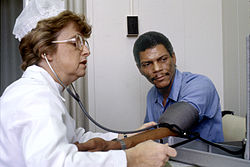
Nursing is a health care profession that "integrates the art and science of caring and focuses on the protection, promotion, and optimization of health and human functioning; prevention of illness and injury; facilitation of healing; and alleviation of suffering through compassionate presence". Nurses practice in many specialties with varying levels of certification and responsibility. Nurses comprise the largest component of most healthcare environments. There are shortages of qualified nurses in many countries.
Nurses develop a plan of care, working collaboratively with physicians, therapists, patients, patients' families, and other team members that focuses on treating illness to improve quality of life.
In the United Kingdom and the United States, clinical nurse specialists and nurse practitioners diagnose health problems and prescribe medications and other therapies, depending on regulations that vary by state. Nurses may help coordinate care performed by other providers or act independently as nursing professionals. In addition to providing care and support, nurses educate the public and promote health and wellness.
In the U.S., nurse practitioners are nurses with a graduate degree in advanced practice nursing, and are permitted to prescribe medications. They practice independently in a variety of settings in more than half of the United States. In the postwar period, nurse education has diversified, awarding advanced and specialized credentials, and many traditional regulations and roles are changing.
Nursing historians face challenges of determining whether care provided to the sick or injured in antiquity is called nursing care. In the fifth century BC, for example, the Hippocratic Collection in places described skilled care and observation of patients by male "attendants", who may have provided care now provided by nurses. Around 600 BC in India, it is recorded in Sushruta Samhita, Book 3, Chapter V about the role of the nurse[citation needed] as "the different parts or members of the body as mentioned before including the skin, cannot be correctly described by one who is not well versed in anatomy. Hence, anyone desirous of acquiring a thorough knowledge of anatomy should prepare a dead body and carefully, observe, by dissecting it, and examining its different parts."
In the Middle Ages, members of religious orders such as nuns and monks often provided nursing-like care. Examples exist in Christian, Islamic, Buddhist, and other traditions. The biblical figure of Phoebe is described in many sources as "the first visiting nurse". These traditions were influential in the development of the ethos of modern nursing. Its religious roots remain in evidence in many countries. One example in the United Kingdom is the use of the historical title "sister" to refer to a senior nurse.
During the Reformation, Protestant reformers shut down monasteries and convents, allowing a few hundred municipal hospices to remain in operation in northern Europe. Nuns who had been serving as nurses were given pensions or told to marry and stay home. Nursing care went to the inexperienced as traditional caretakers, rooted in the Roman Catholic Church, were removed from their positions. The nursing profession in Europe was extinguished for approximately 200 years.
During the Crimean War, Grand Duchess Elena Pavlovna called for women to join the Order of Exaltation of the Cross (Krestodvizhenskaya Obshchina) for a year of service in military hospitals. The first section of twenty-eight "sisters", headed by Aleksandra Petrovna Stakhovich, the Directress of the Order, reached Crimea early in November 1854.
Nursing
Nursing is a health care profession that "integrates the art and science of caring and focuses on the protection, promotion, and optimization of health and human functioning; prevention of illness and injury; facilitation of healing; and alleviation of suffering through compassionate presence". Nurses practice in many specialties with varying levels of certification and responsibility. Nurses comprise the largest component of most healthcare environments. There are shortages of qualified nurses in many countries.
Nurses develop a plan of care, working collaboratively with physicians, therapists, patients, patients' families, and other team members that focuses on treating illness to improve quality of life.
In the United Kingdom and the United States, clinical nurse specialists and nurse practitioners diagnose health problems and prescribe medications and other therapies, depending on regulations that vary by state. Nurses may help coordinate care performed by other providers or act independently as nursing professionals. In addition to providing care and support, nurses educate the public and promote health and wellness.
In the U.S., nurse practitioners are nurses with a graduate degree in advanced practice nursing, and are permitted to prescribe medications. They practice independently in a variety of settings in more than half of the United States. In the postwar period, nurse education has diversified, awarding advanced and specialized credentials, and many traditional regulations and roles are changing.
Nursing historians face challenges of determining whether care provided to the sick or injured in antiquity is called nursing care. In the fifth century BC, for example, the Hippocratic Collection in places described skilled care and observation of patients by male "attendants", who may have provided care now provided by nurses. Around 600 BC in India, it is recorded in Sushruta Samhita, Book 3, Chapter V about the role of the nurse[citation needed] as "the different parts or members of the body as mentioned before including the skin, cannot be correctly described by one who is not well versed in anatomy. Hence, anyone desirous of acquiring a thorough knowledge of anatomy should prepare a dead body and carefully, observe, by dissecting it, and examining its different parts."
In the Middle Ages, members of religious orders such as nuns and monks often provided nursing-like care. Examples exist in Christian, Islamic, Buddhist, and other traditions. The biblical figure of Phoebe is described in many sources as "the first visiting nurse". These traditions were influential in the development of the ethos of modern nursing. Its religious roots remain in evidence in many countries. One example in the United Kingdom is the use of the historical title "sister" to refer to a senior nurse.
During the Reformation, Protestant reformers shut down monasteries and convents, allowing a few hundred municipal hospices to remain in operation in northern Europe. Nuns who had been serving as nurses were given pensions or told to marry and stay home. Nursing care went to the inexperienced as traditional caretakers, rooted in the Roman Catholic Church, were removed from their positions. The nursing profession in Europe was extinguished for approximately 200 years.
During the Crimean War, Grand Duchess Elena Pavlovna called for women to join the Order of Exaltation of the Cross (Krestodvizhenskaya Obshchina) for a year of service in military hospitals. The first section of twenty-eight "sisters", headed by Aleksandra Petrovna Stakhovich, the Directress of the Order, reached Crimea early in November 1854.
Recent media
Recent media