



Community hub
Recent from talks
Knowledge base stats:
Talk channels stats:
Members stats:
Obanazawa
Obanazawa (尾花沢市, Obanazawa-shi) is a city located in Yamagata Prefecture, Japan. As of 1 February 2020[update], the city had an estimated population of 15,237, and a population density of 40.9 persons per km2. The total area of the city is 372.32 square kilometres (144 sq mi).
Obanazawa is located in a mountain valley northeast Yamagata Prefecture, bordered by the Mogami River to the west and the Ōu Mountains to the east.
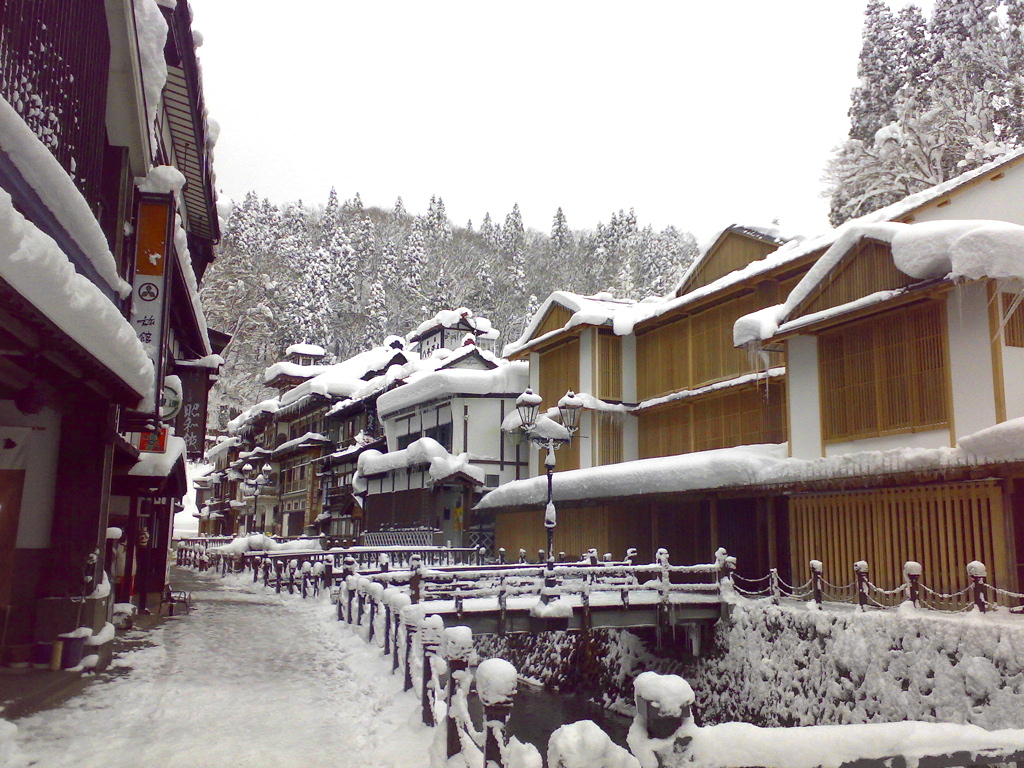
Obanazawa has a Humid continental climate (Köppen climate classification Dfa) with large seasonal temperature differences, with warm to hot (and often humid) summers and cold (sometimes severely cold) winters. Precipitation is significant throughout the year, but is heaviest from August to October. The average annual temperature in Obanazawa is 10.8 °C (51.4 °F). The average annual rainfall is 1,538.5 mm (60.57 in) with December as the wettest month. The temperatures are highest on average in August, at around 23.7 °C (74.7 °F), and lowest in January, at around −1.0 °C (30.2 °F). The city is noted for its very heavy snowfall in winter.
Per Japanese census data, the population of Obanazawa peaked around 1950 and has declined considerably since then.
The area of present-day Obanazawa was part of ancient Dewa Province. After the start of the Meiji period, the area became part of Kitamurayama District, Yamagata Prefecture. The village of Obanazawa was established on April 1, 1889 with the establishment of the modern municipalities system, and was raised to town status on July 26, 1897. It was made a city on April 10, 1959.
Obanazawa is the origin of one version of the Dontsuki song, the 'Hanagasa Dance Song', a song sung in many parts of Yamagata Prefecture.
Obanazawa has a mayor-council form of government with a directly elected mayor and a unicameral city legislature of 14 members. The city contributes one member to the Yamagata Prefectural Assembly. In terms of national politics, the city is part of Yamagata District 2 of the lower house of the Diet of Japan.
The economy of Obanazawa is based on agriculture and forestry. In agriculture, Obanazawa is best known for its watermelons.
Hub AI
Obanazawa AI simulator
(@Obanazawa_simulator)
Obanazawa
Obanazawa (尾花沢市, Obanazawa-shi) is a city located in Yamagata Prefecture, Japan. As of 1 February 2020[update], the city had an estimated population of 15,237, and a population density of 40.9 persons per km2. The total area of the city is 372.32 square kilometres (144 sq mi).
Obanazawa is located in a mountain valley northeast Yamagata Prefecture, bordered by the Mogami River to the west and the Ōu Mountains to the east.
Obanazawa has a Humid continental climate (Köppen climate classification Dfa) with large seasonal temperature differences, with warm to hot (and often humid) summers and cold (sometimes severely cold) winters. Precipitation is significant throughout the year, but is heaviest from August to October. The average annual temperature in Obanazawa is 10.8 °C (51.4 °F). The average annual rainfall is 1,538.5 mm (60.57 in) with December as the wettest month. The temperatures are highest on average in August, at around 23.7 °C (74.7 °F), and lowest in January, at around −1.0 °C (30.2 °F). The city is noted for its very heavy snowfall in winter.
Per Japanese census data, the population of Obanazawa peaked around 1950 and has declined considerably since then.
The area of present-day Obanazawa was part of ancient Dewa Province. After the start of the Meiji period, the area became part of Kitamurayama District, Yamagata Prefecture. The village of Obanazawa was established on April 1, 1889 with the establishment of the modern municipalities system, and was raised to town status on July 26, 1897. It was made a city on April 10, 1959.
Obanazawa is the origin of one version of the Dontsuki song, the 'Hanagasa Dance Song', a song sung in many parts of Yamagata Prefecture.
Obanazawa has a mayor-council form of government with a directly elected mayor and a unicameral city legislature of 14 members. The city contributes one member to the Yamagata Prefectural Assembly. In terms of national politics, the city is part of Yamagata District 2 of the lower house of the Diet of Japan.
The economy of Obanazawa is based on agriculture and forestry. In agriculture, Obanazawa is best known for its watermelons.