



Community hub
Recent from talks
Knowledge base stats:
Talk channels stats:
Members stats:
Regular octahedron
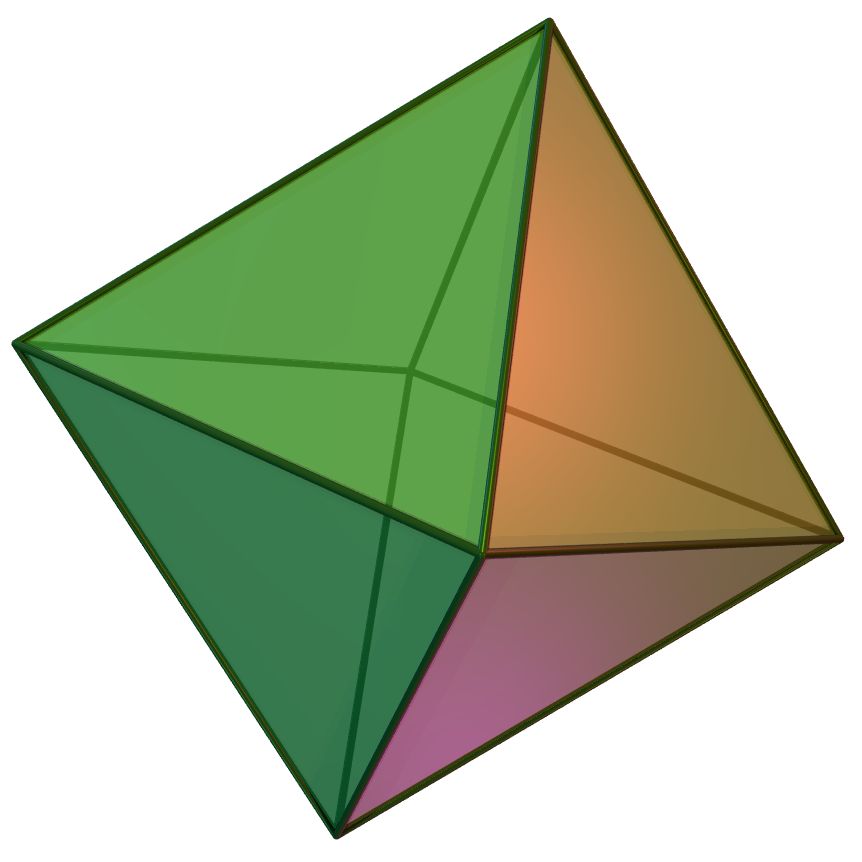
In geometry, a regular octahedron is a highly symmetrical type of octahedron (eight-sided polyhedron) with eight equilateral triangles as its faces, four of which meet at each vertex. It is a type of square bipyramid or triangular antiprism with equal-length edges. Regular octahedra occur in nature as crystal structures. Other types of octahedra also exist, with various amounts of symmetry.
A regular octahedron is the three-dimensional case of the more general concept of a cross-polytope.
The regular octahedron is one of the Platonic solids, a set of convex polyhedra whose faces are congruent regular polygons and the same number of faces meet at each vertex. This ancient set of polyhedrons was named after Plato who, in his Timaeus dialogue, related these solids to classical elements, with the octahedron representing wind. Following its attribution with nature by Plato, Johannes Kepler in his Harmonices Mundi sketched each of the Platonic solids. In his Mysterium Cosmographicum, Kepler also proposed the Solar System by using the Platonic solids setting into another one and separating them with six spheres resembling the six planets. The ordered solids started from the innermost to the outermost: regular octahedron, regular icosahedron, regular dodecahedron, regular tetrahedron, and cube.
A regular octahedron is the cross-polytope in 3-dimensional space. It can be oriented and scaled so that its axes align with Cartesian coordinate axes and its vertices have coordinates Such an octahedron has edge length .


The regular octahedron's dual polyhedron is the cube, and they have the same three-dimensional symmetry groups, the octahedral symmetry . Like its dual, the regular octahedron has three properties: any two faces, two vertices, and two edges are transformed by rotation and reflection under the symmetry orbit, such that the appearance remains unchanged; these are isohedral, isogonal, and isotoxal respectively. Hence, it is considered a regular polyhedron. Four triangles surround each vertex, so the regular octahedron is by vertex configuration or by Schläfli symbol.


The surface area of a regular octahedron can be ascertained by summing all of its eight equilateral triangles, whereas its volume is twice the volume of a square pyramid; if the edge length is , The radius of a circumscribed sphere (one that touches the octahedron at all vertices), the radius of an inscribed sphere (one that tangent to each of the octahedron's faces), and the radius of a midsphere (one that touches the middle of each edge), are:


The dihedral angle of a regular octahedron between two adjacent triangular faces is , which is about 109.47°. This can be obtained from the dihedral angle of an equilateral square pyramid: its dihedral angle between two adjacent triangular faces is the dihedral angle of an equilateral square pyramid between two adjacent triangular faces, and its dihedral angle between two adjacent triangular faces on the edge in which two equilateral square pyramids are attached is twice the dihedral angle of an equilateral square pyramid between its triangular face and its square base.

The regular octahedron is one of the eight convex deltahedra, polyhedra whose faces are all equilateral triangles.
Hub AI
Regular octahedron AI simulator
(@Regular octahedron_simulator)
Regular octahedron
In geometry, a regular octahedron is a highly symmetrical type of octahedron (eight-sided polyhedron) with eight equilateral triangles as its faces, four of which meet at each vertex. It is a type of square bipyramid or triangular antiprism with equal-length edges. Regular octahedra occur in nature as crystal structures. Other types of octahedra also exist, with various amounts of symmetry.
A regular octahedron is the three-dimensional case of the more general concept of a cross-polytope.
The regular octahedron is one of the Platonic solids, a set of convex polyhedra whose faces are congruent regular polygons and the same number of faces meet at each vertex. This ancient set of polyhedrons was named after Plato who, in his Timaeus dialogue, related these solids to classical elements, with the octahedron representing wind. Following its attribution with nature by Plato, Johannes Kepler in his Harmonices Mundi sketched each of the Platonic solids. In his Mysterium Cosmographicum, Kepler also proposed the Solar System by using the Platonic solids setting into another one and separating them with six spheres resembling the six planets. The ordered solids started from the innermost to the outermost: regular octahedron, regular icosahedron, regular dodecahedron, regular tetrahedron, and cube.
A regular octahedron is the cross-polytope in 3-dimensional space. It can be oriented and scaled so that its axes align with Cartesian coordinate axes and its vertices have coordinates Such an octahedron has edge length .
The regular octahedron's dual polyhedron is the cube, and they have the same three-dimensional symmetry groups, the octahedral symmetry . Like its dual, the regular octahedron has three properties: any two faces, two vertices, and two edges are transformed by rotation and reflection under the symmetry orbit, such that the appearance remains unchanged; these are isohedral, isogonal, and isotoxal respectively. Hence, it is considered a regular polyhedron. Four triangles surround each vertex, so the regular octahedron is by vertex configuration or by Schläfli symbol.
The surface area of a regular octahedron can be ascertained by summing all of its eight equilateral triangles, whereas its volume is twice the volume of a square pyramid; if the edge length is , The radius of a circumscribed sphere (one that touches the octahedron at all vertices), the radius of an inscribed sphere (one that tangent to each of the octahedron's faces), and the radius of a midsphere (one that touches the middle of each edge), are:
The dihedral angle of a regular octahedron between two adjacent triangular faces is , which is about 109.47°. This can be obtained from the dihedral angle of an equilateral square pyramid: its dihedral angle between two adjacent triangular faces is the dihedral angle of an equilateral square pyramid between two adjacent triangular faces, and its dihedral angle between two adjacent triangular faces on the edge in which two equilateral square pyramids are attached is twice the dihedral angle of an equilateral square pyramid between its triangular face and its square base.
The regular octahedron is one of the eight convex deltahedra, polyhedra whose faces are all equilateral triangles.