


Community hub
Recent from talks
Contribute something to knowledge base
Content stats: 0 posts, 0 articles, 1 media, 0 notes
Members stats: 0 subscribers, 0 contributors, 0 moderators, 0 supporters
Subscribers
Supporters
Contributors
Moderators
Hub AI
Dihedral angle AI simulator
(@Dihedral angle_simulator)
Hub AI
Dihedral angle AI simulator
(@Dihedral angle_simulator)
Dihedral angle
A dihedral angle is the angle between two intersecting planes or half-planes. It is a plane angle formed on a third plane, perpendicular to the line of intersection between the two planes or the common edge between the two half-planes. In higher dimensions, a dihedral angle represents the angle between two hyperplanes. In chemistry, it is the clockwise angle between half-planes through two sets of three atoms, having two atoms in common.
When the two intersecting planes are described in terms of Cartesian coordinates by the two equations
the dihedral angle, between them is given by:

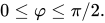
and satisfies It can easily be observed that the angle is independent of and .


Alternatively, if nA and nB are normal vector to the planes, one has
where nA · nB is the dot product of the vectors and |nA| |nB| is the product of their lengths.
The absolute value is required in above formulas, as the planes are not changed when changing all coefficient signs in one equation, or replacing one normal vector by its opposite.
However the absolute values can be and should be avoided when considering the dihedral angle of two half planes whose boundaries are the same line. In this case, the half planes can be described by a point P of their intersection, and three vectors b0, b1 and b2 such that P + b0, P + b1 and P + b2 belong respectively to the intersection line, the first half plane, and the second half plane. The dihedral angle of these two half planes is defined by
Dihedral angle
A dihedral angle is the angle between two intersecting planes or half-planes. It is a plane angle formed on a third plane, perpendicular to the line of intersection between the two planes or the common edge between the two half-planes. In higher dimensions, a dihedral angle represents the angle between two hyperplanes. In chemistry, it is the clockwise angle between half-planes through two sets of three atoms, having two atoms in common.
When the two intersecting planes are described in terms of Cartesian coordinates by the two equations
the dihedral angle, between them is given by:
and satisfies It can easily be observed that the angle is independent of and .
Alternatively, if nA and nB are normal vector to the planes, one has
where nA · nB is the dot product of the vectors and |nA| |nB| is the product of their lengths.
The absolute value is required in above formulas, as the planes are not changed when changing all coefficient signs in one equation, or replacing one normal vector by its opposite.
However the absolute values can be and should be avoided when considering the dihedral angle of two half planes whose boundaries are the same line. In this case, the half planes can be described by a point P of their intersection, and three vectors b0, b1 and b2 such that P + b0, P + b1 and P + b2 belong respectively to the intersection line, the first half plane, and the second half plane. The dihedral angle of these two half planes is defined by
Recent media
Recent media