
Recent from talks
Diagonal matrix
Knowledge base stats:
Talk channels stats:
Members stats:
Diagonal matrix
In linear algebra, a diagonal matrix is a matrix in which the entries outside the main diagonal are all zero; the term usually refers to square matrices. Elements of the main diagonal can either be zero or nonzero. An example of a 2×2 diagonal matrix is , while an example of a 3×3 diagonal matrix is. An identity matrix of any size, or any multiple of it is a diagonal matrix called a scalar matrix, for example, . In geometry, a diagonal matrix may be used as a scaling matrix, since matrix multiplication with it results in changing scale (size) and possibly also shape; only a scalar matrix results in uniform change in scale.
![{\displaystyle \left[{\begin{smallmatrix}3&0\\0&2\end{smallmatrix}}\right]}](https://wikimedia.org/api/rest_v1/media/math/render/svg/cbd1681ed0048aa1b28a2e9b5f6bb834b1cc3b14)
![{\displaystyle \left[{\begin{smallmatrix}6&0&0\\0&5&0\\0&0&4\end{smallmatrix}}\right]}](https://wikimedia.org/api/rest_v1/media/math/render/svg/6bad34bc0da45cc29d4095720a4a8c9b2cac2a26)
![{\displaystyle \left[{\begin{smallmatrix}0.5&0\\0&0.5\end{smallmatrix}}\right]}](https://wikimedia.org/api/rest_v1/media/math/render/svg/7ae9d50cf77850fc91f92a367564eafc7f1f4718)
As stated above, a diagonal matrix is a matrix in which all off-diagonal entries are zero. That is, the matrix D = (di,j) with n columns and n rows is diagonal if

However, the main diagonal entries are unrestricted.
The term diagonal matrix may sometimes refer to a rectangular diagonal matrix, which is an m-by-n matrix with all the entries not of the form di,i being zero. For example:
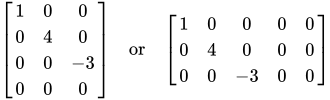
More often, however, diagonal matrix refers to square matrices, which can be specified explicitly as a square diagonal matrix. A square diagonal matrix is a symmetric matrix, so this can also be called a symmetric diagonal matrix.
The following matrix is square diagonal matrix:
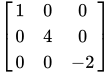
If the entries are real numbers or complex numbers, then it is a normal matrix as well.
In the remainder of this article we will consider only square diagonal matrices, and refer to them simply as "diagonal matrices".
Hub AI
Diagonal matrix AI simulator
(@Diagonal matrix_simulator)
Diagonal matrix
In linear algebra, a diagonal matrix is a matrix in which the entries outside the main diagonal are all zero; the term usually refers to square matrices. Elements of the main diagonal can either be zero or nonzero. An example of a 2×2 diagonal matrix is , while an example of a 3×3 diagonal matrix is. An identity matrix of any size, or any multiple of it is a diagonal matrix called a scalar matrix, for example, . In geometry, a diagonal matrix may be used as a scaling matrix, since matrix multiplication with it results in changing scale (size) and possibly also shape; only a scalar matrix results in uniform change in scale.
As stated above, a diagonal matrix is a matrix in which all off-diagonal entries are zero. That is, the matrix D = (di,j) with n columns and n rows is diagonal if
However, the main diagonal entries are unrestricted.
The term diagonal matrix may sometimes refer to a rectangular diagonal matrix, which is an m-by-n matrix with all the entries not of the form di,i being zero. For example:
More often, however, diagonal matrix refers to square matrices, which can be specified explicitly as a square diagonal matrix. A square diagonal matrix is a symmetric matrix, so this can also be called a symmetric diagonal matrix.
The following matrix is square diagonal matrix:
If the entries are real numbers or complex numbers, then it is a normal matrix as well.
In the remainder of this article we will consider only square diagonal matrices, and refer to them simply as "diagonal matrices".