


Community hub
Recent from talks
Contribute something to knowledge base
Content stats: 0 posts, 0 articles, 1 media, 0 notes
Members stats: 0 subscribers, 0 contributors, 0 moderators, 0 supporters
Subscribers
Supporters
Contributors
Moderators
Hub AI
Off-road vehicle AI simulator
(@Off-road vehicle_simulator)
Hub AI
Off-road vehicle AI simulator
(@Off-road vehicle_simulator)
Off-road vehicle
An off-road vehicle (ORV), also known as an off-highway vehicle (OHV), overland vehicle or adventure vehicle, is a type of transportation specifically engineered to navigate unpaved roads and surfaces. These include trails, forest roads, and other low-traction terrains. Off-road vehicles are widely used in various contexts, from recreational activities to practical applications like agriculture and construction. Events such as the annual Dakar Rally, which spans multiple countries and challenges participants with diverse and extreme terrains, have brought significant attention to these vehicles.
One of the earliest modified off-road vehicles was the Kégresse track, a system for modifying cars developed by Adolphe Kégresse while working for Tsar Nicholas II of Russia between 1906 and 1916. The system employed a caterpillar track with a flexible belt instead of interlocking metal segments, which could be fitted to a conventional vehicle, turning it into a half-track suitable for rough or soft terrain.
After the Russian Revolution of 1917, Kégresse returned to France and the system was used on Citroën cars between 1921 and 1937 for off-road and military vehicles. Citroën sponsored several overland expeditions with these vehicles, crossing North Africa and Central Asia.
The Antarctic Snow Cruiser, a large-wheeled vehicle designed between 1937 and 1939 under the direction of Thomas Poulter, was intended for transport in Antarctica. While the project incorporated novel features, it faced operational difficulties in the harsh Antarctic conditions, and was discontinued.
Jeeps, originally developed as military vehicles during World War II, gained popularity among civilians as utility vehicles. This was also the start of off-roading as a hobby. The wartime Jeeps soon wore out, though, and the Jeep company started to produce civilian derivatives, closely followed by similar vehicles from British Land Rover and Japanese Toyota, Datsun/Nissan, Suzuki, and Mitsubishi. These were all similar: small, compact, four-wheel drive vehicles with, at most, a small hard top to protect the occupants from the elements.
Early off-road vehicles included the U.S. Jeep Wagoneer and Ford Bronco; the British Range Rover; and the Japanese Toyota Land Cruiser, Nissan Patrol, and Suzuki's LJ series. They featured bodies similar to those of a station wagon but on a light truck-like frame, with four-wheel-drive drivetrains. As off-road vehicles increased in popularity during the 1990s, more companies began producing their own lines of what became known as sport utility vehicles (SUV). Manufacturers started incorporating more features to make off-road vehicles competitive with regular vehicles in the consumer market, which eventually evolved into the modern SUV and the newer crossover vehicle, whose off-roading capabilities were reduced in favor of improved on-road handling and luxury.
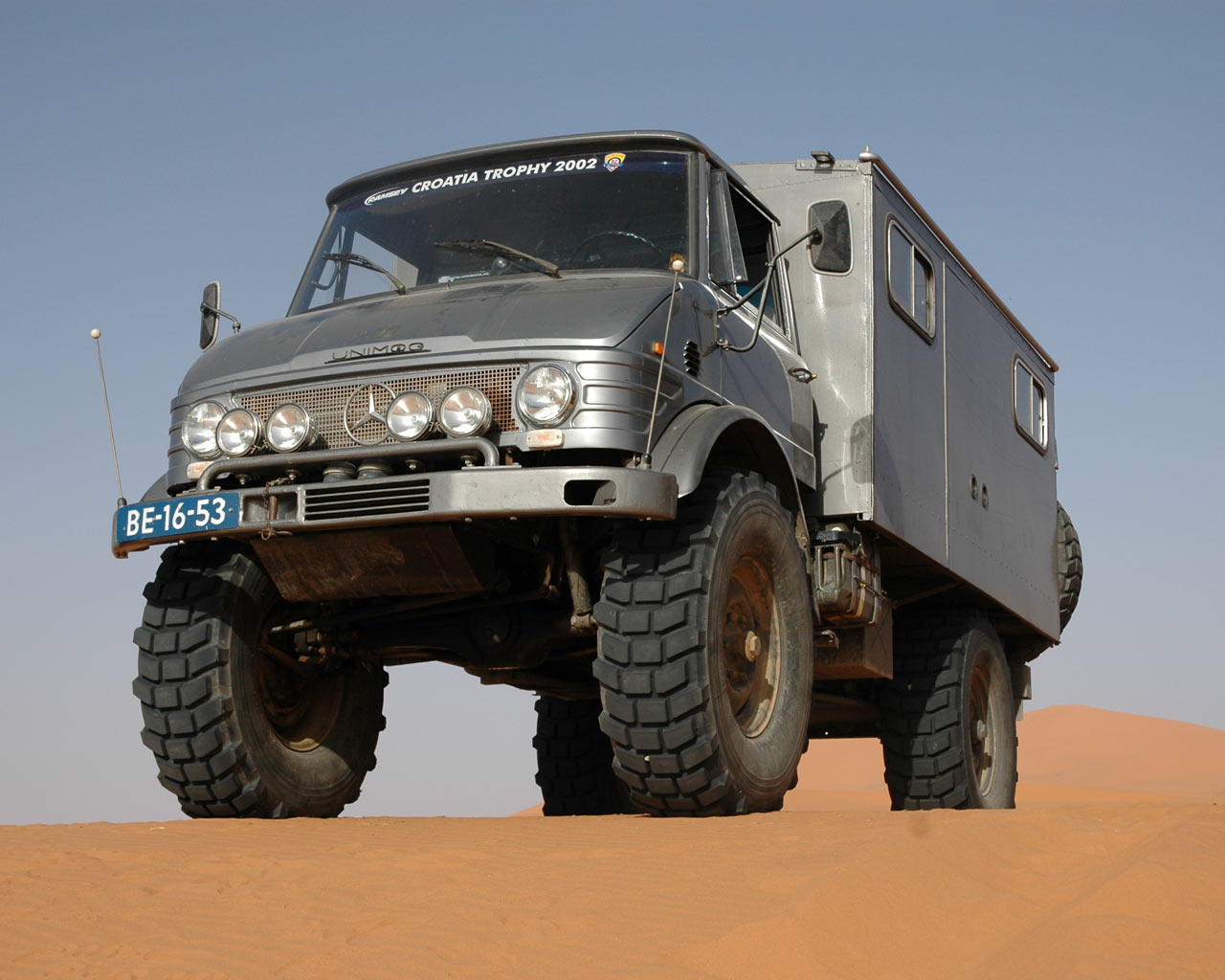
To effectively navigate off the pavement, off-road vehicles require low ground pressure, high ground clearance, and the ability to maintain wheels or track contact on uneven surfaces. Wheeled vehicles achieve this through large or additional tires combined with high and compliant suspension. Tracked vehicles use wide tracks and flexible suspension on the road wheels.
Tracked drivetrains are more expensive to produce and maintain but offer better off-road performance, while wheeled drivetrains are cheaper and allow for higher speeds.
Off-road vehicle
An off-road vehicle (ORV), also known as an off-highway vehicle (OHV), overland vehicle or adventure vehicle, is a type of transportation specifically engineered to navigate unpaved roads and surfaces. These include trails, forest roads, and other low-traction terrains. Off-road vehicles are widely used in various contexts, from recreational activities to practical applications like agriculture and construction. Events such as the annual Dakar Rally, which spans multiple countries and challenges participants with diverse and extreme terrains, have brought significant attention to these vehicles.
One of the earliest modified off-road vehicles was the Kégresse track, a system for modifying cars developed by Adolphe Kégresse while working for Tsar Nicholas II of Russia between 1906 and 1916. The system employed a caterpillar track with a flexible belt instead of interlocking metal segments, which could be fitted to a conventional vehicle, turning it into a half-track suitable for rough or soft terrain.
After the Russian Revolution of 1917, Kégresse returned to France and the system was used on Citroën cars between 1921 and 1937 for off-road and military vehicles. Citroën sponsored several overland expeditions with these vehicles, crossing North Africa and Central Asia.
The Antarctic Snow Cruiser, a large-wheeled vehicle designed between 1937 and 1939 under the direction of Thomas Poulter, was intended for transport in Antarctica. While the project incorporated novel features, it faced operational difficulties in the harsh Antarctic conditions, and was discontinued.
Jeeps, originally developed as military vehicles during World War II, gained popularity among civilians as utility vehicles. This was also the start of off-roading as a hobby. The wartime Jeeps soon wore out, though, and the Jeep company started to produce civilian derivatives, closely followed by similar vehicles from British Land Rover and Japanese Toyota, Datsun/Nissan, Suzuki, and Mitsubishi. These were all similar: small, compact, four-wheel drive vehicles with, at most, a small hard top to protect the occupants from the elements.
Early off-road vehicles included the U.S. Jeep Wagoneer and Ford Bronco; the British Range Rover; and the Japanese Toyota Land Cruiser, Nissan Patrol, and Suzuki's LJ series. They featured bodies similar to those of a station wagon but on a light truck-like frame, with four-wheel-drive drivetrains. As off-road vehicles increased in popularity during the 1990s, more companies began producing their own lines of what became known as sport utility vehicles (SUV). Manufacturers started incorporating more features to make off-road vehicles competitive with regular vehicles in the consumer market, which eventually evolved into the modern SUV and the newer crossover vehicle, whose off-roading capabilities were reduced in favor of improved on-road handling and luxury.
To effectively navigate off the pavement, off-road vehicles require low ground pressure, high ground clearance, and the ability to maintain wheels or track contact on uneven surfaces. Wheeled vehicles achieve this through large or additional tires combined with high and compliant suspension. Tracked vehicles use wide tracks and flexible suspension on the road wheels.
Tracked drivetrains are more expensive to produce and maintain but offer better off-road performance, while wheeled drivetrains are cheaper and allow for higher speeds.
Recent media
Recent media