Hubbry Logo
Okinawan languageOkinawan languageMain
Open search
Okinawan language
Community hub
Okinawan language
logo
8 pages, 0 posts
0 subscribers
Be the first to start a discussion here.
Okinawan language
Okinawan language
from Wikipedia

Okinawan
  • 沖縄口
  • ウチナーグチ
  • Uchināguchi
Pronunciation[ʔut͡ɕinaːɡut͡ɕi]
Native toJapan
RegionSouthern Okinawa Islands
Native speakers
1.2 million (2020)[1]
Language codes
ISO 639-3ryu
Glottologcent2126
ELPSouth-Central Okinawan
Linguasphere
  • 45-CAC-ai
  • 45-CAC-aj
  • 45-CAC-ak[2]
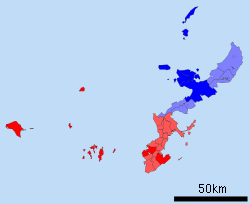
  Northern Okinawan or Kunigami
  South–Central Okinawan or Shuri–Naha

Okinawan (沖縄口, ウチナーグチ, Uchināguchi, [ʔut͡ɕinaːɡut͡ɕi]), or more precisely Central Okinawan, is a Northern Ryukyuan language spoken primarily in the southern half of the island of Okinawa, as well as in the surrounding islands of Kerama, Kumejima, Tonaki, Aguni and a number of smaller peripheral islands.[3] Central Okinawan distinguishes itself from the speech of Northern Okinawa, which is classified independently as the Kunigami language. Both languages are listed by UNESCO as endangered.[4]

Though Okinawan encompasses a number of local dialects,[5] the ShuriNaha variant is generally recognized as the de facto standard,[6] as it had been used as the official language of the Ryukyu Kingdom[7] since the reign of King Shō Shin (1477–1526). Moreover, as the former capital of Shuri was built around the royal palace, the language used by the royal court became the regional and literary standard,[7][6] which thus flourished in songs and poems written during that era.

Today, most Okinawans speak Okinawan Japanese, although a number of people still speak the Okinawan language, most often the elderly. Within Japan, Okinawan is often not seen as a language unto itself but is referred to as the Okinawan dialect (沖縄方言, Okinawa hōgen), or more specifically the Central and Southern Okinawan dialects (沖縄中南部諸方言, Okinawa Chūnanbu Sho hōgen). Okinawan speakers are undergoing language shift as they switch to Japanese, since language use in Okinawa today is far from stable. Okinawans are assimilating and accenting standard Japanese due to the similarity of the two languages, the standardized and centralized education system, the media, business and social contact with mainlanders and previous attempts from Japan to suppress the native languages.[8] Okinawan is still kept alive in popular music, tourist shows and in theaters featuring a local drama called uchinā shibai, which depict local customs and manners.[9]

History

[edit]

Pre-Ryukyu Kingdom

[edit]

Okinawan is a Japonic language, derived from Proto-Japonic and is therefore related to Japanese. The split between Old Japanese and the Ryukyuan languages has been estimated to have occurred as early as the 1st century AD to as late as the 12th century AD. Chinese and Japanese characters were first introduced by a Japanese missionary in 1265.[10]

Ryukyu Kingdom era

[edit]

Pre-Satsuma

[edit]

Hiragana was a much more popular writing system than kanji; thus, Okinawan poems were commonly written solely in hiragana or with little kanji. Okinawan became the official language under King Shō Shin. The Omoro Sōshi, a compilation of ancient Ryukyuan poems, was written in an early form of Okinawan, known as Old Okinawan.

Post-Satsuma to annexation

[edit]

After Ryukyu became a vassal of Satsuma Domain, kanji gained more prominence in poetry; however, official Ryukyuan documents were written in Classical Chinese. During this time, the language gradually evolved into Modern Okinawan.

In 1609, the Ryukyu Kingdom was colonized by the Satsuma Domain in the south of Japan. However, Satsuma did not fully invade the Ryukyu in fear of colliding with China, which had a stronger trading relationship with the Ryukyu at the time.[11]

Japanese annexation to end of World War II

[edit]

When Ryukyu was annexed by Japan in 1879, the majority of people on Okinawa Island spoke Okinawan. Within 10 years, the Japanese government began an assimilation policy of Japanization, where Ryukyuan languages were gradually suppressed. The education system was the heart of Japanization, where Okinawan children were taught Japanese and punished for speaking their native language, being told that their language was just a "dialect".

Language shift to Japanese in Ryukyu/Okinawa began in 1879 when the Japanese government annexed Ryukyu and established Okinawa Prefecture. The prefectural office mainly consisted of people from Kagoshima Prefecture where the Satsuma Domain used to be. This caused the modernization of Okinawa as well as language shift to Japanese. As a result, Japanese became the standard language for administration, education, media, and literature.[11]

In 1902, the National Language Research Council (国語調査委員会) began the linguistic unification of Japan to Standard Japanese. This caused the linguistic stigmatization of many local varieties in Japan including Okinawan. As the discrimination accelerated, Okinawans themselves started to abandon their languages and shifted to Standard Japanese.[11]

American occupation

[edit]

Under American administration, there was an attempt to revive and standardize Okinawan, but this proved difficult and was shelved in favor of Japanese. General Douglas MacArthur attempted to promote Okinawan languages and culture through education.[12] Multiple English words were introduced.

Return to Japan to present day

[edit]

After Okinawa's reversion to Japanese sovereignty, Japanese continued to be the dominant language used, and the majority of the youngest generations only speak Okinawan Japanese. There have been attempts to revive Okinawan by notable people such as Byron Fija and Seijin Noborikawa, but few native Okinawans know the language.[13]

Outside of Japan

[edit]
Sign in Okinawa Uno (a colonia in Bolivia), in Spanish and Okinawan: the text reads めんそ〜れ オキナワへ, Menso~re Okinawa-e.

The Okinawan language is still spoken by communities of Okinawan immigrants in Brazil. The first immigrants from the island of Okinawa to Brazil landed in the Port of Santos in 1908 drawn by the hint of work and farmable land. Once in a new country and far from their homeland, they found themselves in a place where there was no prohibition of their language, allowing them to willingly speak, celebrate and preserve their speech and culture, up to the present day. Currently the Okinawan-Japanese centers and communities in the State of São Paulo are a world reference to this language helping it to stay alive.[14] Courses in Okinawan language and literature are offered at the University of Hawaiʻi at Mānoa and books in Uchinaaguchi have been published in Hawaii.[15]

Classification

[edit]

Okinawan is sometimes grouped with Kunigami as the Okinawan languages; however, not all linguists accept this grouping, some claiming that Kunigami is a dialect of Okinawan.[11] Okinawan is also grouped with Amami (or the Amami languages) as the Northern Ryukyuan languages.

Dialect of the Japanese language

[edit]

Since the creation of Okinawa Prefecture, Okinawan has been labeled a dialect of Japanese as part of a policy of assimilation. Later, Japanese linguists, such as Tōjō Misao, who studied the Ryukyuan languages argued that they are indeed dialects. This is due to the misconception that Japan is a homogeneous state (one people, one language, one nation), and classifying the Ryukyuan languages as such would discredit this assumption.[16] The present-day official stance of the Japanese government remains that Okinawan is a dialect, and it is common within the Japanese population for it to be called 沖縄方言 (okinawa hōgen) or 沖縄弁 (okinawa-ben), which means "Okinawa dialect (of Japanese)". The policy of assimilation, coupled with increased interaction between Japan and Okinawa through media and economics, has led to the development of Okinawan Japanese, which is a dialect of Japanese influenced by the Okinawan and Kunigami languages. Japanese and Okinawan only share 60% of the same vocabulary, despite both being Japonic languages.[17]

Dialects of the Ryukyuan language

[edit]

Okinawan linguist Seizen Nakasone states that the Ryukyuan languages are in fact groupings of similar dialects. As each community has its own distinct dialect, there is no "one language". Nakasone attributes this diversity to the isolation caused by immobility, citing the story of his mother who wanted to visit the town of Nago but never made the 25 km trip before she died of old age.[18]

The contemporary dialects in Ryukyuan language are divided into three large groups: Amami-Okinawa dialects, Miyako-Yaeyama dialects, and the Yonaguni dialect. All of them are mutually unintelligible. Amami is located in the Kagoshima prefecture but it belongs to the Ryukyuan group linguistically. The Yonaguni dialect is very different in phonetics from the other groups but it comes closest to the Yaeyama dialect lexically.[19]

Its own distinct language

[edit]

Outside Japan, Okinawan is considered a separate language from Japanese. This was first proposed by Basil Hall Chamberlain, who compared the relationship between Okinawan and Japanese to that of the Romance languages. UNESCO has marked it as an endangered language.[20]

Sociolinguistics

[edit]

UNESCO listed six Okinawan language varieties as endangered languages in 2009.[21] The endangerment of Okinawan is largely due to the shift to Standard Japanese. Throughout history, Okinawan languages have been treated as dialects of Standard Japanese. For instance, in the 20th century, many schools used "dialect tags" to punish the students who spoke in Okinawan.[22] Consequently, many of the remaining speakers today are choosing not to transmit their languages to younger generations due to the stigmatization of the languages in the past.[11]

There have been several revitalization efforts made to reverse this language shift. However, Okinawan is still poorly taught in formal institutions due to the lack of support from the Okinawan Education Council: education in Okinawa is conducted exclusively in Japanese, and children do not study Okinawan as their second language at school. As a result, at least two generations of Okinawans have grown up without any proficiency in their local languages both at home and school.[11]

Okinawan vocabulary is about 39% lexically similar with Japanese [23] and The Okinawan language is only 71% lexically similar to, or cognate with, standard Japanese. Even the southernmost Japanese dialect (Kagoshima dialect) is only 72% cognate with the northernmost Ryukyuan language (Amami). The Kagoshima dialect of Japanese, however, is 80% lexically similar to Standard Japanese.[24]

Phonology

[edit]

Vowels

[edit]
Front Central Back
Close i u
Close-Mid e o
Open a

The Okinawan language has five vowels, all of which may be long or short, though the short vowels /e/ and /o/ are quite rare,[25] as they occur only in a few native Okinawan words with heavy syllables with the pattern /Ceɴ/ or /Coɴ/, such as /meɴsoːɾeː/ mensōrē "welcome" or /toɴɸaː/ tonfā. The close back vowels /u/ and /uː/ are truly rounded, rather than the compressed vowels of standard Japanese.

Consonants

[edit]

The Okinawan language counts some 20 distinctive segments shown in the chart below, with major allophones presented in parentheses.

IPA chart of Okinawan consonants
Labial Alveolar Alveolo-
palatal
Palatal Labio-
velar
Velar Uvular/
Glottal
Nasal m n (ŋ) (ɴ)
Plosive p   b t   d t͡ɕ   d͡ʑ   ɡʷ k   ɡ ʔ
Fricative ɸ s  (z) (ɕ) (ç) h
Flap ɾ
Approximant j w

The only consonant that can occur as a syllable coda is the archiphoneme |n|. Many analyses treat it as an additional phoneme /N/, the moraic nasal, though it never contrasts with /n/ or /m/.

The consonant system of the Okinawan language is fairly similar to that of standard Japanese, but it does present a few differences on the phonemic and allophonic level. Namely, Okinawan retains the labialized consonants /kʷ/ and /ɡʷ/ which were lost in Late Middle Japanese (though they are retained in a handful of Modern Japanese dialects), possesses a glottal stop /ʔ/, features a voiceless bilabial fricative /ɸ/ distinct from the aspirate /h/, and has two distinctive affricates which arose from a number of different sound processes. Additionally, Okinawan lacks the major allophones [t͡s] and [d͡z] found in Japanese, having historically fronted the vowel /u/ to /i/ after the alveolars /t d s z/, consequently merging [t͡su] tsu into [t͡ɕi] chi, [su] su into [ɕi] shi, and both [d͡zu] dzu and [zu] zu into [d͡ʑi] ji. It also lacks /z/ as a distinctive phoneme, having merged it into /d͡ʑ/.

Bilabial and glottal fricatives

[edit]

The bilabial fricative /ɸ/ has sometimes been transcribed as the cluster /hw/, since, like Japanese, /h/ allophonically labializes into [ɸ] before the high vowel /u/, and /ɸ/ does not occur before the rounded vowel /o/. This suggests that an overlap between /ɸ/ and /h/ exists, and so the contrast in front of other vowels can be denoted through labialization. However, this analysis fails to take account of the fact that Okinawan has not fully undergone the diachronic change */p//ɸ/*/h/ as in Japanese, and that the suggested clusterization and labialization into */hw/ is unmotivated.[26] Consequently, the existence of /ɸ/ must be regarded as independent of /h/, even though the two overlap. Barring a few words that resulted from the former change, the aspirate /h/ also arose from the odd lenition of /k/ and /s/, as well as words loaned from other dialects. Before the glide /j/ and the high vowel /i/, it is pronounced closer to [ç], as in Japanese.

Palatalization

[edit]

The plosive consonants /t/ and /k/ historically palatalized and affricated into /t͡ɕ/ before and occasionally following the glide /j/ and the high vowel /i/: */kiri//t͡ɕiɾi/ chiri "fog", and */k(i)jora//t͡ɕuɾa/ chura- "beautiful". This change preceded vowel raising, so that instances where /i/ arose from */e/ did not trigger palatalization: */ke//kiː/ "hair". Their voiced counterparts /d/ and /ɡ/ underwent the same effect, becoming /d͡ʑ/ under such conditions: */unaɡi//ʔɴnad͡ʑi/ Qnnaji "eel", and */nokoɡiri//nukud͡ʑiɾi/ nukujiri "saw"; but */kaɡeɴ//kaɡiɴ/ kagin "seasoning".

Both /t/ and /d/ may or may not also allophonically affricate before the mid vowel /e/, though this pronunciation is increasingly rare. Similarly, the fricative consonant /s/ palatalizes into [ɕ] before the glide /j/ and the vowel /i/, including when /i/ historically derives from /e/: */sekai/[ɕikeː] shikē "world". It may also palatalize before the vowel /e/, especially so in the context of topicalization: [duɕi] dushi[duɕeː] dusē or dushē "(topic) friend".

In general, sequences containing the palatal consonant /j/ are relatively rare and tend to exhibit depalatalization. For example, /mj/ tends to merge with /n/ ([mjaːku] myāku[naːku] nāku "Miyako"); */rj/ has merged into /ɾ/ and /d/ (*/rjuː//ɾuː/ ~ /duː/ "dragon"); and /sj/ has mostly become /s/ (/sjui/ shui/sui/ sui "Shuri").

Flapping and fortition

[edit]

The voiced plosive /d/ and the flap /ɾ/ tend to merge, with the first becoming a flap in word-medial position, and the second sometimes becoming a plosive in word-initial position. For example, /ɾuː/ "dragon" may be strengthened into [duː] , and /hasidu/ hashidu "door" conversely flaps into [hasiɾu] hashiru. The two sounds do, however, still remain distinct in a number of words and verbal constructions.[citation needed]

Glottal stop

[edit]

Okinawan also features a distinctive glottal stop /ʔ/ that historically arose from a process of glottalization of word-initial vowels.[27] Hence, all vowels in Okinawan are predictably glottalized at the beginning of words (*/ame//ʔami/ ami "rain"), save for a few exceptions. High vowel loss or assimilation following this process created a contrast with glottalized approximants and nasal consonants.[27] Compare */uwa//ʔwa/ Qwa "pig" to /wa/ wa "I", or */ine//ʔɴni/ Qnni "rice plant" to */mune//ɴni/ nni "chest".[28]

Moraic nasal

[edit]

The moraic nasal /N/ has been posited in most descriptions of Okinawan phonology. Like Japanese, /N/ (transcribed using the small capital /ɴ/) occupies a full mora and its precise place of articulation will vary depending on the following consonant. Before other labial consonants, it will be pronounced closer to a syllabic bilabial nasal [m̩], as in /ʔɴma/ [ʔm̩ma] Qnma "horse". Before velar and labiovelar consonants, it will be pronounced as a syllabic velar nasal [ŋ̍], as in /biɴɡata/ [biŋ̍ɡata] bingata, a method of dying clothes. And before alveolar and alveolo-palatal consonants, it becomes a syllabic alveolar nasal /n̩/, as in /kaɴda/ [kan̩da] kanda "vine". In some varieties, it instead becomes a syllabic uvular nasal [ɴ̩]. Elsewhere, its exact realization remains unspecified, and it may vary depending on the first sound of the next word or morpheme. In isolation and at the end of utterances, it is realized as a velar nasal [ŋ̍].

Correspondences with Japanese

[edit]
Correspondences between Japanese and Okinawan
Japanese Okinawan Notes
/e/ /iː/[29]
/i/
/a/ /a/[29]
/o/ /u/[29]
/u/
/ai/ /eː/
/ae/
/au/ /oː/
/ao/
/aja/[citation needed]
/k/ /k/ /ɡ/ also occurs
/ka/ /ka/ /ha/ also occurs
/ki/ /t͡ɕi/ [t͡ɕi]
/ku/ /ku/ /hu/, [ɸu] also occurs
/si/ /si/ /hi/, [çi] also occurs
/su/ /si/ [ɕi]; formerly distinguished as [si]
/hi/ [çi] also occurs
/tu/ /t͡ɕi/ [t͡ɕi]; formerly distinguished as [t͡si]
/da/ /ra/ [d] and [ɾ] have merged
/de/ /ri/
/do/ /ru/
/ni/ /ni/ Moraic /ɴ/ also occurs
/nu/ /nu/
/ha/ /ɸa/ ~ /ha/ /pa/ also occurs, but rarely
/hi/ /pi/ ~ /hi/
/he/
/mi/ /mi/ Moraic /ɴ/ also occurs
/mu/ /mu/
/ri/ /i/ /iri/ is unaffected
/wa/ /wa/ Tends to become /a/ medially

Orthography

[edit]
The Tamaoton no Hinomon (玉陵の碑文), referred to as the Tamaudun no Hinomon in modern Japanese, is the oldest known inscription of Okinawan using both hiragana and kanji.

The Okinawan language was historically written using an admixture of kanji and hiragana. The traditional script of Okinawa is called 古文書. Before the Satsuma Invasion in 1609, Man'yōgana(万葉仮名) was used like in Japanese. The hiragana syllabary is believed to have first been introduced from mainland Japan to the Ryukyu Kingdom some time during the reign of king Shunten in the early thirteenth century.[30][31] It is likely that Okinawans were already in contact with hanzi (Chinese characters) due to extensive trade between the Ryukyu Kingdom and China, Japan and Korea. However, hiragana gained more widespread acceptance throughout the Ryukyu Islands, and most documents and letters were exclusively transcribed using this script, in contrast to in Japan where writing solely in hiragana was considered "women's script". The Omoro Sōshi (おもろさうし), a sixteenth-century compilation of songs and poetry,[32] and a few preserved writs of appointments dating from the same century were written solely in Hiragana.[33] Kanji were gradually adopted due to the growing influence of mainland Japan and to the linguistic affinity between the Okinawan and Japanese languages.[34] However, it was mainly limited to affairs of high importance and to documents sent towards the mainland. The oldest inscription of Okinawan exemplifying its use along with Hiragana can be found on a stone stele at the Tamaudun mausoleum, dating back to 1501.[35][36]

After the invasion of Okinawa by the Shimazu clan of Satsuma in 1609, Okinawan ceased to be used in official affairs.[30] It was replaced by standard Japanese writing and a form of Classical Chinese writing known as kanbun.[30] Despite this change, Okinawan still continued to prosper in local literature up until the nineteenth century. Following the Meiji Restoration, the Japanese government abolished the domain system and formally annexed the Ryukyu Islands to Japan as the Okinawa Prefecture in 1879.[37] To promote national unity, the government then introduced standard education and opened Japanese-language schools based on the Tokyo dialect.[37] Students were discouraged and chastised for speaking or even writing in the local "dialect", notably through the use of "dialect cards" (方言札). As a result, Okinawan gradually ceased to be written entirely until the American takeover in 1945.

Chinese translation of Okinawan Script (Hiragana and Katakana) written by Jo Hoko (徐葆光) in 1721

Since then, Japanese and American scholars have variously transcribed the regional language using a number of ad hoc romanization schemes or the katakana syllabary to demarcate its foreign nature with standard Japanese. Proponents of Okinawan tend to be more traditionalist and continue to write the language using hiragana and kanji. In any case, no standard or consensus concerning spelling issues has ever been formalized, so discrepancies between modern literary works are common.

Tana family documents (田名家文書), which are letters of rank appointment issued by the Shuri Royal Government, are written in 候文(Japanese Epistolary style).[38] However, after the Satsuma invasion, Japanese culture was banned as part of the policy of exoticizing Ryukyu, and under the policy of Haneji Ōji Chōshū, documents within Ryukyu also began to be written in classical Chinese.[39]

Comparison of official documents of Tana family documents in 1523 and 1647.

Tana family documents in 1523
Tana family documents in 1647

Syllabary

[edit]

Technically, they are not syllables, but rather morae. Each mora in Okinawan consists of one or two kana characters. If there are two, then the first kana is followed by a smaller version of the second kana. In each cell of the table below, the top row is the kana (hiragana to the left, katakana to the right of the dot), the middle row in rōmaji (Hepburn romanization), and the bottom row in IPA.

Vowel
a i u e o ya yi yu ye yo wa wi wu we wo n
Consonant
(none) あ・ア
a
[a]
い・イ
i
[i]
う・ウ
u
[u]
え・エ
e
[e]
お・オ
o
[o]
や・ヤ
ya
[ja]
いぃ・イィ
yi
[ji]
ゆ・ユ
yu
[ju]
えぇ・エェ
ye
[je]
よ・ヨ
yo
[jo]
わ・ワ
wa
[wa]
ゐ・ヰ
wi
[wi]
をぅ・ヲゥ
wu
[wu]
ゑ・ヱ
we
[we]
を・ヲ
wo
[wo]
ん・ン
n
[ɴ] ([n̩], [ŋ̣], [ṃ])
Q
(glottal stop)
あ・ア
Qa
[ʔa]
い・イ
Qi
[ʔi]
う・ウ
Qu
[ʔu]
え・エ
Qe
[ʔe]
お・オ
Qo
[ʔo]
っや・ッヤ
Qya
[ʔʲa]
っゆ・ッユ
Qyu
[ʔʲu]
っよ・ッヨ
Qyo
[ʔʲo]
っわ・ッワ
Qwa
[ʔʷa]
っゐ・ッヰ
Qwi
[ʔʷi]
っゑ・ッヱ
Qwe
[ʔʷe]
っを・ッヲ
Qwo
[ʔʷo]
っん・ッン
Qn
[ʔɴ] ([ʔn̩], [ʔṃ])
k か・カ
ka
[ka]
き・キ
ki
[ki]
く・ク
ku
[ku]
け・ケ
ke
[ke]
こ・コ
ko
[ko]
きゃ・キャ
kya
[kʲa]
きゅ・キュ
kyu
[kʲu]
きょ・キョ
kyo
[kʲo]
くゎ・クヮ
kwa
[kʷa]
くぃ・クィ
kwi
[kʷi]
くぇ・クェ
kwe
[kʷe]
くぉ・クォ
kwo
[kʷo]
g が・ガ
ga
[ɡa]
ぎ・ギ
gi
[ɡi]
ぐ・グ
gu
[ɡu]
げ・ゲ
ge
[ɡe]
ご・ゴ
go
[ɡo]
ぎゃ・ギャ
gya
[ɡʲa]
ぎゅ・ギュ
gyu
[ɡʲu]
ぎょ・ギョ
gyo
[ɡʲo]
ぐゎ・グヮ
gwa
[ɡʷa]
ぐぃ・グィ
gwi
[ɡʷi]
ぐぇ・グェ
gwe
[ɡʷe]
ぐぉ・グォ
gwo
[ɡʷo]
s さ・サ
sa
[sa]
すぃ・スィ
si
[si]
す・ス
su
[su]
せ・セ
se
[se]
そ・ソ
so
[so]
sh しゃ・シャ
sha
[ɕa]
し・シ
shi
[ɕi]
しゅ・シュ
shu
[ɕu]
しぇ・シェ
she
[ɕe]
しょ・ショ
sho
[ɕo]
z ざ・ザ
za
[za]
ずぃ・ズィ
zi
[zi]
ず・ズ
zu
[zu]
ぜ・ゼ
ze
[ze]
ぞ・ゾ
zo
[zo]
j じゃ・ジャ
(ぢゃ・ヂャ)

ja
[dʑa]
じ・ジ
(ぢ・ヂ)

ji
[dʑi]
じゅ・ヂュ
(ぢゅ・ヂュ)

ju
[dʑu]
じぇ・ジェ
(ぢぇ・ヂェ)

je
[dʑe]
じょ・ジョ
(ぢょ・ヂョ)

jo
[dʑo]
t た・タ
ta
[ta]
てぃ・ティ
ti
[ti]
とぅ・トゥ
tu
[tu]
て・テ
te
[te]
と・ト
to
[to]
d だ・ダ
da
[da]
でぃ・ディ
di
[di]
どぅ・ドゥ
du
[du]
で・デ
de
[de]
ど・ド
do
[do]
ts つぁ・ツァ
tsa
[t͡sa]
つぃ・ツィ
tsi
[t͡si]
つ・ツ
tsu
[t͡su]
つぇ・ツェ
tse
[t͡se]
つぉ・ツォ
tso
[t͡so]
ch ちゃ・チャ
cha
[t͡ɕa]
ち・チ
chi
[t͡ɕi]
ちゅ・チュ
chu
[t͡ɕu]
ちぇ・チェ
che
[t͡ɕe]
ちょ・チョ
cho
[t͡ɕo]
ya yu yo
n な・ナ
na
[na]
に・ニ
ni
[ni]
ぬ・ヌ
nu
[nu]
ね・ネ
ne
[ne]
の・ノ
no
[no]
にゃ・ニャ
nya
[ɲa]
にゅ・ニュ
nyu
[ɲu]
にょ・ニョ
nyo
[ɲo]
long vowel double consonant
〜(あ、い、う、え、お)・ー
~(a, i, u, e, o)
~[Vː]
っ・ッ
(Any consonant)
[Cː]
h は・ハ
ha
[ha]
ひ・ヒ
hi
[çi]
へ・ヘ
he
[he]
ほ・ホ
ho
[ho]
ひゃ・ヒャ
hya
[ça]
ひゅ・ヒュ
hyu
[çu]
ひょ・ヒョ
hyo
[ço]
f ふぁ・ファ
fa
[ɸa]
ふぃ・フィ
fi
[ɸi]
ふ・フ
fu/hu
[ɸu]
ふぇ・フェ
fe
[ɸe]
ふぉ・フォ
fo
[ɸo]
b ば・バ
ba
[ba]
び・ビ
bi
[bi]
ぶ・ブ
bu
[bu]
べ・ベ
be
[be]
ぼ・ボ
bo
[bo]
p ぱ・パ
pa
[pa]
ぴ・ピ
pi
[pi]
ぷ・プ
pu
[pu]
ぺ・ペ
pe
[pe]
ぽ・ポ
po
[po]
m ま・マ
ma
[ma]
み・ミ
mi
[mi]
む・ム
mu
[mu]
め・メ
me
[me]
も・モ
mo
[mo]
みゃ・ミャ
mya
[mʲa]
みゅ・ミュ
myu
[mʲu]
みょ・ミョ
myo
[mʲo]
r ら・ラ
ra
[ɾa]
り・リ
ri
[ɾi]
る・ル
ru
[ɾu]
れ・レ
re
[ɾe]
ろ・ロ
ro
[ɾo]
りゃ・リャ
rya
[ɾʲa]
りゅ・リュ
ryu
[ɾʲu]
りょ・リョ
ryo
[ɾʲo]

Grammar

[edit]

Okinawan follows a subject–object–verb word order and makes large use of particles as in Japanese. Okinawan retains a number of Japonic grammatical features also found in Old Japanese but lost (or highly restricted) in Modern Japanese, such as a distinction between the terminal form (終止形) and the attributive form (連体形), the genitive function of ga (lost in the Shuri dialect), the nominative function of nu (cf. Japanese: no), as well as honorific/plain distribution of ga and nu in nominative use.

Okinawan conjugation, for comparison in the framework of Classical Japanese
書ちゅん "to write"

Classical Japanese: 書く kaku

Shuri Classical Japanese
Irrealis 未然形 書か kaka- 書か kaka-
Continuative 連用形 書ち kachi- 書き kaki-
Terminal 終止形 書ちゅん kachun 書く kaku
Attributive 連体形 書ちゅる kachuru 書く kaku
Realis 已然形 書き kaki- 書け kake-
Imperative 命令形 書き kaki 書け kake

One etymology given for the -un and -uru endings is the continuative form suffixed with uri ("to be; to exist", cf. Classical Japanese: 居り wori): -un developed from the terminal form uri; -uru developed from the attributive form uru, i.e.:

  • kachuru derives from kachi-uru;
  • kachun derives from kachi-uri; and
  • yumun ("to read", cf. Japanese: 読む yomu) derives from yumi + uri.

A similar etymology is given for the terminal -san and attributive -saru endings for adjectives: the stem suffixed with sa (nominalises adjectives, i.e. high → height, hot → heat), suffixed with ari ("to be; to exist; to have", cf. Classical Japanese: 有り ari), i.e.:

  • takasan ("high; tall", cf. Japanese: 高い takai) derives from taka-sa-ari;
  • achisan ("hot; warm", cf. Japanese: 暑い atsui) derives from atsu-sa-ari; and
  • yutasaru ("good; pleasant", cf. Japanese: 豊かな yutakana "abundant; plentiful") derives from yuta-sa-aru.

Parts of speech

[edit]
Nature of the part of speech in a sentence Part of speech
Independent No conjugation Can become a subject Noun (名詞)
Pronoun (代名詞)
Cannot become a subject Other words come after Modifies Modifies a declinable word Adverb (副詞)
Modifies a substantive Prenominal adjective (連体詞)
Connects Conjunction (接続詞)
Other words may not come after Interjection / exclamation (感動詞)
Conjugates Declinable word Shows movements Conclusive form ends in "ん (n)" Verb (動詞)
Shows the property or state Conclusive form ends in "さん (san)" Adjective (形容詞)
Shows existence or decision of a certain thing "やん (yan)" attaches to a substantive such as a noun Existential-identificative verb (存在動詞)
Shows state of existence of events "やん (yan)" attaches to the word that shows state Adjectival verb (形容動詞)
Dependent Conjugates Makes up for the meanings of conjugated words Conclusive form ends in "ん (n)" Auxiliary Verb (助動詞)
No conjugation Attaches to other words and shows the relationship between words Particle (助詞)
Attaches to the head of a word and adds meaning or makes a new word Prefix (接頭語)
Attaches to the end of a word and adds meaning or makes a new word Suffix (接尾語)

Nouns (名詞)

[edit]

Nouns are classified as independent, non-conjugating part of speech that can become a subject of a sentence

Pronouns (代名詞)

[edit]

Pronouns are classified the same as nouns, except that pronouns are more broad.

Okinawan pronouns
Singular Plural
Personal Demonstrative Personal Demonstrative
Thing Place Direction Thing Place Direction
1st person
  • 我ん (wan)
  • わー ()
  • わみ (wami)
  • 我達 (wattā)
  • いがろー (igarō)
2nd person
  • やー ()
  • やーみ (yāmi)
  • なー ()
  • なーみ (nāmi)
  • 御所 (unju)
  • いったー (ittā)
  • なったー (nattā)
  • うんじゅなーたー (unjunātā)
3rd person Proximal くり (kuri) くり (kuri) くま (kuma)
  • くま (kuma)
  • くがた (kugata)
くったー (kuttā) くったー (kuttā) くま (kuma)
  • くま (kuma)
  • くがた (kugata)
Medial うり (uri) うり (uri) うま (uma)
  • うま (uma)
  • うがた (ugata)
うったー (uttā) うったー (uttā) うま (uma)
  • うま (uma)
  • うがた (ugata)
Distal あり (ari) あり (ari) あま (ama)
  • あま (ama)
  • あがた (agata)
あったー (attā) あったー (attā) あま (ama)
  • あま (ama)
  • あがた (agata)
Indefinite
  • たー ()
  • (ta)
じる (jiru) まー ()
  • まー ()
  • まーかた (mākata)
たったー (tattā) じる (jiru) まー ()
  • まー ()
  • まーかた (mākata)

Adverbs (副詞)

[edit]

Adverbs are classified as an independent, non-conjugating part of speech that cannot become a subject of a sentence and modifies a declinable word (用言; verbs, adverbs, adjectives) that comes after the adverb. There are two main categories to adverbs and several subcategories within each category, as shown in the table below.

Okinawan adverbs
Adverbs showing state or condition
Okinawan Japanese English Example
Time
ひっちー (hitchī)
  • しょっちゅう (shotchū)
  • いつも (itsumo)
  • 始終 (shijū)
Always

あぬ

Anu

夫婦ふぃとぅんだー

fitundā

ひっちー

hitchī,

たっくゎいむっくゎい

takkwaimukkwai

びけーそーん。

bikēsōn.

あぬ 夫婦ふぃとぅんだー ひっちー、 たっくゎいむっくゎい びけーそーん。

Anu fitundā hitchī, takkwaimukkwai bikēsōn.

あの

Ano

夫婦

fūfu

wa

いつも

itsumo,

寄り添って

yorisotte

ばかり

bakari

いる。

iru.

あの 夫婦 は いつも、 寄り添って ばかり いる。

Ano fūfu wa itsumo, yorisotte bakari iru.

That couple is always sticking close.

まーるけーてぃ (mārukēti) たまに (tamani) Occasionally

くゎ

Kwā

まーるけーてぃ

mārukēti,

うや

uya

nu

加勢かしーしーが

kashīshīga

ちゅん。

ichun.

くゎまーるけーてぃうや加勢かしーしーが ちゅん。

Kwā mārukēti, uya nu kashīshīga ichun.

子供

Kodomo

wa

たまに

tamani,

oya

no

手伝い

tetsudai

ni

行く。

iku.

子供 は たまに、 親 の 手伝い に 行く。

Kodomo wa tamani, oya no tetsudai ni iku.

The kid occasionally goes to help his/her parent.

ちゃーき (chāki) 直ぐ (sugu) Already

くぬ

Kunu

くるま

kurumā

ちゃーき

chāki,

けーやんでぃとーんたん。

kēyanditōntan.

くぬ くるまちゃーき、 けーやんでぃとーんたん。

Kunu kurumā chāki, kēyanditōntan.

この

Kono

kuruma

wa

直ぐ

sugu,

壊れて

kowarete

しまっていた。

shimatteita.

この 車 は 直ぐ、 壊れて しまっていた。

Kono kuruma wa sugu, kowarete shimatteita.

This car broke already.

やがてぃ (yagati) やがて (yagate) Shortly

やがてぃ

Yagati,

太陽てぃだ

tida

nu

てぃゆしが、

utiyushiga,

御所うんじょ

unjuō

ーん。

kūn.

やがてぃ太陽てぃだてぃゆしが、 御所うんじょーん。

Yagati, tida nu utiyushiga, unjuō kūn.

やがて

Yagate,

太陽

taiyō

ga

落ちるが、

ochiruga,

あなた

anata

wa

こない。

konai.

やがて、 太陽 が 落ちるが、 あなた は こない。

Yagate, taiyō ga ochiruga, anata wa konai.

The sun will disappear shortly, but you are not here.

未だ (nāda) まだ (mada) Yet

彼女あり

Ariga

ちもー

chimō

なー

nāda,

のーらん。

nōran.

彼女ありちもー なーのーらん。

Ariga chimō nāda, nōran.

彼女

Kanojo

no

機嫌

kigen

wa

まだ

mada,

直らない。

naoranai.

彼女 の 機嫌 は まだ、 直らない。

Kanojo no kigen wa mada, naoranai.

Her mood has yet to become better.

ちゃー (chā) いつも (itsumo) Always

あま

Ama

nu

いのー

inō

ちゃー

chā,

あびとーん。

abitōn.

あま ぬ いのー ちゃー、 あびとーん。

Ama nu inō chā, abitōn.

あそこ

Asoko

no

inu

wa

いつも、

itsumo,

吠えている。

hoeteiru.

あそこ の 犬 は いつも、 吠えている。

Asoko no inu wa itsumo, hoeteiru.

The dog over there is always barking.

ちゅてーや (chutēya)
  • 少しは (sukoshiwa)
  • ちょっとは (chottowa)
A little

ちゅてーや

Chutēya,

っちょーきよー。

matchōkiyō.

ちゅてーやっちょーきよー。

Chutēya, matchōkiyō.

少しは

Sukoshiwa,

待っておいてよ。

matteoiteyo.

少しは、 待っておいてよ。

Sukoshiwa, matteoiteyo.

Wait a little.

あっとぅむす (attumusu) 急に (kyūni) Suddenly

どぅし

Dushi

nu

あっとぅむす

attumusu,

はっょーたんどー。

hachōtandō.

どぅし ぬ あっとぅむす、 はっょーたんどー。

Dushi nu attumusu, hachōtandō.

友達

Tomodachi

ga

急に

kyūni,

来ていたよ。

kiteitayo.

友達 が 急に、 来ていたよ。

Tomodachi ga kyūni, kiteitayo.

My friend suddenly came.

まるひーじーや (maruhījīya) 普段は (fudanwa) Normally

とぅない

Tunai

nu

三郎主さんだーすー

Sandāsū

ya

まるひーじーや

maruhījīya

んてぃどぅゆる。

nintidūyuru.

とぅない三郎主さんだーすーまるひーじーや んてぃどぅゆる。

Tunai nu Sandāsū ya maruhījīya nintidūyuru.

Tonari

no

三郎爺は

Sandā-jī

普段は

fudanwa

寝ている。

neteiru.

隣 の 三郎爺は 普段は 寝ている。

Tonari no Sandā-jī fudanwa neteiru.

Sanda is normally sleeping.

いっとぅちゃー (ittuchā) しばらくは (shibarakuwa) A little while

いっとぅちゃー

Ittuchā,

門口じょーぐち

jōguchi

んじ

nji

っちょーけー。

matchōkē.

いっとぅちゃー門口じょーぐち んじ っちょーけー。

Ittuchā, jōguchi nji matchōkē.

しばらくは

Shibarakuwa,

mon

de

待っておけ。

matteoke.

しばらくは、 門 で 待っておけ。

Shibarakuwa, mon de matteoke.

Wait at the gate a little while.

Quantity
いふぃ (ifi) 少し (sukoshi) A little

三郎さんだー

Sandā,

いふぇー

ifē,

やー

たまし

tamashi

から

kara

きてぃとぅらせー。

wakititurasē.

三郎さんだーいふぇーやー たまし から きてぃとぅらせー。

Sandā, ifē, yā tamashi kara wakititurasē.

三郎、

Sandā,

少し

sukoshi

wa

kimi

no

bun

から

kara

分けてくれ。

waketekure.

三郎、 少し は 君 の 分 から 分けてくれ。

Sandā, sukoshi wa kimi no bun kara waketekure.

Sanda, please share a little bit of yours.

ちゃっさきー (chassakī) 沢山 (takusan) Many, a lot of

御主前うすめー

Usumē

ya

やま

yama

から

kara

ちゃっさきー

chassakī,

たむん

tamun,

ぇーん。

muchichēn.

御主前うすめーやま から ちゃっさきーたむんぇーん。

Usumē ya yama kara chassakī, tamun, muchichēn.

お爺さん

Ojī-san

wa

yama

から

kara

沢山

takusan,

maki

wo

持ってきてある。

mottekitearu.

お爺さん は 山 から 沢山、 薪 を 持ってきてある。

Ojī-san wa yama kara takusan, maki wo mottekitearu.

The old man brought a lot of firewood.

はてぃるか (hatiruka) 随分 (zuibun) A lot

昨日ちぬー

Chinū

ya

はてぃるか

hatiruka,

っちゃん。

atchan.

昨日ちぬーはてぃるかっちゃん。

Chinū ya hatiruka, atchan.

昨日

Kinō

wa

随分

zuibun,

歩いた。

aruita.

昨日 は 随分、 歩いた。

Kinō wa zuibun, aruita.

I walked a lot yesterday.

ぐゎさない (gwasanai) わんさか (wansaka) Abundant

我達わったー

Wattā

はる

haru

んかい

nkai

ya

うーじぇー

ūjē

ぐゎさない

gwasanai,

まんどーんどー。

mandōndō.

我達わったー はる んかい や うーじぇー ぐゎさない、 まんどーんどー。

Wattā haru nkai ya ūjē gwasanai, mandōndō.

私達

Watashitachi

no

hatake

ni

wa

砂糖黍

satōkibi

wa

わんさか

wansaka

あるよ。

aruyo.

私達 の 畑 に は 砂糖黍 は わんさか あるよ。

Watashitachi no hatake ni wa satōkibi wa wansaka aruyo.

We have abundant sugar cane in our farm.

  • 満っちゃきー (mitchakī)
  • 満っちゃかー (mitchakā)
一杯 (ippai) A lot

んむ

Nmu

やれー、

yarē,

しんめーん

shinmēn

なーび

nābi

んかい

nkai

っちゃきー

mitchakī

っちゃかー)、

(mitchakā),

あんどー。

andō.

んむ やれー、 しんめーん なーび んかい っちゃきーっちゃかー)、 あんどー。

Nmu yarē, shinmēn nābi nkai mitchakī (mitchakā), andō.

Imo

なら

nara

大鍋

ōnabe

に、

ni,

一杯

ippai,

あるよ。

aruyo.

芋 なら 大鍋 に、 一杯、 あるよ。

Imo nara ōnabe ni, ippai, aruyo.

We have a lot of potatoes in the big pot.

ゆっかりうっさ (yukkariussa) 随分 (zuibun) A lot

糸満いくまん

Ikuman

んかい

nkai

ya

ちゅかーぎ

churakāgi

nu

ゆっかりうっさ

yukkariussa,

uyu

んでぃ。

ndi.

糸満いくまん んかい や ちゅかーぎゆっかりうっさゆ んでぃ。

Ikuman nkai ya churakāgi nu yukkariussa, uyu ndi.

糸満

Itoman

ni

wa

美人

bijin

ga

随分

zuibun,

いる

iru

そうだ。

sōda.

糸満 に は 美人 が 随分、 いる そうだ。

Itoman ni wa bijin ga zuibun, iru sōda.

I heard that there are a lot of beautiful women in Itoman.

うすまさ (usumasa) 恐ろしく (osoroshiku) Extremely, a lot of

がじゃんびら

Gajanbira

んかい

nkai

ya

うすまさ

usumasa,

がじゃん

gajan

nu

ゆた

uyuta

んでぃ。

ndi.

がじゃんびら んかい や うすまさ、 がじゃん ぬ ゆた んでぃ。

Gajanbira nkai ya usumasa, gajan nu uyuta ndi.

ガジャンビラ

Gajanbira

ni

wa

恐ろしく

osoroshiku,

ka

ga

いた

ita

そうだ。

sōda.

ガジャンビラ に は 恐ろしく、 蚊 が いた そうだ。

Gajanbira ni wa osoroshiku, ka ga ita sōda.

I heard that there were a lot of mosquitoes in Gajanbira.

まんたきー (mantakī) 一杯 (ippai) Full, a lot

みじ

Mijī

まんたきー

mantakī,

りてぃ、

iriti,

たじらしよー。

dajirashiyō.

みじまんたきーりてぃ、 たじらしよー。

Mijī mantakī, iriti, dajirashiyō.

Mizu

wa

一杯

ippai,

入れて、

irete,

焚いてね。

taitene.

水 は 一杯、 入れて、 焚いてね。

Mizu wa ippai, irete, taitene.

Put full of water and heat it.

なーふぃん (nāfin) もっと (motto) More

くぬ

Kunu

yu

んかい

nkai

みじぇー

mijē,

なーふぃん

nāfin,

んべーてぃくぃれー。

nbētikwirē.

くぬ んかい みじぇーなーふぃん、 んべーてぃくぃれー。

Kunu yu nkai mijē, nāfin, nbētikwirē.

この

Kono

お湯

oyu

ni

mizu

wo

もっと

motto,

足してくれ。

tashitekure.

この お湯 に 水 を もっと、 足してくれ。

Kono oyu ni mizu wo motto, tashitekure.

Add more water to this hot water.

軽ってんぐゎ (kattengwa) 少しだけ (sukoshidake) A little

今日ちゅー

Chiyū

nu

持飯むちばん

muchiban

めーや

mēya

ってんぐゎ

kattengwa,

りてぃとぅらせー。

irititurasē.

今日ちゅー持飯むちばん めーや ってんぐゎりてぃとぅらせー。

Chiyū nu muchiban mēya kattengwa, irititurasē.

今日

Kyō

no

弁当

bentō

wa

少しだけ

sukoshidake,

入れてちょうだい。

iretechōdai.

今日 の 弁当 は 少しだけ、 入れてちょうだい。

Kyō no bentō wa sukoshidake, iretechōdai.

Please give me just a little for today's bento box.

Degree
でーじな (dējina) 大変 (taihen) Very

御所うんじゅ

Unju

ga

三線さんしん

sanshin

nu

かー

ya

でーじな

dējina,

上等じょーとー

jōtō

やんやー。

yan'yā

御所うんじゅ三線さんしんかーでーじな上等じょーとー やんやー。

Unju ga sanshin nu kā ya dējina, jōtō yan'yā

あなた

Anata

no

三味線

shamisen

no

kawa

wa

大変

taihen,

上等

jōtō

ですね。

desune.

あなた の 三味線 の 皮 は 大変、 上等 ですね。

Anata no shamisen no kawa wa taihen, jōtō desune.

The leather of your shamisen is expensive.

じまま (jimama) 随分 (zuibun) Fairly, quite

んねー

Wannē

若さいに

wakasainī

ーや

ya

じまま

jimama,

勉強びんちょー

binchō

しゃん。

shan.

んねー 若さいに ーや じまま勉強びんちょー しゃん。

Wannē wakasainī ya jimama, binchō shan.

Watashi

wa

若い頃

wakaikoro

は、

wa,

随分

zuibun,

勉強

benkyō

した。

shita.

私 は 若い頃 は、 随分、 勉強 した。

Watashi wa wakaikoro wa, zuibun, benkyō shita.

When I was young, I used to study quite a lot.

よねー (yonē) そんなには (sonnaniwa) Not too much

今度くんどぅ

Kundu

nu

正月しょーぐゎち

shōgwachi

e

よねー

yonē,

ゆくららんさー。

yukuraransā.

今度くんどぅ正月しょーぐゎちよねー、 ゆくららんさー。

Kundu nu shōgwachi e yonē, yukuraransā.

今度

Kondo

no

正月

shōgatsu

は、

wa,

そんなには

sonnaniwa,

休めないな。

yasumenaina.

今度 の 正月 は、 そんなには、 休めないな。

Kondo no shōgatsu wa, sonnaniwa, yasumenaina.

I cannot rest too much during this New Year's celebration.

いーるく (īruku) 良く (yoku) Often
  • くぬ海んじえ いーるくういじゅんどー。

Kunu umi nji e īruku, uijundō.

  • この海では、良く、泳ぐよ。

Kono umi de wa, yoku, oyoguyo.

  • I often swim in this ocean.
にりるか (niriruka) うんざりするほど (unzarisuruhodo) To a sickening degree
  • 昨日ちぬーや にりるかにー、かやーちゃん。

Chinū ya niriruka, nī, kayāchan.

  • 昨日は、うんざりするほど、荷を運んだ。

Kinō wa, unzarisuruhodo, ni wo hokonda.

  • I carried luggage to a sickening degree yesterday.
わじるか (wajiruka) 怒るほど (okoruhodo) To the extent someone gets irritated
  • 次郎じらーが ちゅくたる書類や 課長かちょーが わじるか間違ばっぺーとーたん。

Jirā ga chukutaru shorui ya kachō ga wajiruka, bappētōtan.

  • 次郎が作った書類は課長が怒るほど、間違っていた。

Jirā ga tsukutta shorui wa kachō ga okoruhodo, machigetteita.

  • The documents that Jira made had so many errors that the department chief got irritated.
あいゆか (aiyuka) とても (totemo) Very
  • んねー あいゆかわたでぃ、ひらきとーたん。

Wannē aiyuka, wata nu yadi, hirakitōtan.

  • 私はとても、お腹が痛くて、しゃがんでいた。

Watashi wa totemo, onaka ga itakute, shagandeita.

  • I had a very bad stomach ache and was squatting down.
ゆくん (yukun) 余計 (yokei) Even more
  • いったーやっちいや ゆくん、ちじどぅやる。

Ittā yatchī ya yukun, chijiduyaru.

  • 君達の兄は余計、駄目だ。

Kimitachi no ani wa yokei, dame da.

  • Your brother is even worse.
たった (tatta) 余計 (yokei) Even more
  • 時間ぬちいねー、ありが やんめーや たったっさなゆんどー。

Jikan nu tachīnē, ari ga yanmē ya tatta, wassanayundō.

  • 時間が経てば、彼の病気は余計、悪くなるよ。

Jikan ga tateba, kare no byōki wa yokei, warukunaruyo.

  • If you wait longer, his illness will be even worse.
ちゅふぁーら (chufāra) 一杯 (ippai) Full, enough
  • むのー なー、ちゅふぁーらだん。

Munō nā, chufāra, kadan.

  • 食事はもう、一杯、食べた。

Shokuji wa mō, ippai, tabeta.

  • I have already had enough food
あんすかー (ansukā) それほどは (sorehodowa) Not so...
  • すーや 三線さんしんや あんすかー上手じょーじえあらん。

Sū ya sanshin ya ansukā, jōji earan.

  • お父さんは三味線はそれほどは、上手ではない。

Otō-san wa shamisen sorehodowa jōzu dewanai.

  • Father is not so good at shamisen.
散ん散んとぅ (chinchintu) 散り散りに (chirijirini) Dispersed, scattered
  • くまぬまんぐらー んとぅどぅ、やーやーたる。

Kuma nu mangurā chinchintu du, yā yātaru.

  • この辺りは散り散りに家がなった。

Kono atari wa chirijirini ie ga natta.

  • Houses were scattered in this area.
Situation
早く (hēku) 早く (hayaku) Quickly
  • 今日ちゅーや へーてぃとぅらしよー。

Chū ya hēku, sutiturashiyō.

  • 今日は早く、集まってくれよ。

Kyō wa hayaku, atsumattekureyo.

  • Please gather quickly today.
ようんなー (younnā) ゆっくり (yukkuri) Slowly
  • むのーあわ慌てぃらんようい、ようんなーめー。

Munō awatiran'youi, younnā, kamē.

  • 食事は慌てず、ゆっくり、食べよ。

Shokuji wa awatezu, yukkuri, tabeyo.

  • Don't rush when you eat, eat slowly.
なんくる (nankuru) 自ずと (onozuto) Naturally
  • とーないねー、なんくる、じんぶんぬん じてぃゅーさに。

Tōnainē, nankuru, jinbunmen njitichūsani.

  • いざとなれば、自ずと、知恵も出てくるだろう。

Iza to nareba, onozuto, chie mo detekuru darō.

  • When the time comes, ideas will automatically come to our minds.
ゆったいくゎったい (yuttaikwattai) どんぶらこと (donburakoto) Adverb for something heavy floating down on water
  • かーういはたから まぎむむぬ ゆったいくゎったいるーりてぃゃん。

Kā nu ui nu hata kara magi mumu nu yuttaikwattai, rūritichan.

  • 川の上の方から大きな桃がどんぶらこと、流れて来た。

Kawa no ue no hō kara ōkina momo ga donburakoto, nagaretekita.

  • A giant peach came floating down the river.
なぐりなぐりとぅ (nagurinaguritu) なごりなごりと (nagorinagorito) Reluctantly, Nostalgically
  • なぐりなぐりとぅ、別りぬ挨拶えーさちすん。

Nagurinaguritu, wakari nu ēsachi sun.

  • なごりなごりと、別れの挨拶をする。

Nagorinagorito, wakare no aisatsu wo suru.

  • We said goodbye reluctantly.
しんじんとぅ (shinjintu) しみじみと (shimijimito) Nostalgically
  • しんじんとぅ、節歌やてぃん、歌てぃんだ。

Shinjintu, fushiuta yatin, utatinda.

  • しみじみと、節歌でも、歌ってみよう。

Shimijimito, fushiuta demo, utattemiyō.

  • Let's sing a traditional song nostalgically.
次第次第 (shidēshidē) 次第に (shidaini) Gradually
  • 太陽てぃだー 西いりーんかい 次第次第しでーしでーてぃてぃ行ちゅん。

Tidā irī nkai shidēshidē, utitīchun.

  • 太陽は西へ次第に、沈んで行く。

Taiyō wa nishi he shidaini, shizundeiku.

  • The sun gradually sets to the west.
ちゅらーさ (churāsa) 残らず (nokorazu) Completely
  • がらさーぬ ちりぶくるちゅらーさ、きざあちねーらん。

Garasā nu chiribukuru, churāsa, kizāchinēran.

  • 烏がゴミ袋を、残らず、漁ってしまった。

Karasu ga gomibukuro, nokorazu, asatteshimatta.

  • The crows completely rummaged through the garbage bags.
どぅく (duku) あまりにも (amarinimo) Too much, excessively
  • どぅく、ゆくしびけー、しーねー、ばちかんじゅん。

Duku, yukushi bikē, shīnē, bachi, kanjun.

  • あまりにも、嘘ばかりついたら、罰が当たる。

Amarinimo, uso bakari tsuitara, batsu ga ataru.

  • If you tell too many lies, you will incur divine punishment.
だんだんだんだん (dandandandan) 段々 (dandan) Gradually
  • なーふぁんそーうとぅお だんだんだんだん、ましなとおん。

Nā fansō nu utu o dandandandan, mashinatōn.

  • あなたの笛の音は段々、良くなっている。

Anata no fue no oto wa dandan, yokunatteiru.

  • You are gradually becoming better at playing flute.
次第に (shidēni) 次第に (shidaini) Gradually
  • いがろうん、次第しでえとぅしとぅたんやあ。

Igaroun, shidēni, tushi, tutan'yā.

  • 我々も次第に歳を取ったね。

Wareware mo shidaini toshi wo totta ne.

  • We have gradually gotten old.
どぅくだら (dukudara) ひどく (hidoku) Badly
  • どぅくだら、ひみちしいねえ、医者いさんかい診しらんでえ。

Dukudara, himichi shīnē, isa nkai mishirandē.

  • ひどく、せき込んだら、医者に診せないと。

Hidoku, seki kondara, isha ni misenaito.

  • If you start to cough badly, you have to go see a doctor.
まっすぐ (massugu) まっすぐ (massugu) Straight
  • くまから あまんかい まっすぐ、行ちいねえ、海んかいじゆん。

Kuma kara ama nkai massugu, ichīnē, umi nkai njiyun.

  • ここからあそこへ、まっすぐ、行くと、海に出る。

Koko kara asoko he, massugu, ikuto, umi ni deru.

  • If you go straight from there, you will see the ocean.
まっとうば (mattouba) 正しく (tadashiku) Correctly
  • なーや 沖縄口うちなーぐちぇー まっとうば使ちかりよお。

Nā ya uchināguchē mattouba, chikariyō.

  • 君は沖縄語を正しく使ってよ。

Kimi wa okinawago wo tadashiku tsukatteyo.

  • Please use Okinawan correctly.
だってぃどぅ (dattidu) ちゃんと (chanto) Properly
  • やーや だってぃどぅちゅくゆんどお。

Yā ya dattidu, chukuyundō.

  • 家はちゃんと、作るんだよ。

Ie wa chanto, tsukurundayo.

  • You must build a house properly.
だてん (daten) きちんと (kichinto) Neatly
  • あんまあや 今日ちゅうや だてん、すがとおん。

Anmā ya chū ya daten, sugatōn.

  • 母は今日はきちんと、身なりを整えている。

Haha wa kyō wa kichinto, minari wo totonoeteiru.

  • My mother has dressed neatly today.
さっぱっとぅ (sappattu) さっぱり (sappari) Freshly
  • 断髪だんぱちさあに、さっぱっとぅ、そおん。

Danpachi sāni, sappattu, sōn.

  • 散髪をして、さっぱりしている。

Sanbatsu wo shite, sappari shiteiru.

  • Looking fresh after a haircut.
しかっとぅ (shikattu) しっかり (shikkari) Carefully
  • うやし、しかっとぅちょうきよお。

Uya nu yushi, shikattu, chichoukiyō.

  • 親の言うことをしっかり、聞いておけよ。

Oya no iukoto wo shikkari, kiiteokeyo.

  • Listen to your parents carefully.
うかっとぅお (ukattuo) うかつには (ukatsuniwa) Thoughtlessly, carelessly
  • あんしん、試験ー、うかっとぅお、受きららん。

Anshin, shikennō, ukattuo, ukiraran.

  • それでも、試験はうかつには受けられない。

Soredemo, shiken wa ukatsuniwa ukerarenai.

  • You cannot take the exam thoughtlessly.
たった (tatta) 余計 (yokei) Even more
  • うぬやんめーや にじいねえ、たったっさなゆんどお。

Unu yanmē ya nijīnē, tatta, wassanayundō.

  • その病気は我慢すると、余計、悪くなるよ。

Sono byōki wa gaman suru to, yokei, warukunaruyo.

  • If you endure your illness too much, it will get even worse.
Adverbs showing judgement
Okinawan Japanese English Example
Assumption
むし (mushi) もし (moshi) If

むし

Mushi,

言いばっぺえしいねえ、

ībappēshīnē,

如何いちゃ

icha

すか。

suka.

むし、 言いばっぺえしいねえ、 如何いちゃ すか。

Mushi, ībappēshīnē, icha suka.

もし

Moshi,

言い間違えたら、

iimachigaetara,

どう

するか。

suruka.

もし、 言い間違えたら、 どう するか。

Moshi, iimachigaetara, dō suruka.

What would we do if we said something wrong.

たとぅい (tatui) 例え (tatoe) Even if

たとぅい

Tatui,

大風うふかじ

ufukaji

nu

吹ちん、

fuchin,

くぬ

kunu

やあ

ya

とおおりらん。

tōoriran.

たとぅい大風うふかじ ぬ 吹ちん、 くぬ やあとおおりらん。

Tatui, ufukaji nu fuchin, kunu yā ya tōoriran.

例え

Tatoe,

大風

ōkaze

ga

吹いても、

fuitemo,

この

kono

ie

wa

倒れない。

taorenai.

例え、 大風 が 吹いても、 この 家 は 倒れない。

Tatoe, ōkaze ga fuitemo, kono ie wa taorenai.

Even if a strong wind blew, this house will not fall down.

例れー (taturē) 例えば (tatoeba) For example, if you compare

例れー

Taturē,

沖縄うちなー

Uchinā

ya

大和やまとぅ

Yamatu

nu

ハワイ

Hawai

やさ。

yasa.

例れー沖縄うちなー大和やまとぅ ぬ ハワイ やさ。

Taturē, Uchinā ya Yamatu nu Hawai yasa.

例えば

Tatoteba

沖縄

Okinawa

wa

日本

Nihon

no

ハワイ

Hawai

さ。

sa.

例えば 沖縄 は 日本 の ハワイ さ。

Tatoteba Okinawa wa Nihon no Hawai sa.

If you compare, Okinawa is like Japan's Hawaii.

Supposition
いやりん (iyarin) きっと(いかにも) (kitto (ikanimo)) Indeed, surely

いやりん

Iyarin,

くぬ

kunu

すーさー

sūsā

ya

山原やんばる

yanbaru

くぇーな

kwēna

どぅ

du

やさに。

yasani.

いやりん、 くぬ すーさー山原やんばる くぇーな どぅ やさに。

Iyarin, kunu sūsā ya yanbaru kwēna du yasani.

きっと

Kitto

(いかにも)

(ikanimo),

この

kono

tori

wa

山原

yanbaru

クイナ

kuina

なの

nano

だろうか。

darōka.

きっと (いかにも)、 この 鳥 は 山原 クイナ なの だろうか。

Kitto (ikanimo), kono tori wa yanbaru kuina nano darōka.

Surely this bird must be an Okinawa rail.

まさか (masaka) まさか (masaka) No way, no idea, unlikely, it is impossible that...

まさか

Masaka,

ちゅ

chu

しま

shima

んかい

nkai

従弟いちく

ichiku

nu

しまゆ

shimayu

んでー、

ndē,

うまーんたん。

umāntan.

まさか、 ちゅ しま んかい 従弟いちく ぬ しまゆ んでー、 うまーんたん。

Masaka, chu shima nkai ichiku nu shimayu ndē, umāntan.

まさか

Masaka,

同じ

onaji

mura

ni

従弟

itoko

ga

住んでいる

sundeiru

とは

towa

思わなかった。

omowanakatta.

まさか、 同じ 村 に 従弟 が 住んでいる とは 思わなかった。

Masaka, onaji mura ni itoko ga sundeiru towa omowanakatta.

I had no idea that my cousin lived in the same village.

むしや (mushiya) もしや (moshiya) By chance
  • むしや、うんじょー わんとぅちるめーや あらに。
  • もしや、あなたは私と同じ歳ではないだろうか。
  • Are you as old as I am by any chance?
むしか (mushika) もしや (moshiya) Perhaps
  • むしか今頃なまぐる我事わあくとぅ心配しわしえらんさに。
  • もしや、今頃、私のことを心配していないだろうな。
  • Perhaps, they might be worried about me now.
まさか (masaka) まさか (masaka) No way, no idea, unlikely, it is impossible that...
  • まさか今日ちゅうや うまちいんでえ うまあんたん。

Masaka chūya umachī ndē umāntan

  • まさか、今日はウマチーとは思わなかった。
  • I had no idea that today was the festival day.
あたまに (atamani) ほんとに (hontoni) Really (intensifier)
  • あたまに今日ちゅうや あちさっさあやあ。
  • ほんとに、今日は暑いねえ。
  • It's really hot today.
Wish
どうでぃん (doudin) どうか (dōka) Please
  • どうでぃんわあが 御願うにげえ、ちたぼうり。
  • どうか、私のお願いを聞いてください。
  • Please could you do me a favor?
たんでぃ (tandi) どうぞ (dōzo) Please
  • たんでぃわんにんかい みじまちくぃみそおれえ。
  • どうぞ、私に水を飲ましてください。
  • Please let me drink some water.
必じ (kannaji) 必ず (kanarazu) Always, have to
  • 二男じなぬうや かんな、サッカー部んかい ゆんでぃ。
  • 二男は必ず、サッカー部に入るんだと。
  • The second oldest son has to join the soccer team.
如何しん (chāshin) どうしても (dōshitemo) Have to, at any cost
  • あぬ映画えいぐゎ如何ちゃあしんじいぶしゃん。
  • あの映画をどうしても、見たい。
  • I want to watch the movie at any cost.
Doubt
如何し (chāshi) どうやって (dōyatte) How
  • くぬパソコンや 如何ちゃあんじゅかすが。
  • このパソコンはどうやって、動かすのか。
  • How do you use this computer?
みったい (mittai) 一体 (ittai) Really
  • みったい、うんじゅおー、我どぅ うせえとおるい。
  • 一体、あなたは私を馬鹿にしているのか。
  • Really, are you making fun of me?
あんすか (ansuka) そんなに (sonnani) So much, really
  • くしぬあばあや あんすか歌上手うたじょうじいやんなあ。
  • 後隣りのあ姉さんはそんなに、歌が上手なのか。
  • Is the lady next door really good at singing?
何んち (nūnchi) 何故 (naze) Why
  • ぬうんちすうや 行かんが。
  • 何故、父は行かないか。
  • Why doesn't father want to go?
Denial or negation
あちらん (achiran) 一向に (ikkōni) Completely, at all
  • ちゃっさ、あさがちしん、あちらんめーあがちんならん。
  • いくら、焦っても、一向に、前に進むことも出来ない。
  • No matter how much we hurry, we cannot make any progress at all.
じょーい (jōi) 絶対 (zettai) Definitely
  • うぬ石ーわらびのーじょーいっちいゆさん。
  • この石は子供は絶対、持てない。
  • This rock, the child definitely cannot hold.
ちゃっさん (chassan) 度を超して (do o koshite) Go too far
  • ちゃっさんあしばんしえーまし。
  • 度を超して、遊ばない方が良い。
  • You should not go too far when you're playing.
いふぃん (ifin) 少しも (sukoshimo) At all
  • どぅく、いちゅなさぬ、いふぃん、ゆくららん。
  • あまりにも、忙しくて、少しも、休めない。
  • I'm so busy I cannot rest at all.
如何ん (chān) どうすることも (dōsurukotomo) Cannot do anything
  • じかじん かんくとぅ、如何ちゃー、ならん。
  • 言うことも聞かないから、どうすることも出来ない。
  • They don't listen, so I cannot do anything.
Decision
じゅんに (junni) 本当に (hontōni) Really, truly
  • くぬ三線さんしんや じゅんに秀物そうむんやっさー。
  • この三味線は本当に、立派なものだな。
  • This is a truly amazing Sanshin.
必じ (kannaji) 必ず (kanarazu) Definitely
  • んねーかんな御所うんじゅとぅくるんかい 行ちゃん。
  • 私は必ず、あなたの所に行く。
  • I will definitely go to your place.
うん如おりー (ungutuorī) そのような事 (sonoyōnakoto) Such a thing
  • うんぐとーりーや 当いめーなかい、たーがん なゆん。
  • そのような事は、当然、誰にでもできる。
  • Anybody can do such a thing.
Others
いちゃんだん (ichandan) むやみに (muyamini) Recklessly
  • んかしちょいちゃんだん、戦、そーたん。
  • 昔の人はむやみに戦争をしていた。
  • People used to recklessly start wars in the past.
うったてぃ (uttati) わざと (wazato) On purpose
  • あんぐゎーなかい だりーんねーし、二歳にーせーうったてぃ、どぅげーりゆたん。
  • 女の子に見られようと、青年はわざと、転びよった。
  • The boy fell on purpose so that the girl would notice him.
なー () もう () Already
  • ちゃこーなー、いたん。
  • お客さんはもう、行ってしまった。
  • The guests are already gone.

Prenominal adjectives (連体詞)

[edit]
Prenominal adjectives (連体詞)
Prenominal adjectives are classified the same as adverbs, except instead of modifying a declinable word, it modifies a substantive (体言; nouns and pronouns).
Okinawan Japanese English
いぃー () 良い (ii) good

Conjunctions (接続詞)

[edit]
Conjunctions (接続詞)
Conjunctions are classified as an independent, non-conjugating part of speech that connects words coming after to words coming before.
Okinawan Japanese English
あんさびーくとぅ (ansabīkutu) そういうわけですから (sō iu wake desukara) "For that reason"
あんし (anshi)
  • それで (sorede)
  • それから (sorekara)
"And then"
やくとぅ (yakutu) だから (dakara) "So"
やしが (yashiga)
  • しかし (shikashi)
  • そうではあるが (sōde wa aruga)
"But"

Interjections and exclamations (感動詞)

[edit]
Interjections and exclamations (感動詞)
Interjections are classified as an independent, non-conjugating part of speech, where it does not modify or connect anything, and other words may not come after it.
Okinawan Japanese English Notes
あい (ai) おや (oya) Oh / wow 驚きの気持ちを表す

Expression of surprise

あきさみよー (akisamiyō) あらまあ (aramā) Oh dear Expression of dismay, concern, or worry
あきとーなー (akitōnā) おやまあ (oyamā) Oh dear 失敗した時や驚いた時などに発する

Expression of dismay, concern, or worry

うー (ū) はい (hai) Yes Honorific "yes"
  • あいびらん (aibiran)
  • をぅーをぅー (wūwū)
いいえ (īe) No 目上の人に対して用いる

Honorific "no"

だー ()
  • おい (oi)
  • どれ (dore)
  • ほら (hora)
Hey
とー ()
  • ほら (hora)
  • よし (yoshi)
All right Expression of pleasure, joy, or permission
とーとー (tōtō)
  • よしよし (yoshiyoshi)
  • ほらほら (horahora)
はっさみよー (hassamiyō) おやまあ (oyamā) Oh dear 呆れ返った時などに発する語
んちゃ (ncha)
  • なるほど (naruhodo)
  • やっぱり (yappari)
  • 予定通りだ (yoteidōrida)
Sure enough, As I expected

Verbs (動詞)

[edit]

Verbs are classified as an independent, conjugating part of speech that shows movements. The conclusive form ends in ん (n).

Adjectives (形容詞)

[edit]

Adjectives are classified as an independent, conjugating part of speech that shows property or state. The conclusive form ends in さん (san).

(存在動詞)

[edit]

存在動詞 are classified as an independent, conjugating part of speech that shows existence or decision of a certain thing. やん (yan) attaches to a substantive.

Adjectival verbs (形容動詞)

[edit]

Adjectival verbs are classified as an independent, conjugating part of speech that shows the state of existence of events. やん (yan) attaches to words that shows state.

Auxiliary verbs (助動詞)

[edit]
Auxiliary verbs (助動詞)
Auxiliary verbs are classified as a dependent, conjugating part of speech that makes up the meanings of conjugated words. The conclusive form ends in ん (n).
Okinawan Japanese English Example
  • あぎーん (agīn)
  • あぎゆん (agiyun)
しつつある (shitsutsuaru)
ぎさん (gisan) そうだ (sōda)
ぐとーん (gutōn) のようだ (noyōda)
  • しみゆん (shimiyun)
  • すん (sun)
させる (saseru)
ぶさん (busan) したい (shitai) want to
みしぇーびーん (mishēbīn) なさいます (nasaimasu)
みしぇーん (mishēn) なさる (nasaru)
ゆーすん (yūsun) ことができる (kotogadekiru) be able to
  • りゆん (riyun)
  • りーん (rīn)
  • れる (reru)
  • られる (rareru)

Particles (助詞)

[edit]
Particles (助詞)
Case markers (格助詞)
Attaches to a substantive and marks the relationship between other words.
Okinawan Japanese Notes/English Example
  • (nu)
  • (ga)
(ga) Nominative case.
Normally ぬ (nu), but が (ga) is used for pronouns and names.
  • いんあびゆん。わああびゆん。
  • 吠える。私喋る。
(nu) (no) Genitive case; possessor.
  • うわーししみーねー、からだんかいましやん。
  • 肉を食べると体に良い。
Ø (Archaic: (yu)) (wo) Accusative case.
Modern Okinawan does not use a direct object particle, like casual Japanese speech. "yu" exists mainly in old literary composition.
っし (sshi) (de) Instrumental case; the means by which something is achieved.
  • バスっしちゃびら。
  • バス行こう。
  • Let's go by bus.
さーに (sāni)
  • 沖縄口うちなーぐちさーに手紙てぃがみちゃん。
  • 沖縄語手紙を書いた。
  • I wrote the letter in Okinawan.
なかい (nakai)・んかい (nkai) (e)・に (ni) Dative case; indirect object, benefactor, goal of motion. 手段・方法
  • 沖縄うちなーんかいめんそーれー!
  • 沖縄へようこそ!
  • Welcome to Okinawa!
をぅとーてぃ (wutōti)・をぅてぃ (wuti) Locative case; marks the location where an action takes place, usually pertaining to an animate subject. Derives from the participle form of the verb をぅん wun "to be, to exist".
  • くまをぅとーてぃゆくぃさん。
  • ここ休みたい。
  • I want to rest (at) here.
やか (yaka) より (yori) "as much as"; upper limit
  • ありやか大和口やまとぅぐち上手じょおじやあらん。
  • より日本語が上手ではない。
  • My Japanese isn't as good as his.
から (kara) から (kara) Ablative case; source, cause. 起点
なーりー (nārī) 場所・位置
んじ (nji) (de) 場所
(n) 所属等
ぬ→「〜している」「〜である」「〜い・しい」pp459.
とぅ (tu) (to) 相手
んでぃ (ndi) (to) Quotative.
(ni) 時・場所等
Adverbial Particles (副助詞)
Okinawan Japanese Notes/English Example
びけー (bikē) だけ (dake)
びけーん (bikēn) ばかり (bakari) "only; limit"
  • ローマびけーん書物すむち
  • ローマ字ばかりの書物。
  • A romaji only book.
だき (daki) だけ (dake)
までぃ (madi) まで (made) "up to, until, as far as"
  • くぬ電車でんしゃあ、首里しゅいまでぃちゃびーん。けーまでぃちょーいびーん。
  • この電車は首里まで行く。帰るまで待つ。
  • This train goes as far as Shuri. I'll wait until you come home.
くれー (kurē) ぐらい (gurai) "around, about, approximately"
  • 十分じっぷんくれーかかゆん。
  • 十分ぐらいかかる。
  • It will take about 10 minutes.
ふどぅ (fudu) ほど (hodo)
あたい (atai) ぐらい (gurai) as much as; upper limit.
  • うぬ建物たてぃむのうむゆるあたいたかこーねーやびらん。
  • あの建物は思うぐらい高くないよ。
  • That building is not as tall as you imagine it to be.
んちょーん (nchōn) さえ (sae)
うっさ (ussa) だけ (dake)
うっぴ (uppi) だけ (dake)
  • んじしゃるうっぴんでぃんまびいん。
  • 寝たいだけ寝ていいよ。
  • You can sleep as much as you want.
うひ (uhi) だけ (dake)
さく (saku) ほど (hodo)、だけ (dake)
Binding particles (係助詞)
Okinawan Japanese Notes/English Example
(ya) (wa) Topic particle for long vowels, proper nouns, or names.

For other nouns, the particle fuses with short vowels. a → ā, i → ē, u → ō, e → ē, o → ō, n → nō. Pronoun 我ん (wan?) (I) becomes topicalized as 我んねー (wannē?) instead of 我んのー (wannō?) or 我んや (wan'ya?), although the latter does appear in some musical or literary works.

あー (ā)
えー (ē)
おー (ō)
のー ()
(n) (mo) "Also"
やてぃん (yatin) でも (demo) "even, also in"
  • 宇宙うちゅーからやてぃん万里まんり長城ちょーじょーいゆん。大和やまとぅやてぃんいんちりーんぐち勉強びんちょーすん。
  • 万里の長城は宇宙からでも見れる。日本でも英語を習う
  • The Great Wall of China can even be seen from space. Also in Japan, we study English.
がん (gan) でも (demo)
ぬん (nun) でも (demo)
しか (shika) しか (shika)
てぃらむん (tiramun) たるもの (tarumono)
とぅか (tuka)
  • とか (toka)
  • (ya)
どぅ (du)
  • (zo)
  • こそ (koso)
(ru)
  • (zo)
  • こそ (koso)
Sentence-ending particles (終助詞)
Okinawan Japanese Notes/English Example
(ga)

やが (yaga)

(ka) Final interrogatory particle
(mi) (ka) Final interrogatory particle
(ni) 可否疑問
(i) 強調疑問
がやー (gayā) かな (kana)
さに (sani) だろう (darō)
なー () (no) Final particle expressing 問いかけ・念押し
ばー () 軽い疑問
どー ()
  • (zo)
  • (yo)
(yo) (yo)
ふー () 軽く言う
(na) (na) Prohibitive
(e) 命令
(sa) (sa)
でむね (demune) 断定
せー () 断定
Interjectory Particles (間投助詞)
Okinawan Japanese Notes/English Example
てー () (ne)
  • (yo)
  • よお ()
  • (ne)
  • (yo)
  • (ya)
  • やあ ()
  • (nu)
  • (yo)
なー () (ne)
さり (sari) ねえ ()
ひゃー (hyā) 意外、軽蔑
Conjunctive particles (接続助詞)

Prefixes (接頭語)

[edit]

Suffixes (接尾語)

[edit]

Others

[edit]

Copula

[edit]
Okinawan Past tense Japanese
  • あびーん (abīn)
  • いびーん (ibīn)
A[clarify] ます (masu) −2 です (desu) −3 やいびーん (yaibīn) −4 でーびる (dēbiru) A[clarify] −5 でございます (degozaimasu)

Question words (疑問詞)

[edit]
Okinawan Japanese English
いくち (ikuchi) いくつ (ikutsu) "How much"
いち (ichi) いつ (itsu) "When"
じる (jiru) どれ (dore) "Which"
たー () (dare) "Who"
たったー (tattā) 誰々 (daredare) "Who" (plural)
ちゃー (chā) どう () "How" (in what way)
ちぁっさ (chassa)
  • どれだけ (doredake)
  • いくら (ikura)
"How much"
  • ちゃっぴ (chappi)
  • ちゃぬあたい (chanuatai)
どれほど (dorehodo) "How"
ちゃぬ (chanu)
  • どの (dono)
  • どのような (donoyōna)
"What kind"
ぬー () (nani) "What"
ぬーんち (nūnchi) どうして (dōshite) "Why"
まー () どこ (doko) "Where"

Syntax

[edit]

The basic word order is subject–object–verb.

Okinawan is a marked nominative language (with the accusative being unmarked) that also shows minor active–stative variation in intransitive verbs relating to existence or emergence. In existence or emergence verbs, the subject may be optionally unmarked (except for pronouns and proper names, which must be marked with ga), and marked human subjects cannot use ga anymore, but rather always with the often-inanimate marker nu.[40]

Example

[edit]

Sample text in Standard Okinawan (Shuri-Naha dialect)

[edit]

In Kanji

[edit]

人間ー誰ん生まりやぎーなー自由やい、また、胴大切に思ゆる肝とぅ胴守らんでぃる肝ー、誰やてぃんゆぬ如授かとーるむんやん。人間ー元からいー矩ぬ備わとーくとぅ、互ーに兄弟やんでぃる考ーさーに事に当たらんだれーならん。(without ruby characters)

人間にんじのたーまりやぎーなー自由じゆやい、また、どぅー大切てーしちうむゆるちむとぅどぅーまむらんでぃるちもー、たーやてぃんゆぬぐとぅさじゃかとーるむんやん。人間にんじのむーとぅからいーかにすなわとーくとぅ、たげーに兄弟ちょーでーやんでぃるかんげーさーにくとぅたらんだれーならん。(with ruby characters)

Transliteration

[edit]

Ninjinō tā n 'nmariyagīnā jiyu yai, mata, dū tēshichi ni umuyuru chimu tu dū mamurandiru chimō, tā yatin yunugutu sajakatōru mun yan. Ninjinō mūtu kara īka ni nu sunawatōkutu, tagē ni chōdēyandiru kangēsā ni kutu ni atarandarē naran. (UDHR Article 1)

See also

[edit]

Notes

[edit]

References

[edit]
[edit]
Revisions and contributorsEdit on WikipediaRead on Wikipedia
from Grokipedia
The Okinawan language, known natively as Uchināguchi (ウチナーグチ), is a Northern Ryukyuan language of the Japonic family, spoken primarily in the central and southern regions of Okinawa Island and surrounding minor islands within Japan's Ryukyu archipelago. Distinct from Standard Japanese—its closest relative in the Japonic family—Okinawan exhibits low mutual intelligibility, with key linguistic differences including a six-vowel phonemic inventory contrasting Japanese's five-vowel system, as well as unique grammatical and lexical features developed over millennia of relative isolation. Historically the lingua franca of the Ryukyu Kingdom from the 15th to 19th centuries, Okinawan served administrative and cultural functions until Japan's 1879 annexation imposed assimilation policies, including mandatory use of Standard Japanese in schools via punitive measures like hōgen fuda (dialect tags) and broader socioeconomic shifts favoring Japanese proficiency, which precipitated rapid language shift and endangerment. With fewer than 100,000 native speakers today—predominantly elderly—and intergenerational transmission largely interrupted, it faces extinction risks as recognized by UNESCO, though grassroots revitalization efforts, including community classes and digital resources, seek to counter this decline amid ongoing debates over its official "dialect" status in Japan, which obscures its linguistic autonomy.

Historical Development

Origins and Early Divergence

The Okinawan language belongs to the Northern Ryukyuan subgroup of the , which form a primary branch of the Japonic language family alongside Japanese. Both Ryukyuan and Japanese descend from a common ancestor, Proto-Japonic, reconstructed through based on shared phonological, morphological, and lexical features. Proto-Japonic is posited to have been spoken by populations migrating into the and , likely originating from continental via the Korean Peninsula during the or early , though precise migration routes remain debated among historical linguists. Linguistic divergence between the Proto-Japonic varieties that evolved into Japanese and those into Ryukyuan occurred due to geographic isolation imposed by the and the Ryukyu island chain, separating the Ryukyus from and the mainland. Comparative analysis of sound changes, such as the retention in Ryukyuan of Proto-Japonic *p- initials (e.g., Okinawan *pisa "one" vs. Japanese *hito), and differences in vowel systems and verb conjugations, indicate the split predated the 8th century AD, with estimates placing it around 1,700 years ago, roughly contemporaneous with the late Yayoi to early periods (circa 300–700 AD). This timeline aligns with archaeological evidence of cultural continuity in the Ryukyus, including shell-mound sites from the , suggesting early Japonic speakers arrived and adapted in relative isolation, preserving archaic features lost in mainland Japanese under influence from continental contacts. Early Ryukyuan development, including proto-Okinawan forms, shows minimal early borrowing from Chinese or Korean compared to Japanese, reflecting limited external trade until later periods; instead, innovations arose internally, such as the merger of certain consonants and the development of distinct systems tied to Ryukyuan social structures. No indigenous existed prior to contact with Chinese script in the , so early history relies on phonological reconstruction and toponyms preserved in Ryukyuan oral traditions, which exhibit Japonic roots distinct from Ainu or Austronesian substrates sometimes hypothesized but unsupported by core vocabulary matches. This divergence underscores Ryukyuan's status as a sister family rather than a , as mutual intelligibility was lost early due to independent phonological shifts, like the Ryukyuan preservation of pitch accent patterns closer to Proto-Japonic than modern Japanese.

Ryukyu Kingdom Period

During the period (1429–1609), prior to the Satsuma invasion, the Okinawan language—particularly its Shuri dialect—functioned as the primary spoken across the unified kingdom's central domains, supporting , proceedings, and daily communication among elites and commoners. This marked a consolidation of linguistic practices amid the kingdom's maritime trade networks and tributary diplomacy with Ming , where dominated written official records for external relations, but local Ryukyuan vernaculars persisted in internal governance and cultural transmission. The most prominent evidence of written Okinawan emerges in the Omoro Sōshi, a compendium of approximately 1,500 shamanic chants, poems, and prayers compiled between 1532 and 1623 under royal auspices during the kingdom's cultural zenith under kings like Shō Shin (r. 1477–1526). These texts, performed at ceremonial and religious events in Shuri, capture Old Okinawan in its archaic form, featuring a six-vowel system (including a high /ï/ absent in contemporary Japanese), distinct morphology such as conjugations with -ru endings, and vocabulary tied to Ryukyuan cosmology, navigation, and ancestor worship. Written primarily in hiragana with supplementary for phonetic approximation and semantic glosses, the Omoro represents the earliest extensive attestation of the language, diverging markedly from continental Japanese in syntax and lexicon while preserving Proto-Japonic roots. Okinawan writing systems during this time relied on a syllabic approach adapted from Japanese kana scripts, using irregular variants and minimal integration to transcribe spoken forms, contrasting with the kanbun-style employed for diplomatic missives and chronicles like the Chūzan Seikan. This diglossic setup— speech versus Sinographic —fostered a rich of chanted and , with regional dialects (e.g., those of Amami or southern Okinawa) showing early barriers yet shared phonological traits like glottal stops and pitch accent patterns. The language's vitality in this period is evidenced by its role in kingdom rituals and elite education, unmarred by systematic suppression until later external pressures.

Era of Satsuma Influence and Annexation (1609–1879)

In 1609, forces from Japan's invaded and subjugated the , establishing it as a obligated to pay while preserving the kingdom's formal to sustain its longstanding tributary relationship with and avoid international repercussions. This conquest introduced limited but notable administrative oversight by Satsuma commissioners, who monitored tribute collection—estimated at around 5,000 kilograms of rice annually plus other goods—and restricted Ryukyu's independent foreign trade to routes benefiting Satsuma. Ryukyuan languages, including Central Okinawan, remained the dominant vernacular spoken by the population throughout the islands, with no documented policies mandating their suppression or replacement by Japanese during this era. Contact with Satsuma administrators, who spoke the divergent of Japanese, fostered some lexical borrowing into Ryukyuan varieties, particularly in administrative and trade-related domains, as elites developed functional bilingualism to facilitate interactions. Official written records shifted toward incorporating Japanese bureaucratic elements, such as the sōrō-style format prevalent in Satsuma documents, which emphasized kanji-heavy prose with Japanese syntactic patterns, marking a departure from prior Ryukyuan traditions that more closely mirrored influences in court poetry and edicts. Satsuma's governance prioritized economic extraction over linguistic or cultural overhaul, allowing Ryukyuan oral traditions—like omoro chants and local dialects—to persist without interference, as full integration risked alerting to the kingdom's subjugation. This restraint delayed widespread language shift until the . In 1879, Japan's central government formally annexed Ryukyu, dissolving the kingdom and reorganizing it as , thereby transitioning to and escalating pressures on through standardized Japanese education and administration.

Imperial Japanese Assimilation and World War II (1879–1945)

In 1879, the Meiji government formally annexed the Ryukyu Kingdom, transforming it into Okinawa Prefecture and initiating a policy of dōka (assimilation) aimed at integrating the islands into the Japanese nation-state. This involved the systematic promotion of standard Japanese (hyōjungo) as the sole medium of public education and administration, with Ryukyuan languages, including Okinawan, prohibited in schools to foster linguistic uniformity. The prefectural government established Japan's first language training center, using textbooks such as Okinawa taiwa to drill Okinawan students in Japanese conversation and grammar, enforcing compliance through corporal punishment for dialect use. By the early 20th century, these measures had accelerated , with Okinawan speakers facing and economic disadvantages for persisting in their native tongue. Public campaigns, including resolutions by Okinawan educators in the , endorsed Japanese-only policies, framing dialect retention as backwardness incompatible with modernization. Enrollment in rose sharply—from under 10% in 1880 to over 90% by 1920—ensuring generational exposure to Japanese, which eroded oral transmission of Okinawan among youth. Despite pockets of resistance, such as private omoro recitations preserving classical Ryukyuan forms, institutional pressures reduced fluent speakers, with surveys indicating a halving of primary Okinawan use in households by the 1930s. During the lead-up to and throughout , assimilation intensified under imperial ideology, equating linguistic conformity with loyalty to the . Military from onward required Okinawan men to communicate in Japanese for training and operations, further marginalizing local languages in daily life. The in April–June 1945 devastated the islands, killing over 100,000 civilians—about one-quarter of the population—and destroying cultural repositories, though direct linguistic documentation from the chaos is sparse; survivors' accounts later highlight how prewar suppression had already limited Okinawan's role in resistance or community cohesion amid the fighting. Post-battle analyses note that wartime reinforced Japanese monolingualism, portraying dialect speakers as unreliable, which compounded the pre-existing shift toward Japanese dominance.

Postwar Occupation and Reversion to Japan (1945–1972)

Following 's surrender on , 1945, the established military administration over the , including Okinawa, which lasted until reversion to in 1972. Initially, U.S. policy sought to distance Okinawans from Japanese influence by promoting Ryukyuan cultural autonomy, including efforts to develop textbooks in local languages and banning Japanese teaching materials in schools. However, local educators through organizations like the Okinawan Teachers Association resisted this, advocating for Standard Japanese to affirm ties to and facilitate eventual reunification, leading to a revival of prewar assimilation practices such as hogen fuda (dialect tags) worn by students punished for speaking Okinawan in schools. By 1950, following the San Francisco Peace Treaty of 1951, educational policy shifted decisively toward as the medium of instruction, as decided in a of school directors, positioning it as a symbol of impending reversion and modernization. This reinforced linguistic suppression, with like Okinawan condemned in public spheres and media, while U.S.-funded initiatives such as radio broadcasts occasionally incorporated dialects but struggled with and avoided Japanese terminology. Intergenerational transmission of Okinawan was disrupted early in the occupation, resulting in most individuals born after 1950 becoming monolingual in Japanese, particularly in urban areas, though rural persistence allowed limited domestic use. The Okinawa Reversion Agreement, effective May 15, 1972, transferred administrative control back to , resuming and intensifying prewar policies of linguistic assimilation without formal recognition of in or . Post-reversion, Japan's Ministry of Education enforced Standard Japanese dominance through curricula emphasizing national unity, further marginalizing Okinawan and contributing to its rapid decline, as evidenced by accounts from linguists like Karimata Shigehisa documenting suppressed transmission in the 1960s–1970s. This period solidified Okinawan's shift from vernacular to heritage status, with no reversal of suppression despite local identity movements.

Contemporary Decline and Persistence (1972–Present)

Following Okinawa's reversion to Japanese sovereignty on May 15, 1972, the Okinawan language (Uchinaaguchi) experienced accelerated decline amid intensified integration into Japan's national linguistic framework, where Standard Japanese dominates , administration, and media. Although overt suppression ended with the U.S. occupation, the absence of institutional support for Okinawan in public domains—coupled with mandatory Japanese-medium schooling—halted intergenerational transmission, confining fluent use primarily to private, familial contexts among those born before 1950. By the late , surveys indicated that fewer than 20% of schoolchildren in central Okinawa could speak basic Okinawan, reflecting a causal chain from policy-driven to cultural erosion. Demographic data underscores the severity: as of the , native speakers number fewer than 100,000 worldwide, with most over age 60 and concentrated in southern . Estimates from linguistic fieldwork suggest around 95,000 individuals maintain it as a , while receptive competence extends to perhaps 190,000, but daily conversational use is rare among those under 40, often limited to code-mixing with Japanese. classified Okinawan as "definitely endangered" in 2009, projecting potential by 2050 absent intervention, due to domain loss in , governance, and youth socialization. This status aligns with broader Ryukyuan , where Japanese proficiency correlates inversely with Okinawan retention, driven by economic incentives favoring the . Persistence manifests in cultural niches and grassroots initiatives, particularly since the 1990s. Okinawan endures in traditional performing arts like kumiodori theater and sanshin music, where artists such as Seijin Noborikawa incorporated it into post-reversion recordings, sustaining oral traditions amid pop cultural hybridization. Local radio broadcasts and community workshops, initiated by groups like the Okinawa Center for Language Study (founded ), have documented vocabulary and grammar, producing dictionaries and pedagogical materials used in elective high school courses reaching thousands annually by 2010. communities, notably in , bolster continuity through immersion programs; for instance, the University of Hawai'i's Okinawan language classes since 1995 have trained over 500 learners, countering homeland attrition via cultural reconnection. Prefecture-level policies, such as City's 2005 ordinance promoting Ryukyuan heritage, allocate modest funding for signage and festivals, though these remain symbolic without mandatory curriculum integration. Challenges to revival persist, as Japanese hegemony—rooted in post-1972 economic reconstruction prioritizing national unity—limits scalability; peer-reviewed analyses note that voluntary efforts yield low proficiency gains, with only 5-10% of participants achieving . Nonetheless, rising indigenous identity movements, amplified by 2010s protests against U.S. bases, have reframed Okinawan as a marker of distinct , spurring digital archiving projects like online corpora exceeding 1 million words by 2020. These elements indicate resilience in non-official spheres, though empirical trends forecast further contraction without policy shifts toward bilingualism.

Linguistic Classification

Placement in the Japonic Family

The Okinawan language, specifically Central Okinawan, is classified as a member of the Northern Ryukyuan subgroup within the Ryukyuan branch of the Japonic language family. The Japonic family encompasses Japanese (including its mainland dialects) and the Ryukyuan languages, with the latter forming a distinct branch due to systematic phonological, morphological, and lexical divergences from Japanese proper. Linguistic evidence, including comparative reconstructions of Proto-Japonic, indicates that Proto-Ryukyuan separated from Proto-Japanese approximately between the 3rd and 8th centuries AD, predating the documented history of the Ryukyu Islands and reflecting a proto-language stage with shared innovations such as verb conjugation patterns and core vocabulary that unify the family but differentiate Ryukyuan from mainland Japanese. Within Ryukyuan, Northern varieties like Okinawan share features such as a five-vowel system and certain consonant reflexes (e.g., retention of *p- in initial positions) that distinguish them from Southern Ryukyuan languages, including Miyakoan and Yaeyaman, which exhibit greater phonological erosion and innovation. This internal subdivision is supported by lexicostatistical analyses showing 60-70% cognate retention between Okinawan and Japanese, dropping lower with more distant Ryukyuan branches, underscoring Okinawan's intermediate position while affirming its coordinate status to Japanese in the family tree rather than a subordinate dialect continuum. The Japonic family itself is considered a linguistic isolate, with no established genetic links to Altaic, Austronesian, or other proposed phyla, based on the absence of regular sound correspondences or deep shared morphology beyond superficial resemblances.

Evidence for Separation from Japanese

Linguists classify Okinawan as part of the of the , distinct from the , based on comparative reconstruction indicating a divergence estimated at 2400–2500 years ago, around 400–500 BCE. This split predates the emergence of attested texts from the 8th century CE, allowing independent evolution in , , and morphology. Okinawan and Japanese exhibit low , with speakers unable to comprehend each other without prior exposure or study, a criterion distinguishing separate languages from dialects within a continuum. , while sharing core Japonic due to common ancestry, drops below 70% for basic terms, with Okinawan retaining unique substrates and innovations absent in Japanese. Phonologically, Okinawan features a six-vowel system (/a, i, u, e, o, ɨ/), including a high central unrounded not present in Japanese's five-vowel inventory (/a, i, u, e, o/), alongside prevalent glottal stops ([ʔ]) and clusters like /gw/ and /kw/ that contrast with Japanese's simpler syllable structure. Grammatically, Okinawan employs distinct verb conjugations, such as irregular stems for irrealis forms (e.g., chu- 'to do' vs. Japanese suru), and particles like sai for progressive aspect, diverging from Japanese equivalents. These systematic differences, corroborated by phonological reconstructions and dialectometry, support Okinawan's status as a separate from Japanese rather than a thereof.

The Dialect vs. Language Debate

The classification of Okinawan—referring primarily to the Northern Okinawan variety, also known as Uchinaaguchi—as either a dialect of Japanese or a distinct language hinges on linguistic criteria such as mutual intelligibility, structural divergence, and genealogical separation within the Japonic family. Standard Japanese speakers cannot comprehend Okinawan without prior exposure or study, with mutual intelligibility effectively absent, a threshold commonly used in linguistics to demarcate languages from dialects. Grammatical features further underscore separation: Okinawan lacks a copula verb equivalent to Japanese desu, employs distinct verb conjugation patterns (e.g., affirmative imperatives in -yuu versus Japanese -nasai), and exhibits phonological traits like vowel harmony and a simpler consonant inventory not found in Japanese. Lexical similarity stands at approximately 71%, lower than typical for mutually intelligible varieties and comparable to distances between recognized Romance languages like Italian and French. Historically, the debate intensified during the 1940 hōgen ronsō (dialect debate) in Okinawa, where intellectuals like Yanagi Muneyoshi advocated preserving local varieties as cultural integral to folk identity, while others, including educators, argued for recognition as separate languages to justify vernacular-medium instruction amid assimilation pressures from . This discourse reflected tensions between national standardization—favoring dialect status to reinforce Japanese unity—and local utility, as dialect classification marginalized Ryukyuan forms in formal education, accelerating shift to Japanese. Postwar Japanese linguistic scholarship, influenced by institutional priorities, often retained the dialect label, prioritizing continuity over empirical divergence, though this stance has faced critique for understating endangerment risks. Internationally, linguists classify Okinawan and other Ryukyuan varieties as a sister branch to Japanese within Japonic, not subordinate dialects, based on proto-language reconstruction and comparative evidence showing divergence predating written records, likely over 1,000 years ago. UNESCO's designation of Ryukyuan languages as endangered in 2009 aligns with this view, emphasizing distinct transmission and vitality metrics separate from Japanese dialects. The persistence of dialect terminology in Japan correlates with sociopolitical factors, including assimilation policies from the Meiji era onward, which prioritized monolingualism in standard Japanese, potentially biasing domestic assessments against full linguistic autonomy. Revitalization efforts, such as those by the Okinawa Institute of Language and Ryukyuan Culture, increasingly frame Okinawan as a language to bolster heritage claims, countering empirical decline where fewer than 10% of youth achieve fluency as of 2020 surveys.

Dialectal Variations within Okinawan

The Okinawan language, spoken primarily on , encompasses several mutually intelligible dialects that vary regionally across northern, central, and southern areas. These dialects form a continuum with differences in , , and accent patterns, though comprehension remains high among speakers from different villages. The Shuri-Naha variant, used historically in the Ryukyu Kingdom's capital, serves as the for modern documentation and revitalization efforts. Northern Okinawan dialects, such as those in Kunigami and Kin villages, exhibit greater inter-dialectal divergence compared to southern varieties, including shared lexical innovations like kasusu for '' derived from proto-Northern Ryukyuan gacucu. These northern forms feature a pitch-accent system with three patterns (high-flat, low-flat, low-rising) and retain about 1,000 fluent elderly speakers as of recent surveys. Central dialects, centered around and Shuri, emphasize flat or falling pitch patterns, influencing standard representations. Southern dialects, spoken in areas like Itoman, show closer alignment with the central standard but include localized and prosodic variations. Overall, while phonological inventories remain consistent with five vowels and twelve consonants across variants, lexical and accentual differences highlight micro-variations adapted to local environments and historical settlements. boundaries often correlate with geographical features, contributing to the language's regional diversity within a unified Okinawan framework.

Sociolinguistic Dynamics

Speaker Population and Endangerment Status

The Okinawan language, specifically Central Okinawan or Uchinaaguchi, is spoken by an estimated fewer than 100,000 native speakers worldwide as of 2024, with the vast majority residing in , . These figures derive from extrapolations of survey data indicating around 95,000 individuals with Central Okinawan as their , primarily among those over 60 years old, and roughly 190,000 with some heritage proficiency. Speaker numbers have declined sharply since the mid-20th century due to institutionalized Japanese-language and media dominance, with minimal transmission to children under 40. UNESCO classifies Okinawan as "definitely endangered," meaning speakers continue to use it but intergenerational transmission is no longer the norm, placing it at risk of by 2050 absent revitalization efforts. This status aligns with Ethnologue's assessment that children are not acquiring the language as a primary medium, reflecting severe domain loss in , governance, and daily communication. Among , Okinawan retains the largest speaker base but faces acute pressures from Japanese assimilation, with dialects like Kunigami (northern variant) showing even fewer fluent users. ![Boundaries of the Okinawan Languages][float-right] Revitalization initiatives, such as community classes and digital archiving, have marginally increased passive knowledge but have not reversed the shift, as proficiency remains confined to informal, elderly-dominated contexts. Projections indicate a potential halving of fluent speakers by 2030 if current trends persist, underscoring the urgency for policy interventions prioritizing native-medium instruction.

Language Shift and Assimilation Pressures

Following the annexation of the Ryukyu Kingdom by Japan in 1879, imperial policies systematically promoted assimilation into Standard Japanese, including prohibitions on using Okinawan (Uchinaaguchi) in public schools, where students faced corporal punishment or public shaming for speaking it. This enforcement aligned with the "one people, one language, one nation" ideology, framing Okinawan varieties as dialects to be eradicated for national cohesion and modernization, though empirical evidence shows mutual unintelligibility with Japanese, indicating distinct language status. These pressures accelerated during the early , with "bottom-up consolidation" where Okinawan elites and communities increasingly adopted Japanese for , reinforced by exclusionary practices like against non-Japanese speakers in employment and . By the , wartime mobilization intensified suppression, equating local language use with disloyalty, leading to near-total exclusion from formal domains. Post-1945 U.S. occupation briefly allowed some Ryukyuan expression, but reversion to in 1972 restored monolingual Japanese dominance in media, bureaucracy, and schooling, perpetuating shift as younger generations prioritize over heritage maintenance. Contemporary data underscore the resultant decline: fluent Okinawan speakers number fewer than as of , confined largely to those over 60, with intergenerational transmission near zero due to parental avoidance in homes to shield children from stigma or disadvantage. classifies Northern Okinawan and related Ryukyuan varieties as endangered, projecting extinction by 2050 absent reversal of assimilation incentives like Japanese-only curricula and urban migration diluting use. Causal factors include not just policy but ideological framing of Japanese as synonymous with , though revitalization efforts face resistance from entrenched monolingual norms in Japanese institutions.

Role in Identity and Culture

The Okinawan language, known as Uchinaaguchi, serves as a cornerstone of , embedding unique historical narratives, environmental knowledge, and social values that differentiate it from mainland Japanese traditions. Traditional songs and poems, such as those compiled in the Omoro Sōshi anthology from the early 1600s, preserve indigenous and rituals in Uchinaaguchi, reflecting the Ryukyu Kingdom's pre-annexation and animistic beliefs. These oral forms, often performed with the , encode geological and climatic histories of the , as evidenced by lyrics documenting past typhoons and land formations otherwise lost to written records. In festivals and communal rituals, Uchinaaguchi reinforces and regional identity, particularly through shima-uta (island songs) that accompany dances and ancestor veneration during events like Obon. Folk expressions in the language, including proverbs and work chants, transmit practical wisdom tied to agrarian and maritime lifestyles, fostering a sense of continuity amid historical disruptions like the annexation by and post-World War II American occupation. Despite assimilation pressures, its use in these contexts symbolizes resistance to linguistic homogenization, with revival efforts in the late linking language proficiency to authentic Okinawan ethnicity. For diaspora communities, particularly in and formed by early 20th-century migrations, Uchinaaguchi sustains through sanshin music and song transmission, countering generational loss and affirming descent from the Ryukyus over Japanese . Empirical studies of speakers indicate that bilingualism in Uchinaaguchi correlates with stronger retention of ancestral customs, such as family altars and seasonal rites, underscoring its causal role in perpetuating non-Japanese ethnic markers. However, institutionalized suppression since the has marginalized it in formal education, prompting contemporary movements to integrate it into and media for identity reclamation.

Phonology

Vowel Inventory and Harmony

The Okinawan language, exemplified by the Shuri-Naha dialect, features five vowel phonemes: /i/, /e/, /a/, /o/, /u/. These occur in both short and long forms, with phonemic length contrasts distinguishing minimal pairs, such as /fʔii/ "" versus /fʔiː/ "rice plant". Short realizations of the mid s /e/ and /o/ are uncommon, typically restricted to closed syllables or specific morphological contexts, while long /eː/ and /oː/ are more frequent outcomes of historical mergers. In articulatory terms, the high vowels /i/ and /u/ may centralize to [ɨ] or [ʉ]-like qualities in certain prosodic positions, particularly before glottalized consonants or in unaccented syllables, though these are allophonic rather than phonemic in core Central Okinawan varieties. Some analyses of related Northern Ryukyuan dialects, such as Nakijin, posit an expanded inventory including a distinct central high vowel /ɨ/ derived from historical raising and centralization processes, but this remains debated for Shuri Okinawan proper, where five phonemes suffice to account for contrasts. Okinawan exhibits no comprehensive system of the type seen in languages with long-distance feature spreading, such as tongue root or backness agreement across boundaries. Instead, limited local assimilation occurs in , where adjacent vowels fuse or level to a long quality, often yielding mid vowels from disparate pairs (e.g., *ae > /eː/, *ao > /oː/). This process, rooted in proto-Japonic vowel interactions, reduces hiatus and explains the marginal status of short /e/ and /o/, as original mid vowels frequently lengthen or raise historically (*e > i, *o > u in open syllables). Positional lengthening further affects s in even-numbered syllables, with /a/ extending obligatorily and high vowels optionally, conditioned by accent and rather than harmonic agreement.

Consonant System

The consonant inventory of Okinawan (Central dialects, such as those of and Shuri) encompasses stops, affricates, fricatives, nasals, a flap, glides, and the , totaling approximately 20 phonemes depending on analysis. Stops occur at bilabial (/p, b/), alveolar (/t, d/), and velar (/k, g/) places of articulation, with /g/ typically realized as prenasalized [ŋg] and /d/ varying between and [ɾ] or [nd] in intervocalic positions. Affricates include alveolar /ts, dz/ (with /ts/ often allophonic to /s/ before high back vowels) and alveolo-palatal /tɕ, dʑ/, the latter arising historically from palatalization processes distinct from those in Japanese. Fricatives feature a voiceless bilabial /ɸ/ (retained from proto-Japonic, contrasting with Japanese /h/ in native lexicon), alveolar /s, z/, alveolo-palatal /ɕ, ʑ/, and glottal /h/. The glottal stop /ʔ/ is phonemically distinct and prominently realized word-initially before vowels, rendering all lexical items consonant-initial unlike in Japanese; it also appears intervocalically as a moraic segment in clusters like /ʔC/. Nasals comprise bilabial /m/, alveolar /n/, and velar /ŋ/ (often from /g/ or gemination), with phonological analyses distinguishing obstruent nasals (prenasalized stops) from sonorant nasals based on distributional and morphophonemic behavior. Approximants include palatal /j/ and labio-velar /w/, while /ɾ/ functions as a flap. Labialized velars /kʷ, gʷ/ persist in some forms, reflecting conservative retention absent in mainland Japanese. Consonant clusters are permitted, particularly involving /ʔ/ (e.g., /ʔk, ʔt/), and historical reconstructions of Middle Okinawan (18th century) posit a similar system with 13 consonants including /p, t, k, s, ts, ɸ, ʃ, tʃ, j, w, m, n, l/ (l > modern /ɾ/). Allophonic variation includes palatalization of /s, z, t, d/ before /i/ (yielding [ɕ, ʑ, tɕ, dʑ]), and /ɸ/ may condition lip rounding in adjacent vowels. These features underscore Okinawan's divergence from Japanese, with empirical evidence from dialectal corpora supporting the phonemic status of elements like /ʔ/ and /ɸ/ through minimal pairs and borrowing adaptations.
Manner/PlaceBilabialAlveolarPostalveolar/PalatalVelarGlottal
Stopsp, bt, dk, g
Affricatests, dztɕ, dʑ
Fricativesɸs, zɕ, ʑh
Nasalsmnŋ
Flapɾ
Glidesjw
Glottal stopʔ

Key Phonological Processes

Okinawan exhibits several distinctive phonological processes that differentiate it from Standard Japanese, including insertion and historical consonant palatalization. The [ʔ] appears non-phonemically before word-initial vowels but is phonemic before glides and nasals, often arising from of initial vowels and serving to break potential hiatus or mark prosodic boundaries. This process contributes to the language's rhythmic structure, as seen in forms where [ʔ] contrasts with its absence before liquids in certain environments. Consonant palatalization and affrication represent key historical shifts, particularly affecting velars and alveolars. For instance, sequences like */-ika/ and */iga/ underwent palatalization by the early , while */ida/ palatalized during the same period; affrication targeted */ti/ and */ita/ by the early , with */ki/, */gi/, and */di/ following slightly later. These changes, driven by proximity to high front vowels or glides, resulted in affricates such as /t͡ɕ/ from /t/ and /k/ before /j/, enhancing the language's inventory of coronal sounds. In the Shuri dialect, r-epenthesis inserts /r/ intervocalically at verb stem boundaries, particularly when vowel-stem verbs adopt consonant-stem-like suffixation for forms like the negative (-ran) or imperative (-re), as in *uke- becoming uke-ran "not receive." This morphological-phonological adaptation reflects speakers' reanalysis of irregular vowel-initial suffixes, leading to the erosion of stem-class distinctions by aligning vowel-stems with r-initial paradigms. Vowel fusion in hiatus contexts involves contraction or deletion, where identical adjacent vowels merge (e.g., wakasa aN > wakasaN) or differing vowels fuse into a single quality, preventing sequences of non-identical vowels across morpheme boundaries. Such processes maintain syllabic integrity and align with broader Japonic tendencies toward monophthongization, though Okinawan's retention of longer vowels amplifies the effect compared to mainland varieties.

Comparisons with Standard Japanese

The phonological inventory of Okinawan exhibits both shared features and notable divergences from Standard Japanese, reflecting their from Proto-Japonic while highlighting innovations or retentions unique to the Ryukyuan branch. Both languages maintain a basic open syllable structure predominantly of the form CV(C), with voicing contrasts among obstruents, but Okinawan demonstrates greater phonetic elaboration in certain areas. In the vowel system, Okinawan (specifically Northern varieties) posits a six-vowel inventory—including a high central unrounded /ɨ/ (often underlying and realized contextually)—contrasting sharply with Standard Japanese's five-vowel system of /a, i, u, e, o/. This distinction enables phonemic contrasts absent in Japanese, such as /kɨ/ versus /ki/, and Okinawan preserves Proto-Japonic vowel oppositions like *i/*e and *u/*o that merged in Japanese by the period; for instance, Proto-Japonic *peru ('garlic') and *piru ('daytime') remain distinct in Ryukyuan reflexes but became homophonous as piro in . The systems are broadly similar, encompassing stops, fricatives, nasals, and with parallel voicing distinctions, yet Okinawan features a more phonologically integrated word-initial /ʔ/, which creates minimal pairs like /ʔa/ versus /a/ and is more consistently realized than the optional, less contrastive in Japanese. Okinawan words are obligatorily -initial (barring certain particles), aligning with Japanese tendencies but enforcing stricter constraints. Phonological processes in Okinawan diverge in areas like prosody and assimilation: its pitch accent system is generally simpler, often featuring initial high pitch without the multiple tonal patterns and downstep rules of Japanese, and it lacks the systematic (sequential voicing) assimilation prevalent in Japanese . Phonetic fusions and elisions, such as reductions or lenitions, operate under distinct rules in Okinawan, yielding patterns "amazingly different" from Japanese equivalents in and cliticization. These differences underscore Okinawan's retention of archaic Japonic traits amid independent evolution.

Orthography and Writing

Historical Scripts and Adaptations

Prior to the widespread adoption of borrowed scripts, inhabitants of the Okinawan islands developed partial indigenous writing systems for practical purposes such as tallying and notation, spanning from ancient times to the early . These included sūchūma tally numerals, documented from the 13th century, used for counting items like , , and , often incorporating family symbols known as yāban or dahan. More complex systems, such as Kaida writing, integrated sūchūma marks, dahan symbols, approximately 70-80 pictographs, and numerals derived from Chinese and Japanese sources, appearing on boards and tally sticks in villages like Awase. These native systems remained non-phonetic and partial, supplementing rather than replacing later imported scripts like or for full linguistic expression. With increasing contact with , particularly from the 13th century onward, Okinawan vernacular began to be recorded using hiragana, a syllabic script borrowed from the mainland. The most prominent early example is the Omoro Sōshi, a compilation of shamanic songs and chants gathered between 1531 and 1623, transcribed almost entirely in this syllabic to capture Old Okinawan phonology. Official documents, by contrast, employed written in , reflecting tributary relations with , while vernacular literature and songs favored due to limited literacy among commoners. Adaptations of the hiragana system proved necessary to accommodate Okinawan's distinct phonological features, including a richer inventory (up to eight vowels versus Japanese's five) and like the , which lacked direct equivalents in standard Japanese . This resulted in ad hoc phonetic mappings and spelling variations in texts like the Omoro Sōshi, where characters represented Okinawan-specific sounds through contextual or approximative usage rather than a fixed . Such conventions persisted into the 19th century in Ryukyuan literature, blending with for nouns and employing (variant forms) in older manuscripts, though no standardized system emerged before Japanese annexation in 1879 enforced greater alignment with national Japanese orthographic norms.

Modern Romanization Systems

Modern romanization systems for Okinawan (Uchinaaguchi) remain non-standardized, with linguists and educators employing Latin-based schemes adapted from Japanese conventions to accommodate the language's distinct phonology, including like /ɸ/ and /ç/, glottal stops, and patterns not present in standard Japanese. These systems gained prominence after , during efforts to revive written Okinawan amid U.S. occupation and linguistic documentation, often prioritizing phonetic accuracy over uniformity. For instance, the bilabial /ɸ/ (before /u/) may be rendered as "h" or "f", while the palatal /ç/ (before /i/ or /e/) is typically "h"; the /ɰ/ before /a/ or /e/ uses "w", shifting to elsewhere. Scholars frequently adapt the Revised Hepburn romanization—originally developed for Japanese in the 19th century—to Okinawan, modifying it for Ryukyuan-specific sounds, such as distinguishing /dzi/ from /dʑi/ or representing glottal stops with an apostrophe (e.g., "ha'i" for "yes"). This approach appears in linguistic resources like dialect databases and phrasebooks, where examples include "Uchināguchi" for the language's self-designation and "Mensooree" for the greeting "hello." However, variations persist due to dialectal differences (e.g., Shuri-Naha vs. northern forms) and the absence of governmental endorsement, leading some materials to favor katakana or hiragana extensions over Latin script for native speakers.
PhonemeCommon RomanizationExample Word (Okinawan)Gloss
/ɸ/h or f before ufutsā (or hutsu)far
/ç/h before i/echii (or hii)blood
ʔ (glottal stop)'ha'iyes
/ɰ/w before a/ewaI (topic marker)
Such adaptations facilitate comparative studies with Japanese but highlight ongoing challenges in , as no single system dominates educational or cultural revival efforts as of 2025.

Standardization Challenges

The of Okinawan faces substantial obstacles due to extensive dialectal diversity, with varieties across and the broader Ryukyus exhibiting phonological and lexical differences that defy a unified . For example, the five principal Ryukyuan groupings—Amami-Ōshima, Okinawan, Miyako, Yaeyama, and —lack , making it infeasible to impose a single standard without marginalizing peripheral dialects. Within central Okinawan (Uchinaaguchi), sub-dialects like Shuri-Naha and Kunigami further complicate consensus, as efforts to elevate one variety for orthographic purposes risk alienating speakers of others. Historical suppression under Japanese imperial policies from onward eradicated indigenous writing traditions and tied literacy exclusively to Standard Japanese, resulting in the absence of a sustained modern written Okinawan corpus. Coercive measures, such as bans on Ryukyuan speech via the 1907 ordinance and "dialect tags" in the , reinforced perceptions of Okinawan as unfit for formal writing, exacerbating endangerment by limiting textual production. Post-1945 U.S. occupation initiatives to revive and standardize Okinawan were abandoned in favor of Japanese upon reversion to in 1972, perpetuating reliance on ad hoc adaptations of hiragana or without institutional backing. Contemporary efforts, including those by the Society for the Promotion and Propagation of the Ryukyuan Languages (founded 1995), have proposed standards based on central Okinawan using modified Japanese , yet no formalized consensus exists, leading to persistent spelling discrepancies in literature, textbooks, and media. Challenges include accurately rendering distinctive features like smooth versus abrupt voice onset and in shallow orthographies, which prove tricky without dedicated scripts, often resulting in inconsistent representations across authors. Surveys of eleven Okinawan textbooks and dictionaries reveal varied orthographic practices, hindering learner access and reclamation by sowing confusion in pedagogical materials. Institutional barriers compound these issues, as Japan's classification of Okinawan as a "" precludes official recognition, funding, or curriculum integration, confining revitalization to and volunteer-led initiatives amid declining fluent speakers (primarily elderly). Revitalization advocates report linguistic insecurity among new learners, who grapple with orthographic flux and internalized stigma from assimilation eras, stalling widespread adoption despite small gains like classes and radio programs. Without shifts, such as educational mandates, remains elusive, perpetuating the language's vulnerability.

Grammar

Nominal and Pronominal Systems

Okinawan nouns exhibit no inflectional morphology for case, number, or , with such categories instead marked by postpositions or contextual . are primarily expressed through particles, including the genitive nu (alternating with ga in some contexts) for possession and the nominative ga for subject marking in certain subordinate clauses. Derivational morphology on nouns is limited but productive, involving ation to stems for forming relational or emphatic forms; examples include the suffix -sa deriving abstract nouns from verbs or adjectives (e.g., yurusa 'gentleness' from yuru 'gentle') and vowel lengthening or for intensification or plurality indication, such as hita-hita for 'many feet'. Nominal compounding is common, often head-final, as in imi-kui 'ear food' meaning ''. The pronominal system distinguishes personal, , , , and direction pronouns, with forms varying by but standardized in descriptions of Shuri Okinawan. Personal pronouns inflect minimally, often through extensions borrowed from Japanese or alternations for . Common singular forms include first-person wa(n) or wii (exclusive), second-person yaa, and third-person i or ya (animate reference), with plural extensions like -mii or -tari. follow a proximal-medial-distal pattern: unu (this near speaker), anu (that near hearer), a (that remote). pronouns such as du 'here' and directionals like mai 'come' integrate into spatial expressions, reflecting the language's agglutinative tendencies without case agreement on pronouns themselves.
CategorySingular Forms (Shuri Okinawan)Plural/Notes
1st Personwa(n), wiiwami, wiitarii (inclusive/exclusive distinctions in some varieties)
2nd Personyaayaami, yaatarii (polite anji in formal contexts)
3rd Personi, ya (animate)imi, yatari (inanimate often omitted or contextual)
Pronouns frequently elide in subject position due to topic prominence, with full forms resuming for emphasis or contrast. , such as Japanese-derived -san or native unju 'you (honorific)', overlay the system in intergenerational or formal speech, though native speakers increasingly favor avoidance strategies over direct pronominal use to maintain deference.

Verbal Morphology and Tense-Aspect

Okinawan verbs exhibit agglutinative morphology, with finite forms minimally comprising a , a tense element, and a terminal mood . Unlike Standard Japanese, which primarily distinguishes godan (five-grade) and ichidan (one-grade) classes, Okinawan recognizes a broader array of conjugation patterns, including quinquagrade (multi-grade) verbs, monograde verbs, and irregular forms such as cuun ('do') and sun ('be'). These classes determine stem alternations and allomorphy, with verbs often grouped by final (e.g., stems ending in -a, -i, -u, or like -k, -s, -t). For instance, dictionary (plain non-past indicative) forms typically end in -un or -in, reflecting class-specific or adjustments. Tense marking distinguishes non-past from , with the latter realized via the -ta-. Non-past forms employ class-dependent markers, such as lengthening or -i-/-ju- in related Northern Ryukyuan dialects, culminating in the indicative -n. Aspect and interweave with tense, yielding distinctions beyond simple chronology. The (-ta-n), as in aki-ta-n ('opened' from aki- 'open'), conveys a neutral event. A witnessed variant (-i-ta-n, e.g., aki-i-ta-n) requires the speaker's direct perceptual overlap with the event, encoding direct . In contrast, the present (-tee-n, e.g., aki-tee-n) profiles an inferred event via its current resultant state, functioning as an indirect evidential without necessitating witness. These forms highlight Okinawan's sensitivity to speaker knowledge, diverging from Standard Japanese's less evidential tense system. Mood is obligatorily suffixed to tense elements, with indicative -n for declarative statements, imperative forms via direct stem linkage or -i, and interrogative variants like -ga or -saa. No dedicated exists; futurity emerges through intentional mood (-bu-) or auxiliaries like yaru ('will do'). precedes tense-aspect, often via na- or cha- prefixes, as in na-aki-ta-n ('did not open'). Dialectal variation, particularly between /Shuri and rural forms, complicates uniform description, with ongoing analysis hindered by limited standardized corpora.

Adjectival and Adverbial Forms

In Okinawan, inflecting adjectives, conventionally referred to as sa-adjectives due to their stem characteristics, exhibit a conjugation system simpler than that of verbs but capable of marking tense, , and . The non-past predicative form terminates in -san, exemplified by shirusan 'white' and takasan 'tall or expensive'. The past predicative form shifts to -satan, as in shirusatan 'was '. employs the auxiliary -koo neen appended to the stem, yielding forms like shirukoo neen 'not white', while the past negative combines this with -tan to produce shirukooneen tan 'was not white'. Polite variants conclude in -ibiin, such as shirusaibiin ' (polite)'. Attributive usage of these adjectives precedes nouns directly, without intervening particles or copulas, as in Uchinaa suba nu maasan 'Okinawa soba is delicious', where maasan functions predicatively but illustrates the class's nominal modification potential. A distinct category of adjectival nouns exists alongside inflecting adjectives, exhibiting minimal inflection akin to lexical nouns and requiring a copula like ya or nu for predication or modification, though their morphology remains underdeveloped relative to sa-adjectives. Adverbial forms derive primarily from adjectival roots via the -ku, forming non-finite modifiers for verbs, as seen in structures concatenating the root with -ku for subordinate adverbial clauses; certain root classes, such as Class II-B, obligatorily incorporate this . This system parallels adverbialization but persists more robustly in Okinawan, where adverbs retain conjugational capacity for tense and mood, unlike in modern standard Japanese. Independent adverbs, such as yonnaa 'slowly', operate without derivation in some cases, often expressing manner, supposition (iyarin 'surely'), or condition (mushi 'if'). Adverbial interrogatives may append -naa to stems for softened questioning, e.g., yonnaa naa 'is it slowly?'.

Particles, Auxiliaries, and Syntax

Okinawan follows a subject-object-verb (SOV) , with modifiers preceding heads and agglutinative verb complexes formed by suffixation of , and polarity markers to the main verb stem, often followed by . Clauses exhibit marked nominative alignment, where subjects and agents are typically marked while direct objects remain unmarked, differing from Japanese's consistent case marking. Topic-comment structures are prominent, with topics fronted and marked distinctly from subjects, and conditional or subordinate clauses precede main clauses. Case particles in Okinawan are fewer and less obligatory than in Japanese, with hierarchies influencing nominative and genitive marking: ga for high-animacy nouns (e.g., pronouns, proper names, humans) and nu for lower-animacy ones (e.g., non-humans), though zero-marking occurs variably, especially in accusative positions. Dative particles include ke or nake for indirect objects and beneficiaries, while locative/allative uses feature nkai or ni (e.g., for direction or place). Topic particles such as ya or ja introduce new or focused topics (e.g., "Kunu yashee-ya nuu yaibiiga?" " ?"), while focus particles like ru (contrastive) and n (additive, "also") cliticize to phrases. Sentence-final particles include ga for wh-questions, naa or na for yes/no questions, and doː for admonitives. Auxiliaries in Okinawan form complex predicates by following the main in its continuative or conjunctive form, encoding aspect, direction, benefaction, or modality. Existential distinguish : ur- or wuibiin for animate subjects (possession/ of people) and ar- or aibiin for inanimates. The versatile auxiliary rijun (in Shuri dialect) expresses passive (with agents marked by dative nkai), circumstantial potential, and non-subject honorifics, attaching to stems (e.g., passive equivalents to Japanese -sareru). Other include uk- (preparative), ik- (andative direction), and politeness forms like -abiin or yaibiin (copula "to be"). These elements integrate into -final clusters, maintaining head-final syntax while allowing serialization for nuanced causation or .

Lexicon

Native Vocabulary and Etymology

The native vocabulary of the Okinawan language, specifically Central Okinawan, derives predominantly from , the reconstructed common ancestor of the , which branched from Proto-Japonic prior to the 8th century CE. This core lexicon encompasses basic nouns, verbs, and function words inherited through phonological and morphological evolution unique to the Ryukyuan lineage, often retaining archaic Proto-Japonic features lost in mainland Japanese, such as vowel distinctions (ui vs. əi) and certain consonant clusters. Etymological reconstructions, informed by comparative data across Ryukyuan dialects (e.g., Amami, Miyako, Yaeyama), reveal systematic sound changes, including the simplification of medial nasals and development of tones absent in Japanese. Key examples illustrate this inheritance: the term for "sun," tida in Central Okinawan, reflects Proto-Ryukyuan teda, potentially cognate with Classical Japanese tendau ("heavenly body"), undergoing assimilation (tenda > teda) and vowel shifts, though its religious connotations in Ryukyuan oral traditions (e.g., sun deities in the Omoro Sōshi anthology) suggest possible semantic specialization. Similarly, interrogatives like nawo or nowo ("what?") preserve Proto-Ryukyuan forms without direct Japanese equivalents in usage, while grammatical elements such as the instrumental marker se and plural suffixes kja or ta demonstrate morphological innovations diverging from Japanese. Semantic shifts are evident in words like wata, originally denoting "intestines" in Proto-Japonic but extending to "belly" in Ryukyuan contexts, highlighting localized conceptual adaptations. These native terms contrast with later borrowings, forming about 60-70% of the inherited core lexicon as estimated in dialect dictionaries, with etymologies bolstered by Ryukyuan's in refining Proto-Japonic reconstructions (e.g., excluding Korean loans like Japanese kaso "father" absent in Ryukyuan). Ongoing scholarly work emphasizes Ryukyuan's value for tracing Japonic , though dialectal variation complicates uniform Proto-Ryukyuan attributions.

Borrowings from Japanese and Other Sources

The Okinawan lexicon incorporates numerous borrowings from Japanese, a consequence of intensified contact following the Satsuma clan's invasion in 1609 and the formal annexation of the into in 1879, which enforced Japanese-language and administrative use from the late onward. These loans predominantly address lexical gaps in areas like , , , and urban life, where native Ryukyuan terms were limited or displaced by standardization efforts. Phonological adaptations often occur, aligning Japanese forms with Okinawan's simpler and system, such as the simplification of intervocalic stops or merger of certain vowels. While core vocabulary remains largely with Japanese due to shared Japonic ancestry, borrowings from Standard Japanese—rather than earlier dialects—dominate modern registers, contributing to in bilingual speakers. Sino-Japanese vocabulary, derived from Chinese via Japanese intermediaries, forms another key borrowing layer, entering primarily through official Ryukyuan interactions with during the tributary period (1429–1879) and later Japanese influence. These terms, often for abstract, administrative, or scholarly concepts, exhibit irregular phonological correspondences across Ryukyuan varieties, indicating relatively recent adoption post-medieval period rather than proto-inheritance; examples include words for governmental roles or numerals adapted from readings but pronounced in Japonic style. Direct Chinese loans are sparse in spoken Okinawan, limited by the kingdom's use of mainly for writing rather than vernacular speech until the . Borrowings from non-Japonic sources are minimal but include English terms introduced during the U.S. occupation (1945–1972) and persistent bases, typically via Japanese (foreign ) for items like consumer goods or —e.g., adapted forms for "radio" or "." Portuguese influence from 16th-century European contact appears negligible in the lexicon, with no substantial evidence of direct loans beyond possible indirect transmission through Japanese. Overall, Japanese and Sino-Japanese elements overshadow other inputs, reflecting asymmetrical power dynamics in historical contacts rather than balanced exchange.

Semantic Shifts and Innovations

In the Ryukyuan languages, including Okinawan varieties, certain inherited Proto-Japonic lexical items underwent semantic shifts that distinguish them from mainland Japanese, contributing to branch-specific innovations in core vocabulary. A prominent example involves the Proto-Japonic term *wata, originally denoting 'intestines'. In Ryukyuan, this word broadened to signify 'belly', as evidenced in forms like Shuri Okinawan wáta and Shodon wátʰǎ, reflecting a metaphorical extension from internal organs to the abdominal region. In contrast, Japanese retained wata strictly for 'intestines', employing hara (from a separate root) for 'belly', highlighting divergent paths of semantic evolution post-divergence around 2,000 years ago. This shift is posited as a diagnostic Ryukyuan innovation, likely arising from internal cognitive or cultural reassociations rather than external borrowing. Such changes extend to other body part terms, where Ryukyuan varieties exhibit or narrowed extensions not paralleled in Japanese. For instance, in response to stimuli for 'belly', Ryukyuan speakers consistently proffer wata or bata variants, underscoring the stability of this shift across , whereas Japanese regional forms like Tohoku hara preserve distinct etymologies. These semantic divergences, though less frequent than phonological ones, amplify lexical unintelligibility between Okinawan and Japanese, with mutual comprehension dropping below 50% in basic comparisons. Empirical from dialect surveys indicate that body part nomenclature shows higher semantic variation in peripheral Japonic branches like Ryukyuan, potentially driven by substrate influences or independent drift, though causal mechanisms remain understudied due to limited historical corpora. Modern semantic innovations in Okinawan lexicon often arise from contact-induced extensions during toward Japanese, where native terms acquire extended or senses in bilingual contexts. For example, traditional Okinawan words for or may semantically broaden to encompass Japanese-influenced abstract concepts, as documented in substrate analyses of transitional speech varieties. However, these are typically rather than systematic, with preservation efforts prioritizing retention of pre-shift meanings to counter erosion. Overall, Ryukyuan semantic shifts underscore the languages' independent trajectory, with fewer than 10% of core vocabulary items showing such changes, concentrated in concrete domains like .

Revitalization and Preservation

Early 20th-Century Documentation Efforts

Iha Fuyū (1876–1947), recognized as a foundational figure in Okinawan studies, initiated key documentation efforts following his training at Imperial University, from which he graduated in 1904. His scholarship integrated linguistic analysis with folklore and historical preservation, recording Okinawan vocabulary, idioms, and grammatical patterns through compilations of oral traditions and ancient texts like the Omoro Sōshi, a collection of Ryukyuan songs from the 16th–17th centuries containing early attestations of the language. These works aimed to affirm Okinawan cultural value within a Japanese national framework, countering assimilation pressures that prioritized standard Japanese over local varieties. Amid broader Japanese surveys treating as regional hōgen (dialects) slated for , Iha's efforts stood out for their emphasis on empirical collection of spoken forms from elderly informants in central Okinawa. By the 1910s–1920s, he published studies such as Okinawa yōkō (1910), which included lexical and phonetic descriptions derived from fieldwork, providing one of the earliest systematic records of Central Okinawan and distinct from mainland Japanese. However, these initiatives were constrained by imperial policies promoting linguistic uniformity, limiting distribution and depth; Iha's output totaled around 200 publications, many incorporating data but not standalone grammars. Such documentation faced systemic challenges, as Japanese authorities viewed Ryukyuan varieties through a lens of national integration rather than independent linguistic merit, resulting in sparse institutional support until the prewar period. Iha's approach, blending preservation with accommodation to Japanese identity, influenced later scholars but yielded no comprehensive or by 1930, with efforts remaining fragmented and informant-based rather than corpus-driven.

Post-1970s Community Initiatives

In Yomitan Village, community-led documentation efforts commenced in 1973 through the establishment of the Yomitan Village History Editorial Office, focusing on collecting oral in the local variety of Uchinaaguchi. Over subsequent decades, volunteers gathered more than 5,000 stories from 746 residents across 22 village sections, resulting in the publication of 29 Uchinaaguchi-related materials, including 15 volumes of from 1979 to 2003 and five DVDs between 2014 and 2018. These initiatives, supported by groups such as Yūgao no Kai and the Yomitan History and founded in 1974, preserved over 5,000 hours of interviews, emphasizing local linguistic variants and serving as educational resources for cultural transmission. The Society for Okinawan Language Revitalization (Uchinaaguchi fukyū kyōgikai), formed in 2000, marked a pivotal grassroots push for institutionalizing Uchinaaguchi instruction, advocating for dialect classes in schools and broader societal use as a marker of distinct Okinawan identity. By 2008, the society transitioned to nonprofit status, expanding activities to include advocacy for Ryukyuan languages in education and community workshops, amid recognition of post-1970s dialect erosion. Complementary efforts involved local societies in Okinawa City and other areas, which sustained pre-existing groups from the mid-20th century into revitalization programs promoting conversational proficiency. Diaspora communities have paralleled these with performing arts and classes; in Hawaii, groups like Ryukyu/Okinawa troupes integrate Uchinaaguchi into cultural events to foster reconnection, addressing intergenerational transmission gaps since the 1980s. Grassroots utilization of the internet and social media has further enabled informal preservation, with varied local networks documenting and sharing resources despite limited institutional backing.

Recent Developments and Global Diaspora Efforts (2000–2025)

In 2000, the Society for Okinawan Language Revitalization (Uchinaaguchi fukyū kyōgikai) was established, marking a pivotal shift toward active reclamation efforts for the endangered Okinawan language, emphasizing individual engagement and cultural identity over mere preservation. This initiative spurred grassroots programs, including master-apprentice pairings and school-based video workshops, contributing to the emergence of approximately 100 new speakers by 2023 through informal acquisition. Despite persistent challenges such as linguistic insecurity among adult learners and the absence of formal bilingual education, these efforts have fostered improved attitudes toward Ryukyuan languages in the 21st century. Digital and computational tools have advanced reclamation since the , with projects like the Uchinaguchi Project aggregating over 291 YouTube videos, a searchable with 76 entries, and phrasebooks to facilitate global access for learners. Complementing this, the Open Multilingual Online Lexicon of Okinawan (OMOLO), developed using methods, provides a multilingual resource in Japanese, English, , and Spanish to support lexicon building, tasks, and Universal Dependencies treebanking for technologies. Academic contributions include the 2024 publication of Basic Okinawan: From Conversation to Grammar, the first English-language textbook, featuring native speaker recordings and narrative-based lessons to aid preservation amid projections of thousands of languages vanishing by 2124. Diaspora communities have integrated these resources into targeted initiatives, particularly in and , where Okinawan descendants number nearly 50,000 and significant immigrant populations, respectively. In , Mānoa alumni-led efforts, including the aforementioned textbook, address intergenerational transmission gaps for local Okinawan families, bolstered by 2025 campaigns highlighting the 's critical endangerment status per classifications. In São Paulo, , weekly Uchinaguchi courses launched in 2008 at community centers incorporate proverbs, folktales, and media like podcasts, alongside cultural performances during events such as the 2008 Okinawa centenary, though constrained by funding shortages and material limitations in . These global endeavors underscore a decolonizing approach, countering historical suppression while leveraging technology for broader reclamation.

Barriers to Effective Revival

The effective revival of the Okinawan language, a Ryukyuan tongue spoken primarily in Japan's Okinawa Prefecture, is hindered by entrenched historical assimilation policies enacted after the 1879 annexation of the Ryukyu Kingdom. These included the 1907 Ordinance to Regulate the Dialect, which banned Ryukyuan languages in schools and public offices, and the 1931 Movement for the Enforcement of the Standard Language, which imposed coercive measures like "dialect tags" to punish non-Japanese speech. Such policies accelerated the shift to Standard Japanese, disrupting natural intergenerational transmission by the 1950s, with post-World War II U.S. occupation efforts also prioritizing Japanese proficiency. Government policies continue to pose institutional barriers by classifying Okinawan as a Japanese dialect rather than a distinct , denying it recognition and access to preservation programs. Education remains exclusively in Japanese, with proposals to integrate Okinawan into curricula repeatedly denied by bodies like the Okinawa Education Council, lacking any comprehensive national language policy or funding allocation. This monolingual framework, rooted in a homogenized , ties revitalization to unresolved socio-economic and political inequities, where Japanese dominance in administration, media, and incentivizes over use. Demographic pressures exacerbate , as fluent speakers are overwhelmingly elderly; nearly all individuals under 60 exhibit little to no proficiency, with fewer than 100,000 native speakers worldwide reported in 2024. , migration to , and family shifts toward Japanese in homes have severed transmission chains, leaving middle generations as semi-speakers with only passive comprehension. Linguistic and practical obstacles include extensive dialectal variation across Ryukyuan varieties, absent a standardized form, which complicates the development of unified teaching materials and learner acquisition. Shortages of trained educators, reliable proficiency data, and —evident in low enrollment for programs like a canceled Yoron Island course—further stall initiatives, as does limited institutional infrastructure for documentation and media production.

Illustrative Examples

Sample Text in Central Okinawan

Common greetings in Central Okinawan (Uchinaaguchi) include "うきみそーちー" (ukimisoochii) for "good morning," literally meaning "Are you awake?" and carrying a gentle connotation suitable for family or close relations. The all-purpose greetings "はいさい" (haisai, used by men) and "はいたい" (haitai, used by women) are also commonly used in the morning, irrespective of specific time-of-day intent. The following excerpt from a traditional Central Okinawan folk song illustrates the language's poetic structure and vocabulary, drawn from south-central dialects such as those of and Shuri:
Tinsagu-nu hana-ya
Chimisachi-ni sumiti
Uya-nu yushigutu-ya
Chimu-ni sumiri
This follows an 8-8-8-6 mora pattern typical of Okinawan oral traditions, employing native Ryukyuan roots like tinsagu (a plant species) and yushigutu (teachings or moral guidance).

Translation and Analysis

The proverb Ichariba choodee, a canonical example in Central Okinawan (Uchinaaguchi), translates to English as "Once we meet (even in a distant field), we are brothers and sisters." This rendering captures the cultural emphasis on immediate bonds formed through encounter, regardless of prior relation, a value rooted in historical Ryukyuan communalism amid insular island life. Linguistically, the phrase exemplifies Central Okinawan's divergence from Standard Japanese while sharing Japonic roots. It employs subject-object-verb (SOV) ordering implicitly through nominal compounding, as in ichariba ("one-field-place," from Proto-Japonic *itu + ri + pa, denoting a single distant meeting spot), followed by the concessive particle choodee (from chōde, meaning "even if" or "though," affixed to evoke hypothetical unity). Unlike Japanese, which lost intervocalic stops (e.g., Proto-Japonic *p > h/w), Okinawan retains /b/ in riba (field/place), highlighting phonological archaisms like a six-vowel inventory (/a, i, u, e, o, ɨ/) that enables distinctions absent in Japanese's five-vowel system. Morphologically, choodee derives from verbal conjugation patterns featuring , passive, and potential voices via suffixes (e.g., -raru for passive, -u for causative), though compacted here for idiomatic brevity; often uses -n (e.g., kamaran "not care" vs. Japanese nai). Lexically, non-cognate terms predominate—icha- (one) cognates loosely with Japanese ichi but evolves uniquely, underscoring mutual unintelligibility (estimated 70-80% lexical divergence). This structure prioritizes relational semantics over explicit , reflecting causal realism in Ryukyuan expression: social ties emerge causally from interaction, encoded without Japanese-style topic markers like wa.

References

  1. https://en.wikivoyage.org/wiki/Okinawan_phrasebook
Add your contribution
Related Hubs
User Avatar
No comments yet.