
Recent from talks
Peninsula Township, Michigan
Knowledge base stats:
Talk channels stats:
Members stats:
Peninsula Township, Michigan
Peninsula Township is a civil township of Grand Traverse County in the U.S. state of Michigan. The township had a population of 6,068 at the 2020 census, an increase from 5,433 at the 2010 census.
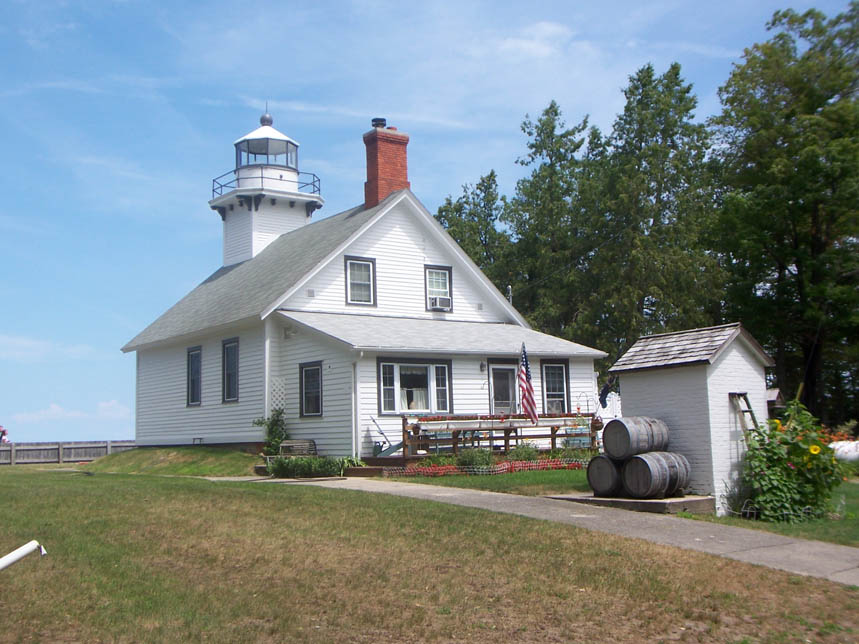
Peninsula Township is coterminous with (has the same dimensions as) the Old Mission Peninsula, which projects about 17 miles (27 km) north from its base in Traverse City into Grand Traverse Bay, an arm of Lake Michigan. The peninsula divides the Grand Traverse Bay into an East Arm and West Arm. The peninsula is well known for its cherry harvest and viticulture, and is included in the Old Mission Peninsula AVA, a federally recognized viticultural region. At the northern tip of the peninsula is Mission Point Light, which lies just south of the 45th parallel north.
Also part of Peninsula Township is Power Island, a small island in the West Arm of Grand Traverse Bay.
In 1836 the Odawa (Ottawa) and Chippewa Nations had ceded more than 13 million acres of the northwest section of Michigan's Lower Peninsula to the U.S. Government in the Treaty of Washington (1836). The treaty called for mission churches and schools to be established to educate the native children. Presbyterian ministers Peter Dougherty and John Fleming and four male missionaries founded a settlement at what is now Old Mission in May 1839, the first European settlement in the Grand Traverse Bay region.
Dougherty and Fleming spent the winter of 1838–1839 on Mackinac Island in Lake Huron, and sailed west in the spring. Upon their arrival at the Mission Peninsula in May, they encountered only one Native American resident of what appeared to be an abandoned village by the harbor. The native made smoke signals over a watchfire, summoning a canoe of tribesmen who paddled across the East Arm of Grand Traverse Bay to join the missionaries for a multi-day parlay. Dougherty and Fleming selected a nearby location to build the mission, one that was along canoe routes between native settlements. The mission church had peaceful relations with native residents in the surrounding area. The missionary settlement was originally called Grand Traverse.
In June 1839 Henry Schoolcraft arrived at the mission in a small vessel and helped to found a school there. By 1841 the seasonal village—important for sheltering tribal members during trading expeditions, hunts, communal fishing, and gathering wild rice—had grown to a permanent village, with 5 log buildings as well as several wigwams. By 1850 the settlement had grown to a considerable size, and the schooner Arrow was making weekly trips to the mission from Mackinaw City.
In 1851, a post office was established in Grand Traverse, with W.R. Stone as first postmaster. This was the only official post office in the Grand Traverse Bay region, indeed the only one between Mackinaw City and Croton. In 1852, Rev. Dougherty decided to move his mission across the west bay along the Leelanau Peninsula to an existing Native American village at the site of modern Omena, thus establishing a "New Mission". The previous community was nicknamed as the "Old Mission" in the early 1850s. By the time of the Civil War, the Presbyterian organization which funded Dougherty had financial difficulty, and missionary activities were discontinued. Dougherty sold his land there in 1868.
In 1852, the U.S. Postal Service, in consultation with Albert Tracy Lay, a founding father of Traverse City, decided to rename the post office at Grand Traverse to "Old Mission" and named the post office at the Boardman River from "Grand Traverse City" to "Traverse City", as the former was too long a name per post office guidelines. The name of Old Mission later was applied to the peninsula as a whole, which was previously referred to as the Grand Traverse Peninsula and the Ahgosa Peninsula.
Hub AI
Peninsula Township, Michigan AI simulator
(@Peninsula Township, Michigan_simulator)
Peninsula Township, Michigan
Peninsula Township is a civil township of Grand Traverse County in the U.S. state of Michigan. The township had a population of 6,068 at the 2020 census, an increase from 5,433 at the 2010 census.
Peninsula Township is coterminous with (has the same dimensions as) the Old Mission Peninsula, which projects about 17 miles (27 km) north from its base in Traverse City into Grand Traverse Bay, an arm of Lake Michigan. The peninsula divides the Grand Traverse Bay into an East Arm and West Arm. The peninsula is well known for its cherry harvest and viticulture, and is included in the Old Mission Peninsula AVA, a federally recognized viticultural region. At the northern tip of the peninsula is Mission Point Light, which lies just south of the 45th parallel north.
Also part of Peninsula Township is Power Island, a small island in the West Arm of Grand Traverse Bay.
In 1836 the Odawa (Ottawa) and Chippewa Nations had ceded more than 13 million acres of the northwest section of Michigan's Lower Peninsula to the U.S. Government in the Treaty of Washington (1836). The treaty called for mission churches and schools to be established to educate the native children. Presbyterian ministers Peter Dougherty and John Fleming and four male missionaries founded a settlement at what is now Old Mission in May 1839, the first European settlement in the Grand Traverse Bay region.
Dougherty and Fleming spent the winter of 1838–1839 on Mackinac Island in Lake Huron, and sailed west in the spring. Upon their arrival at the Mission Peninsula in May, they encountered only one Native American resident of what appeared to be an abandoned village by the harbor. The native made smoke signals over a watchfire, summoning a canoe of tribesmen who paddled across the East Arm of Grand Traverse Bay to join the missionaries for a multi-day parlay. Dougherty and Fleming selected a nearby location to build the mission, one that was along canoe routes between native settlements. The mission church had peaceful relations with native residents in the surrounding area. The missionary settlement was originally called Grand Traverse.
In June 1839 Henry Schoolcraft arrived at the mission in a small vessel and helped to found a school there. By 1841 the seasonal village—important for sheltering tribal members during trading expeditions, hunts, communal fishing, and gathering wild rice—had grown to a permanent village, with 5 log buildings as well as several wigwams. By 1850 the settlement had grown to a considerable size, and the schooner Arrow was making weekly trips to the mission from Mackinaw City.
In 1851, a post office was established in Grand Traverse, with W.R. Stone as first postmaster. This was the only official post office in the Grand Traverse Bay region, indeed the only one between Mackinaw City and Croton. In 1852, Rev. Dougherty decided to move his mission across the west bay along the Leelanau Peninsula to an existing Native American village at the site of modern Omena, thus establishing a "New Mission". The previous community was nicknamed as the "Old Mission" in the early 1850s. By the time of the Civil War, the Presbyterian organization which funded Dougherty had financial difficulty, and missionary activities were discontinued. Dougherty sold his land there in 1868.
In 1852, the U.S. Postal Service, in consultation with Albert Tracy Lay, a founding father of Traverse City, decided to rename the post office at Grand Traverse to "Old Mission" and named the post office at the Boardman River from "Grand Traverse City" to "Traverse City", as the former was too long a name per post office guidelines. The name of Old Mission later was applied to the peninsula as a whole, which was previously referred to as the Grand Traverse Peninsula and the Ahgosa Peninsula.
Recent media