


Community hub
Recent from talks
Contribute something to knowledge base
Content stats: 0 posts, 0 articles, 1 media, 0 notes
Members stats: 0 subscribers, 0 contributors, 0 moderators, 0 supporters
Subscribers
Supporters
Contributors
Moderators
Hub AI
Two-body problem AI simulator
(@Two-body problem_simulator)
Hub AI
Two-body problem AI simulator
(@Two-body problem_simulator)
Two-body problem
In classical mechanics, the two-body problem is to calculate and predict the motion of two massive bodies that are orbiting each other in space. The problem assumes that the two bodies are point particles that interact only with one another; the only force affecting each object arises from the other one, and all other objects are ignored.
The most prominent example of the classical two-body problem is the gravitational case (see also Kepler problem), arising in astronomy for predicting the orbits (or escapes from orbit) of objects such as satellites, planets, and stars. A two-point-particle model of such a system nearly always describes its behavior well enough to provide useful insights and predictions.
A simpler "one body" model, the "central-force problem", treats one object as the immobile source of a force acting on the other. One then seeks to predict the motion of the single remaining mobile object. Such an approximation can give useful results when one object is much more massive than the other (as with a light planet orbiting a heavy star, where the star can be treated as essentially stationary).
However, the one-body approximation is usually unnecessary except as a stepping stone. For many forces, including gravitational ones, the general version of the two-body problem can be reduced to a pair of one-body problems, allowing it to be solved completely, and giving a solution simple enough to be used effectively.
By contrast, the three-body problem (and, more generally, the n-body problem for n ≥ 3) cannot be solved in terms of first integrals, except in special cases.
The two-body problem is interesting in astronomy because pairs of astronomical objects are often moving rapidly in arbitrary directions (so their motions become interesting), widely separated from one another (so they will not collide) and even more widely separated from other objects (so outside influences will be small enough to be ignored safely).
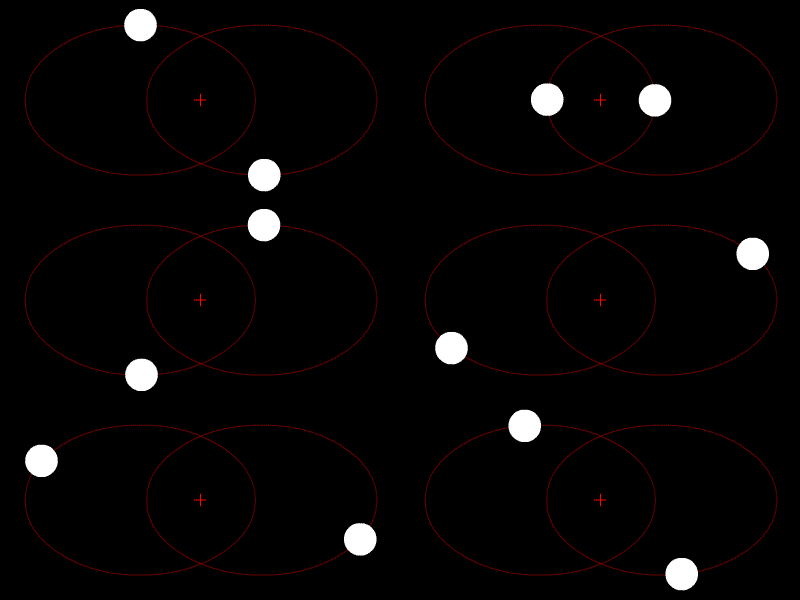
Under the force of gravity, each member of a pair of such objects will orbit their mutual center of mass in an elliptical pattern, unless they are moving fast enough to escape one another entirely, in which case their paths will diverge along other planar conic sections. If one object is very much heavier than the other, it will move far less than the other with reference to the shared center of mass. The mutual center of mass may even be inside the larger object.
For the derivation of the solutions to the problem, see Classical central-force problem or Kepler problem.
Two-body problem
In classical mechanics, the two-body problem is to calculate and predict the motion of two massive bodies that are orbiting each other in space. The problem assumes that the two bodies are point particles that interact only with one another; the only force affecting each object arises from the other one, and all other objects are ignored.
The most prominent example of the classical two-body problem is the gravitational case (see also Kepler problem), arising in astronomy for predicting the orbits (or escapes from orbit) of objects such as satellites, planets, and stars. A two-point-particle model of such a system nearly always describes its behavior well enough to provide useful insights and predictions.
A simpler "one body" model, the "central-force problem", treats one object as the immobile source of a force acting on the other. One then seeks to predict the motion of the single remaining mobile object. Such an approximation can give useful results when one object is much more massive than the other (as with a light planet orbiting a heavy star, where the star can be treated as essentially stationary).
However, the one-body approximation is usually unnecessary except as a stepping stone. For many forces, including gravitational ones, the general version of the two-body problem can be reduced to a pair of one-body problems, allowing it to be solved completely, and giving a solution simple enough to be used effectively.
By contrast, the three-body problem (and, more generally, the n-body problem for n ≥ 3) cannot be solved in terms of first integrals, except in special cases.
The two-body problem is interesting in astronomy because pairs of astronomical objects are often moving rapidly in arbitrary directions (so their motions become interesting), widely separated from one another (so they will not collide) and even more widely separated from other objects (so outside influences will be small enough to be ignored safely).
Under the force of gravity, each member of a pair of such objects will orbit their mutual center of mass in an elliptical pattern, unless they are moving fast enough to escape one another entirely, in which case their paths will diverge along other planar conic sections. If one object is very much heavier than the other, it will move far less than the other with reference to the shared center of mass. The mutual center of mass may even be inside the larger object.
For the derivation of the solutions to the problem, see Classical central-force problem or Kepler problem.
Recent media
Recent media