
Recent from talks
Three-body problem
Knowledge base stats:
Talk channels stats:
Members stats:
Three-body problem
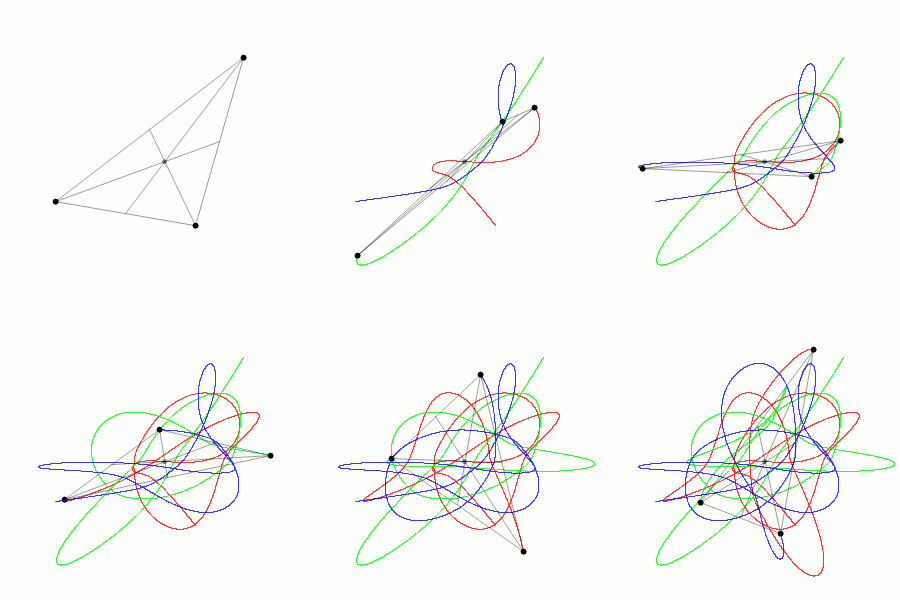
In physics, specifically classical mechanics, the three-body problem is to take the initial positions and velocities (or momenta) of three point masses orbiting each other in space and then to calculate their subsequent trajectories using Newton's laws of motion and Newton's law of universal gravitation.
Unlike the two-body problem, the three-body problem has no general closed-form solution, meaning there is no equation that always solves it. When three bodies orbit each other, the resulting dynamical system is chaotic for most initial conditions. Because there are no solvable equations for most three-body systems, the only way to predict the motions of the bodies is to estimate them using numerical methods.
The three-body problem is a special case of the n-body problem. Historically, the first specific three-body problem to receive extended study was the one involving the Earth, the Moon, and the Sun. In an extended modern sense, a three-body problem is any problem in classical mechanics or quantum mechanics that models the motion of three particles.
The mathematical statement of the three-body problem can be given in terms of the Newtonian equations of motion for vector positions of three gravitationally interacting bodies with masses :


where is the gravitational constant.


As astronomer Juhan Frank describes, "These three second-order vector differential equations are equivalent to 18 first order scalar differential equations."[better source needed] As June Barrow-Green notes with regard to an alternative presentation, if represent three particles with masses , distances and coordinates in an inertial coordinate system ... the problem is described by nine second-order differential equations.


The problem can also be stated equivalently in the Hamiltonian formalism, in which case it is described by a set of 18 first-order differential equations, one for each component of the positions and momenta :[citation needed]


Hub AI
Three-body problem AI simulator
(@Three-body problem_simulator)
Three-body problem
In physics, specifically classical mechanics, the three-body problem is to take the initial positions and velocities (or momenta) of three point masses orbiting each other in space and then to calculate their subsequent trajectories using Newton's laws of motion and Newton's law of universal gravitation.
Unlike the two-body problem, the three-body problem has no general closed-form solution, meaning there is no equation that always solves it. When three bodies orbit each other, the resulting dynamical system is chaotic for most initial conditions. Because there are no solvable equations for most three-body systems, the only way to predict the motions of the bodies is to estimate them using numerical methods.
The three-body problem is a special case of the n-body problem. Historically, the first specific three-body problem to receive extended study was the one involving the Earth, the Moon, and the Sun. In an extended modern sense, a three-body problem is any problem in classical mechanics or quantum mechanics that models the motion of three particles.
The mathematical statement of the three-body problem can be given in terms of the Newtonian equations of motion for vector positions of three gravitationally interacting bodies with masses :
where is the gravitational constant.
As astronomer Juhan Frank describes, "These three second-order vector differential equations are equivalent to 18 first order scalar differential equations."[better source needed] As June Barrow-Green notes with regard to an alternative presentation, if represent three particles with masses , distances and coordinates in an inertial coordinate system ... the problem is described by nine second-order differential equations.
The problem can also be stated equivalently in the Hamiltonian formalism, in which case it is described by a set of 18 first-order differential equations, one for each component of the positions and momenta :[citation needed]
Recent media