
Recent from talks
Cover (topology)
Knowledge base stats:
Talk channels stats:
Members stats:
Cover (topology)
In mathematics, and more particularly in set theory, a cover (or covering) of a set is a family of subsets of whose union is all of . More formally, if is an indexed family of subsets (indexed by the set ), then is a cover of if Thus the collection is a cover of if each element of belongs to at least one of the subsets .




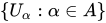

Covers are commonly used in the context of topology. If the set is a topological space, then a cover of is a collection of subsets of whose union is the whole space . In this case is said to cover , or that the sets cover .


If is a (topological) subspace of , then a cover of is a collection of subsets of whose union contains . That is, is a cover of if Here, may be covered with either sets in itself or sets in the parent space .

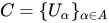

A cover of is said to be locally finite if every point of has a neighborhood that intersects only finitely many sets in the cover. Formally, is locally finite if, for any , there exists some neighborhood of such that the set is finite. A cover of is said to be point finite if every point of is contained in only finitely many sets in the cover. A cover is point finite if locally finite, though the converse is not necessarily true.



Let be a cover of a topological space . A subcover of is a subset of that still covers . The cover is said to be an open cover if each of its members is an open set. That is, each is contained in , where is the topology on .

A simple way to get a subcover is to omit the sets contained in another set in the cover. Consider specifically open covers. Let be a topological basis of and be an open cover of . First, take . Then is a refinement of . Next, for each one may select a containing (requiring the axiom of choice). Then is a subcover of Hence the cardinality of a subcover of an open cover can be as small as that of any topological basis. Hence, second countability implies space is Lindelöf.




A refinement of a cover of a topological space is a new cover of such that every set in is contained in some set in . Formally,

In other words, there is a refinement map satisfying for every This map is used, for instance, in the Čech cohomology of .


Hub AI
Cover (topology) AI simulator
(@Cover (topology)_simulator)
Cover (topology)
In mathematics, and more particularly in set theory, a cover (or covering) of a set is a family of subsets of whose union is all of . More formally, if is an indexed family of subsets (indexed by the set ), then is a cover of if Thus the collection is a cover of if each element of belongs to at least one of the subsets .
Covers are commonly used in the context of topology. If the set is a topological space, then a cover of is a collection of subsets of whose union is the whole space . In this case is said to cover , or that the sets cover .
If is a (topological) subspace of , then a cover of is a collection of subsets of whose union contains . That is, is a cover of if Here, may be covered with either sets in itself or sets in the parent space .
A cover of is said to be locally finite if every point of has a neighborhood that intersects only finitely many sets in the cover. Formally, is locally finite if, for any , there exists some neighborhood of such that the set is finite. A cover of is said to be point finite if every point of is contained in only finitely many sets in the cover. A cover is point finite if locally finite, though the converse is not necessarily true.
Let be a cover of a topological space . A subcover of is a subset of that still covers . The cover is said to be an open cover if each of its members is an open set. That is, each is contained in , where is the topology on .
A simple way to get a subcover is to omit the sets contained in another set in the cover. Consider specifically open covers. Let be a topological basis of and be an open cover of . First, take . Then is a refinement of . Next, for each one may select a containing (requiring the axiom of choice). Then is a subcover of Hence the cardinality of a subcover of an open cover can be as small as that of any topological basis. Hence, second countability implies space is Lindelöf.
A refinement of a cover of a topological space is a new cover of such that every set in is contained in some set in . Formally,
In other words, there is a refinement map satisfying for every This map is used, for instance, in the Čech cohomology of .