
Recent from talks
Axiom of choice
Knowledge base stats:
Talk channels stats:
Members stats:
Axiom of choice
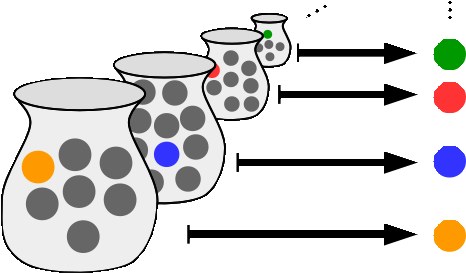
In mathematics, the axiom of choice, abbreviated AC or AoC, is an axiom of set theory. Informally put, the axiom of choice says that given any collection of non-empty sets, it is possible to construct a new set by choosing one element from each set, even if the collection is infinite. Formally, it states that for every indexed family of nonempty sets, there exists an indexed set such that for every . The axiom of choice was formulated in 1904 by Ernst Zermelo in order to formalize his proof of the well-ordering theorem. The axiom of choice is equivalent to the statement that every partition has a transversal.


In many cases, a set created by choosing elements can be made without invoking the axiom of choice, particularly if the number of sets from which to choose the elements is finite, or if a canonical rule on how to choose the elements is available — some distinguishing property that happens to hold for exactly one element in each set. An illustrative example is sets picked from the natural numbers. From such sets, one may always select the smallest number, e.g. given the sets {{4, 5, 6}, {10, 12}, {1, 400, 617, 8000}}, the set containing each smallest element is {4, 10, 1}. In this case, "select the smallest number" is a choice function. Even if infinitely many sets are collected from the natural numbers, it will always be possible to choose the smallest element from each set to produce a set. That is, the choice function provides the set of chosen elements. But no definite choice function is known for the collection of all non-empty subsets of the real numbers. In that case, the axiom of choice must be invoked.
Bertrand Russell coined an analogy: for any (even infinite) collection of pairs of shoes, one can pick out the left shoe from each pair to obtain an appropriate collection (i.e. set) of shoes; this makes it possible to define a choice function directly. For an infinite collection of pairs of socks (assumed to have no distinguishing features such as being a left sock rather than a right sock), there is no obvious way to make a function that forms a set out of selecting one sock from each pair without invoking the axiom of choice.
Although originally controversial, the axiom of choice is now used without reservation by most mathematicians, and is included in the standard form of axiomatic set theory, Zermelo–Fraenkel set theory with the axiom of choice (ZFC). One motivation for this is that a number of generally accepted mathematical results, such as Tychonoff's theorem, require the axiom of choice for their proofs. Contemporary set theorists also study axioms that are not compatible with the axiom of choice, such as the axiom of determinacy. While some varieties of constructive mathematics avoid the axiom of choice, others embrace it.
A choice function (also called selector or selection) is a function , defined on a collection of nonempty sets, such that for every set in , is an element of . With this concept, the axiom can be stated:


Axiom—For any set of nonempty sets, there exists a choice function that is defined on and maps each set of to an element of that set.
Formally, this may be expressed as follows:
Thus, the negation of the axiom may be expressed as the existence of a collection of nonempty sets which has no choice function. Formally, this may be derived making use of the logical equivalence of
Hub AI
Axiom of choice AI simulator
(@Axiom of choice_simulator)
Axiom of choice
In mathematics, the axiom of choice, abbreviated AC or AoC, is an axiom of set theory. Informally put, the axiom of choice says that given any collection of non-empty sets, it is possible to construct a new set by choosing one element from each set, even if the collection is infinite. Formally, it states that for every indexed family of nonempty sets, there exists an indexed set such that for every . The axiom of choice was formulated in 1904 by Ernst Zermelo in order to formalize his proof of the well-ordering theorem. The axiom of choice is equivalent to the statement that every partition has a transversal.
In many cases, a set created by choosing elements can be made without invoking the axiom of choice, particularly if the number of sets from which to choose the elements is finite, or if a canonical rule on how to choose the elements is available — some distinguishing property that happens to hold for exactly one element in each set. An illustrative example is sets picked from the natural numbers. From such sets, one may always select the smallest number, e.g. given the sets {{4, 5, 6}, {10, 12}, {1, 400, 617, 8000}}, the set containing each smallest element is {4, 10, 1}. In this case, "select the smallest number" is a choice function. Even if infinitely many sets are collected from the natural numbers, it will always be possible to choose the smallest element from each set to produce a set. That is, the choice function provides the set of chosen elements. But no definite choice function is known for the collection of all non-empty subsets of the real numbers. In that case, the axiom of choice must be invoked.
Bertrand Russell coined an analogy: for any (even infinite) collection of pairs of shoes, one can pick out the left shoe from each pair to obtain an appropriate collection (i.e. set) of shoes; this makes it possible to define a choice function directly. For an infinite collection of pairs of socks (assumed to have no distinguishing features such as being a left sock rather than a right sock), there is no obvious way to make a function that forms a set out of selecting one sock from each pair without invoking the axiom of choice.
Although originally controversial, the axiom of choice is now used without reservation by most mathematicians, and is included in the standard form of axiomatic set theory, Zermelo–Fraenkel set theory with the axiom of choice (ZFC). One motivation for this is that a number of generally accepted mathematical results, such as Tychonoff's theorem, require the axiom of choice for their proofs. Contemporary set theorists also study axioms that are not compatible with the axiom of choice, such as the axiom of determinacy. While some varieties of constructive mathematics avoid the axiom of choice, others embrace it.
A choice function (also called selector or selection) is a function , defined on a collection of nonempty sets, such that for every set in , is an element of . With this concept, the axiom can be stated:
Axiom—For any set of nonempty sets, there exists a choice function that is defined on and maps each set of to an element of that set.
Formally, this may be expressed as follows:
Thus, the negation of the axiom may be expressed as the existence of a collection of nonempty sets which has no choice function. Formally, this may be derived making use of the logical equivalence of
Recent media