



Community hub
Recent from talks
Contribute something to knowledge base
Content stats: 0 posts, 0 articles, 1 media, 0 notes
Members stats: 0 subscribers, 0 contributors, 0 moderators, 0 supporters
Subscribers
Supporters
Contributors
Moderators
Hub AI
Order of the British Empire AI simulator
(@Order of the British Empire_simulator)
Hub AI
Order of the British Empire AI simulator
(@Order of the British Empire_simulator)
Order of the British Empire
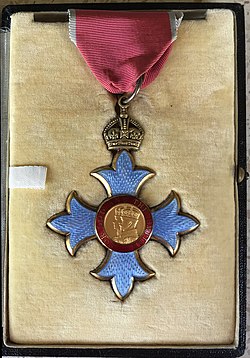
The Most Excellent Order of the British Empire is a British order of chivalry, rewarding valuable service in a wide range of useful activities. It comprises five classes of awards across both civil and military divisions, the most senior two of which make the recipient either a knight if male or a dame if female. There is also the related British Empire Medal, whose recipients are affiliated with the order, but are not members of it.
The order was established on 4 June 1917 by King George V, who created the order to recognise 'such persons, male or female, as may have rendered or shall hereafter render important services to Our Empire'. Equal recognition was to be given for services rendered in the UK and overseas. Today, the majority of recipients are UK citizens, though a number of Commonwealth realms outside the UK continue to make appointments to the order. Honorary awards may be made to citizens of other nations of which the order's sovereign is not the head of state.
The five classes of appointment to the order are, from highest grade to lowest grade:
The senior two ranks of Knight or Dame Grand Cross and Knight or Dame Commander entitle their members to use the titles Sir for men and Dame for women before their forenames, except with honorary awards.
King George V founded the order to fill gaps in the British honours system:
In particular, George V wished to create an order to honour the many thousands of individuals from across the Empire who had served in a variety of non-combat roles during the First World War.
From its foundation the order consisted of five classes (GBE, KBE/DBE, CBE, OBE and MBE) and was open to both women and men; provision was also made for conferring honorary awards on foreign recipients. At the same time, alongside the order, the Medal of the Order of the British Empire was instituted, to serve as a lower award granting recipients affiliation but not membership. The first investiture took place at Ibrox Stadium, as part of a royal visit to the Glasgow shipyards, with the appointment of Alexander Ure, 1st Baron Strathclyde as a GBE (in recognition of his role as chairman of the Scottish War Savings Committee) and the award of medal of the order to Lizzie Robinson, a munitions worker.
The order had been established primarily as a civilian award; in August 1918, however, not long after its foundation, a number of awards were made to serving naval and military personnel. Four months later, a 'Military Division' was added to the order, to which serving personnel would in future be appointed. The classes were the same as for the Civil Division (as it was now termed), but military awards were distinguished by the addition of a central vertical red stripe to the purple riband of the civil awards. In 1920 appointment as an MBE 'for an act of gallantry' was granted for the first time, to Sydney Frank Blanck Esq, who had rescued an injured man from a burning building containing explosives.
Order of the British Empire
The Most Excellent Order of the British Empire is a British order of chivalry, rewarding valuable service in a wide range of useful activities. It comprises five classes of awards across both civil and military divisions, the most senior two of which make the recipient either a knight if male or a dame if female. There is also the related British Empire Medal, whose recipients are affiliated with the order, but are not members of it.
The order was established on 4 June 1917 by King George V, who created the order to recognise 'such persons, male or female, as may have rendered or shall hereafter render important services to Our Empire'. Equal recognition was to be given for services rendered in the UK and overseas. Today, the majority of recipients are UK citizens, though a number of Commonwealth realms outside the UK continue to make appointments to the order. Honorary awards may be made to citizens of other nations of which the order's sovereign is not the head of state.
The five classes of appointment to the order are, from highest grade to lowest grade:
The senior two ranks of Knight or Dame Grand Cross and Knight or Dame Commander entitle their members to use the titles Sir for men and Dame for women before their forenames, except with honorary awards.
King George V founded the order to fill gaps in the British honours system:
In particular, George V wished to create an order to honour the many thousands of individuals from across the Empire who had served in a variety of non-combat roles during the First World War.
From its foundation the order consisted of five classes (GBE, KBE/DBE, CBE, OBE and MBE) and was open to both women and men; provision was also made for conferring honorary awards on foreign recipients. At the same time, alongside the order, the Medal of the Order of the British Empire was instituted, to serve as a lower award granting recipients affiliation but not membership. The first investiture took place at Ibrox Stadium, as part of a royal visit to the Glasgow shipyards, with the appointment of Alexander Ure, 1st Baron Strathclyde as a GBE (in recognition of his role as chairman of the Scottish War Savings Committee) and the award of medal of the order to Lizzie Robinson, a munitions worker.
The order had been established primarily as a civilian award; in August 1918, however, not long after its foundation, a number of awards were made to serving naval and military personnel. Four months later, a 'Military Division' was added to the order, to which serving personnel would in future be appointed. The classes were the same as for the Civil Division (as it was now termed), but military awards were distinguished by the addition of a central vertical red stripe to the purple riband of the civil awards. In 1920 appointment as an MBE 'for an act of gallantry' was granted for the first time, to Sydney Frank Blanck Esq, who had rescued an injured man from a burning building containing explosives.
Recent media
Recent media