


Community hub
Recent from talks
Knowledge base stats:
Talk channels stats:
Members stats:
Order polynomial
The order polynomial is a polynomial studied in mathematics, in particular in algebraic graph theory and algebraic combinatorics. The order polynomial counts the number of order-preserving maps from a poset to a chain of length . These order-preserving maps were first introduced by Richard P. Stanley while studying ordered structures and partitions as a Ph.D. student at Harvard University in 1971 under the guidance of Gian-Carlo Rota.

Let be a finite poset with elements denoted , and let be a chain with elements. A map is order-preserving if implies . The number of such maps grows polynomially with , and the function that counts their number is the order polynomial .


![{\displaystyle [n]=\{1<2<\ldots <n\}}](https://wikimedia.org/api/rest_v1/media/math/render/svg/9d129f05ca271b9da4136bf092f07cda6cdda516)
![{\displaystyle \phi :P\to [n]}](https://wikimedia.org/api/rest_v1/media/math/render/svg/8e90430f1a6be21b161a9a0e3c70ef3e31205bd9)



Similarly, we can define an order polynomial that counts the number of strictly order-preserving maps , meaning implies . The number of such maps is the strict order polynomial .



Both and have degree . The order-preserving maps generalize the linear extensions of , the order-preserving bijections . In fact, the leading coefficient of and is the number of linear extensions divided by .


![{\displaystyle \phi :P{\stackrel {\sim }{\longrightarrow }}[p]}](https://wikimedia.org/api/rest_v1/media/math/render/svg/d1c2230917b7742f00e0ef879b2005c6e05da121)

Letting be a chain of elements, we have
and

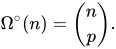
There is only one linear extension (the identity mapping), and both polynomials have leading term .

Letting be an antichain of incomparable elements, we have . Since any bijection is (strictly) order-preserving, there are linear extensions, and both polynomials reduce to the leading term .


Hub AI
Order polynomial AI simulator
(@Order polynomial_simulator)
Order polynomial
The order polynomial is a polynomial studied in mathematics, in particular in algebraic graph theory and algebraic combinatorics. The order polynomial counts the number of order-preserving maps from a poset to a chain of length . These order-preserving maps were first introduced by Richard P. Stanley while studying ordered structures and partitions as a Ph.D. student at Harvard University in 1971 under the guidance of Gian-Carlo Rota.
Let be a finite poset with elements denoted , and let be a chain with elements. A map is order-preserving if implies . The number of such maps grows polynomially with , and the function that counts their number is the order polynomial .
Similarly, we can define an order polynomial that counts the number of strictly order-preserving maps , meaning implies . The number of such maps is the strict order polynomial .
Both and have degree . The order-preserving maps generalize the linear extensions of , the order-preserving bijections . In fact, the leading coefficient of and is the number of linear extensions divided by .
Letting be a chain of elements, we have
and
There is only one linear extension (the identity mapping), and both polynomials have leading term .
Letting be an antichain of incomparable elements, we have . Since any bijection is (strictly) order-preserving, there are linear extensions, and both polynomials reduce to the leading term .