
Hubbry Logo
Ordinal analysisOrdinal analysisMain
Open search
Ordinal analysis
Community hub
Ordinal analysis
logo
7 pages, 0 posts
0 subscribers
Be the first to start a discussion here.
Ordinal analysis
Ordinal analysis
from Wikipedia

In proof theory, ordinal analysis assigns ordinals (often large countable ordinals) to mathematical theories as a measure of their strength. If theories have the same proof-theoretic ordinal they are often equiconsistent, and if one theory has a larger proof-theoretic ordinal than another it can often prove the consistency of the second theory.

In addition to obtaining the proof-theoretic ordinal of a theory, in practice ordinal analysis usually also yields various other pieces of information about the theory being analyzed, for example characterizations of the classes of provably recursive, hyperarithmetical, or functions of the theory.[1]

History

[edit]

The field of ordinal analysis was formed when Gerhard Gentzen in 1934 used cut elimination to prove, in modern terms, that the proof-theoretic ordinal of Peano arithmetic is ε0. See Gentzen's consistency proof.

Definition

[edit]

Ordinal analysis concerns true, effective (recursive) theories that can interpret a sufficient portion of arithmetic to make statements about ordinal notations.

The proof-theoretic ordinal of such a theory is the supremum of the order types of all ordinal notations (necessarily recursive, see next section) that the theory can prove are well founded—the supremum of all ordinals for which there exists a notation in Kleene's sense such that proves that is an ordinal notation. Equivalently, it is the supremum of all ordinals such that there exists a recursive relation on (the set of natural numbers) that well-orders it with ordinal and such that proves transfinite induction of arithmetical statements for .

Ordinal notations

[edit]

Some theories, such as subsystems of second-order arithmetic (Z2), have no conceptualization or way to make arguments about transfinite ordinals. For example, to formalize what it means for a subsystem of Z2 to "prove well-ordered", we instead construct an ordinal notation with order type . can now work with various transfinite induction principles along , which substitute for reasoning about set-theoretic ordinals.

However, some pathological notation systems exist that are unexpectedly difficult to work with. For example, Rathjen gives a primitive recursive notation system that is well-founded if and only if PA is consistent,[2]p. 3 despite having order type . Including such a notation in the ordinal analysis of PA would result in the false equality .

Upper bound

[edit]

Since an ordinal notation must be recursive, the proof-theoretic ordinal of any theory is less than or equal to the Church–Kleene ordinal . In particular, the proof-theoretic ordinal of an inconsistent theory is equal to , because an inconsistent theory trivially proves that all ordinal notations are well-founded.

For any theory that's both -axiomatizable and -sound, the existence of a recursive ordering that the theory fails to prove is well-ordered follows from the bounding theorem, and said provably well-founded ordinal notations are in fact well-founded by -soundness. Thus the proof-theoretic ordinal of a -sound theory that has a axiomatization will always be a (countable) recursive ordinal, that is, strictly less than . [2]Theorem 2.21

Examples

[edit]

Theories with proof-theoretic ordinal ω

[edit]
  • Q, Robinson arithmetic (although the definition of the proof-theoretic ordinal for such weak theories has to be tweaked)[citation needed].
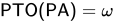
  • PA, the first-order theory of the nonnegative part of a discretely ordered ring.

Theories with proof-theoretic ordinal ω2

[edit]
  • RFA, rudimentary function arithmetic.[3]
  • 0, arithmetic with induction on Δ0-predicates without any axiom asserting that exponentiation is total.

Theories with proof-theoretic ordinal ω3

[edit]

Friedman's grand conjecture suggests that much "ordinary" mathematics can be proved in weak systems having this as their proof-theoretic ordinal.

Theories with proof-theoretic ordinal ωn (for n = 2, 3, ... ω)

[edit]
  • 0 or EFA augmented by an axiom ensuring that each element of the n-th level of the Grzegorczyk hierarchy is total.

Theories with proof-theoretic ordinal ωω

[edit]

Theories with proof-theoretic ordinal ε0

[edit]

Theories with proof-theoretic ordinal the Feferman–Schütte ordinal Γ0

[edit]

This ordinal is sometimes considered to be the upper limit for "predicative" theories.

Theories with proof-theoretic ordinal the Bachmann–Howard ordinal

[edit]

The Kripke–Platek or CZF set theories are weak set theories without axioms for the full powerset given as set of all subsets. Instead, they tend to either have axioms of restricted separation and formation of new sets, or they grant existence of certain function spaces (exponentiation) instead of carving them out from bigger relations.

Theories with larger proof-theoretic ordinals

[edit]
Unsolved problem in mathematics
What is the proof-theoretic ordinal of full second-order arithmetic?[4]
  • , Π11 comprehension has a rather large proof-theoretic ordinal, which was described by Takeuti in terms of "ordinal diagrams",[5]p. 13 and which is bounded by ψ0ω) in Buchholz's notation. It is also the ordinal of , the theory of finitely iterated inductive definitions. And also the ordinal of MLW, Martin-Löf type theory with indexed W-Types Setzer (2004).
  • IDω, the theory of ω-iterated inductive definitions. Its proof-theoretic ordinal is equal to the Takeuti–Feferman–Buchholz ordinal.
  • T0, Feferman's constructive system of explicit mathematics has a larger proof-theoretic ordinal, which is also the proof-theoretic ordinal of the KPi, Kripke–Platek set theory with iterated admissibles and .
  • KPi, an extension of Kripke–Platek set theory based on a recursively inaccessible ordinal, has a very large proof-theoretic ordinal described in a 1983 paper of Jäger and Pohlers, where I is the smallest inaccessible.[6] This ordinal is also the proof-theoretic ordinal of .
  • KPM, an extension of Kripke–Platek set theory based on a recursively Mahlo ordinal, has a very large proof-theoretic ordinal θ, which was described by Rathjen (1990).
  • TTM, an extension of Martin-Löf type theory by one Mahlo-universe, has an even larger proof-theoretic ordinal .
  • has a proof-theoretic ordinal equal to , where refers to the first weakly compact, due to (Rathjen 1993)
  • has a proof-theoretic ordinal equal to , where refers to the first -indescribable and , due to (Stegert 2010).
  • has a proof-theoretic ordinal equal to where is a cardinal analogue of the least ordinal which is -stable for all and , due to (Stegert 2010).

Most theories capable of describing the power set of the natural numbers have proof-theoretic ordinals that are so large that no explicit combinatorial description has yet been given. This includes , full second-order arithmetic () and set theories with powersets including ZF and ZFC. The strength of intuitionistic ZF (IZF) equals that of ZF.

Table of ordinal analyses

[edit]
Table of proof-theoretic ordinals
Ordinal First-order arithmetic Second-order arithmetic Kripke–Platek set theory Type theory Constructive set theory Explicit mathematics
,
,
, ,
[1] ,
, [7]p. 13 [7]p. 13, [7]p. 13
[8][7]p. 13 [9]: 40 
[7]p. 13 [7]p. 13, [7]p. 13, [10]p. 8, [11]p. 148, [11]p. 148, [12] [13]p. 869
,[14] [15]: 8 
[16]p. 959
,[17][15] ,[18]: 7  [17]p. 17, [17]p. 5
, [17]p. 52
, [19]p. 137 , [20]
, [21]p. 17, [21]p. 17 [22]p. 140, [22]p. 140, [22]p. 140, [10]p. 8 [13]p. 870
[10]p. 27, [10]p. 27
[23]p.9
[2]
,[24] , [21]p. 22, [21]p. 22, [25], [19]p. 137 , , ,[26] [27]p. 26 [13]p. 878, [13]p. 878 ,
[28]p.13
[29]
[18]: 7 
[18]: 7 
, [30] [31]p.1167, [31]p.1167
[30] [31]p.1167, [31]p.1167
[30]: 11 
[32]p.233, [32]p.233 [33]p.276 [33]p.276
[32]p.233, [18] [33]p.277 [33]p.277
[18]: 7 
,[34] [18]: 7 
, [19]p. 171 [18]: 7  [19]p. 171
[3] [10]p. 8 ,[2] , [13]p. 869
[10]p. 31, [10]p. 31, [10]p. 31
[35]
[10]p. 33, [10]p. 33, [10]p. 33
[4] , [27]p. 26, [27]p. 26, [27]p. 26, [27]p. 26, [27]p. 26 [27]p. 26, [27]p. 26
[4]p. 28 [4]p. 28, [36]p. 27
[37]
[38]p. 14
[39]
[37]
[37]
[5]
[4]p. 28 [36]p. 27
[4]p. 28, [36]p. 27
[6]
, , [40] ,
, , ,,, [40]: 72  ,[40]: 72  ,[40]: 72 

, [40]: 72 

, , [40]: 72  [40]: 72 
, , [40]: 72  [40]: 72 
, [40]: 72  [40]: 72 
, , [40]: 72  , [40]: 72 
, , [40]: 72  , [40]: 72 
[7] [4]p. 28,
[41]: 38 
[8]
[9]
[10] [42]
[11] [43] [43]
[12] [44]
[13] [45]
[14] [45]
[46] ,[46] [47]
[46] ,
[48] ,
? [48] , , Bar [49] [50]

Key

[edit]

This is a list of symbols used in this table:

  • ψ represents various ordinal collapsing functions as defined in their respective citations.
  • Ψ represents either Rathjen's or Stegert's Psi.
  • φ represents Veblen's function.
  • ω represents the first transfinite ordinal.
  • εα represents the epsilon numbers.
  • Γα represents the gamma numbers (Γ0 is the Feferman–Schütte ordinal)
  • Ωα represent the uncountable ordinals (Ω1, abbreviated Ω, is ω1). Countability is considered necessary for an ordinal to be regarded as proof theoretic.
  • is an ordinal term denoting a stable ordinal, and the least admissible ordinal above .
  • is an ordinal term denoting an ordinal such that ; N is a variable that defines a series of ordinal analyses of the results of forall . when N=1,
  • Additional symbols can be found in the notes.

This is a list of the abbreviations used in this table:

  • First-order arithmetic
    • is Robinson arithmetic
    • is the first-order theory of the nonnegative part of a discretely ordered ring.
    • is rudimentary function arithmetic.
    • is arithmetic with induction restricted to Δ0-predicates without any axiom asserting that exponentiation is total.
    • is elementary function arithmetic.
    • is arithmetic with induction restricted to Δ0-predicates augmented by an axiom asserting that exponentiation is total.
    • is elementary function arithmetic augmented by an axiom ensuring that each element of the n-th level of the Grzegorczyk hierarchy is total.
    • is augmented by an axiom ensuring that each element of the n-th level of the Grzegorczyk hierarchy is total.
    • is primitive recursive arithmetic.
    • is arithmetic with induction restricted to Σ1-predicates.
    • is Peano arithmetic.
    • is but with induction only for positive formulas.
    • extends PA by ν iterated fixed points of monotone operators.
    • is not exactly a first-order arithmetic system, but captures what one can get by predicative reasoning based on the natural numbers.
    • is autonomously iterated (in other words, once an ordinal is defined, it can be used to index a new series of definitions.)
    • extends PA by ν iterated least fixed points of monotone operators.
    • is not exactly a first-order arithmetic system, but captures what one can get by predicative reasoning based on ν-times iterated generalized inductive definitions.
    • is autonomously iterated .
    • is a weakened version of based on W-types.
    • is a transfinite induction of length α no more than -formulas. It happens to be the representation of the ordinal notation when used in first-order arithmetic.
  • Second-order arithmetic

In general, a subscript 0 means that the induction scheme is restricted to a single set induction axiom.

    • is a second order form of sometimes used in reverse mathematics.
    • is a second order form of sometimes used in reverse mathematics.
    • is recursive comprehension.
    • is weak Kőnig's lemma.
    • is arithmetical comprehension.
    • is plus the full second-order induction scheme.
    • is the predicate "the nth Turing jump of X is Y".
    • is arithmetical transfinite recursion.
    • is plus the full second-order induction scheme.
    • is the bar induction axiom.
    • is plus the assertion "every true -sentence with parameters holds in a (countable coded) -model of ".
  • Kripke–Platek set theory
    • is Kripke–Platek set theory with the axiom of infinity.
    • is Kripke–Platek set theory, whose universe is an admissible set containing .
    • is a weakened version of based on W-types.
    • asserts that the universe is a limit of admissible sets.
    • is a weakened version of based on W-types.
    • asserts that the universe is inaccessible sets.
    • asserts that the universe is hyperinaccessible: an inaccessible set and a limit of inaccessible sets.
    • asserts that the universe is a Mahlo set.
    • is augmented by a certain first-order reflection scheme.
    • is KPi augmented by the axiom .
    • is KPI augmented by the assertion "at least one recursively Mahlo ordinal exists".
    • is with an axiom stating that 'there exists a non-empty and transitive set M such that '.

A superscript zero indicates that -induction is removed (making the theory significantly weaker).

  • Type theory
    • is the Herbelin-Patey Calculus of Primitive Recursive Constructions.
    • is type theory without W-types and with universes.
    • is type theory without W-types and with finitely many universes.
    • is type theory with a next universe operator.
    • is type theory without W-types and with a superuniverse.
    • is type theory without W-types and with autonomously iterated universes.
    • is type theory with one universe and Aczel's type of iterative sets.
    • is type theory with indexed W-Types.
    • is type theory with W-types and one universe.
    • is type theory with W-types and finitely many universes.
    • is type theory with W-types and with autonomously iterated universes.
    • is type theory with a Mahlo universe.
    • is System F, also polymorphic lambda calculus or second-order lambda calculus.
  • Constructive set theory
    • is Aczel's constructive set theory.
    • is plus the regular extension axiom.
    • is plus the full-second order induction scheme.
    • is with a Mahlo universe.
  • Explicit mathematics
    • is basic explicit mathematics plus elementary comprehension
    • is plus join rule
    • is plus join axioms
    • is a weak variant of the Feferman's .
    • is , where is inductive generation.
    • is , where is the full second-order induction scheme.

See also

[edit]

Notes

[edit]

Citations

[edit]
  1. ^ M. Rathjen, "Admissible Proof Theory and Beyond". In Studies in Logic and the Foundations of Mathematics vol. 134 (1995), pp.123--147.
  2. ^ a b c Rathjen, The Realm of Ordinal Analysis. Accessed 2021 September 29.
  3. ^ Krajicek, Jan (1995). Bounded Arithmetic, Propositional Logic and Complexity Theory. Cambridge University Press. pp. 18–20. ISBN 9780521452052. defines the rudimentary sets and rudimentary functions, and proves them equivalent to the Δ0-predicates on the naturals. An ordinal analysis of the system can be found in Rose, H. E. (1984). Subrecursion: functions and hierarchies. University of Michigan: Clarendon Press. ISBN 9780198531890.
  4. ^ a b c d e f M. Rathjen, Proof Theory: From Arithmetic to Set Theory (p.28). Accessed 14 August 2022.
  5. ^ Rathjen, Michael (2006), "The art of ordinal analysis" (PDF), International Congress of Mathematicians, vol. II, Zürich: Eur. Math. Soc., pp. 45–69, MR 2275588, archived from the original (PDF) on 2009-12-22, retrieved 2024-05-03
  6. ^ D. Madore, A Zoo of Ordinals (2017, p.2). Accessed 12 August 2022.
  7. ^ a b c d e f g J. Avigad, R. Sommer, "A Model-Theoretic Approach to Ordinal Analysis" (1997).
  8. ^ M. Rathjen, W. Carnielli, "Hydrae and subsystems of arithmetic" (1991)
  9. ^ Jeroen Van der Meeren; Rathjen, Michael; Weiermann, Andreas (2014). "An order-theoretic characterization of the Howard-Bachmann-hierarchy". arXiv:1411.4481 [math.LO].
  10. ^ a b c d e f g h i j k G. Jäger, T. Strahm, "Second order theories with ordinals and elementary comprehension". Archive for Mathematical Logic vol. 34 (1995).
  11. ^ a b H. M. Friedman, S. G. Simpson, R. L. Smith, "Countable algebra and set existence axioms". Annals of Pure and Applied Logic vol. 25, iss. 2 (1983).
  12. ^ Follows from theorem IX.4.4 of S. G. Simpson, Subsystems of Second-Order Arithmetic (2009).
  13. ^ a b c d e G. Jäger, "The Strength of Admissibility Without Foundation". Journal of Symbolic Logic vol. 49, no. 3 (1984).
  14. ^ B. Afshari, M. Rathjen, "Ordinal Analysis and the Infinite Ramsey Theorem". In Lecture Notes in Computer Science vol. 7318 (2012)
  15. ^ a b Marcone, Alberto; Montalbán, Antonio (2011). "The Veblen functions for computability theorists". The Journal of Symbolic Logic. 76 (2): 575–602. arXiv:0910.5442. doi:10.2178/jsl/1305810765. S2CID 675632.
  16. ^ S. Feferman, "Theories of finite type related to mathematical practice". In Handbook of Mathematical Logic, Studies in Logic and the Foundations of Mathematics vol. 90 (1977), ed. J. Barwise, pub. North Holland.
  17. ^ a b c d M. Heissenbüttel, "Theories of ordinal strength and " (2001)
  18. ^ a b c d e f g D. Probst, "A modular ordinal analysis of metapredicative subsystems of second-order arithmetic" (2017)
  19. ^ a b c d F. Ranzi, From a Flexible Type System to Metapredicative Wellordering Proofs. Doctoral thesis, University of Bern, 2015.
  20. ^ A. Cantini, "On the relation between choice and comprehension principles in second order arithmetic", Journal of Symbolic Logic vol. 51 (1986), pp. 360--373.
  21. ^ a b c d Fischer, Martin; Nicolai, Carlo; Pablo Dopico Fernandez (2020). "Nonclassical truth with classical strength. A proof-theoretic analysis of compositional truth over HYPE". arXiv:2007.07188 [math.LO].
  22. ^ a b c S. G. Simpson, "Friedman's Research on Subsystems of Second Order Arithmetic". In Harvey Friedman's Research on the Foundations of Mathematics, Studies in Logic and the Foundations of Mathematics vol. 117 (1985), ed. L. Harrington, M. Morley, A. Šcedrov, S. G. Simpson, pub. North-Holland.
  23. ^ J. Avigad, "An ordinal analysis of admissible set theory using recursion on ordinal notations". Journal of Mathematical Logic vol. 2, no. 1, pp.91--112 (2002).
  24. ^ S. Feferman, "Iterated inductive fixed-point theories: application fo Hancock's conjecture". In Patras Logic Symposion, Studies in Logic and the Foundations of Mathematics vol. 109 (1982).
  25. ^ S. Feferman, T. Strahm, "The unfolding of non-finitist arithmetic", Annals of Pure and Applied Logic vol. 104, no.1--3 (2000), pp.75--96.
  26. ^ S. Feferman, G. Jäger, "Choice principles, the bar rule and autonomously iterated comprehension schemes in analysis", Journal of Symbolic Logic vol. 48, no. (1983), pp.63--70.
  27. ^ a b c d e f g h U. Buchholtz, G. Jäger, T. Strahm, "Theories of proof-theoretic strength ". In Concepts of Proof in Mathematics, Philosophy, and Computer Science (2016), ed. D. Probst, P. Schuster. DOI 10.1515/9781501502620-007.
  28. ^ T. Strahm, "Autonomous fixed point progressions and fixed point transfinite recursion" (2000). In Logic Colloquium '98, ed. S. R. Buss, P. Hájek, and P. Pudlák . DOI 10.1017/9781316756140.031
  29. ^ G. Jäger, T. Strahm, "Fixed point theories and dependent choice". Archive for Mathematical Logic vol. 39 (2000), pp.493--508.
  30. ^ a b c T. Strahm, "Autonomous fixed point progressions and fixed point transfinite recursion" (2000)
  31. ^ a b c d C. Rüede, "Transfinite dependent choice and ω-model reflection". Journal of Symbolic Logic vol. 67, no. 3 (2002).
  32. ^ a b c C. Rüede, "The proof-theoretic analysis of Σ11 transfinite dependent choice". Annals of Pure and Applied Logic vol. 122 (2003).
  33. ^ a b c d T. Strahm, "Wellordering Proofs for Metapredicative Mahlo". Journal of Symbolic Logic vol. 67, no. 1 (2002)
  34. ^ F. Ranzi, T. Strahm, "A flexible type system for the small Veblen ordinal" (2019). Archive for Mathematical Logic 58: 711–751.
  35. ^ K. Fujimoto, "Notes on some second-order systems of iterated inductive definitions and -comprehensions and relevant subsystems of set theory". Annals of Pure and Applied Logic, vol. 166 (2015), pp. 409--463.
  36. ^ a b c G. Jäger, T. Strahm, "The proof-theoretic analysis of the Suslin operator in applicative theories". In Reflections on the Foundations of Mathematics: Essays in Honor of Solomon Feferman (2002).
  37. ^ a b c Krombholz, Martin; Rathjen, Michael (2019). "Upper bounds on the graph minor theorem". arXiv:1907.00412 [math.LO].
  38. ^ W. Buchholz, S. Feferman, W. Pohlers, W. Sieg, Iterated Inductive Definitions and Subsystems of Analysis: Recent Proof-Theoretical Studies
  39. ^ W. Buchholz, Proof Theory of Impredicative Subsystems of Analysis (Studies in Proof Theory, Monographs, Vol 2 (1988)
  40. ^ a b c d e f g h i j k l m n o M. Rathjen, "Investigations of Subsystems of Second Order Arithmetic and Set Theory in Strength between and : Part I". Archived 7 December 2023.
  41. ^ M. Rathjen, "The Strength of Some Martin-Löf Type Theories"
  42. ^ See conservativity result in Rathjen (1996), "The Recursively Mahlo Property in Second Order Arithmetic", Math. Log. Quart., 42: 59–66, doi:10.1002/malq.19960420106 giving same ordinal as
  43. ^ a b A. Setzer, "A Model for a type theory with Mahlo universe" (1996).
  44. ^ M. Rathjen, "Proof Theory of Reflection". Annals of Pure and Applied Logic vol. 68, iss. 2 (1994), pp.181--224.
  45. ^ a b Stegert, Jan-Carl, "Ordinal Proof Theory of Kripke-Platek Set Theory Augmented by Strong Reflection Principles" (2010).
  46. ^ a b c Arai, Toshiyasu (2023-04-01). "Lectures on Ordinal Analysis". arXiv:2304.00246 [math.LO].
  47. ^ Arai, Toshiyasu (2023-04-07). "Well-foundedness proof for -reflection". arXiv:2304.03851 [math.LO].
  48. ^ a b Arai, Toshiyasu (2024-02-12). "An ordinal analysis of -Collection". arXiv:2311.12459 [math.LO].
  49. ^ Blot, Valentin (2022-08-02). "A direct computational interpretation of second-order arithmetic via update recursion". Proceedings of the 37th Annual ACM/IEEE Symposium on Logic in Computer Science. ACM. pp. 1–11. doi:10.1145/3531130.3532458. ISBN 978-1-4503-9351-5.
  50. ^ Lubarsky, Robert (2015-10-02). "CZF and Second Order Arithmetic". arXiv:1510.00469 [math.LO].

References

[edit]
Revisions and contributorsEdit on WikipediaRead on Wikipedia
from Grokipedia
Ordinal analysis is a central area of in that quantifies the proof-theoretic strength of formal theories by associating them with specific countable ordinals, enabling consistency proofs through finitistic means extended by up to those ordinals. This approach originated as part of David Hilbert's program in the to secure the foundations of by providing finitary consistency proofs for axiomatic systems, though it evolved significantly after Kurt of 1931 demonstrated the limitations of purely finitistic methods. A landmark achievement came in 1936 when Gerhard proved the consistency of Peano arithmetic (PA) using along the ordinal ε₀, the smallest ordinal closed under the operation α ↦ ω^α, marking the birth of ordinal analysis as a systematic tool. Key concepts in ordinal analysis include the proof-theoretic ordinal of a theory T, often defined as the smallest ordinal |T|{Con} such that a base theory like (PRA) equipped with up to |T|{Con} proves Con(T), the consistency of T. Another measure is |T|_{sup}, the supremum of the ordinals corresponding to well-founded orderings provable in T. These ordinals are represented using computable notation systems, such as those based on normal forms or the Veblen hierarchy, which encode transfinite structures in a way that allows effective proof manipulations. Central techniques involve cut-elimination theorems, like Gentzen's Hauptsatz, applied to infinitary calculi, and normalization in typed calculi, which bound the complexity of proofs and yield upper bounds on the ordinals. Notable results include the analysis of subsystems: predicative analysis reaches the Γ₀, the limit of the Feferman hierarchy of Mahlo ordinals, while Π¹₁-comprehension with bar induction corresponds to ψ(Ω_ω), involving Bachmann–Howard notation with large Veblen ordinals Ω. Ordinal analysis has also been extended to stronger systems, such as Kripke–Platek (analyzed up to ψ(ε_{M+1})), and has applications in establishing equiconsistencies, proving combinatorial independence results like , and comparing the strengths of type theories via the Curry–Howard isomorphism. Despite its successes, ordinal analyses remain challenging for very strong theories, often requiring innovative ordinal hierarchies that mimic large cardinals in .

Fundamentals

Overview and Motivation

Ordinal analysis is a branch of that assigns a proof-theoretic ordinal to a formal mathematical theory, representing the order-type of the well-founded trees arising from its sequent calculi or the supremum of ordinals along which the theory can prove . This ordinal serves as a precise measure of the theory's proof-theoretic strength, quantifying the extent to which it can justify principles of over well-orderings. The primary motivation for ordinal analysis stems from David Hilbert's program in the early 20th century, which aimed to establish the consistency of mathematics using purely finitistic methods that avoid infinite processes. Kurt Gödel's incompleteness theorems of 1931 demonstrated that no sufficiently strong theory, such as Peano arithmetic, can prove its own consistency within finitistic bounds, necessitating alternative approaches to relative consistency proofs. Ordinal analysis addresses this by providing consistency results relative to weaker systems incorporating transfinite induction up to ordinals below the theory's own proof-theoretic strength, thereby extending Hilbert's finitistic ideals into transfinite realms without invoking impredicative set-theoretic assumptions. Ordinal analysis draws on the ordinal hierarchy from , where ordinals form a well-ordered class extending beyond the finite numbers, to structure proofs via along computable well-orderings. This connection allows theories to be calibrated against the "height" of the ordinal hierarchy they can handle, revealing hierarchies of interpretability among formal systems and facilitating the extraction of computational content from proofs. For strong theories like Peano arithmetic, finitistic methods fail because their induction schema permits proofs of unbounded complexity that encode transfinite concepts, making direct cut-elimination or consistency proofs impossible without infinitary tools. Ordinal analysis overcomes this limitation by embedding such theories into systems with , enabling rigorous bounds on proof complexity and relative consistency statements that cannot achieve.

Basic Concepts in Proof Theory

Formal theories in are deductive systems comprising a , a set of axioms, and rules of inference, designed to codify mathematical reasoning and derive theorems from foundational principles. Axiomatic systems form the core of such theories, where theorems are logically deduced from a finite or recursive set of axioms that capture the intended structure of mathematical objects, such as the natural numbers in Peano arithmetic (PA). The consistency problem arises centrally in these systems: a theory is consistent if it does not prove a contradiction, such as 0=10=1, and proving this meta-mathematically is essential to establish the reliability of the deductions it yields. sought finitistic methods to verify consistency, but demonstrated that sufficiently strong axiomatic systems cannot prove their own consistency within themselves. Key proof-theoretic tools include and , both introduced by Gentzen to analyze the structure of proofs. employs introduction and elimination rules for logical connectives and quantifiers, allowing derivations that mimic informal reasoning, with a normalization theorem ensuring that proofs can be transformed into a without detours. , in contrast, represents proofs using of the form ΓΔ\Gamma \Rightarrow \Delta, where Γ\Gamma and Δ\Delta are multisets of formulas, and includes structural rules like weakening and contraction alongside logical rules. The states that any provable with the cut rule—an inference combining two premises to derive a conclusion—can be proved without it, preserving logical validity and often reducing proof complexity. Gentzen applied cut-elimination to establish the consistency of PA through a form of . Concepts of proof-theoretic strength gauge the expressive power of formal theories relative to one another. Interpretability captures this by saying that a theory TT interprets a theory SS if TT proves the consistency of SS along with axioms ensuring the existence of a model for SS within TT, allowing theorems of SS to be relatively interpreted in TT. Reduction to weaker systems measures strength by showing that the theorems of a stronger theory SS are provable or interpretable in a base theory TT, or that SS is relatively consistent over TT, providing a hierarchy of formal systems. Ordinal diagrams serve as a tool for proving termination in processes like cut-elimination, by assigning to proofs elements from a well-founded ordering that decreases with each reduction step, ensuring no infinite descending chains. Consistency proofs are distinguished as syntactic or semantic. Syntactic proofs, such as those via cut-elimination, demonstrate consistency by showing that no formal derivation yields a contradiction, relying solely on the syntax of the system without reference to external models. Semantic proofs, conversely, establish consistency by constructing a model—a structure satisfying the axioms where contradictions are false—often using set-theoretic or algebraic interpretations. Ordinal analysis utilizes these proof-theoretic concepts to furnish syntactic consistency proofs for increasingly strong theories.

Historical Development

Early Foundations (1930s–1950s)

The foundations of ordinal analysis emerged within the broader context of David Hilbert's program, which sought to secure the consistency of mathematics through finitary methods in the and . Hilbert advocated for formalizing mathematical theories axiomatically and proving their consistency using only concrete, finite manipulations of symbols, avoiding reference to infinite totalities or ideal elements. This approach, detailed in Hilbert's lectures and writings, emphasized the ε-calculus as a tool for constructing consistency proofs for systems like Peano arithmetic (PA), where proofs would remain within the bounds of intuitive, contentual reasoning about natural numbers. Kurt Gödel's incompleteness theorems of 1931 profoundly disrupted this finitary ideal, demonstrating that any consistent capable of expressing basic arithmetic is incomplete—containing true statements that cannot be proved within the system—and cannot prove its own consistency. These results, published in Gödel's seminal paper, revealed the limitations of , as no finitary proof could fully capture the consistency of such systems without invoking stronger, non-finitary principles. This impasse prompted a pivot in toward transfinite methods, where ordinals would quantify the strength of proofs and enable relative consistency statements. Gerhard Gentzen addressed this challenge directly in 1936 with a consistency proof for PA, employing up to the ordinal ϵ0\epsilon_0—the limit of the sequence ω,ωω,ωωω,\omega, \omega^\omega, \omega^{\omega^\omega}, \dots. Gentzen's proof relied on his newly developed , formalized in the system LK, and incorporated the , or , which ensures that any derivation can be transformed into one without detours involving non-atomic cuts. By showing that no proof of 0=10=1 exists in PA under this induction principle, Gentzen established Con(PA) relative to the well-foundedness of ordinals below ϵ0\epsilon_0, marking the birth of ordinal analysis as a tool for measuring proof-theoretic strength. In parallel during the 1930s, and developed early ordinal notations to classify the computational power of recursive functions, laying groundwork for ordinal hierarchies in . Church, through his and analysis of recursive functions, introduced notations that assigned ordinals to levels of , equating lambda-definable functions with general recursive ones by 1936. Turing extended this in his 1939 thesis by constructing ordinal logics, where systems Λα\Lambda_\alpha for ordinals α\alpha iterate inference rules transfinitely to capture higher degrees of , proving completeness for certain ordinal-based logics relative to true arithmetic statements. These notations provided a framework for embedding ordinals into the analysis of recursive processes, influencing later proof-theoretic applications. Post-war developments in the , particularly Georg Kreisel's unwinding program, further bridged ordinals to the structure of proofs by extracting constructive content from non-finitist arguments. Kreisel's no-counterexample interpretation (n.c.i.) for arithmetic showed that for Π20\Pi_2^0 sentences provable in PA, the witnessing functions are precisely those ordinal-recursive below ϵ0\epsilon_0, linking syntactic proofs to ordinal-bounded via effective transfinite . This "unwinding" theorem, articulated in Kreisel's 1951–1952 papers, formalized how ordinals assign heights to proof trees, enabling the derivation of recursive bounds from classical proofs and solidifying ordinal analysis as a method for interpreting proof strength.

Key Advances (1960s–1980s)

In the 1960s, significant progress in ordinal analysis was made through the independent efforts of and Kurt Schütte, who extended the method to impredicative subsystems of , particularly those involving Π¹₁-comprehension. Feferman developed a framework for analyzing predicative and semi-predicative systems, identifying the Γ₀ as the proof-theoretic ordinal bounding the consistency strength of theories with Π¹₁-comprehension axioms, marking a boundary beyond which impredicativity becomes unavoidable. Schütte's concurrent work similarly established Γ₀ as the least upper bound for well-orderings provable in such systems, using refined ordinal notations to calibrate the principles embeddable within them. These advances shifted ordinal analysis from purely predicative arithmetic toward handling comprehension principles that quantify over sets defined by over sets, providing a precise measure of their relative strengths. Building on this foundation in the , Wolfram Pohlers introduced innovative techniques employing infinitary logics and ordinal diagrams to tackle the ordinal analysis of iterated inductive definitions, such as the system ID₁. Pohlers' approach utilized cut-elimination theorems for infinitary sequent calculi, enabling the extraction of ordinal upper bounds for proofs in impredicative settings without relying on finitary restrictions. His development of ordinal diagrams—structured representations of well-orderings that incorporate inductive hierarchies—facilitated the analysis of systems where definitions iterate over previous stages, yielding notations that capture the growth rates of provably total recursive functions in these theories. This method proved instrumental for analyzing finite iterations of inductive definitions, establishing proof-theoretic ordinals that extended beyond Γ₀ and highlighted the interplay between proof normalization and transfinite recursion. The 1980s saw Wilfried Buchholz refine these techniques with a family of ordinal collapsing functions tailored to impredicative theories, particularly subsystems of and . In his 1986 paper, Buchholz introduced a of proof-theoretic ordinal functions ψ^ν(α) that large cardinals onto countable ordinals, providing succinct notations for the strengths of theories involving iterated comprehension or inductive definitions. These functions allowed for the precise of consistency strengths in impredicative contexts, where traditional Veblen hierarchies proved insufficient, and were applied to yield upper bounds for s like those extending Kripke-Platek . Complementing this, William Howard's earlier but influential work on fragments of culminated in the identification of the Bachmann-Howard ordinal as a key benchmark, representing the proof-theoretic ordinal for s with restricted comprehension, such as Δ¹₁-comprehension, and serving as a of ε_{Ω+1} via ordinal diagrams. A major milestone of this era was the ordinal analysis of Kripke-Platek set theory (KP), achieved through Buchholz's collapsing functions, which established its proof-theoretic ordinal as ψ(ε_{Ω+1}), the Bachmann-Howard ordinal. This analysis demonstrated that KP proves the well-foundedness of ordinals up to this limit, providing a consistency proof relative to weaker systems and underscoring the theory's role as a foundational framework for recursion theory. These developments collectively expanded the scope of ordinal analysis to encompass impredicative set-theoretic principles, paving the way for measuring the strengths of increasingly complex formal systems.

Modern Extensions (1990s–Present)

In the 1990s and 2000s, Michael Rathjen advanced ordinal analysis by developing sophisticated ordinal notations for theories involving iterated inductive definitions, such as ID₁, and for systems modeling Mahlo universes. His work on ID₁ extended earlier analyses by incorporating multi-layered collapsing functions to capture the proof-theoretic strength of iterated Π¹₁-reflection principles, yielding notations that reach beyond the Bachmann-Howard ordinal. For Mahlo universes, Rathjen provided an ordinal analysis of Kripke-Platek with a Mahlo axiom (KPM), utilizing ordinal collapsing functions based on weakly Mahlo cardinals to define notations up to the proof-theoretic ordinal of the system, which formalizes a recursively Mahlo of sets. Computational approaches to ordinal analysis emerged in the , focusing on programs to verify cut-elimination and consistency for weak theories through automated manipulation of ordinal notations. These tools facilitated empirical exploration of ordinal hierarchies, though limited to notations below ε₀ due to . Extensions of ordinal analysis to higher-order proof theory involved adapting collapsing techniques to type theories and impredicative systems, measuring strengths via ordinals that encode higher-type functionals. In , ordinal analysis methods have been applied to calibrate the axiomatic strength of subsystems like ACA₀ and ATR₀, showing equivalences between well-ordering principles and comprehension axioms through finitary reductions bounded by specific ordinals. For instance, analyses reveal that certain reverse mathematics theorems require up to ψ(ε_{Ω+1})(0) in extended notations. Recent results from 2020 to 2025 have addressed gaps in analyses of strong comprehension theories and small axioms. In 2020, Dmytro Taranovsky proved the well-foundedness of an conjectured to be the proof-theoretic ordinal of Π¹₂-CA₀, using a assuming Π¹₁-soundness. A 2021 framework extended ordinal analysis to Π¹₂-consequences of theories like ACA₀, providing a non-ordinal measure of strength via recursive enumerability of extensions. In 2023, Toshiyasu Arai gave an ordinal analysis of Kripke-Platek with the and Π^N-collection axioms. In 2025, ordinal analyses were provided for extensions of Church's thesis (CM) and for well-ordering principles along with well quasi-orders. These developments incorporate computational verification for partial notations. Open challenges persist in automating ordinal collapsing functions, particularly for theories exceeding Π¹₂-CA₀, where the recursive definition of multi-level collapses becomes infeasible due to non-primitive recursive complexity and the need for novel regularity conditions on cardinals. Current efforts struggle with scaling notations to uncountable limits while maintaining verifiability in weak metatheories.

Core Methodology

Proof-Theoretic Ordinals

In , the proof-theoretic ordinal of a formal TT, denoted T|T|, is formally defined as the least ordinal α\alpha such that TT does not prove the well-orderedness of α\alpha. Equivalently, it is the supremum of the order types of all well-orderings that TT can prove to be well-founded, expressed as T=sup{αTWO(α)}|T| = \sup \{ \alpha \mid T \vdash \mathsf{WO}(\alpha) \}, where WO(α)\mathsf{WO}(\alpha) is the statement asserting that the ordinal α\alpha is well-ordered. This ordinal can also be characterized through the structure of proofs in : after cut-elimination, which normalizes derivations to eliminate detours, the of the resulting derivation tree provides a measure of the theory's strength, with T|T| corresponding to the supremum of such over all proofs in TT. The construction of T|T| relies on fundamental sequences for limit ordinals, which define a recursive allowing the explicit representation and comparison of ordinals up to T|T| during the normalization process of proofs. Furthermore, T|T| relates to the height of the syntactic completeness tree in proof search procedures, representing the maximal depth of well-founded derivations before incompleteness arises, and aligns with concepts like Tait's ordinal in systems where normalization assigns ordinals to reduction paths. In contrast to interpretability ordinals, which quantify the relative strength of theories through mutual interpretations and capture broader consistency hierarchies, proof-theoretic ordinals specifically gauge the direct extent of provable well-orderings within a single theory.

Ordinal Notations and Assignment

Ordinal notations in are recursive well-orderings on the natural numbers that provide effective representations of large countable ordinals, typically expressed in forms such as normal form or more advanced hierarchies to mimic the structure of transfinite ordinals through fundamental sequences. These notations enable the formal encoding of and induction principles within computable frameworks, allowing proof theorists to analyze the strength of formal systems by associating them with specific well-orderings. The assignment of an ordinal notation to a theory involves embedding the theory's proofs into a base system augmented with along the notation, often reducing the theory to (PRA) plus quantifier-free up to the ordinal represented by the notation. This process establishes a lower bound on the proof-theoretic ordinal by showing that the theory proves the well-foundedness of the notation and all ordinal statements interpretable within it, thereby measuring the theory's consistency strength relative to induction along that ordering. Prominent examples of ordinal notation systems include the Veblen hierarchy, which extends the exponential function φ0(α)=ωα\varphi_0(\alpha) = \omega^\alpha to higher fixed points via φβ(α)\varphi_\beta(\alpha), generating notations up to ordinals like Γ0\Gamma_0, the least fixed point of the hierarchy itself. The Hardy hierarchy provides another approach, defining a sequence of functions Hα(n)H_\alpha(n) indexed by ordinals to represent growth rates corresponding to ordinal notations, particularly useful for analyzing predicative systems through diagonalization over lower levels. Bachmann's ψ\psi-function introduces collapsing mechanisms to denote even larger ordinals by projecting inaccessible structures onto countable ones, as seen in notations for the Bachmann-Howard ordinal. A key feature of such collapsing functions is exemplified by Bachmann's ψ\psi, defined as ψ(α)=min{β\On:C(α,β)Ωβ}\psi(\alpha) = \min \{ \beta \in \On : C(\alpha, \beta) \cap \Omega \subseteq \beta \}, where C(α,β)C(\alpha, \beta) is the closure of {0,Ω}β\{0, \Omega\} \cup \beta under addition, multiplication, Veblen functions, and previous ψ\psi-values for arguments less than α\alpha, and Ω\Omega denotes a regular ordinal like the first uncountable cardinal in the notation. This construction ensures that ψ(α)\psi(\alpha) enumerates ordinals below the or similar, providing a systematic way to "collapse" higher cardinal structures into countable notations. For adequacy in ordinal analysis, notation systems must be primitive recursive in their definitions and comparisons, ensuring of predecessor functions and well-ordering proofs, while sufficiently covering the theory's strength by including all ordinals provably well-ordered within the system. This primitive recursiveness guarantees that induction along the notation remains finitistically justifiable, aligning with the goals of consistency proofs in .

Upper Bounds and Consistency

In ordinal analysis, an upper bound for the proof-theoretic ordinal |T| of a theory T is established by demonstrating that |T| < β for some notation ordinal β, typically through an interpretation or embedding of T into a weaker base system equipped with transfinite induction up to β. This involves showing that proofs in T can be simulated or reduced within the weaker system, where the ordinal β serves as a measure of the complexity bound for cut-elimination or proof normalization processes. Such embeddings ensure that no proof in T can witness ill-foundedness beyond β, thereby bounding the ordinals provably well-ordered in T. The primary application of these upper bounds is in relative consistency proofs, where the well-foundedness of β in a stronger metatheory allows one to derive the consistency of T. For instance, if |T| < ε₀ and Peano arithmetic (PA) proves transfinite induction up to ε₀, then PA proves the consistency of T, as any purported proof of inconsistency in T would require descending an infinite sequence below ε₀, contradicting the well-ordering principle. This technique, pioneered by Gentzen for PA itself, reduces the consistency statement Con(T) to the well-foundedness of the ordinal hierarchy up to β. More generally, for a subsystem T, Con(T) follows if T can be interpreted in extended by transfinite induction TI(β) for some β > |T|, ensuring that T's axioms and rules preserve consistency relative to this base. Key techniques for obtaining these upper bounds include model-theoretic embeddings and the use of ordinal diagrams to analyze termination orders in proof reductions. Model-theoretic approaches embed T into structures where ordinal largeness conditions—such as α-large sets of natural numbers—guarantee that proofs terminate below β, providing a combinatorial for the bound without relying solely on syntactic cut-elimination. Ordinal diagrams, on the other hand, represent the dependency structures in infinitary proof systems, assigning ordinals to diagram reductions to ensure well-founded descent, which is crucial for analyzing stronger theories beyond basic arithmetic. These methods often combine with infinitary calculi to handle the elimination of cuts or comprehension axioms, yielding the desired into systems like PRA + TI(β). Despite their power, upper bounds in ordinal analysis are frequently loose, as the embedding processes introduce overhead that exceeds the exact strength of T, necessitating separate lower bound constructions to pinpoint |T| precisely. For example, early analyses of PA yielded bounds larger than ε₀ before refinements matched the exact ordinal. This looseness arises because the choice of base system and notation for β must balance expressiveness with provability, often resulting in conservative extensions that overestimate the required induction height. Achieving tight bounds thus requires iterative refinements, combining upper and lower analyses to calibrate the proof-theoretic ordinal accurately.

Specific Analyses

Theories with Proof-Theoretic Ordinal ω

Theories with proof-theoretic ordinal ω represent the weakest level of formal arithmetic systems capable of expressing basic properties of natural numbers, such as successor, , and , but lacking the strength to establish the well-foundedness of the ordinal ω itself. These systems can prove the for all finite ordinals (i.e., order types less than ω), which aligns with their proofs terminating in finite steps of a tree-like structure, mirroring the ω. However, they cannot perform or prove that the natural numbers form a well-ordering under the standard ordering, limiting their ability to handle infinite descending sequences beyond finite lengths. A example is (Q), introduced as a minimal axiomatization of arithmetic without induction. Q consists of six axioms formalizing the domain of natural numbers, including the existence of zero, successor injectivity, and recursive definitions for and , all without quantifiers in induction. The proof-theoretic ordinal of Q is ω, as it verifies well-orderings of all finite lengths but fails to prove the totality of even basic functions like successor to or the well-orderedness of ω. This weakness manifests in Q's inability to derive simple facts, such as ∀x (x = 0 ∨ ∃y (x = Sy)), highlighting its limited consistency strength compared to stronger arithmetics; for instance, Q's consistency cannot be proved in certain bounded induction systems like IΔ₀ + exp. These theories connect to through their provably total functions, which are restricted to a subclass of primitive recursive functions definable via finite iterations and compositions, without the full power to capture all primitive recursive totality. (PRA), while related as a quantifier-free induction over primitive recursive predicates, extends beyond this level with proof-theoretic ordinal ω^ω, allowing proofs of well-orderings up to much larger ordinals and formalizing all primitive recursive functions as total. Nonetheless, the foundational computations in Q and similar systems remain tied to finite-step processes, underscoring the ordinal ω as the boundary of their expressive power for well-foundedness proofs.

Theories with Proof-Theoretic Ordinal ω²

No major standard subsystems of Peano arithmetic have a proof-theoretic ordinal exactly ω². The hierarchy jumps from ω (for ) to ω^ω (for PRA and IΣ₁). Weak theories with very limited induction may prove well-orderings up to finite multiples of ω (order type ω · n), but these do not reach the full ω² as a precise measure of strength. For context, upper bounds in analyses of extremely weak systems sometimes reference small ordinals like ω², but sharp analyses assign larger ordinals to significant theories.

Theories with Proof-Theoretic Ordinal ω³

No major standard subsystems of Peano arithmetic have a proof-theoretic ordinal exactly ω³. Similar to ω², the progression in ordinal analysis for arithmetic subsystems typically involves exponential towers rather than finite powers. Theories like IΣ₂ achieve ordinals such as ω^{ω^ω}, reflecting nested inductions that capture iterated exponentials.

Theories with Proof-Theoretic Ordinal ωⁿ (Finite n ≥ 4)

Subsystems of Peano arithmetic with induction restricted to Σ_k formulas (IΣ_k) for finite k ≥ 1 do not have proof-theoretic ordinals ω^{k+1} as simple finite powers. Instead, their ordinals form exponential towers of ω's, with the height increasing with k: for example, |IΣ_1| = ω^ω (sup of ω^n for finite n), |IΣ_2| = ω^{ω^ω}, |IΣ_3| = ω^{ω^{ω^ω}}, and so on, approaching ε₀ as k grows. This reflects the increasing ability to prove well-foundedness for more complex notations via cut-elimination or model-theoretic methods. These results provide consistency proofs relative to with up to the corresponding tower ordinal, bridging to full Peano arithmetic at ε₀.

Theories with Proof-Theoretic Ordinal ω^ω

Theories achieving a proof-theoretic ordinal of ω^ω represent a significant step in the hierarchy of subsystems of Peano arithmetic, capturing the strength to formalize up to the supremum of all finite iterations of ordinal . (PRA), which axiomatizes primitive recursive functions via quantifier-free induction, has proof-theoretic ordinal ω^ω. Similarly, the subsystem IΣ₁, featuring induction restricted to Σ₁-formulas, also attains this ordinal, enabling the proof of well-foundedness for ordinal notations representing towers of exponentials of height bounded by ω. These theories handle multiple nested exponentials, such as ω^{ω^n} for finite n, through ordinal notations that encode primitive recursive well-orderings. For instance, PRA proves the well-ordering of structures like the hierarchies up to ω^ω, but fails for taller towers approaching ε₀. In IΣ₁, the availability of Σ₁-induction allows representation of all primitive recursive functions, mirroring PRA's computational power while providing a framework for ordinal assignments. Ordinal notations for ω^ω often employ the initial segment of the Veblen hierarchy, where φ_0(α) = ω^α, culminating in φ_0(ω) = ω^ω as the least ordinal closed under . As a transitional stage, these analyses exhaust the exponential hierarchies built from finite powers ω^n, preparing the ground for theories reaching ε₀ by demonstrating how iterated saturates below the first . Building on prior cases, ω^ω emerges as the natural supremum, highlighting the cumulative strength of limited induction .

Theories with Proof-Theoretic Ordinal ε₀

The proof-theoretic ordinal of Peano arithmetic (PA), a foundational theory of natural numbers with the full induction schema, is ε₀. This ordinal, first established through Gerhard Gentzen's seminal consistency proof, represents the supremum of the order-types of well-orderings that PA can prove to be well-founded using principles available within the theory. Gentzen demonstrated that PA's consistency follows from up to ε₀ in , marking ε₀ as the precise measure of PA's proof-theoretic strength. The ordinal ε₀ is defined as the least fixed point of the on ordinals, specifically ε₀ = sup { ω, ω^ω, ω^{ω^ω}, … }, where the supremum is taken over finite towers of exponentiations starting from ω. In Gentzen's framework, this arises from analyzing cut-elimination in an infinitary version of PA, known as PA_ω, where eliminating cut formulas reduces the order-type of derivations to less than ε₀. This cut-elimination process yields a normalization that bounds the complexity of proofs, ensuring no infinite descending sequences in the associated ordinal notations below ε₀. The subsystem of ACA₀, which includes the arithmetic comprehension axiom allowing the formation of sets defined by arithmetic formulas, also has proof-theoretic ordinal ε₀, equivalent to that of PA. This equivalence highlights that ACA₀ captures the same inductive strength as PA despite its second-order nature, as both systems prove the well-foundedness of ordinals up to but not including ε₀. Ordinal analysis confirms that |PA| = |ACA₀| = ε₀, with consistency results transferable between them via interpretability. A key implication of this ordinal assignment is that PA proves the consistency of all theories weaker than itself whose proof-theoretic ordinals are strictly less than ε₀, such as those analyzed at levels like ω^ω. This follows from PA's ability to formalize up to any α < ε₀, enabling relative consistency proofs for subtheories within this range. Thus, ε₀ delineates the boundary beyond which PA cannot establish consistency internally, underscoring the limits of finitistic reasoning in arithmetic.

Theories with Proof-Theoretic Ordinal Γ₀

The Γ₀ represents the proof-theoretic strength of predicative , serving as the supremum of ordinals obtainable through predicative definitions and reasoning over the natural numbers. It is defined as the limit of the Veblen hierarchy, specifically Γ₀ = sup{φ_α(0) | α < ε₀}, where φ_α denotes the α-th function in the Veblen normal form hierarchy starting from φ_0(β) = ω^β. In their seminal 1964 work, established that systems of predicative analysis, formalized through ramified , achieve exactly this ordinal strength, thereby delineating the boundaries of predicative without impredicative set existence principles. Independently, Kurt Schütte arrived at the same conclusion, confirming that Γ₀ captures the consistency of such systems via cut-elimination and ordinal assignments in ramified analysis. This result highlights how predicative comprehension axioms align with transfinite inductions up to Γ₀, providing a rigorous measure of the theory's provably total recursive functions. The subsystem Π¹₁-CA₀ of , which includes comprehension for Π¹₁ formulas over the natural numbers, has proof-theoretic ordinal Γ₀, reflecting its equivalence to predicative analysis in terms of well-ordering proofs. Similarly, ID₁, the theory extending Peano arithmetic with a single monotone inductive definition predicate, attains the same ordinal, as its inductive closure aligns with the ramified hierarchy up to Γ₀. These analyses employ ordinal notations derived from ramified types to embed cut-free proofs and verify consistency relative to weaker systems like those with ordinal ε₀.

Theories with Proof-Theoretic Ordinal ψ(ε_{Ω+1})

Kripke-Platek set theory (), a foundational system for admissible ordinals and set-theoretic , possesses a proof-theoretic ordinal of ψ(ε_{Ω+1}) when analyzed using Wilfried Buchholz's ordinal notation system. This ordinal, known as the Bachmann-Howard ordinal, marks the supremum of ordinals provably well-ordered in and serves as a precise measure of the theory's consistency strength relative to . The analysis, pioneered by Gerhard Jäger, embeds into an infinitary proof system where cut-elimination yields this upper bound for the Π₂-reflected fragment. Buchholz's collapsing function ψ systematically enumerates countable ordinals by "collapsing" structures involving the first uncountable ordinal Ω, effectively mapping arguments beyond Ω back to countable levels while preserving closure under fundamental operations like Veblen hierarchies. Specifically, ψ(α) denotes the smallest ordinal not attainable from smaller arguments via , , , and the collapsing of regular cardinals strictly less than Ω. In this framework, ε_{Ω+1} represents the least fixed point of the ε-function extended across Ω, and ψ(ε_{Ω+1}) captures the full extent of predicative comprehension admissible in KP without invoking impredicative power sets. This notation extends earlier systems, such as those reaching Γ₀ for arithmetic theories, by incorporating set-theoretic collapsing to handle higher recursive structures. The identification of ψ(ε_{Ω+1}) as the boundary of predicative traces to the work of William Howard, which built upon Heinz Bachmann's constructions of ordinal hierarchies for , culminating in a notation that bounds the iterative hierarchy of comprehension axioms. Jäger's proof formalized this for KP by showing that models of the theory, such as L_η for η < ψ(ε_{Ω+1}), satisfy the axioms up to the Π₂ level, while the full ordinal ensures consistency via Gentzen-style cut-elimination in operator-controlled derivations. This result underscores KP's role as a canonical for ordinal analysis, bridging arithmetic and stronger set-theoretic fragments without requiring the in its base form.

Theories with Larger Proof-Theoretic Ordinals

Theories of n iterated inductive definitions, denoted ID_n, extend arithmetic by allowing n levels of impredicative inductive definitions, and their proof-theoretic strength increases with n. The proof-theoretic ordinal of ID_n is given by the extended Buchholz collapse function ψ(Ω_n), where Ω denotes the first uncountable ordinal, reflecting the hierarchical buildup of inductive processes up to the n-th level. This result was established through cut-elimination techniques and ordinal hierarchies, initially bounded by Pohlers using Takeuti's methods in the Bachmann-Pfeiffer notation as θ_ε(Ω_n+1)^0, later refined to the ψ notation by Buchholz. Subsystems of second-order arithmetic with higher comprehension axioms, such as Π¹₂-CA₀, which asserts comprehension for Π¹₂ formulas, achieve greater strength by enabling more complex definitions of sets. The proof-theoretic ordinal of Π¹₂-CA₀ is ψ(ε_{Ω_ω+1}), where the subscript ω indicates iteration over countably many levels, marking a significant escalation beyond the finite iterations of ID_n. Extensions like Π¹_k-CA₀ for larger k further expand this to ψ(ε_{Ω_{ω^k}+1}), capturing the impredicative comprehension's capacity to define sets via higher quantification. These analyses, pioneered by Pohlers and refined by Buchholz, provide consistency proofs relative to weaker systems via embedding into . Michael Rathjen extended ordinal analysis to impredicative set theories incorporating small large cardinals, such as the existence of a , which is a whose regular cardinals form a stationary set. For Kripke-Platek set theory with a Mahlo axiom (KPM), the proof-theoretic ordinal is ψ(Ω_1^M), where M is the , collapsing the Mahlo structure to countable ordinals. Rathjen's notations based on weakly Mahlo cardinals yield even larger bounds, up to ψ(I(Ω_ω)), where I(κ) denotes the smallest above κ, enabling analyses of theories with iterated reflection principles or elementary embeddings. These results demonstrate equiconsistency with systems assuming the existence of such cardinals, using infinitary cut-elimination and ordinal collapsing functions tailored to cardinal hierarchies. In the , computational methods have confirmed aspects of ordinal analyses for transfinite iterations like ID_ω, the theory of ω-iterated inductive definitions, whose proof-theoretic ordinal is the Takeuti-Feferman-Buchholz ordinal, often denoted ψ(ε_{Ω_ω+1}). Recent work using cyclic proofs for arithmetical inductive definitions has verified cut-elimination and well-foundedness up to this ordinal, providing algorithmic checks for derivation lengths in ID_{<ω}. These computational approaches address longstanding gaps in manual verifications for infinite iterations, updating earlier analyses by Feferman and Buchholz with practical implementations in proof assistants.

Summary and Resources

Table of Ordinal Analyses

The following table provides a quick reference for the proof-theoretic ordinals of selected formal theories, spanning subsystems of arithmetic, second-order arithmetic, inductive definitions, and set theory. The proof-theoretic ordinal |T| of a theory T is defined as the least recursive ordinal α such that T is Π^0_2-equivalent to primitive recursive arithmetic (PRA) extended by the transfinite induction schema TI(<α) along well-orderings less than α. This equivalence implies that PRA + TI(<|T|) proves the consistency of T, while T does not prove the well-foundedness of |T| itself. Notation systems refer to the standard ordinal collapsing or hierarchical functions used in the respective analyses (e.g., Veblen φ or Buchholz ψ). Entries are selected to represent key milestones and recent advances, with gaps noted for theories like full ZFC, whose ordinal remains unknown but is believed to exceed ψ(Ω_ω). Recent post-2000 results, such as those for collection principles and higher comprehension, are included to reflect ongoing progress in ordinal analysis. As of 2025, further advances include ordinal analyses of well-quasi-order principles (Arai, arXiv:2511.11196).
TheoryProof-Theoretic OrdinalNotation SystemKey References
Robinson arithmetic (Q)ωFinite ordinalsTarski et al. (1953)
IΔ₀ωFinite ordinalsKaye (1991)
EFA (Elementary Function Arithmetic)ω³Cantor normal formSommer (1992)
IΣ₁, PRAω^ωCantor normal formAvigad (2001)
IΣ₂ω^(ω^ω)Cantor normal formPohlers (1989)
PA (Peano Arithmetic)ε₀Veblen φ(1,0)Gentzen (1936) ; Avigad (2001)
ACA₀ε₀Veblen φ(1,0)Simpson (2009)
ID₁ (One Inductive Definition)φ(ε₀,0)Binary VeblenPohlers (1981)
ATR₀, Π¹₁-CA₀, \hat{ID}_{<ω}Γ₀Ternary Veblen φ(1,0,0)Buchholz et al. (1981) ; Rathjen (2005) ; Simpson (2009)
KP (Kripke-Platek Set Theory)ψ(ε_{Ω+1})Buchholz ψBuchholz (1986) ; Jäger (1986)
Π¹₂-CA₀ψ(Γ₀)Buchholz ψRathjen (2014)
Π₁-Collection (in set theory)ψ(Ω_ψ(ε_{Ω+1}))Extended Buchholz ψArai (2021)
ID_∞ (Infinitary Inductive Definitions)ψ(Ω_ω)Buchholz ψBuchholz (1994) ; Rathjen (1995)
This table focuses on seminal and high-impact analyses; exhaustive listings of all subsystems (e.g., ZFC fragments like ZFC without replacement, whose ordinal is at least ψ(Ω_Ω)) are omitted for conciseness, as they often share ordinals with nearby theories. For instance, fragments of ZFC up to certain replacement levels align with ordinals around ψ(ε_{Ω+1}), but full details require specialized notations beyond standard collapsing functions. Recent works, such as Rathjen's analyses of higher reflection principles and Arai's 2021 result for Π₁-Collection, extend the reach of ordinal analysis to theories previously inaccessible, confirming ordinals involving iterated collapsing over large cardinals like Ω_ω.

Key to Table Notations

This section explains the standard abbreviations, symbols, and conventions appearing in the table of ordinal analyses, drawing from established proof-theoretic literature. These notations facilitate concise representation of proof-theoretic strengths and related concepts.

Abbreviations

The following abbreviations denote key formal systems analyzed in ordinal analysis:
  • PA: Peano Arithmetic, the first-order axiomatization of arithmetic including axioms for zero, successor, addition, multiplication, and the induction schema for all formulas.
  • ZFC: Zermelo-Fraenkel set theory with the axiom of choice, the foundational system for most mathematics comprising axioms of extensionality, pairing, union, power set, infinity, replacement, foundation, regularity, and choice.
  • ACA₀: Arithmetical comprehension axiom in the subsystem of second-order arithmetic, allowing comprehension for arithmetical formulas.
  • ID₁: The theory of one inductive definition over Peano Arithmetic, formalizing the least fixed point of a monotone operator on sets of natural numbers.
  • KP: Kripke-Platek set theory, a weak axiomatic set theory with axioms of extensionality, foundation, pair, union, Δ₀-comprehension, Δ₀-collection, and ∈-induction.

Ordinal Symbols

Basic ordinal notations build on transfinite arithmetic and hierarchies:
  • ω: The smallest infinite ordinal, with order type isomorphic to the natural numbers under the usual ordering.
  • ω^n (for finite n ≥ 1): Ordinal , where ω^1 = ω, ω^2 = sup{ω · m | m < ω} = ω · ω, and higher powers follow recursively via .
  • ω^ω: The supremum of {ω^n | n < ω}, the least upper bound in the Veblen hierarchy at the ω level.
  • ε₀: The smallest ordinal ε satisfying ε = ω^ε, the least fixed point of the exponential function α ↦ ω^α.
  • Γ₀: The Feferman-Schütte ordinal, the limit of the iterated Veblen functions φ_β(0) for all β < ε₀, marking the boundary of predicative ordinal analysis.

Collapsing and Extended Notations

Advanced symbols employ ordinal collapsing functions to represent large countable ordinals via larger cardinals:
  • ψ(α): Buchholz's ψ-function, part of a ψ_ν(α) that collapses ordinals below inaccessible cardinals to produce notations for proof-theoretic ordinals beyond ε₀.
  • Ω: The first uncountable ordinal, serving as a in collapsing notations to enumerate countable ordinals up to high complexity.
  • I(κ): The Mahlo operation on a cardinal κ, yielding the smallest ordinal closed under the enumeration of Mahlo cardinals below κ, used in extended collapsing functions for impredicative analyses.

Bounds and Analysis Types

Entries in the table distinguish between types of ordinal assignments and methodological approaches:
  • Upper bound: An ordinal α such that the theory proves (TI) along any well-ordering of type < α but not TI(α); it provides a conservative limit on provable ordinals.
  • Exact bound: The least ordinal α where the theory proves TI(β) for all β < α but fails TI(α), precisely measuring the proof-theoretic strength.
  • Predicative: Refers to analyses avoiding impredicative definitions (quantification over totalities including the defined object), typically bounded by Γ₀.
  • Impredicative: Allows definitions quantifying over totalities that may include the object being defined, enabling ordinals beyond Γ₀.
These notations follow conventions from seminal works in proof theory, such as Pohlers' comprehensive treatment.

References

Add your contribution
Related Hubs
User Avatar
No comments yet.