



Community hub
Recent from talks
Knowledge base stats:
Talk channels stats:
Members stats:
Orel (spacecraft)
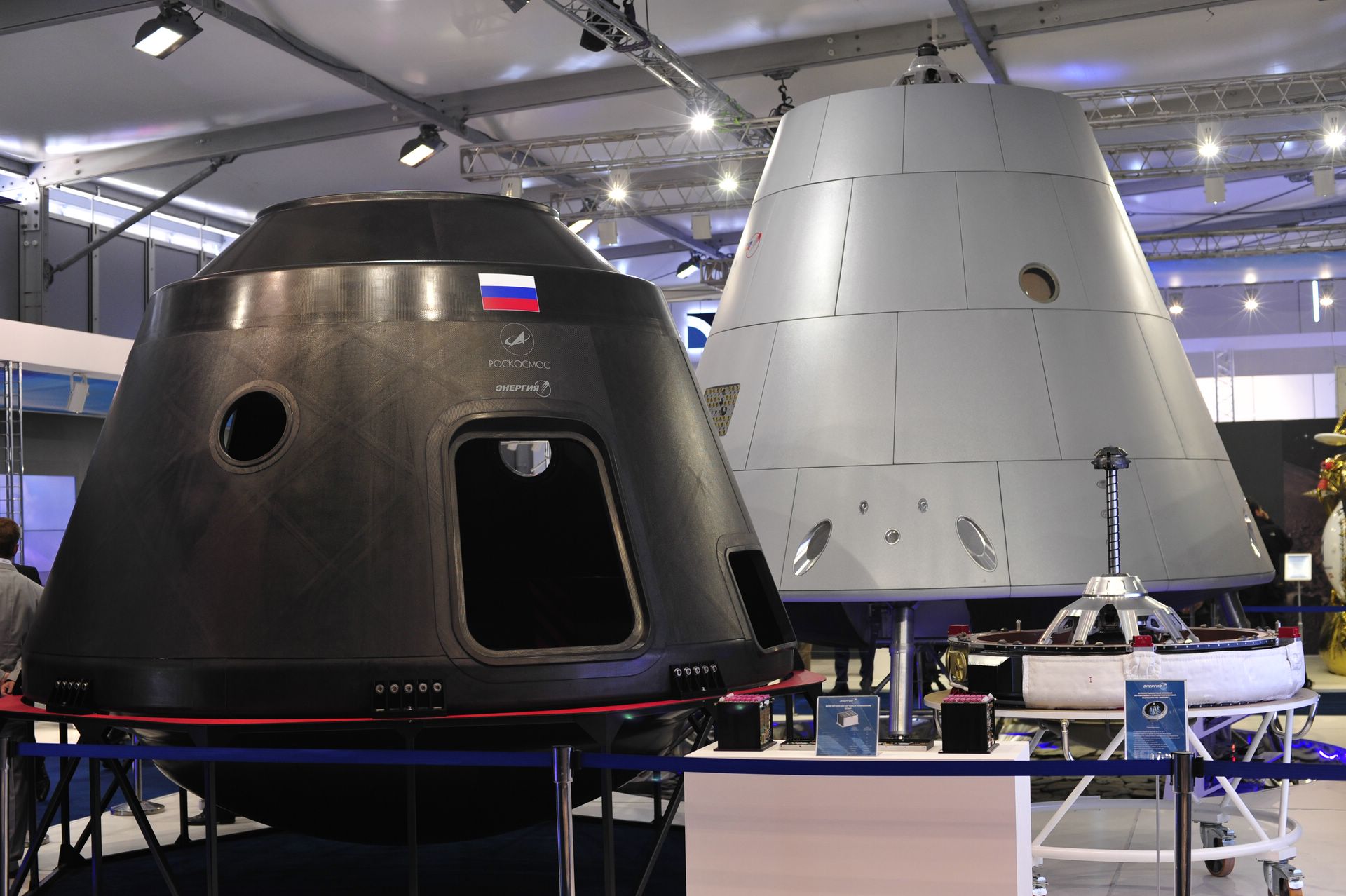
Orel (Russian: Орёл, lit. 'Eagle') or Oryol, formerly Federation (Russian: Федерация, romanized: Federatsiya), and PPTS (Russian: Перспективная Пилотируемая Транспортная Система, romanized: Perspektivnaya Pilotiruemaya Transportnaya Sistema, lit. 'Prospective Piloted Transport System'), is a project by Roscosmos to develop a new-generation, partially reusable crewed spacecraft.
Until 2016, the official name was (Russian: Пилотируемый Транспортный Корабль Нового Поколения, lit. 'New Generation Piloted Transport Ship') or PTK NP. The goal of the project is to develop a next-generation spacecraft to replace the Soyuz spacecraft developed by the former Soviet Union to support low Earth orbit and lunar operations. It is similar in function to the US Orion or Commercial Crew Development spacecraft.
The PPTS project was started following a failed attempt by Russia and the European Space Agency (ESA) to co-develop the Crew Space Transportation System (CSTS). Following ESA member states declining to finance Kliper in 2006 over concerns about workshare then again declining to finance development of CSTS in 2009 over technology transfer to Russia that could be used for military purposes, the Russian Federal Space Agency ordered a new crewed spacecraft from Russian companies. A development contract was awarded to RKK Energia on 19 December 2013.
Orel is intended to be capable of carrying crews of four into Earth orbit and beyond, with different mass versions suitable for 5, 14, or 30 day missions. If docked with a space station, it could stay in space up to a year, which is double the duration of the Soyuz spacecraft. The spacecraft will send cosmonauts to lunar orbit, with a plan to place a space station there, called Lunar Orbital Station.
Previously, ESA officials had inquired whether they could be part of the Constellation Program of the United States, with NASA focused on its Orion spacecraft, but they had received a negative response. Consequently, Europe decided to join the Russians to co-develop a new-generation crewed spacecraft. ESA insisted on a joint design rather than the Russian-designed Kliper, and as a result the joint Russian/European CSTS project came into being. CSTS had completed an initial study phase, which lasted for 18 months from September 2006 to spring 2008, before the project was shut down before an ESA member state conference in November 2008. ESA decided to use some technology of the CSTS project from its Automated Transfer Vehicle.
The Russian space agency, Roscosmos, had repeatedly received proposals from Moscow-based Khrunichev enterprise to develop a new-generation crewed spacecraft based on the TKS spacecraft that would be launched on the new Angara launch Vehicle. Citing the requirement to start work on a new crewed spacecraft, Russia decided to go forward with the project by itself.[clarification needed]
By the first quarter of 2009, Roscosmos had finalized its requirements for the next-generation crewed spacecraft and had received proposals from both RKK Energia and Khrunichev enterprise. This was the actual beginning of the PPTS project. The agency was finally ready to name the prime developer of the vehicle. Formally, only two organizations which were practically capable of developing crewed space vehicles competed in the government tender to build the new spacecraft—RKK Energia in Korolev and Moscow-based Khrunichev enterprise.
Although Roscosmos has remained tight-lipped about the project, a number of Russian officials made statements hinting about various stages of the project. On 21 January 2009, the head of Roscosmos, Anatoly Perminov, told Rossiyskaya Gazeta, a Russian newspaper, that Russia would likely proceed with independent development of the next-generation crewed spacecraft. According to Perminov, the agency and its main research and certification center—TsNIIMash—had already conducted an expanded meeting of the Scientific and Technical Council, NTS, examining follow-on transport systems, including the next-generation crewed ship. It would be followed by a government tender to select a developer for the new vehicle. Perminov further indicated that the new spacecraft would be expected to enter service within a time frame of the Orion spacecraft, but a more detailed development plan would be ready with the preliminary design of the vehicle in the middle of 2010.[citation needed]
Hub AI
Orel (spacecraft) AI simulator
(@Orel (spacecraft)_simulator)
Orel (spacecraft)
Orel (Russian: Орёл, lit. 'Eagle') or Oryol, formerly Federation (Russian: Федерация, romanized: Federatsiya), and PPTS (Russian: Перспективная Пилотируемая Транспортная Система, romanized: Perspektivnaya Pilotiruemaya Transportnaya Sistema, lit. 'Prospective Piloted Transport System'), is a project by Roscosmos to develop a new-generation, partially reusable crewed spacecraft.
Until 2016, the official name was (Russian: Пилотируемый Транспортный Корабль Нового Поколения, lit. 'New Generation Piloted Transport Ship') or PTK NP. The goal of the project is to develop a next-generation spacecraft to replace the Soyuz spacecraft developed by the former Soviet Union to support low Earth orbit and lunar operations. It is similar in function to the US Orion or Commercial Crew Development spacecraft.
The PPTS project was started following a failed attempt by Russia and the European Space Agency (ESA) to co-develop the Crew Space Transportation System (CSTS). Following ESA member states declining to finance Kliper in 2006 over concerns about workshare then again declining to finance development of CSTS in 2009 over technology transfer to Russia that could be used for military purposes, the Russian Federal Space Agency ordered a new crewed spacecraft from Russian companies. A development contract was awarded to RKK Energia on 19 December 2013.
Orel is intended to be capable of carrying crews of four into Earth orbit and beyond, with different mass versions suitable for 5, 14, or 30 day missions. If docked with a space station, it could stay in space up to a year, which is double the duration of the Soyuz spacecraft. The spacecraft will send cosmonauts to lunar orbit, with a plan to place a space station there, called Lunar Orbital Station.
Previously, ESA officials had inquired whether they could be part of the Constellation Program of the United States, with NASA focused on its Orion spacecraft, but they had received a negative response. Consequently, Europe decided to join the Russians to co-develop a new-generation crewed spacecraft. ESA insisted on a joint design rather than the Russian-designed Kliper, and as a result the joint Russian/European CSTS project came into being. CSTS had completed an initial study phase, which lasted for 18 months from September 2006 to spring 2008, before the project was shut down before an ESA member state conference in November 2008. ESA decided to use some technology of the CSTS project from its Automated Transfer Vehicle.
The Russian space agency, Roscosmos, had repeatedly received proposals from Moscow-based Khrunichev enterprise to develop a new-generation crewed spacecraft based on the TKS spacecraft that would be launched on the new Angara launch Vehicle. Citing the requirement to start work on a new crewed spacecraft, Russia decided to go forward with the project by itself.[clarification needed]
By the first quarter of 2009, Roscosmos had finalized its requirements for the next-generation crewed spacecraft and had received proposals from both RKK Energia and Khrunichev enterprise. This was the actual beginning of the PPTS project. The agency was finally ready to name the prime developer of the vehicle. Formally, only two organizations which were practically capable of developing crewed space vehicles competed in the government tender to build the new spacecraft—RKK Energia in Korolev and Moscow-based Khrunichev enterprise.
Although Roscosmos has remained tight-lipped about the project, a number of Russian officials made statements hinting about various stages of the project. On 21 January 2009, the head of Roscosmos, Anatoly Perminov, told Rossiyskaya Gazeta, a Russian newspaper, that Russia would likely proceed with independent development of the next-generation crewed spacecraft. According to Perminov, the agency and its main research and certification center—TsNIIMash—had already conducted an expanded meeting of the Scientific and Technical Council, NTS, examining follow-on transport systems, including the next-generation crewed ship. It would be followed by a government tender to select a developer for the new vehicle. Perminov further indicated that the new spacecraft would be expected to enter service within a time frame of the Orion spacecraft, but a more detailed development plan would be ready with the preliminary design of the vehicle in the middle of 2010.[citation needed]