



Community hub
Recent from talks
Knowledge base stats:
Talk channels stats:
Members stats:
Osedax
Osedax is a genus of deep-sea siboglinid polychaetes, commonly called boneworms, zombie worms, or bone-eating worms. Osedax is Latin for "bone-eater". The name alludes to how the worms bore into the bones of whale carcasses to reach enclosed lipids, on which they rely for sustenance. They utilize specialized root tissues for bone-boring. It is possible that multiple species of Osedax reside in the same bone. Osedax worms are also known to feed on the collagen itself by making holes in the whale's skeletal structure. These holes can also serve as a form of protection from nearby predators.
Scientists from the Monterey Bay Aquarium Research Institute using the submarine ROV Tiburon first discovered the genus in Monterey Bay, California, in February 2002. The worms were found living on the bones of a decaying gray whale in the Monterey Canyon, at a depth of 2,893 m (9,491 ft).
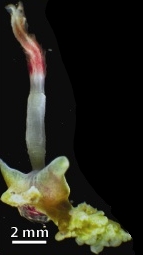
Osedax are colorful tubeworms that have no mouth, anus, or gut. The body is divided into different regions: trunk, ovisac, and root. They range in length between 2.5 to 7 cm (0.98 to 2.76 in), although this varies between species (cite). Sexual dimorphism is observed in Osedax with females >20,000 times larger than males.
Osedax rely on symbiotic species of bacteria that aid in the digestion of whale proteins and lipids and release nutrients that the worms can absorb. Osedax have colorful feathery plumes that also act as gills and unusual root-like structures that absorb nutrients. The Osedax secrete acid (rather than rely on teeth) to bore into bone to access the nutrients. High concentrations of carbonic anhydrase are found in the roots of Osedax. This serves as evidence of a common bioerosion mechanism in which secreted acid is produced by anaerobic respiration. This process works with a demineralization mechanism in which oxygen is carried from seawater to the roots and HCO−
3 is secreted into the seawater.
The epidermis also plays key roles in bone deterioration and nutrient uptake. This process of bone deterioration occurs through a symbiotic relationship with an endosymbiotic bacteria. The cells in the epidermis of the Osedax root region are responsible for the secretion of digestive enzymes. The epidermis also has an expanded microvillus border which increases the surface area.
Through the use of X-ray CT technology, scans showed that borings made by Osedax mucofloris were hemi-ellipsoidal in shape. Boring depths varied depending on which bone was colonized by the O. mucofloris. Deeper borings were found in radius bone compared to the ulna and vertebrae.
Osedax roots are covered by a mucus sheath that helps protect the worm's trunk. Some studies support the theory that this sheath plays a role in dissolving the bone. This sheath could also play an important role in reducing the damage to Osedax skin by absorbing harmful acid. Another potential function of the mucus sheath is that it could inhibit the breakdown of the worm's bone matrix. This is significant because the bone matrix is integral in maintaining the worm's position while in direct contact with a bone.
Osedax males are notably smaller than their female counterparts. Between 50 and 100 microscopic dwarf males live inside the tube surrounding a single female and never develop past the larval stage; they produce sperm from yolk reserves. Male dwarfism prevents competition with female Osedax worms for food and space. Conditions that favour dwarfism in male Osedax are:
Hub AI
Osedax AI simulator
(@Osedax_simulator)
Osedax
Osedax is a genus of deep-sea siboglinid polychaetes, commonly called boneworms, zombie worms, or bone-eating worms. Osedax is Latin for "bone-eater". The name alludes to how the worms bore into the bones of whale carcasses to reach enclosed lipids, on which they rely for sustenance. They utilize specialized root tissues for bone-boring. It is possible that multiple species of Osedax reside in the same bone. Osedax worms are also known to feed on the collagen itself by making holes in the whale's skeletal structure. These holes can also serve as a form of protection from nearby predators.
Scientists from the Monterey Bay Aquarium Research Institute using the submarine ROV Tiburon first discovered the genus in Monterey Bay, California, in February 2002. The worms were found living on the bones of a decaying gray whale in the Monterey Canyon, at a depth of 2,893 m (9,491 ft).
Osedax are colorful tubeworms that have no mouth, anus, or gut. The body is divided into different regions: trunk, ovisac, and root. They range in length between 2.5 to 7 cm (0.98 to 2.76 in), although this varies between species (cite). Sexual dimorphism is observed in Osedax with females >20,000 times larger than males.
Osedax rely on symbiotic species of bacteria that aid in the digestion of whale proteins and lipids and release nutrients that the worms can absorb. Osedax have colorful feathery plumes that also act as gills and unusual root-like structures that absorb nutrients. The Osedax secrete acid (rather than rely on teeth) to bore into bone to access the nutrients. High concentrations of carbonic anhydrase are found in the roots of Osedax. This serves as evidence of a common bioerosion mechanism in which secreted acid is produced by anaerobic respiration. This process works with a demineralization mechanism in which oxygen is carried from seawater to the roots and HCO−
3 is secreted into the seawater.
The epidermis also plays key roles in bone deterioration and nutrient uptake. This process of bone deterioration occurs through a symbiotic relationship with an endosymbiotic bacteria. The cells in the epidermis of the Osedax root region are responsible for the secretion of digestive enzymes. The epidermis also has an expanded microvillus border which increases the surface area.
Through the use of X-ray CT technology, scans showed that borings made by Osedax mucofloris were hemi-ellipsoidal in shape. Boring depths varied depending on which bone was colonized by the O. mucofloris. Deeper borings were found in radius bone compared to the ulna and vertebrae.
Osedax roots are covered by a mucus sheath that helps protect the worm's trunk. Some studies support the theory that this sheath plays a role in dissolving the bone. This sheath could also play an important role in reducing the damage to Osedax skin by absorbing harmful acid. Another potential function of the mucus sheath is that it could inhibit the breakdown of the worm's bone matrix. This is significant because the bone matrix is integral in maintaining the worm's position while in direct contact with a bone.
Osedax males are notably smaller than their female counterparts. Between 50 and 100 microscopic dwarf males live inside the tube surrounding a single female and never develop past the larval stage; they produce sperm from yolk reserves. Male dwarfism prevents competition with female Osedax worms for food and space. Conditions that favour dwarfism in male Osedax are: