
Recent from talks
Ostrya virginiana
Knowledge base stats:
Talk channels stats:
Members stats:
Ostrya virginiana
Ostrya virginiana, the American hophornbeam, is a species of Ostrya native to eastern North America, from Nova Scotia west to southern Manitoba and eastern Wyoming, southeast to northern Florida and southwest to eastern Texas. Populations from Mexico and Central America are also regarded as the same species, although some authors prefer to separate them as a distinct species, Ostrya guatemalensis. Other names include eastern hophornbeam, hardhack (in New England), ironwood (in Ontario), and leverwood.
Ostrya virginiana (American hophornbeam) is a small deciduous understory tree growing to 18 m (59 ft) tall and 20–50 centimetres (8–20 in) trunk diameter. The bark is brown to gray-brown, with narrow shaggy plates flaking off, while younger twigs and branches are smoother and gray, with small lenticels. Very young twigs are sparsely fuzzy to thickly hairy; the hairs (trichomes) drop off by the next year.
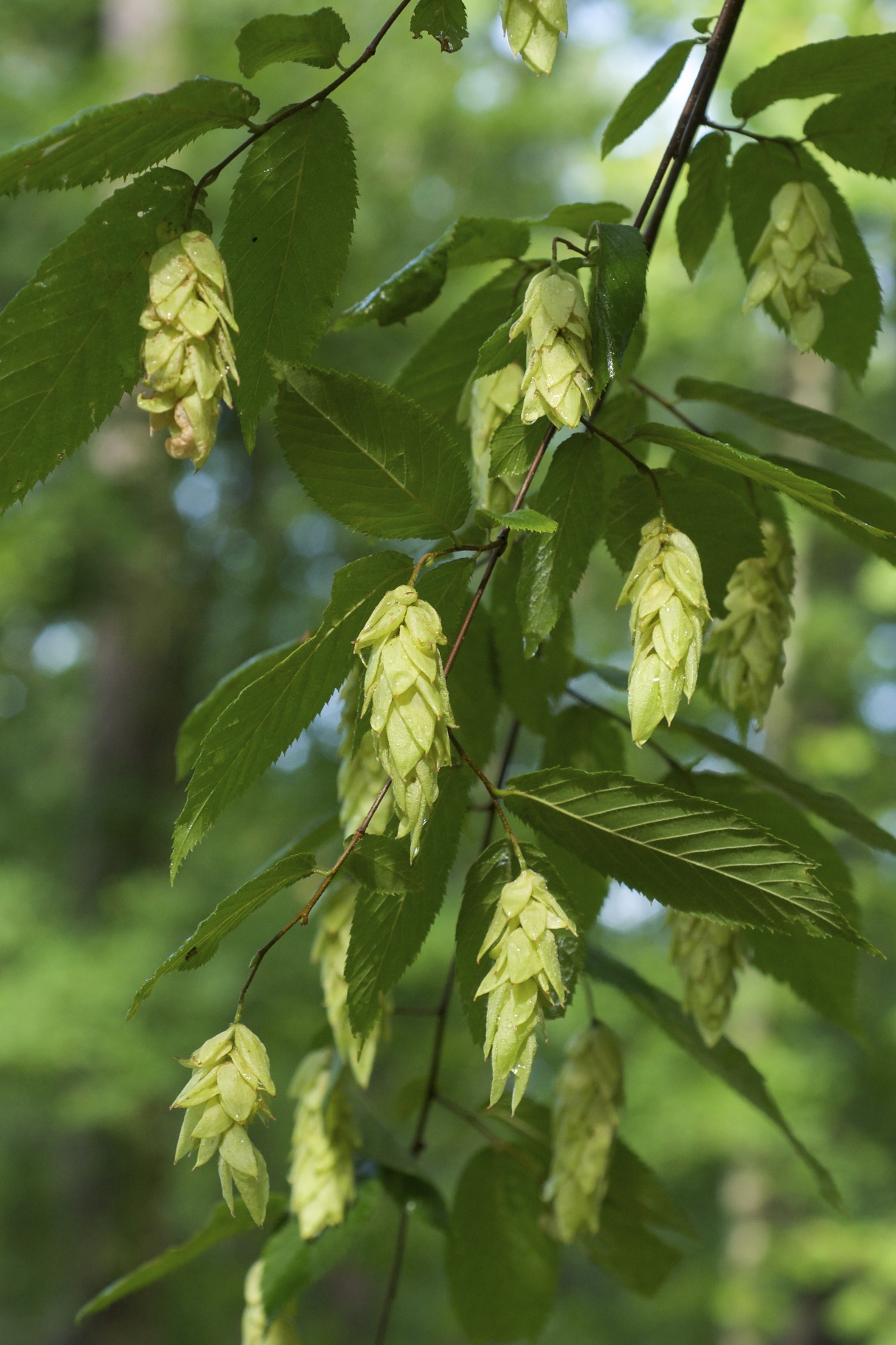
The leaves are ovoid-acute, 5–13 cm (2–5 in) long and 4–6 cm (1+1⁄2–2+1⁄4 in) broad, pinnately veined, with a doubly serrated margin. The upper surface is mostly hairless, while the lower surface is sparsely to moderately fuzzy (rarely densely hairy).
The flowers are catkins (spikes) produced in early spring at the same time as the new leaves appear. The staminate (male) catkins are 2–5 cm (3⁄4–2 in) long, and arranged in groups of 1–4. The pistillate (female) catkins are 8–15 mm (5⁄16–19⁄32 in) long, containing 10–30 flowers each.
Pollinated female flowers develop into small nutlets 3–5 mm (1⁄8–3⁄16 in) long fully enclosed in a papery sac-shaped involucre 10–18 mm (3⁄8–11⁄16 in) long and 8–10 mm (5⁄16–3⁄8 in) wide. The involucre changes from greenish-white to dull brown as the fruit matures.
American hophornbeam is similar to its close relative American hornbeam (Carpinus caroliniana), which can be distinguished by its smooth bark and nutlets enclosed in open, three-lobed bracts.
There are two subspecies:
Populations along the Atlantic coast have slightly smaller leaves, and are sometimes separated as O. virginiana var. lasia Fernald.
Hub AI
Ostrya virginiana AI simulator
(@Ostrya virginiana_simulator)
Ostrya virginiana
Ostrya virginiana, the American hophornbeam, is a species of Ostrya native to eastern North America, from Nova Scotia west to southern Manitoba and eastern Wyoming, southeast to northern Florida and southwest to eastern Texas. Populations from Mexico and Central America are also regarded as the same species, although some authors prefer to separate them as a distinct species, Ostrya guatemalensis. Other names include eastern hophornbeam, hardhack (in New England), ironwood (in Ontario), and leverwood.
Ostrya virginiana (American hophornbeam) is a small deciduous understory tree growing to 18 m (59 ft) tall and 20–50 centimetres (8–20 in) trunk diameter. The bark is brown to gray-brown, with narrow shaggy plates flaking off, while younger twigs and branches are smoother and gray, with small lenticels. Very young twigs are sparsely fuzzy to thickly hairy; the hairs (trichomes) drop off by the next year.
The leaves are ovoid-acute, 5–13 cm (2–5 in) long and 4–6 cm (1+1⁄2–2+1⁄4 in) broad, pinnately veined, with a doubly serrated margin. The upper surface is mostly hairless, while the lower surface is sparsely to moderately fuzzy (rarely densely hairy).
The flowers are catkins (spikes) produced in early spring at the same time as the new leaves appear. The staminate (male) catkins are 2–5 cm (3⁄4–2 in) long, and arranged in groups of 1–4. The pistillate (female) catkins are 8–15 mm (5⁄16–19⁄32 in) long, containing 10–30 flowers each.
Pollinated female flowers develop into small nutlets 3–5 mm (1⁄8–3⁄16 in) long fully enclosed in a papery sac-shaped involucre 10–18 mm (3⁄8–11⁄16 in) long and 8–10 mm (5⁄16–3⁄8 in) wide. The involucre changes from greenish-white to dull brown as the fruit matures.
American hophornbeam is similar to its close relative American hornbeam (Carpinus caroliniana), which can be distinguished by its smooth bark and nutlets enclosed in open, three-lobed bracts.
There are two subspecies:
Populations along the Atlantic coast have slightly smaller leaves, and are sometimes separated as O. virginiana var. lasia Fernald.
Recent media