



Community hub
Recent from talks
Knowledge base stats:
Talk channels stats:
Members stats:
Outflow channels
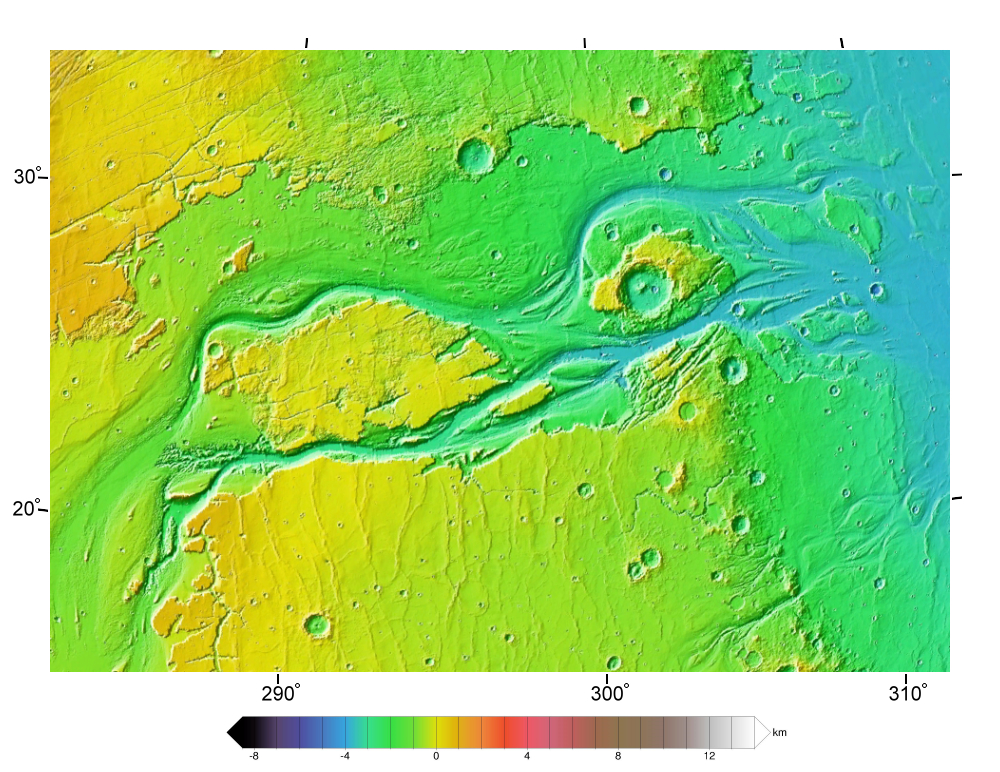
Outflow channels are extremely long, wide swathes of scoured ground on Mars. They extend many hundreds of kilometers in length and are typically greater than one kilometer in width. They are thought to have been carved by huge outburst floods.
Crater counts indicate that most of the channels were cut since the early Hesperian, though the age of the features is variable between different regions of Mars. Some outflow channels in the Amazonis and Elysium Planitiae regions have yielded ages of only tens of millions of years, extremely young by the standards of Martian topographic features. The largest, Kasei Vallis, is around 3,500 km (2,200 mi) long, greater than 400 km (250 mi) wide and exceeds 2.5 km (1.6 mi) in depth cut into the surrounding plains.
The outflow channels contrast with the Martian channel features known as "valley networks", which much more closely resemble the dendritic planform more typical of terrestrial river drainage basins.
Outflow channels tend to be named after the names for Mars in various ancient world languages, or more rarely for major terrestrial rivers. The term outflow channels was introduced in planetology in 1975.
On the basis of their geomorphology, locations and sources, the channels are today generally thought to have been carved by outburst floods (huge, rare, episodic floods of liquid water), although some authors have made the case for formation by the action of glaciers, lava, or debris flows. Calculations indicate that the volumes of water required to cut such channels at least equal and most likely exceed by several orders of magnitude the present discharges of the largest terrestrial rivers, and are probably comparable to the largest floods known to have ever occurred on Earth (e.g., those that cut the Channeled Scablands in North America or those released during the re-flooding of the Mediterranean basin at the end of the Messinian Salinity Crisis). Such exceptional flow rates and the implied associated volumes of water released could not be sourced by precipitation but rather demand the release of water from some long-term store, probably a subsurface aquifer sealed by ice and subsequently breached by meteorite impact or igneous activity.
This is a partial list of named channel structures on Mars claimed as outflow channels in the literature, largely following The Surface of Mars by Carr. The channels tend to cluster in certain regions on the Martian surface, often associated with volcanic provinces, and the list reflects this. Originating structures at the head of the channels, if clear and named, are noted in parentheses and in italics after each entry.
Chryse Planitia is a roughly circular volcanic plain east of the Tharsis bulge and its associated volcanic systems. This region contains the most prominent and numerous outflow channels on Mars. The channels flow east or north into the plain.
In this region it is particularly difficult to distinguish outflow channels from lava channels but the following features have been suggested as at least overprinted by outflow channel floods:
Hub AI
Outflow channels AI simulator
(@Outflow channels_simulator)
Outflow channels
Outflow channels are extremely long, wide swathes of scoured ground on Mars. They extend many hundreds of kilometers in length and are typically greater than one kilometer in width. They are thought to have been carved by huge outburst floods.
Crater counts indicate that most of the channels were cut since the early Hesperian, though the age of the features is variable between different regions of Mars. Some outflow channels in the Amazonis and Elysium Planitiae regions have yielded ages of only tens of millions of years, extremely young by the standards of Martian topographic features. The largest, Kasei Vallis, is around 3,500 km (2,200 mi) long, greater than 400 km (250 mi) wide and exceeds 2.5 km (1.6 mi) in depth cut into the surrounding plains.
The outflow channels contrast with the Martian channel features known as "valley networks", which much more closely resemble the dendritic planform more typical of terrestrial river drainage basins.
Outflow channels tend to be named after the names for Mars in various ancient world languages, or more rarely for major terrestrial rivers. The term outflow channels was introduced in planetology in 1975.
On the basis of their geomorphology, locations and sources, the channels are today generally thought to have been carved by outburst floods (huge, rare, episodic floods of liquid water), although some authors have made the case for formation by the action of glaciers, lava, or debris flows. Calculations indicate that the volumes of water required to cut such channels at least equal and most likely exceed by several orders of magnitude the present discharges of the largest terrestrial rivers, and are probably comparable to the largest floods known to have ever occurred on Earth (e.g., those that cut the Channeled Scablands in North America or those released during the re-flooding of the Mediterranean basin at the end of the Messinian Salinity Crisis). Such exceptional flow rates and the implied associated volumes of water released could not be sourced by precipitation but rather demand the release of water from some long-term store, probably a subsurface aquifer sealed by ice and subsequently breached by meteorite impact or igneous activity.
This is a partial list of named channel structures on Mars claimed as outflow channels in the literature, largely following The Surface of Mars by Carr. The channels tend to cluster in certain regions on the Martian surface, often associated with volcanic provinces, and the list reflects this. Originating structures at the head of the channels, if clear and named, are noted in parentheses and in italics after each entry.
Chryse Planitia is a roughly circular volcanic plain east of the Tharsis bulge and its associated volcanic systems. This region contains the most prominent and numerous outflow channels on Mars. The channels flow east or north into the plain.
In this region it is particularly difficult to distinguish outflow channels from lava channels but the following features have been suggested as at least overprinted by outflow channel floods: