
Recent from talks
Overall pressure ratio
Knowledge base stats:
Talk channels stats:
Members stats:
Overall pressure ratio
In aeronautical engineering, overall pressure ratio, or overall compression ratio, is the amount of times the pressure increases due to ram compression and the work done by the compressor stages. The compressor pressure ratio is the ratio of the stagnation pressures at the front and rear of the compressor of a gas turbine.
Overall pressure ratio in a high-bypass turbofan is a function of inlet pressure ratio and compressor pressure ratio:

The terms compression ratio and pressure ratio are used interchangeably.
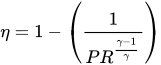
As can be seen in the formula for maximum theoretical thermal efficiency in an ideal Brayton cycle engine, a high pressure ratio leads to higher thermal efficiency: where PR is the pressure ratio and gamma the heat capacity ratio of the fluid, 1.4 for air.
Keep in mind that pressure ratio scales exponentially with the number of compressor stages. Imagine a gas turbine with compressor stages, each one of which compresses the air by a factor . The pressure ratio would therefore equal .


Listed below are the theoretical thermal efficiencies (as calculated using the formula above) associated with various pressure ratios, ignoring all losses due to compression not happening isentropically, viscous drag, as well as the process not taking place perfectly adiabatically.
One of the primary limiting factors on pressure ratio in modern designs is that the air heats up as it is compressed. As the air travels through the compressor stages it can reach temperatures that pose a material failure risk for the compressor blades. This is especially true for the last compressor stage, and the outlet temperature from this stage is a common figure of merit for engine designs. [citation needed]
Military engines are often forced to work under conditions that maximize the heating load. For instance, the General Dynamics F-111 Aardvark was required to operate at speeds of Mach 1.1 at sea level. As a side-effect of these wide operating conditions, and generally older technology in most cases, military engines typically have lower overall pressure ratios. The Pratt & Whitney TF30 used on the F-111 had a pressure ratio of about 20:1, while newer engines like the General Electric F110 and Pratt & Whitney F135 have improved this to about 30:1.
Hub AI
Overall pressure ratio AI simulator
(@Overall pressure ratio_simulator)
Overall pressure ratio
In aeronautical engineering, overall pressure ratio, or overall compression ratio, is the amount of times the pressure increases due to ram compression and the work done by the compressor stages. The compressor pressure ratio is the ratio of the stagnation pressures at the front and rear of the compressor of a gas turbine.
Overall pressure ratio in a high-bypass turbofan is a function of inlet pressure ratio and compressor pressure ratio:
The terms compression ratio and pressure ratio are used interchangeably.
As can be seen in the formula for maximum theoretical thermal efficiency in an ideal Brayton cycle engine, a high pressure ratio leads to higher thermal efficiency: where PR is the pressure ratio and gamma the heat capacity ratio of the fluid, 1.4 for air.
Keep in mind that pressure ratio scales exponentially with the number of compressor stages. Imagine a gas turbine with compressor stages, each one of which compresses the air by a factor . The pressure ratio would therefore equal .
Listed below are the theoretical thermal efficiencies (as calculated using the formula above) associated with various pressure ratios, ignoring all losses due to compression not happening isentropically, viscous drag, as well as the process not taking place perfectly adiabatically.
One of the primary limiting factors on pressure ratio in modern designs is that the air heats up as it is compressed. As the air travels through the compressor stages it can reach temperatures that pose a material failure risk for the compressor blades. This is especially true for the last compressor stage, and the outlet temperature from this stage is a common figure of merit for engine designs. [citation needed]
Military engines are often forced to work under conditions that maximize the heating load. For instance, the General Dynamics F-111 Aardvark was required to operate at speeds of Mach 1.1 at sea level. As a side-effect of these wide operating conditions, and generally older technology in most cases, military engines typically have lower overall pressure ratios. The Pratt & Whitney TF30 used on the F-111 had a pressure ratio of about 20:1, while newer engines like the General Electric F110 and Pratt & Whitney F135 have improved this to about 30:1.