


Community hub
Recent from talks
Contribute something to knowledge base
Content stats: 0 posts, 0 articles, 1 media, 0 notes
Members stats: 0 subscribers, 0 contributors, 0 moderators, 0 supporters
Subscribers
Supporters
Contributors
Moderators
Hub AI
PFM-1 mine AI simulator
(@PFM-1 mine_simulator)
Hub AI
PFM-1 mine AI simulator
(@PFM-1 mine_simulator)
PFM-1 mine
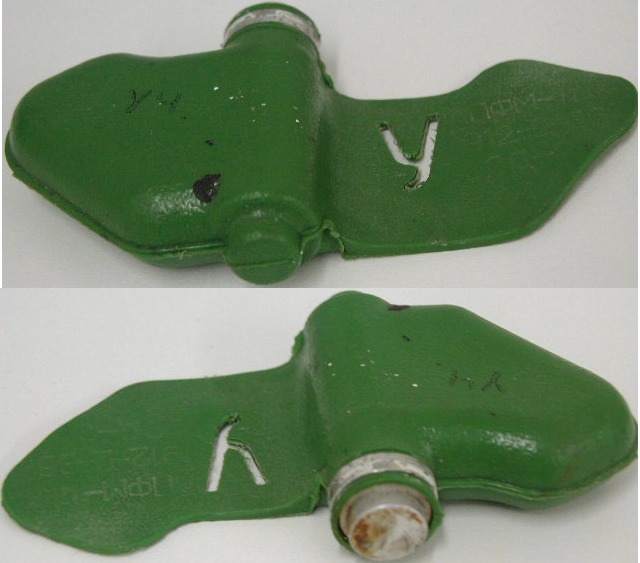
PFM-1 (Russian: ПФМ-1 — Противопехотная Фугасная Мина-1, lit. 'Anti-infantry high-explosive mine') is a scatterable high explosive anti-personnel land mine of Soviet and Russian production. It is also known as a Flower Petal Mine (Russian: Лепесток), Green Parrot, or Butterfly Mine. The mines can be deployed from mortars, helicopters and airplanes in large numbers; they glide to the ground without exploding and will explode later upon contact.
The mine consists of a polyethylene plastic container containing 37 g (1.3 oz) of VS-6D or VS-60D liquid explosive. The two wings of the PFM-1 allow it to glide after being released in the air, then spin, stabilizing it and slowing its descent, similar to maple seeds. The thick wing contains the liquid explosive. The two wings together are 120 mm (4.7 in) long. The plastic body can be produced in a variety of colours for best camouflage. As existing stocks were in European green rather than sand coloured, the first examples used in 1980s Afghanistan were green and easily visible. This led to their name 'green parrots'.
The shape and bright colour is attractive to children, inspiring criticism that they look like a toy.[dubious – discuss]
The mine comes in two variants: PFM-1 and PFM-1S. The only difference between the two variants is that the PFM-1S comes with a self-destruct mechanism, with a nominal self destruct time for 85% of all mines of 40 hours. The self destruct mechanism is designed to activate after 1– 40 hours depending on ambient temperature. The PFM-1S self-destruct mechanism is not very reliable, and is likely to leave mines in an armed or sensitive state; with mines known to continue to randomly self-destruct for weeks after deployment. The mines cannot be laid manually and must be laid using minelaying systems, such as the remote mining machine UMZ,the portable mining kit - PKM (mortar), and those present on multiple rocket launchers, helicopters (VSM-1 mine system) or airplanes. The remote minelaying systems can only use cluster munitions containing PFM-1 mines. The cassettes that contain the PFM-1 mines are KSF-1 (72 PFM-1), KSF-1S (64 PFM-1S) or KSF-1S-0.5 (36 PFM-1 and 36 PFM-1S).
Because the mine is so light, it can be carried in waterways and move downstream after heavy rains or melting snow. The PFM-1 mines are notorious for attaining good camouflage in the conditions of dense foliage, snow or sand.
The mine is stored with a pin restraining a detonating plunger. Once the arming pin is removed, the plunger is slowly forced forward by a spring until it contacts the detonator, at which point it is armed.
Deformation of the soft plastic skin of the mine forces the arming plunger to strike the detonator, detonating the mine. Because the body of the mine is a single cumulative pressure primer, it is extremely dangerous to handle the mine: The Imperial War Museum states that "A pressure in excess of 5kg would activate the mine". Holding it between the thumb and forefinger may be enough to make it explode. The charge is usually nonlethal, although sufficient to maim.
The PFM-1(S) mines can be disposed by destruction or activation by mechanical or explosive means; they cannot be disarmed. The mines are generally disposed of in-situ to prevent unintended initiation while moving. If the mine has to be moved, it is done so with an implement that is at least 3 meters long, made of soft materials (for example, plastic) to prevent injury in the event the mine detonates in transit. The disposal technician should ideally wear suitable personal protective equipment (PPE), including gloves and a helmet with a ballistic visor of at least 8–10 mm of PMMA. If the mine is to be destroyed mechanically, then they should be driven on by the tracks of an armoured vehicle, or impacted with a load weighing at least 60 kg. Otherwise, the technician must dispose of the mine with at least 200 grams of explosive at least 4–5m away. The requirement to use soft materials is due to secondary fragments that may be generated as a result of the mine exploding: if the mine is placed on a hard or metallic surface, such as asphalt or steel, it could generate secondary fragmentation and potentially wound the disposal technician, or people around them. As it is almost impossible to tell the PFM-1 and PFM-1S versions apart care should be taken when approaching them as the mine's self-destruction mechanism may actuate.
PFM-1 mine
PFM-1 (Russian: ПФМ-1 — Противопехотная Фугасная Мина-1, lit. 'Anti-infantry high-explosive mine') is a scatterable high explosive anti-personnel land mine of Soviet and Russian production. It is also known as a Flower Petal Mine (Russian: Лепесток), Green Parrot, or Butterfly Mine. The mines can be deployed from mortars, helicopters and airplanes in large numbers; they glide to the ground without exploding and will explode later upon contact.
The mine consists of a polyethylene plastic container containing 37 g (1.3 oz) of VS-6D or VS-60D liquid explosive. The two wings of the PFM-1 allow it to glide after being released in the air, then spin, stabilizing it and slowing its descent, similar to maple seeds. The thick wing contains the liquid explosive. The two wings together are 120 mm (4.7 in) long. The plastic body can be produced in a variety of colours for best camouflage. As existing stocks were in European green rather than sand coloured, the first examples used in 1980s Afghanistan were green and easily visible. This led to their name 'green parrots'.
The shape and bright colour is attractive to children, inspiring criticism that they look like a toy.[dubious – discuss]
The mine comes in two variants: PFM-1 and PFM-1S. The only difference between the two variants is that the PFM-1S comes with a self-destruct mechanism, with a nominal self destruct time for 85% of all mines of 40 hours. The self destruct mechanism is designed to activate after 1– 40 hours depending on ambient temperature. The PFM-1S self-destruct mechanism is not very reliable, and is likely to leave mines in an armed or sensitive state; with mines known to continue to randomly self-destruct for weeks after deployment. The mines cannot be laid manually and must be laid using minelaying systems, such as the remote mining machine UMZ,the portable mining kit - PKM (mortar), and those present on multiple rocket launchers, helicopters (VSM-1 mine system) or airplanes. The remote minelaying systems can only use cluster munitions containing PFM-1 mines. The cassettes that contain the PFM-1 mines are KSF-1 (72 PFM-1), KSF-1S (64 PFM-1S) or KSF-1S-0.5 (36 PFM-1 and 36 PFM-1S).
Because the mine is so light, it can be carried in waterways and move downstream after heavy rains or melting snow. The PFM-1 mines are notorious for attaining good camouflage in the conditions of dense foliage, snow or sand.
The mine is stored with a pin restraining a detonating plunger. Once the arming pin is removed, the plunger is slowly forced forward by a spring until it contacts the detonator, at which point it is armed.
Deformation of the soft plastic skin of the mine forces the arming plunger to strike the detonator, detonating the mine. Because the body of the mine is a single cumulative pressure primer, it is extremely dangerous to handle the mine: The Imperial War Museum states that "A pressure in excess of 5kg would activate the mine". Holding it between the thumb and forefinger may be enough to make it explode. The charge is usually nonlethal, although sufficient to maim.
The PFM-1(S) mines can be disposed by destruction or activation by mechanical or explosive means; they cannot be disarmed. The mines are generally disposed of in-situ to prevent unintended initiation while moving. If the mine has to be moved, it is done so with an implement that is at least 3 meters long, made of soft materials (for example, plastic) to prevent injury in the event the mine detonates in transit. The disposal technician should ideally wear suitable personal protective equipment (PPE), including gloves and a helmet with a ballistic visor of at least 8–10 mm of PMMA. If the mine is to be destroyed mechanically, then they should be driven on by the tracks of an armoured vehicle, or impacted with a load weighing at least 60 kg. Otherwise, the technician must dispose of the mine with at least 200 grams of explosive at least 4–5m away. The requirement to use soft materials is due to secondary fragments that may be generated as a result of the mine exploding: if the mine is placed on a hard or metallic surface, such as asphalt or steel, it could generate secondary fragmentation and potentially wound the disposal technician, or people around them. As it is almost impossible to tell the PFM-1 and PFM-1S versions apart care should be taken when approaching them as the mine's self-destruction mechanism may actuate.
Recent media
Recent media