
Recent from talks
Buffer solution
Knowledge base stats:
Talk channels stats:
Members stats:
Buffer solution
A buffer solution is a solution where the pH does not change significantly on dilution or if an acid or base is added at constant temperature. Its pH changes very little when a small amount of strong acid or base is added to it. Buffer solutions are used as a means of keeping pH at a nearly constant value in a wide variety of chemical applications. In nature, there are many living systems that use buffering for pH regulation. For example, the bicarbonate buffering system is used to regulate the pH of blood, and bicarbonate also acts as a buffer in the ocean.
Buffer solutions resist pH change because of a chemical equilibrium between the weak acid HA and its conjugate base A−:
When some strong acid is added to an equilibrium mixture of the weak acid and its conjugate base, hydrogen ions (H+) are added, and the equilibrium is shifted to the left, in accordance with Le Chatelier's principle. Because of this, the hydrogen ion concentration increases by less than the amount expected for the quantity of strong acid added. Similarly, if strong alkali is added to the mixture, the hydrogen ion concentration decreases by less than the amount expected for the quantity of alkali added. In Figure 1, the effect is illustrated by the simulated titration of a weak acid with pKa = 4.7. The relative concentration of undissociated acid is shown in blue, and of its conjugate base in red. The pH changes relatively slowly in the buffer region, pH = pKa ± 1, centered at pH = 4.7, where [HA] = [A−]. The hydrogen ion concentration decreases by less than the amount expected because most of the added hydroxide ion is consumed in the reaction
and only a little is consumed in the neutralization reaction (which is the reaction that results in an increase in pH)
Once the acid is more than 95% deprotonated, the pH rises rapidly because most of the added alkali is consumed in the neutralization reaction.
Buffer capacity is a quantitative measure of the resistance to change of pH of a solution containing a buffering agent with respect to a change of acid or alkali concentration. It can be defined as follows: where is an infinitesimal amount of added base, or where is an infinitesimal amount of added acid. pH is defined as −log10[H+], and d(pH) is an infinitesimal change in pH.


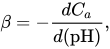

With either definition the buffer capacity for a weak acid HA with dissociation constant Ka can be expressed as where [H+] is the concentration of hydrogen ions, and is the total concentration of added acid. Kw is the equilibrium constant for self-ionization of water, equal to 1.0×10⁻¹⁴. Note that in solution H+ exists as the hydronium ion H3O+, and further aquation of the hydronium ion has negligible effect on the dissociation equilibrium, except at very high acid concentration.
![{\displaystyle \beta =2.303\left([{\mathrm {H} {\vphantom {A}}^{+}}]+{\frac {T_{\mathrm {HA} }K_{a}[{\mathrm {H} {\vphantom {A}}^{+}}]}{(K_{a}+[{\mathrm {H} {\vphantom {A}}^{+}}])^{2}}}+{\frac {K_{\text{w}}}{[{\mathrm {H} {\vphantom {A}}^{+}}]}}\right),}](https://wikimedia.org/api/rest_v1/media/math/render/svg/bf8b7c2c34d12f8145df3299a061593aaa76643a)

This equation shows that there are three regions of raised buffer capacity (see figure 2).
Hub AI
Buffer solution AI simulator
(@Buffer solution_simulator)
Buffer solution
A buffer solution is a solution where the pH does not change significantly on dilution or if an acid or base is added at constant temperature. Its pH changes very little when a small amount of strong acid or base is added to it. Buffer solutions are used as a means of keeping pH at a nearly constant value in a wide variety of chemical applications. In nature, there are many living systems that use buffering for pH regulation. For example, the bicarbonate buffering system is used to regulate the pH of blood, and bicarbonate also acts as a buffer in the ocean.
Buffer solutions resist pH change because of a chemical equilibrium between the weak acid HA and its conjugate base A−:
When some strong acid is added to an equilibrium mixture of the weak acid and its conjugate base, hydrogen ions (H+) are added, and the equilibrium is shifted to the left, in accordance with Le Chatelier's principle. Because of this, the hydrogen ion concentration increases by less than the amount expected for the quantity of strong acid added. Similarly, if strong alkali is added to the mixture, the hydrogen ion concentration decreases by less than the amount expected for the quantity of alkali added. In Figure 1, the effect is illustrated by the simulated titration of a weak acid with pKa = 4.7. The relative concentration of undissociated acid is shown in blue, and of its conjugate base in red. The pH changes relatively slowly in the buffer region, pH = pKa ± 1, centered at pH = 4.7, where [HA] = [A−]. The hydrogen ion concentration decreases by less than the amount expected because most of the added hydroxide ion is consumed in the reaction
and only a little is consumed in the neutralization reaction (which is the reaction that results in an increase in pH)
Once the acid is more than 95% deprotonated, the pH rises rapidly because most of the added alkali is consumed in the neutralization reaction.
Buffer capacity is a quantitative measure of the resistance to change of pH of a solution containing a buffering agent with respect to a change of acid or alkali concentration. It can be defined as follows: where is an infinitesimal amount of added base, or where is an infinitesimal amount of added acid. pH is defined as −log10[H+], and d(pH) is an infinitesimal change in pH.
With either definition the buffer capacity for a weak acid HA with dissociation constant Ka can be expressed as where [H+] is the concentration of hydrogen ions, and is the total concentration of added acid. Kw is the equilibrium constant for self-ionization of water, equal to 1.0×10⁻¹⁴. Note that in solution H+ exists as the hydronium ion H3O+, and further aquation of the hydronium ion has negligible effect on the dissociation equilibrium, except at very high acid concentration.
This equation shows that there are three regions of raised buffer capacity (see figure 2).