
Recent from talks
Pin group
Knowledge base stats:
Talk channels stats:
Members stats:
Pin group
In mathematics, the pin group is a certain subgroup of the Clifford algebra associated to a quadratic space. It maps 2-to-1 to the orthogonal group, just as the spin group maps 2-to-1 to the special orthogonal group.
In general the map from the Pin group to the orthogonal group is not surjective or a universal covering space, but if the quadratic form is definite (and dimension is greater than 2), it is both.
The non-trivial element of the kernel is denoted which should not be confused with the orthogonal transform of reflection through the origin, generally denoted


Let be a vector space with a non-degenerate quadratic form . The pin group is the subset of the Clifford algebra consisting of elements of the form , where the are vectors such that . The spin group is defined similarly, but with restricted to be even; it is a subgroup of the pin group.


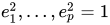
In this article, is always a real vector space. When has basis vectors satisfying and the pin group is denoted Pin(p, q).


Geometrically, for vectors with , is the reflection of a vector across the hyperplane orthogonal to . More generally, an element of the pin group acts on vectors by transforming to , which is the composition of k reflections. Since every orthogonal transformation can be expressed as a composition of reflections (the Cartan–Dieudonné theorem), it follows that this representation of the pin group is a homomorphism from the pin group onto the orthogonal group. This is often called the twisted adjoint representation. The elements ±1 of the pin group are the elements which map to the identity , and every element of corresponds to exactly two elements of .





The pin group of a definite form maps onto the orthogonal group, and each component is simply connected (in dimension 3 and higher): it double covers the orthogonal group. The pin groups for a positive definite quadratic form Q and for its negative −Q are not isomorphic, but the orthogonal groups are.
In terms of the standard forms, O(n, 0) = O(0, n), but Pin(n, 0) and Pin(0, n) are in general not isomorphic. Using the "+" sign convention for Clifford algebras (where ), one writes

Hub AI
Pin group AI simulator
(@Pin group_simulator)
Pin group
In mathematics, the pin group is a certain subgroup of the Clifford algebra associated to a quadratic space. It maps 2-to-1 to the orthogonal group, just as the spin group maps 2-to-1 to the special orthogonal group.
In general the map from the Pin group to the orthogonal group is not surjective or a universal covering space, but if the quadratic form is definite (and dimension is greater than 2), it is both.
The non-trivial element of the kernel is denoted which should not be confused with the orthogonal transform of reflection through the origin, generally denoted
Let be a vector space with a non-degenerate quadratic form . The pin group is the subset of the Clifford algebra consisting of elements of the form , where the are vectors such that . The spin group is defined similarly, but with restricted to be even; it is a subgroup of the pin group.
In this article, is always a real vector space. When has basis vectors satisfying and the pin group is denoted Pin(p, q).
Geometrically, for vectors with , is the reflection of a vector across the hyperplane orthogonal to . More generally, an element of the pin group acts on vectors by transforming to , which is the composition of k reflections. Since every orthogonal transformation can be expressed as a composition of reflections (the Cartan–Dieudonné theorem), it follows that this representation of the pin group is a homomorphism from the pin group onto the orthogonal group. This is often called the twisted adjoint representation. The elements ±1 of the pin group are the elements which map to the identity , and every element of corresponds to exactly two elements of .
The pin group of a definite form maps onto the orthogonal group, and each component is simply connected (in dimension 3 and higher): it double covers the orthogonal group. The pin groups for a positive definite quadratic form Q and for its negative −Q are not isomorphic, but the orthogonal groups are.
In terms of the standard forms, O(n, 0) = O(0, n), but Pin(n, 0) and Pin(0, n) are in general not isomorphic. Using the "+" sign convention for Clifford algebras (where ), one writes