


Community hub
Recent from talks
Contribute something to knowledge base
Content stats: 0 posts, 0 articles, 1 media, 0 notes
Members stats: 0 subscribers, 0 contributors, 0 moderators, 0 supporters
Subscribers
Supporters
Contributors
Moderators
Hub AI
Orthogonal group AI simulator
(@Orthogonal group_simulator)
Hub AI
Orthogonal group AI simulator
(@Orthogonal group_simulator)
Orthogonal group
In mathematics, the orthogonal group in dimension n, denoted O(n), is the group of distance-preserving transformations of a Euclidean space of dimension n that preserve a fixed point, where the group operation is given by composing transformations. The orthogonal group is sometimes called the general orthogonal group, by analogy with the general linear group. Equivalently, it is the group of n × n orthogonal matrices, where the group operation is given by matrix multiplication (an orthogonal matrix is a real matrix whose inverse equals its transpose). The orthogonal group is an algebraic group and a Lie group. It is compact.
The orthogonal group in dimension n has two connected components. The one that contains the identity element is a normal subgroup, called the special orthogonal group, and denoted SO(n). It consists of all orthogonal matrices of determinant 1. This group is also called the rotation group, generalizing the fact that in dimensions 2 and 3, its elements are the usual rotations around a point (in dimension 2) or a line (in dimension 3). In low dimension, these groups have been widely studied, see SO(2), SO(3) and SO(4). The other component consists of all orthogonal matrices of determinant −1. This component does not form a group, as the product of any two of its elements is of determinant 1, and therefore not an element of the component.
By extension, for any field F, an n × n matrix with entries in F such that its inverse equals its transpose is called an orthogonal matrix over F. The n × n orthogonal matrices form a subgroup, denoted O(n, F), of the general linear group GL(n, F); that is

More generally, given a non-degenerate symmetric bilinear form or quadratic form on a vector space over a field, the orthogonal group of the form is the group of invertible linear maps that preserve the form. The preceding orthogonal groups are the special case where, on some basis, the bilinear form is the dot product, or, equivalently, the quadratic form is the sum of the square of the coordinates.
All orthogonal groups are algebraic groups, since the condition of preserving a form can be expressed as an equality of matrices.
The name of "orthogonal group" originates from the following characterization of its elements. Given a Euclidean vector space E of dimension n, the elements of the orthogonal group O(n) are, up to a uniform scaling (homothecy), the linear maps from E to E that map orthogonal vectors to orthogonal vectors.
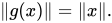
The orthogonal O(n) is the subgroup of the general linear group GL(n, R), consisting of all endomorphisms that preserve the Euclidean norm; that is, endomorphisms g such that
Let E(n) be the group of the Euclidean isometries of a Euclidean space S of dimension n. This group does not depend on the choice of a particular space, since all Euclidean spaces of the same dimension are isomorphic. The stabilizer subgroup of a point x ∈ S is the subgroup of the elements g ∈ E(n) such that g(x) = x. This stabilizer is (or, more exactly, is isomorphic to) O(n), since the choice of a point as an origin induces an isomorphism between the Euclidean space and its associated Euclidean vector space.
Orthogonal group
In mathematics, the orthogonal group in dimension n, denoted O(n), is the group of distance-preserving transformations of a Euclidean space of dimension n that preserve a fixed point, where the group operation is given by composing transformations. The orthogonal group is sometimes called the general orthogonal group, by analogy with the general linear group. Equivalently, it is the group of n × n orthogonal matrices, where the group operation is given by matrix multiplication (an orthogonal matrix is a real matrix whose inverse equals its transpose). The orthogonal group is an algebraic group and a Lie group. It is compact.
The orthogonal group in dimension n has two connected components. The one that contains the identity element is a normal subgroup, called the special orthogonal group, and denoted SO(n). It consists of all orthogonal matrices of determinant 1. This group is also called the rotation group, generalizing the fact that in dimensions 2 and 3, its elements are the usual rotations around a point (in dimension 2) or a line (in dimension 3). In low dimension, these groups have been widely studied, see SO(2), SO(3) and SO(4). The other component consists of all orthogonal matrices of determinant −1. This component does not form a group, as the product of any two of its elements is of determinant 1, and therefore not an element of the component.
By extension, for any field F, an n × n matrix with entries in F such that its inverse equals its transpose is called an orthogonal matrix over F. The n × n orthogonal matrices form a subgroup, denoted O(n, F), of the general linear group GL(n, F); that is
More generally, given a non-degenerate symmetric bilinear form or quadratic form on a vector space over a field, the orthogonal group of the form is the group of invertible linear maps that preserve the form. The preceding orthogonal groups are the special case where, on some basis, the bilinear form is the dot product, or, equivalently, the quadratic form is the sum of the square of the coordinates.
All orthogonal groups are algebraic groups, since the condition of preserving a form can be expressed as an equality of matrices.
The name of "orthogonal group" originates from the following characterization of its elements. Given a Euclidean vector space E of dimension n, the elements of the orthogonal group O(n) are, up to a uniform scaling (homothecy), the linear maps from E to E that map orthogonal vectors to orthogonal vectors.
The orthogonal O(n) is the subgroup of the general linear group GL(n, R), consisting of all endomorphisms that preserve the Euclidean norm; that is, endomorphisms g such that
Let E(n) be the group of the Euclidean isometries of a Euclidean space S of dimension n. This group does not depend on the choice of a particular space, since all Euclidean spaces of the same dimension are isomorphic. The stabilizer subgroup of a point x ∈ S is the subgroup of the elements g ∈ E(n) such that g(x) = x. This stabilizer is (or, more exactly, is isomorphic to) O(n), since the choice of a point as an origin induces an isomorphism between the Euclidean space and its associated Euclidean vector space.
Recent media
Recent media