


Community hub
Recent from talks
Contribute something
Nothing was collected or created yet.
140 New Montgomery
View on Wikipedia
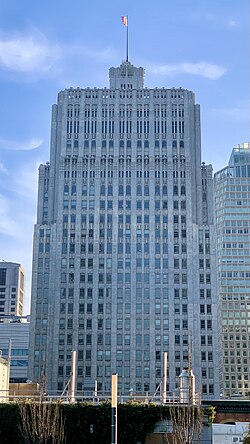
140 New Montgomery Street is a 26-floor Art Deco mixed-use office tower located in San Francisco's South of Market district, close to the St. Regis Museum Tower and the San Francisco Museum of Modern Art.[2] Constructed in 1925 as a modern headquarters for The Pacific Telephone & Telegraph Co., it was originally known as The Pacific Telephone & Telegraph Company Building or simply the Telephone Building,[2][1] and, after 1984, as The Pacific Bell Building[14] or The PacBell Building.[15]
Key Information


When it opened on May 30, 1925, The Pacific Telephone Building was San Francisco's first significant skyscraper development, and was the tallest building in San Francisco, until the Russ Building matched its height in 1927 at the time of its completion.[2][11][12] The building was the first high-rise south of Market Street, and along with the Russ Building, remained the city's tallest until it was overtaken by 650 California Street in 1964. It was the first high rise located on the west coast to be occupied solely by a single tenant.[12]
AT&T sold the building in 2007. As of 2013, Internet company Yelp was the main tenant.[16][17] Yelp moved out in 2021 following a rise in remote work during the COVID-19 pandemic.
History
[edit]The building was designed to consolidate numerous smaller buildings and outdated offices into a modern headquarters for The Pacific Telephone & Telegraph Co., and as a result, was designated as the Pacific Telephone & Telegraph Co. Coast Division Offices by the company, though referred to colloquially as The Telephone Building.[18][11]
The building's architecture was influenced by Eliel Saarinen's Tribune Tower design, in particular regarding the setbacks on the higher floors.[1]
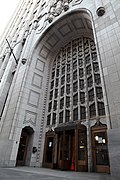
In reference to the Bell System, of which The Pacific Telephone & Telegraph Co. was a member of at the time of construction, the façade featured bell motifs in many locations, most notably surrounding the arch over the main entrance doors on New Montgomery Street. The decorations near the base and in the lobby also include references to the candlestick telephone and the pneumatic tube, some of the most modern communication technologies in use at the time.[1] After the breakup of the Bell System (AT&T) in 1984,[19] and the formation the Regional Bell Operating Companies, also known as the Baby Bells, Pacific Telephone changed its name to Pacific Bell.

Statues of eight eagles (each 13 feet (4.0 m) in height) perch atop the tower's crown.[20][21] The building has an L—shaped floor plan, and the architecture decoratively incorporates spotlights to show the exterior's terra cotta ornamentation day and night.[18] The lobby is decorated with images of plants, clouds, unicorns, and phoenixes and has a plaster ceiling inspired by Chinese brocade.[22]
In 1929, Sir Winston Churchill visited the building and made his first transatlantic telephone call, phoning his London home.[23][24][8]
For 44 years until 1978, the top of the roof was used to convey official storm warnings to sailors at the direction of the United States National Weather Service, in the form of a 25 feet (7.6 metres) long triangular red flag by day, and a red light at night.[8]
The 1989 Loma Prieta earthquake did only minor damage to the building, affecting parts of the terracotta cladding and requiring the eight eagle sculptures to be replaced with fiberglass replicas.[1]
In the 21st century
[edit]In 2006, AT&T moved out of the building, following its merger with SBC Communications.[1] In 2007, the PacBell Building was sold by AT&T to Stockbridge Capital Group and Wilson Meany Sullivan for US$118 million.[25] In 2008, the new owners filed plans to convert the tower into 118 luxury condominiums. However, those plans were put on hold during the 2008 financial crisis, and the building sat empty for nearly six years.[26]
Following a surge in office demand in 2010–2011, Wilson Meany Sullivan changed the plans back to office space.[26] Major renovation work began in February 2012, to improve the building's seismic performance, install all–new mechanical, electric, plumbing and fire sprinkler systems, and preserve and restore the building's historic lobby, at an estimated cost of US$80–100 million.[27] In 2012, Yelp announced it had signed a lease on the building's 100,000 square feet (9,300 m2) of office space through 2020.[28] After two expansions, the company held a total of almost 150,000 square feet (14,000 m2) on 13 floors in the fall 2015.[16]
In April 2016, Pembroke Real Estate Inc., a Boston–based REIT, acquired 140 New Montgomery as part of its portfolio — its second acquisition in San Francisco.[6][29][30][31] According to property records, Pembroke paid US$284 million for the property, at around US$962 per square foot.[30][31]
In 2021, Yelp did not renew its 2011 lease, and instead subleased a smaller space at nearby 350 Mission Street, due to the rise of remote work in the COVID-19 pandemic.[32] As of May 2023, during what the San Francisco Chronicle described as "Downtown San Francisco['s] worst office vacancy crisis on record," the building had a vacancy rate of 32.9%.[33]
-
 Souvenir Photo (1927)
 -
 140 New Montgomery entrance
 -
 The building as seen from Yerba Buena Gardens, rising behind the San Francisco Museum of Modern Art
 -
 View from Market Street
.jpg)


_seen_from_Mission_Street_-_cropped,_perspective_transformed.jpg)
See also
[edit]
External links
[edit]
- Official website

- Pacific Telephone & Telegraph Co. at Structurae
- 140 New Montgomery Street at the Council on Tall Buildings and Urban Habitat's The Skyscraper Center
- "Emporis building ID 118764". Emporis. Archived from the original on March 4, 2016.
- "PacBell Building". SkyscraperPage.
- Pacific Telephone & Telegraph Co. Building by James R. Miller, 1924, architectural drawing, charcoal and graphite on paper, at the San Francisco Museum of Modern Art
- "140 New Montgomery — The 140 Story". The140story.com. Archived from the original on May 10, 2021. Retrieved December 17, 2018.
- Pacific Telephone & Telegraph Company Building photographs for multiple San Francisco locations at the San Francisco Public Library
- Madrigal, Alexis C. (March 19, 2014). "A 26-Story History of San Francisco". The Atlantic.

References
[edit]- ^ a b c d e f Poletti, Therese (January 3, 2009). "On Hold in San Francisco. How the Economic Crisis Has Stalled the Renovation of the City's Telephone Building". Preservation. Archived from the original on June 10, 2015. Retrieved May 19, 2023.
{{cite web}}: CS1 maint: bot: original URL status unknown (link) - ^ a b c d "Emporis building ID 118764". Emporis. Archived from the original on March 4, 2016.
- ^ "PacBell Building". SkyscraperPage.
- ^ Pacific Telephone & Telegraph Co. at Structurae
- ^ "140 New Montgomery Street — The Skyscraper Center". SkyscraperCenter.com. Archived from the original on December 18, 2018. Retrieved December 17, 2018.
- ^ a b "140 New Montgomery — San Francisco — North America". Pembroke.com. Archived from the original on December 17, 2018. Retrieved December 17, 2018.
- ^ "Inventory of the A.A. and A.M. Cantin Collection, 1933-1977". OAC.CdLib.org. Archived from the original on December 18, 2018. Retrieved December 17, 2018.
Alexander (Aimwell) Cantin was born March 4, 1876, and died in 1964. He is possibly best known for designing a series of Pacific Telephone and Telegraph buildings in San Francisco and collaborated with the firm of Miller and Pflueger on the 26-story, Coast Division Building of the Pacific Telephone and Telegraph Company at 140 New Montgomery Street.
- ^ a b c Nolte, Carl (October 20, 1995). "Pac Bell Rings In 70th Birthday of S.F. Headquarters". SFgate.com. Archived from the original on December 18, 2018. Retrieved January 2, 2019.
- ^ "Timothy Pflueger — Architect — Then — Design". 140NM.com. Archived from the original on July 3, 2018. Retrieved January 2, 2019.
- ^ "Cantin, Alexander & Mackenzie — Environmental Design Archives, College of Environmental Design, University of California, Berkeley". Archives.CED.Berkeley.edu. Archived from the original on January 2, 2019. Retrieved January 2, 2019.
- ^ a b c Poletti, Therese; Pavia, Tom (September 3, 2008). Art Deco San Francisco: The Architecture of Timothy Pflueger (1st ed.). New York: Princeton Architectural Press. pp. 59–79. ISBN 978-1-56898-756-9. OCLC 191732382. Retrieved January 2, 2019.
- ^ a b c Historic American Buildings Survey (HABS) No. CA-2870, "Pacific Telephone Building, 140 New Montgomery Street", 25 photos, 4 data pages, 3 photo caption pages
- ^ Mahjoub, Nina A.; Stringer, Megan; Tremayne, Bill (2015). "Retrofit / Seismic: Sustaining a Historic High-Rise Structure" (PDF). CTUBH Journal (1). Chicago, IL: Council on Tall Buildings and Urban Habitat: 34–39. ISSN 1946-1186. JSTOR ctbuhj. OCLC 183595840. Archived (PDF) from the original on October 7, 2018. Retrieved January 2, 2019.
- ^ Waxmann, Laura (February 3, 2021). "Exclusive: Yelp's entire San Francisco HQ listed for lease". San Francisco Business Times. Retrieved May 12, 2025.
- ^ Sheber, Lauren (June 7, 2018). "The most beautiful buildings in San Francisco". Time Out San Francisco. Retrieved May 12, 2025.
- ^ a b Simonson, Sharon (August 19, 2013). "Yelp Occupies 140 New Montgomery". TheRegistrySF.com. Archived from the original on December 18, 2018. Retrieved January 2, 2019.
- ^ "Russ Building, San Francisco". Emporis. Archived from the original on April 16, 2017. Retrieved December 17, 2018.
- ^ a b Smith, Richard C. (September 1925). "The News Letter and the Telephone". San Francisco News Letter (Diamond Jubilee ed.). Archived from the original on January 20, 2010. Retrieved December 17, 2018 – via Virtual Museum of the City of San Francisco.
- ^ Pollack, Andrew (January 1, 1984). "Bell System Breakup Opens Era of Great Expectations and Great Concern". The New York Times. ISSN 0362-4331. Archived from the original on August 13, 2017. Retrieved May 23, 2023.
- ^ Bevk, Alex (March 8, 2012). "Pacific Telephone Building Scraps Plans For Condos, Moves On To Office Space". SF.curbed.com. Archived from the original on October 8, 2012. Retrieved December 7, 2013.
- ^ Dineen, J. K. (August 22, 2013). "Sneak peek: Yelp's new San Francisco HQ set to open". San Francisco Business Times. Retrieved December 7, 2013.
- ^ Nyren, Ron (Spring 2023). "7 Dazzling Art Deco Buildings for Architecture Admirers". Preservation Magazine. National Trust for Historic Preservation.
- ^ "Noted Statesman visits Telephone Building" (PDF). The Pacific Telephone Magazine. September 1929. Archived from the original (PDF) on July 3, 2018. Retrieved January 2, 2019.
- ^ "Pacific Telephone & Telegraph Company Building — San Francisco, USA Attractions". LonelyPlanet.com. Archived from the original on January 3, 2019. Retrieved January 2, 2019.
- ^ Haeber, Jonathan M. (June 22, 2009). "An Abandoned Skyscraper: The Pac Bell Building". Bearings. Richmond, California: Chronicas Media. Archived from the original on June 25, 2009. Retrieved January 2, 2019.
- ^ a b Poletti, Therese (March 7, 2012). "New Call by Developer on Historic Tower". The Wall Street Journal. Archived from the original on November 18, 2017. Retrieved December 9, 2012.
A historic skyscraper in downtown San Francisco, the Pacific Telephone & Telegraph building, empty for almost six years, is about to become a hub of construction activity as a US$50 million–plus modernization project begins. ... This is a new strategy from the developer, which in 2008 filed plans to turn the tower, also known as the Telephone Building, into 118 luxury condominiums, at an estimated cost of US$80 million to US$100 million.
- ^ "140 New Montgomery". 140NM.com. 2012. Archived from the original on April 20, 2012. Retrieved April 3, 2012.
- ^ "Yelp signs Pacific Telephone Building lease to 2020". San Francisco Chronicle. May 9, 2012. Archived from the original on May 10, 2012. Retrieved May 10, 2012.
- ^ "Company Overview of Pembroke Real Estate Inc". Bloomberg Markets. Retrieved December 17, 2018.
- ^ a b Li, Roland (December 15, 2016). "Developers double their money with $350 million SoMA office sale". San Francisco Business Times. Archived from the original on April 30, 2017. Retrieved December 17, 2018.
- ^ a b Li, Roland (March 24, 2017). "Wilson Meany sells a revamped, historic gem (video)". San Francisco Business Times. Archived from the original on March 31, 2017. Retrieved December 17, 2018.
- ^ Li, Roland (November 5, 2021). "Former Yelp headquarters in attracts 6 new tenants as S.F. office market continues recovery". San Francisco Chronicle. Archived from the original on May 19, 2023. Retrieved May 19, 2023.
- ^ Li, Roland; Devulapalli, Sriharsha (May 8, 2023). "Downtown S.F. has 18.4 million square feet of empty office space. We mapped every vacancy". San Francisco Chronicle. Archived from the original on May 19, 2023. Retrieved May 19, 2023.
| Authority control databases: Geographic |
|---|
