


Community hub
Recent from talks
Contribute something to knowledge base
Content stats: 0 posts, 0 articles, 1 media, 0 notes
Members stats: 0 subscribers, 0 contributors, 0 moderators, 0 supporters
Subscribers
Supporters
Contributors
Moderators
Hub AI
Pacific jumping mouse AI simulator
(@Pacific jumping mouse_simulator)
Hub AI
Pacific jumping mouse AI simulator
(@Pacific jumping mouse_simulator)
Pacific jumping mouse
The Pacific jumping mouse (Zapus trinotatus) is a species of rodent in the family Zapodidae. Found in Canada and the United States, its natural habitats are temperate grassland and swamps.
Pacific jumping mice can be distinguished from other rodents that belong to the same genus by their larger size. They have a distinct color separation between the back and underside. Other distinctive features of the Pacific jumping mouse, especially in contrast to the Western jumping mouse, include ears fringed with light brown fur or with fur that matches the back.
These rodents prefer to live in moist habitats and are frequently found in riparian or meadow areas near rivulets. They rely on grass seeds as their main diet, and thus they prefer inhabiting areas with thick vegetation, which provide refuge from predators as well as food resources. Besides eating grass, they feed also on fungi and insects. They spend most of the autumn season fattening up in preparation for winter hibernation, which is spent in small burrows in the ground. When their hibernation period of up to 8 months is over, they mate and produce a litter of 4 or more young. Pacific jumping mice have many predators, including snakes, coyotes, owls, and foxes.
Pacific jumping mice prefer living in moist regions, such as marshes with alder, salmonberry, skunk-cabbage, and riparian alder ecosystems commonly found in coastal redwood woodlands. In northern regions they dwell in dense woodlands, wet grassy regions, and alpine meadows of the Cascade Mountains in Washington and the Olympic Peninsula. These mice can be found in marshy thickets, woodlands edges that contain both weedy understory and ferns, and in meadows.
The habitat of Pacific jumping mice includes streams, brushlands, lakes, woodlands, forests, fields, swamps, meadows, shrubs, bogs, marshes, and the banks of rivers and ponds. Their range covers the entire Pacific Northwest, California, and western Canada.
The diet of Pacific jumping mice include fungi, fish, insects, mollusks, wild fruits, seeds, and wild berries. They forage for food material at ground level and will cut down tall plants to reach seeds. Other behaviors include cutting grass and leaving it in an orderly pile, but hey do not store food. The dental formula of Zapus trinotatus is 1.0.1.31.0.0.3 = 18.
Infant Pacific jumping mice vocalize in sharp squeals. Mature mice evade predators by leaping distances of over 150 cm; they leap with their head turned downwards, arching their back and diving on the ground while at the same time preparing to make another leap. They may also evade predation by remaining motionless and depending on the camouflage effect of their fur. They are most active from dusk until dawn. They feed by seizing food with their forepaws. Their behavior is typically nervous and high-strung, and they can be aggressive when trapped. However, despite showing some signs of aggressiveness, the Pacific jumping mouse is naturally gentle. When engaged in fighting, they produce a characteristic squeaking noise and at the same time pulsate their tails against the substrate, thus producing a drumming noise. When this rodent is agitated, it jumps and moves madly from one place to another. Pacific jumping mice prepare for summer by constructing a fragile domed-shaped nest with a single entrance, usually placed on the ground.
Pacific jumping mouse sexually mature the year after they are born. Males become sexually active in May or June, which is when females are also fertile. Their gestation period lasts about 18–23 days and give birth in July or August. Each litter consist of about 4-8 young, which are weaned after 4 weeks. The Pacific jumping mouse are born pink and hairless, and weigh around 0.7–0.9 grams at birth. They are also born with their eyes shut and depend on their mother to survive the first few weeks. They become independent after about a month.
Pacific jumping mouse
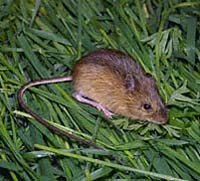
The Pacific jumping mouse (Zapus trinotatus) is a species of rodent in the family Zapodidae. Found in Canada and the United States, its natural habitats are temperate grassland and swamps.
Pacific jumping mice can be distinguished from other rodents that belong to the same genus by their larger size. They have a distinct color separation between the back and underside. Other distinctive features of the Pacific jumping mouse, especially in contrast to the Western jumping mouse, include ears fringed with light brown fur or with fur that matches the back.
These rodents prefer to live in moist habitats and are frequently found in riparian or meadow areas near rivulets. They rely on grass seeds as their main diet, and thus they prefer inhabiting areas with thick vegetation, which provide refuge from predators as well as food resources. Besides eating grass, they feed also on fungi and insects. They spend most of the autumn season fattening up in preparation for winter hibernation, which is spent in small burrows in the ground. When their hibernation period of up to 8 months is over, they mate and produce a litter of 4 or more young. Pacific jumping mice have many predators, including snakes, coyotes, owls, and foxes.
Pacific jumping mice prefer living in moist regions, such as marshes with alder, salmonberry, skunk-cabbage, and riparian alder ecosystems commonly found in coastal redwood woodlands. In northern regions they dwell in dense woodlands, wet grassy regions, and alpine meadows of the Cascade Mountains in Washington and the Olympic Peninsula. These mice can be found in marshy thickets, woodlands edges that contain both weedy understory and ferns, and in meadows.
The habitat of Pacific jumping mice includes streams, brushlands, lakes, woodlands, forests, fields, swamps, meadows, shrubs, bogs, marshes, and the banks of rivers and ponds. Their range covers the entire Pacific Northwest, California, and western Canada.
The diet of Pacific jumping mice include fungi, fish, insects, mollusks, wild fruits, seeds, and wild berries. They forage for food material at ground level and will cut down tall plants to reach seeds. Other behaviors include cutting grass and leaving it in an orderly pile, but hey do not store food. The dental formula of Zapus trinotatus is 1.0.1.31.0.0.3 = 18.
Infant Pacific jumping mice vocalize in sharp squeals. Mature mice evade predators by leaping distances of over 150 cm; they leap with their head turned downwards, arching their back and diving on the ground while at the same time preparing to make another leap. They may also evade predation by remaining motionless and depending on the camouflage effect of their fur. They are most active from dusk until dawn. They feed by seizing food with their forepaws. Their behavior is typically nervous and high-strung, and they can be aggressive when trapped. However, despite showing some signs of aggressiveness, the Pacific jumping mouse is naturally gentle. When engaged in fighting, they produce a characteristic squeaking noise and at the same time pulsate their tails against the substrate, thus producing a drumming noise. When this rodent is agitated, it jumps and moves madly from one place to another. Pacific jumping mice prepare for summer by constructing a fragile domed-shaped nest with a single entrance, usually placed on the ground.
Pacific jumping mouse sexually mature the year after they are born. Males become sexually active in May or June, which is when females are also fertile. Their gestation period lasts about 18–23 days and give birth in July or August. Each litter consist of about 4-8 young, which are weaned after 4 weeks. The Pacific jumping mouse are born pink and hairless, and weigh around 0.7–0.9 grams at birth. They are also born with their eyes shut and depend on their mother to survive the first few weeks. They become independent after about a month.
Recent media
Recent media