Hubbry Logo
Packhorse bridgePackhorse bridgeMain
Open search
Packhorse bridge
Community hub
Packhorse bridge
logo
8 pages, 0 posts
0 subscribers
Be the first to start a discussion here.
Packhorse bridge
Packhorse bridge
from Wikipedia
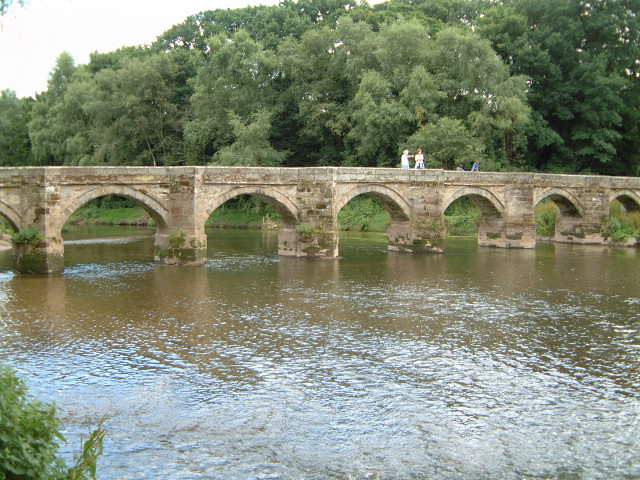
Essex Bridge, a packhorse bridge across the River Trent
Medieval packhorse bridge crossing the Almofrei at Cotobade, Galicia

A packhorse bridge is a bridge intended to carry packhorses (horses loaded with sidebags or panniers) across a river or stream. Typically a packhorse bridge consists of one or more narrow (one horse wide) masonry arches, and has low parapets so as not to interfere with the panniers borne by the horses.[1] Multi-arched examples sometimes have triangular cutwaters that are extended upward to form pedestrian refuges.[2]: 24–25 

Packhorse bridges were often built on the trade routes (often called packhorse routes) that formed major transport arteries across Europe and Great Britain until the coming of the turnpike roads and canals in the 18th century.[1] Before the road-building efforts of Napoleon, all crossings of the Alps were on packhorse trails.[3] Travellers' carriages were dismantled and transported over the mountain passes by ponies and mule trains.

Definition

[edit]

In the British Isles at least, the definition of a packhorse bridge is somewhat nebulous. Ernest Hinchliffe discusses the difficulty of defining a true packhorse bridge in A Guide to the Packhorse Bridges of England.[2] He claims that "before the eighteenth century bridges were described as 'horse bridges' or 'cart bridges'" and his strict definition excludes the latter. He suggests that a classic packhorse bridge should generally be:

  • less than 6 feet (1.8 m) in width;
  • built before 1800;
  • on a recognised packhorse route.

He categorises the 190 English bridges listed in his book into three groups:

  • Group 1: 6 feet (1.8 m) wide or less, built before 1800 and with known packhorse associations;
  • Group 2: bridges that fail one or other of the above criteria, but which are generally referred to as packhorse bridges;
  • Group 3: bridges sometimes claimed as packhorse bridges, but dismissed as such by the author.[2]: 6–7 

The difficulty of classification is illustrated by Moulton Bridge in Suffolk, which Hinchliffe places in Group 1 but which English Heritage describes as "perhaps not strictly a packhorse bridge since it was wide enough to take carts".[4]

List of packhorse bridges in the British Isles

[edit]

The following list includes all listed buildings described as packhorse bridges by English Heritage, Cadw, or Historic Scotland; all 106 of Hinchliffe's Group 1 bridges in England; and certain other candidates. (For England, Hinchliffe's Group numbers are given as superscripts after the bridge name.)

England

[edit]
County Location NameGroup Photograph Crosses Notes
Bedfordshire Sutton
52°06′42″N 0°13′08″W / 52.1117°N 0.2190°W / 52.1117; -0.2190
Sutton Packhorse Bridge1
Potton Brook Medieval with later repairs; two pointed arches. Grade II* listed,[5] Scheduled monument.[6]
Cheshire Crowton
53°16′13″N 2°37′34″W / 53.2702°N 2.6262°W / 53.2702; -2.6262
Acton Brook Single segmental arch. Carries public bridleway.
Cheshire Hockenhull Platts
53°11′10″N 2°47′05″W / 53.1861°N 2.7848°W / 53.1861; -2.7848
Roman Bridges1
River Gowy Three bridges, "probably late 18th-century"[7] or "late 17th-century".[8] Grade II listed.[7][9] The three bridges carry a public byway.
Cheshire Quarry Bank Mill, Styal
53°20′38″N 2°15′01″W / 53.3440°N 2.2503°W / 53.3440; -2.2503
The Packhorse Bridge
River Bollin 1820, single segmental arch. Grade II listed.[10] Carries a public byway.
Cheshire/Derbyshire Three Shire Heads
53°12′50″N 1°59′15″W / 53.2139°N 1.9875°W / 53.2139; -1.9875
Three Shire Heads Bridge2
River Dane Probably late 18th-century; single span. Grade II listed.[11] Carries public byway.
Cornwall Bowithick
50°36′55″N 4°34′09″W / 50.6154°N 4.5691°W / 50.6154; -4.5691
Bowithick Bridge
Penpont Water Probably early 19th-century; three stone arches, one larger and two small. Grade II listed.[12]
Cornwall Launceston
50°38′29″N 4°21′58″W / 50.641492°N 4.366202°W / 50.641492; -4.366202
West Bridge (Prior's Bridge)
River Kensey Late medieval; five-span bridge with two cut-waters. Grade I listed.[13]
Cumbria Ambleside
54°27′09″N 2°57′33″W / 54.4525°N 2.9592°W / 54.4525; -2.9592
High Sweden Bridge1
Scandale Beck Late 17th-century; single-span. Grade II listed.[14]< Carries public footpath.
Cumbria Barbon
54°13′50″N 2°35′37″W / 54.2306°N 2.5937°W / 54.2306; -2.5937
High Beckfoot Bridge1
Barbon Beck Probably late 17th- or 18th-century; described as "ruinous" in 1725.[8] Single-span. Grade II listed.[15] Carries public bridleway.
Cumbria Dean
54°37′29″N 3°27′33″W / 54.6246°N 3.4592°W / 54.6246; -3.4592
Calva Hall packhorse bridge1
River Marron Dated 1697;[2]: 38  single-span. Grade II listed.[16]
Cumbria Drigg
54°22′32″N 3°25′21″W / 54.3756°N 3.4224°W / 54.3756; -3.4224
Drigg Holme Packhorse Bridge1
River Irt Single-span. Scheduled monument.[17] Carries public bridleway.
Cumbria Eskdale
54°23′44″N 3°15′00″W / 54.3956°N 3.2499°W / 54.3956; -3.2499
Doctor[s] Bridge2
River Esk Probably 17th-century, widened in 1734. Grade II listed.[18] Carries public road.
Cumbria Gaisgill
54°27′10″N 2°33′39″W / 54.4527°N 2.5609°W / 54.4527; -2.5609
Barugh Bridge1
Rais Gill Probably 18th-century, but maybe earlier. Grade II listed.[19] Carries public byway.
Cumbria Knock
54°39′02″N 2°28′45″W / 54.6506°N 2.4791°W / 54.6506; -2.4791
Swindale Beck Possibly 17th-century; single segmental arch. Grade II listed.[20]
Cumbria Little Langdale
54°25′04″N 3°03′42″W / 54.4178°N 3.0616°W / 54.4178; -3.0616
Slater[s] Bridge1
River Brathay 17th-century; two clapper slabs and a single arch. Grade II* listed.[21] Carries public footpath.
Cumbria Lowgill
54°21′44″N 2°35′32″W / 54.3621°N 2.5921°W / 54.3621; -2.5921
Lowgill Packhorse Bridge
Lowgill Beck Probably 17th- or 18th-century; single-span. Grade II listed.[22]
Cumbria Pennington
54°12′24″N 3°08′28″W / 54.2066°N 3.1411°W / 54.2066; -3.1411
Devil's Bridge1
Rathmoss Beck 17th- or 18th-century; single-span. Grade II listed.[23] Alongside public road.
Cumbria Sca Fell
54°25′20″N 3°11′32″W / 54.4221°N 3.1923°W / 54.4221; -3.1923
Lingcove or Throstlegarth Bridge1
Lingcove Beck Single arch. On Open Access land.
Cumbria Seathwaite, Allerdale
54°29′16″N 3°10′59″W / 54.4877°N 3.1830°W / 54.4877; -3.1830
Stockley Bridge2
Grains Gill Early- or mid-18th-century; single span. Grade II listed.[24] Carries public bridleway.
Cumbria Shap
54°32′11″N 2°43′11″W / 54.5364°N 2.7197°W / 54.5364; -2.7197
Parish Crag Bridge1
Swindale Beck Probably 18th-century; single span. Grade II listed.[25] Carries public footpath.
Cumbria Shap
54°32′16″N 2°45′05″W / 54.5378°N 2.7515°W / 54.5378; -2.7515
Park Bridge2
Haweswater Beck 1860–69; single span.[26] Carries public footpath.
Cumbria Stainton
54°16′00″N 2°43′58″W / 54.2666°N 2.7327°W / 54.2666; -2.7327
packhorse bridge1
Stainton Beck Probably 17th-century; single segmental arch. Grade II listed.[27] Adjacent to ford.
Cumbria Ullock
54°36′07″N 3°25′54″W / 54.6020°N 3.4318°W / 54.6020; -3.4318
packhorse bridge1
Black Beck Single span.[2]: 52 
Cumbria Wasdale Head
54°28′06″N 3°15′24″W / 54.4682°N 3.2567°W / 54.4682; -3.2567
Row Bridge1
Mosedale Beck Probably 18th-century; single span. Grade II listed.[28][29]
Cumbria Watendlath
54°32′14″N 3°07′17″W / 54.5371°N 3.1214°W / 54.5371; -3.1214
Watendlath Packhorse Bridge1
Watendlath Beck 18th-century; single span. Grade II listed.[30][31] Carries public bridleway.
Cumbria Wilton
54°28′44″N 3°26′46″W / 54.4790°N 3.4460°W / 54.4790; -3.4460
Monk's Bridge1
River Calder Probably 17th- or 18th-century; single span. Also known as High Wath Bridge, Mattie Benn's Bridge, Hannah Benn Bridge and Roman Bridge.[2]: 46  Grade II listed.[32][33]
Cumbria Winster
54°20′27″N 2°54′18″W / 54.3408°N 2.9051°W / 54.3408; -2.9051
tributary of River Winster Probably 17th-century. Grade II listed.[34] Adjacent to A5074 road.
Cumbria Winster
54°19′37″N 2°54′08″W / 54.3269°N 2.9021°W / 54.3269; -2.9021
Winster Bridge1
River Winster 1729 with 20th-century parapet; single span. Grade II listed.[35]
Derbyshire Ashford-in-the-Water
53°13′24″N 1°42′37″W / 53.2232°N 1.7104°W / 53.2232; -1.7104
Sheepwash Bridge2
River Wye 18th-century; three low arches, with integral walled sheep pen on southern bank. Grade II* listed,[36] Scheduled monument.
Derbyshire Bakewell
53°13′03″N 1°40′44″W / 53.2175°N 1.6788°W / 53.2175; -1.6788
Holme Bridge1
River Wye 1664; five segmental arches. Grade I listed,[37] Scheduled monument.[38] Carries public bridleway.
Derbyshire Edale
53°22′16″N 1°48′58″W / 53.3710°N 1.8161°W / 53.3710; -1.8161
Gibraltar Bridge1
Grindsbrook 18th-century; single span. Grade II listed.[39] Carries public footpath.
Derbyshire Edale
53°22′20″N 1°52′07″W / 53.3721°N 1.8687°W / 53.3721; -1.8687
Youngate or Jacob's Ladder Bridge1
River Noe Possibly 17th-century; single span. Grade II listed.[40] Carries public bridleway (part of the Pennine Way).
Derbyshire nr Errwood Hall
53°15′23″N 1°58′55″W / 53.2563°N 1.9820°W / 53.2563; -1.9820
Goyts Bridge1
River Goyt Moved to current position in 1968 from Goyt's Bridge hamlet. In open access land.
Derbyshire Hayfield
53°22′48″N 1°55′35″W / 53.3801°N 1.9263°W / 53.3801; -1.9263
Bowden Bridge1
River Kinder Probably 18th-century; single-span. Grade II listed.[41] Carries public footpath.
Derbyshire/Staffordshire Hollinsclough
53°11′56″N 1°54′26″W / 53.1988°N 1.9072°W / 53.1988; -1.9072
Hopping Packhorse Bridge1
River Dove Single semicircular arch.[2]: 114–115  Carries public bridleway.
Derbyshire/Staffordshire Hollinsclough
53°12′12″N 1°55′24″W / 53.2034°N 1.9232°W / 53.2034; -1.9232
Washgate Bridge1
River Dove Early 18th-century; single-span. Grade II listed, "A rare example of a perfectly preserved packhorse bridge."[42] Carries public byway.
Derbyshire/South Yorkshire Howden Reservoir
53°27′09″N 1°44′48″W / 53.4526°N 1.7467°W / 53.4526; -1.7467
Slippery Stones Bridge2
River Derwent 1672; two segmental arches. Rebuilt 1959 after relocation from Derwent village. Grade II listed,[43] Scheduled monument.[44] Carries public bridleway.
Derbyshire Lea Hall
53°03′28″N 1°42′26″W / 53.0577°N 1.7073°W / 53.0577; -1.7073
Bradbourne Brook 17th-century or earlier; single pointed arch. Formerly Grade II listed, now delisted.[45] On private land.
Derbyshire/South Yorkshire Longdendale
53°29′46″N 1°47′42″W / 53.4962°N 1.7950°W / 53.4962; -1.7950
Ladyshaw Bridge
Salter's Brook 17th-century; single-span. Carries public byway, part of the Trans-Pennine Trail.
Derbyshire/Staffordshire Milldale
53°05′20″N 1°47′38″W / 53.0890°N 1.7938°W / 53.0890; -1.7938
Viator's Bridge1
River Dove 17th-century or earlier; two segmental arches. Grade II listed.[46] Carries public footpath. Mentioned in The Compleat Angler (1653) by Izaak Walton.
Derbyshire Youlgreave
53°10′24″N 1°40′48″W / 53.1732°N 1.6799°W / 53.1732; -1.6799
Bradford Packhorse Bridge1
River Bradford 18th-century, single segmental arch. Grade II listed.[47] Carries public bridleway.
Derbyshire Youlgreave
53°11′00″N 1°40′49″W / 53.1833°N 1.6804°W / 53.1833; -1.6804
Coalpit Bridge1
River Lathkill Mid-18th-century; three segmental arches. Grade II listed.[48] Carries public bridleway.
Devon Brendon
51°13′14″N 3°45′50″W / 51.2205°N 3.7639°W / 51.2205; -3.7639
Packhorse Bridge
East Lyn River Probably 17th- or 18th-century; single round arch. Grade II listed.[49]
Devon Drewsteignton
50°41′44″N 3°46′52″W / 50.6955°N 3.7810°W / 50.6955; -3.7810
Fingle Bridge
River Teign 17th-century Grade II* listed three-arch granite bridge carrying unclassified road with pedestrian refuges over cutwaters.[50]
Devon Membury
50°48′30″N 3°02′39″W / 50.8082°N 3.0442°W / 50.8082; -3.0442
Beckford Bridge1
River Yarty 18th- or 19th-century; single-span. Grade II listed,[51] Scheduled monument.[52]
Devon Sidford
50°42′10″N 3°13′22″W / 50.7029°N 3.2229°W / 50.7029; -3.2229
Sidford Bridge1
River Sid Said to be 12th-century. Grade II listed. Parapets of original packhorse bridge incorporated into widened road bridge of 1930 carrying A3052 road.[53]
Devon Westcott Barton, Marwood
51°07′37″N 4°06′03″W / 51.1269°N 4.1007°W / 51.1269; -4.1007
Knowl Water Probably 18th- or early 19th-century. Grade II listed.[54] Carries public footpath.
Dorset near Corfe Castle
50°39′45″N 2°02′55″W / 50.6626°N 2.0485°W / 50.6626; -2.0485
Sharford Bridge1
Corfe River Scheduled monument.[55] Carries public bridleway.
Dorset Fifehead Neville
50°53′57″N 2°19′33″W / 50.8993°N 2.3257°W / 50.8993; -2.3257
Fifehead Neville Packhorse Bridge1
River Divelish Probably medieval. Grade II listed; two triangular pointed arches.[56][57] Carries footpath alongside ford on public road.
Dorset Gussage St Michael
50°54′45″N 2°01′42″W / 50.9126°N 2.0282°W / 50.9126; -2.0282
packhorse bridge
River Allen Probably 18th-century; single semicircular arch. Grade II listed.[58] Carries public footpath.
Dorset Holwell
50°54′25″N 2°25′45″W / 50.9069°N 2.4291°W / 50.9069; -2.4291
packhorse bridge1 Caundle Brook Probably medieval, with 19th- and 20th-century alterations. Grade II listed.[59] Carries public bridleway.
Dorset Rampisham
50°49′07″N 2°37′24″W / 50.8187°N 2.6232°W / 50.8187; -2.6232
packhorse bridge1
River Frome 16th- or 17th-century alterations; three pointed arches. Grade II listed.[60] Carries public bridleway.
Dorset Sturminster Marshall
50°48′04″N 2°04′42″W / 50.8010°N 2.0782°W / 50.8010; -2.0782
packhorse bridge1
River Winterborne 17th-century; single cambered arch. Grade II listed.[61] Carries public bridleway.
Dorset Tarrant Monkton
50°52′51″N 2°04′45″W / 50.8808°N 2.0793°W / 50.8808; -2.0793
packhorse bridge1
River Tarrant Probably 17th-century; 3 segmental arches. Grade II listed.[62] Alongside ford on public road.
Durham Bowes
54°32′06″N 1°59′57″W / 54.5350°N 1.9992°W / 54.5350; -1.9992
Nabb Bridge1
Deepdale Beck 1699 per datestone (contra English Heritage listing, which says "Mid C18"); single segmental arch. Grade II listed.[63]
Durham Brafferton
54°34′06″N 1°31′58″W / 54.5682°N 1.5328°W / 54.5682; -1.5328
Ketton Packhorse Bridge1
River Skerne Late 17th- or early 18th-century; single segmental arch. Grade II listed.[64]
Durham Cornsay
54°47′39″N 1°46′55″W / 54.7941°N 1.7819°W / 54.7941; -1.7819
Pan Burn Possibly early 18th-century; single wide segmental arch. Grade II listed.[65] On private land.
Durham Egglestone Abbey
54°31′56″N 1°54′19″W / 54.5322°N 1.9052°W / 54.5322; -1.9052
Bow Bridge1
Thorsgill Beck 17th-century; single round arch.[2]: 56  Grade II listed.[66]
Durham Headlam
54°33′55″N 1°43′28″W / 54.5653°N 1.7245°W / 54.5653; -1.7245
packhorse bridge1
Headlam or Dyance Beck Probably 18th-century; single round arch. Grade II listed.[67]
Durham West Hope
54°28′44″N 1°57′09″W / 54.4788°N 1.9524°W / 54.4788; -1.9524
West Hope Packhorse Bridge1 Hill or Waitgill Beck Single segmental arch.[2]: 59 
Essex Feering
51°50′25″N 0°42′26″E / 51.8402°N 0.7071°E / 51.8402; 0.7071
Roman Arches River Blackwater c.1750; seven brick arches. Under restoration.[68]
Gloucestershire Slad
51°46′16″N 2°09′53″W / 51.7711°N 2.1647°W / 51.7711; -2.1647
packhorse bridge1
Dillay Brook Carries public footpath.
Gloucestershire/Warwickshire Todenham
52°02′09″N 1°38′38″W / 52.0357°N 1.6440°W / 52.0357; -1.6440
packhorse bridge1
Knee Brook Possibly 16th-century in origin, rebuilt 18th century; two semicircular arches. Grade II listed.[69] Carries public bridleway.
Gloucestershire Wickwar
51°35′29″N 2°23′22″W / 51.5914°N 2.3895°W / 51.5914; -2.3895
Sturt Bridge1
Little Avon River Also known as Roman Arch. Probably late medieval or 16th-/17th-century; two arches. Grade II listed.[70] Carries public footpath.
Greater Manchester Prestolee
53°33′08″N 2°22′36″W / 53.5523°N 2.3767°W / 53.5523; -2.3767
Prestolee Bridge1
River Irwell Late 18th-century; five semicircular arches with cutwaters. Grade II listed.[71]
Greater Manchester Strines
53°22′58″N 2°03′05″W / 53.3829°N 2.0515°W / 53.3829; -2.0515
Roman Bridge1
River Goyt 18th-century; single segmental span. Grade II listed.[72][73] Carries public bridleway.
Greater Manchester Uppermill
53°33′14″N 2°00′33″W / 53.5540°N 2.0091°W / 53.5540; -2.0091
Diggle Brook "Medieval". Adjacent to Oldham & Ripponden Trust Turnpike bridge (1864)[74] and Brownhill Bridge Mill, which is Grade II listed.[75]
Kent Eynsford
51°22′05″N 0°12′39″E / 51.3680°N 0.2109°E / 51.3680; 0.2109
Eynsford Bridge
River Darent 17th-century, two round arches. Grade II listed.[76]
Lancashire Barrowford
53°51′28″N 2°12′38″W / 53.8577°N 2.2105°W / 53.8577; -2.2105
Higherford Old Bridge2
Pendle Water 16th/17th-century, parapets added 1814–15; single span. Grade II* listed,[77] Scheduled monument.[78]
Lancashire Bleasdale
53°54′24″N 2°39′44″W / 53.9066°N 2.6621°W / 53.9066; -2.6621
Brooks Packhorse Bridge1
River Brock Single-span. Listed per Hinchliffe,[2]: 61  but not in English Heritage listings.
Lancashire Catlow Bottoms
53°49′22″N 2°10′37″W / 53.8227°N 2.1770°W / 53.8227; -2.1770
packhorse bridge1
Catlow Brook "Perhaps C17"; single semicircular arch. Grade II listed.[79]
Lancashire Capernwray
53°54′15″N 2°19′44″W / 53.9041°N 2.3288°W / 53.9041; -2.3288
River Keer Date uncertain; single semi-elliptical arch. Grade II listed.[80]
Lancashire Clitheroe
53°50′52″N 2°27′04″W / 53.8478°N 2.4511°W / 53.8478; -2.4511
Old Bridge, Lower Hodder; Cromwell's Bridge
River Hodder c. 1562; three segmental arches, the middle arch being wider. Grade II* listed,[81][82] Scheduled monument.[83]
Lancashire Sawley
54°08′27″N 2°43′22″W / 54.1408°N 2.7228°W / 54.1408; -2.7228
Swanside Bridge
Smithies Brook 17th-century or earlier; single high segmental arch. Grade II listed.[84] Carries public footpath.
Lancashire Wycoller
53°50′58″N 2°06′15″W / 53.8494°N 2.1043°W / 53.8494; -2.1043
Wycoller Packhorse Bridge1
Wycoller Beck 17th-century or perhaps earlier; two segmental arches. Grade II* listed,[85] Scheduled monument.[86] Carries a public footpath.
Leicestershire Anstey
52°40′16″N 1°11′05″W / 52.6711°N 1.1847°W / 52.6711; -1.1847
Anstey Bridge1
Rothley Brook Also known as The Old Bridge. Dated by W.G.Hoskins as c. 1500, by Jervoise as late 17th-century, and by English Heritage as 16th/17th-century;[2]: 121  five arches. Grade II* listed,[87] Scheduled monument.[88] Carries public footpath.
Leicestershire Anstey
52°40′30″N 1°10′43″W / 52.6750°N 1.1785°W / 52.6750; -1.1785
King William's Bridge3
Rothley Brook Probably 17th-century; two round arches. Grade II listed.[89] Carries public bridleway.
Leicestershire Aylestone
52°36′12″N 1°09′46″W / 52.6033°N 1.1629°W / 52.6033; -1.1629
Aylestone Old Bridge1
River Soar Also known as the Roman Bridge. Probably 15th-century; eleven small arches (eight on bridge, three on causeway). Grade II* listed,[90] Scheduled monument.[91]
Leicestershire Medbourne
52°31′45″N 0°49′18″W / 52.5292°N 0.8218°W / 52.5292; -0.8218
packhorse bridge1
Medbourne Brook Possibly 13th-century; four arches. Scheduled monument.[92]
Leicestershire Rearsby
52°43′27″N 1°02′15″W / 52.7243°N 1.0375°W / 52.7243; -1.0375
Seven Arch Bridge1
Rearsby Brook Pevsner says medieval, but datestone says 1714; seven semicircular arches, one almost buried. Grade II listed.[93]
Leicestershire Thurcaston
52°41′24″N 1°10′25″W / 52.6900°N 1.1736°W / 52.6900; -1.1736
Coffin Bridge1
Rothley Brook Three similar bridges between Thurcaston and Cropston: Sandham Bridge (52°41′34″N 1°09′57″W / 52.6929°N 1.1658°W / 52.6929; -1.1658) and Coffin Bridge (52°41′24″N 1°10′25″W / 52.6900°N 1.1736°W / 52.6900; -1.1736), both with two arches, and a third, single-span, bridge at 52°41′33″N 1°09′56″W / 52.6924°N 1.1655°W / 52.6924; -1.1655. All three are 16th- or 17th-century and separately Grade II listed.[94][95][96]
Lincolnshire Utterby
53°25′10″N 0°02′13″W / 53.4194°N 0.0369°W / 53.4194; -0.0369
Utterby Packhorse Bridge1
14th-century; double chamfered cambered arch. Grade II* listed.[97]
Lincolnshire West Rasen
53°23′22″N 0°24′10″W / 53.3895°N 0.4028°W / 53.3895; -0.4028
Bishop's Bridge1
River Rase 15th-century; three segmental arches. Grade II* listed,[98] Scheduled monument.[99]
Norfolk Walsingham
52°53′38″N 0°52′37″E / 52.8940°N 0.8770°E / 52.8940; 0.8770
packhorse bridge1
River Stiffkey Original date unknown, probably reconstructed late 19th century; four small arches. Grade II listed.[100] In grounds of Walsingham Abbey.
Northamptonshire Charwelton
52°12′01″N 1°13′07″W / 52.2003°N 1.2186°W / 52.2003; -1.2186
Charwelton Bridge1
River Cherwell Probably 15th-century; two pointed arches. Grade II listed,[101] Scheduled monument.[102] Carries roadside pavement.
Northumberland Ovingham
54°58′02″N 1°52′15″W / 54.9672°N 1.8709°W / 54.9672; -1.8709
Ovingham Packhorse Bridge1
Whittle Burn 18th-century per English Heritage (Hinchliffe says 1698[2]: 65 ); two segmental arches. Grade II listed.[103]
North Yorkshire Aldbrough St John
54°29′51″N 1°41′21″W / 54.4975°N 1.6893°W / 54.4975; -1.6893
packhorse bridge1
Aldbrough Beck Possibly 16th- or 17th-century; three segmental pointed arches. Grade II listed.[104] Carries public footpath.
North Yorkshire Birstwith
54°02′17″N 1°38′29″W / 54.0381°N 1.6415°W / 54.0381; -1.6415
New Bridge1
River Nidd Also known as Haxby Bridge. 1822; single-span. Grade II listed.[105] Carries public right-of-way.
North Yorkshire Boltby
54°16′22″N 1°14′49″W / 54.2728°N 1.2470°W / 54.2728; -1.2470
packhorse bridge1
Gurtof Beck Single semicircular arch.[2]: 67 
North Yorkshire Clapham
54°07′07″N 2°23′30″W / 54.1185°N 2.3918°W / 54.1185; -2.3918
Brokken Bridge1
Clapham Beck Probably 18th-century; single segmental arch.[106] Carries public footpath.
North Yorkshire Croft-on-Tees
54°29′05″N 1°34′05″W / 54.4848°N 1.5680°W / 54.4848; -1.5680
Clow Beck Packhorse Bridge1
Clow Beck Possibly 15th-century; two segmental arches on differing alignments. Grade II listed.[107] Carries public bridleway.
North Yorkshire Danby
54°27′36″N 0°53′30″W / 54.4599°N 0.8916°W / 54.4599; -0.8916
Duck Bridge1
River Esk Ancient stone bridge over the River Esk, about 1 km North from Danby Castle.
North Yorkshire Glaisdale
54°26′20″N 0°47′32″W / 54.4389°N 0.7921°W / 54.4389; -0.7921
Beggars Bridge2
River Esk 1619; single segmental arch. Grade II* listed.[108] Carries public footpath.
North Yorkshire Hampsthwaite
54°01′25″N 1°36′17″W / 54.0236°N 1.6048°W / 54.0236; -1.6048
Cockhill Packhorse Bridge1
Cockhill Beck Probably 17th-century; single small semicircular arch. Grade II listed.[109]
North Yorkshire Hubberholme
54°12′18″N 2°06′03″W / 54.2049°N 2.1008°W / 54.2049; -2.1008
Crook Gill Bridge1
Crook Gill Single segmental arch.[2]: 72 
North Yorkshire Ivelet
54°22′32″N 2°06′16″W / 54.3756°N 2.1045°W / 54.3756; -2.1045
Ivelet Bridge2
River Swale Late 16th-century; single semicircular arch. Grade II* listed.[110]
North Yorkshire Knox nr Harrogate
54°00′54″N 1°33′06″W / 54.0150°N 1.5516°W / 54.0150; -1.5516
Knox or Spruisty Bridge1
Oak Beck 17th- or 18th-century; single slightly pointed arch. Grade II listed.[111]
North Yorkshire Linton
54°03′39″N 2°00′20″W / 54.0607°N 2.0055°W / 54.0607; -2.0055
Redmayne Packhorse Bridge1
Linton or Eller Beck Late 17th- or early 18th-century; single shallow arch with additional flood arch. Grade II listed.[112] Carries public byway alongside ford.
North Yorkshire Norwood
53°57′13″N 1°42′09″W / 53.9535°N 1.7025°W / 53.9535; -1.7025
Dob Park Bridge1
River Washburn Probably early 17th-century; single segmental arch. Grade II listed.[113] Carries public byway.
North Yorkshire Pickering
54°13′39″N 0°47′17″W / 54.2274°N 0.7880°W / 54.2274; -0.7880
Ings Bridge1
Pickering Beck Probably early 19th-century; single segmental arch. Grade II listed.[114] Adjacent to public road.
North Yorkshire Ravenseat, Swaledale
54°25′32″N 2°12′46″W / 54.4256°N 2.2129°W / 54.4256; -2.2129
Ravenseat Bridge1
Whitsundale Beck 18th-century; single segmental arch. Grade II listed.[115] Carries farm access.
North Yorkshire Romanby
54°20′10″N 1°27′03″W / 54.3360°N 1.4509°W / 54.3360; -1.4509
Packhorse Bridge1
Willow Beck 16th-century, repaired 1621; single segmental arch. Grade II listed.[116] Carries public footpath.
North Yorkshire Skipton
53°57′40″N 2°00′37″W / 53.9610°N 2.0102°W / 53.9610; -2.0102
Skipton packhorse bridge
Wilderness Beck Probably 17th-century; single arch. Grade II listed.[117] Carries public footpath.
North Yorkshire Sowerby
54°13′11″N 1°20′02″W / 54.2198°N 1.3339°W / 54.2198; -1.3339
Town End Bridge1
Cod Beck Also known as World's End Bridge. 1672; single segmental arch. Grade II listed.[118] Carries public footpath.
North Yorkshire Spofforth
53°57′31″N 1°26′58″W / 53.9585°N 1.4495°W / 53.9585; -1.4495
packhorse bridge
River Crimple 18th-century; single arch. Grade II listed.[119]
North Yorkshire Stokesley
54°28′09″N 1°11′34″W / 54.4692°N 1.1927°W / 54.4692; -1.1927
Taylorson's Bridge1
River Leven 17th- or early 18th-century; single round arch. Grade II listed.[120]
North Yorkshire Thornthwaite
54°01′47″N 1°44′10″W / 54.0296°N 1.7361°W / 54.0296; -1.7361
Thornthwaite Packhorse Bridge1
Fall or Padside or Darley Beck Single segmental span. Scheduled monument.[121]
North Yorkshire Westerdale
54°26′47″N 0°58′40″W / 54.4464°N 0.9779°W / 54.4464; -0.9779
Hunter's Sty (Stee) Bridge2
River Esk 13th-century, restored 1874; single round span. Scheduled monument.[122] Carries public footpath.
North Yorkshire Yockenthwaite
54°12′26″N 2°08′52″W / 54.2071°N 2.1477°W / 54.2071; -2.1477
Yockenthwaite Bridge2
River Wharfe Probably early 18th-century; single segmental arch. Grade II listed.[123]
Nottinghamshire Ratcliffe-on-Soar
52°52′05″N 1°16′13″W / 52.8681°N 1.2702°W / 52.8681; -1.2702
Red Hill Lock Bridge
River Soar
(Loughborough Navigation)
Late 18th- or early 19th-century; single semicircular brick arch. Grade II listed.[124] Although described as such in the official listing, this canal bridge is not a packhorse bridge by most accepted definitions.
Shropshire Clun
52°25′13″N 3°01′49″W / 52.4204°N 3.0303°W / 52.4204; -3.0303
Clun Bridge
River Clun Probably 16th-century; five segmental arches. Grade II listed.[125] Carries A488 road.
Shropshire Rushbury
52°31′11″N 2°43′08″W / 52.5197°N 2.7190°W / 52.5197; -2.7190
Rushbury Packhorse Bridge1
Eaton Brook 17th-century; single segmental arch. Grade II listed.[126] Carries public bridleway.
Somerset Allerford
51°12′40″N 3°34′08″W / 51.2110°N 3.5688°W / 51.2110; -3.5688
Allerford Bridge1
River Aller Medieval; two segmental-headed arches. Grade II* listed,[127] Scheduled monument.[128] Adjoins public road through ford.
Somerset Bruton
51°06′42″N 2°27′12″W / 51.1118°N 2.4534°W / 51.1118; -2.4534
Bow Bridge, Plox1
River Brue Possibly 15th-century; single-span. Grade I listed,[129] Scheduled monument.[130]
Somerset Charterhouse
51°17′54″N 2°43′16″W / 51.2983°N 2.7210°W / 51.2983; -2.7210
17th- or 18th-century; single low segmental arch. Grade II listed.[131]
Somerset Chew Stoke
51°21′11″N 2°38′10″W / 51.3531°N 2.6360°W / 51.3531; -2.6360
packhorse bridge3
Strode Brook Two round arches.
Somerset Chewton Keynsham
51°23′45″N 2°29′52″W / 51.3959°N 2.4978°W / 51.3959; -2.4978
Chewton Packhorse Bridge
River Chew Early 18th-century; two segmental arches. Grade II listed,[132] Scheduled monument.[133] Carries public byway.
Somerset Dowlish Wake
50°54′38″N 2°53′21″W / 50.9106°N 2.8893°W / 50.9106; -2.8893
Dowlish Wake Packhorse Bridge
Dowlish Brook 17th- or 18th-century rebuild of medieval bridge; four round arches (two inserted 1994–97 for flood relief purposes).[134] Grade II listed.[135] Carries public footpath alongside road.
Somerset Dunster
51°10′45″N 3°26′49″W / 51.1792°N 3.4470°W / 51.1792; -3.4470
Gallox Bridge1
River Avill Possibly 15th-century; two round arches. Grade I listed,[136] Scheduled monument. Carries public bridleway.
Somerset Ilchester
51°00′28″N 2°42′50″W / 51.0077°N 2.7140°W / 51.0077; -2.7140
Pill Bridge1
River Ivel 17th-century; three semicircular arches. Grade II listed,[137] Scheduled monument.[138] Carries public bridleway.
Somerset Horner
51°11′55″N 3°34′47″W / 51.1985°N 3.5797°W / 51.1985; -3.5797
Hacketty Way Bridge1
River Horner Late medieval; single-span. Grade II* listed,[139] Scheduled monument.[140] Carries public bridleway.
Somerset West Luccombe
51°12′13″N 3°34′40″W / 51.2035°N 3.5777°W / 51.2035; -3.5777
West Luccombe packhorse bridge
River Horner Late medieval; single-span. Grade II* listed,[141] Scheduled monument.[142] Carries public footpath.
Somerset Oare
51°12′57″N 3°43′52″W / 51.2159°N 3.7310°W / 51.2159; -3.7310
Malmsmead Bridge
Badgworthy Water 17th–18th-century; two rounded arches. Grade II listed.[143] Carries public road.
Somerset Oare
51°12′18″N 3°41′25″W / 51.2050°N 3.6904°W / 51.2050; -3.6904
Robber's Bridge
Weir Water Carries public road.
Somerset Queen Camel
51°01′22″N 2°34′48″W / 51.0229°N 2.5799°W / 51.0229; -2.5799
packhorse bridge1
River Cam Carries public footpath.
Somerset Rode
51°17′03″N 2°17′25″W / 51.2842°N 2.2903°W / 51.2842; -2.2903
Scutt's Bridge1
River Frome Three semicircular arches. Grade II listed.[144] Carries public footpath.
Somerset Tellisford
51°17′59″N 2°16′48″W / 51.2996°N 2.2799°W / 51.2996; -2.2799
Tellisford Bridge2
River Frome Three semicircular arches. Grade II listed.[145] Carries public footpath.
Somerset Watchet
51°10′28″N 3°20′55″W / 51.1745°N 3.3486°W / 51.1745; -3.3486
Kentsford Bridge1
Washford River Probably late medieval; two segmental arches. Grade II listed.[146] Carries public footpath.
Somerset Wellow
51°19′17″N 2°22′21″W / 51.3213°N 2.3725°W / 51.3213; -2.3725
Wellow Bridge
Wellow Brook Late medieval; two round arches. Grade II listed.[147] Carries public footpath.
Somerset Winsford
51°07′31″N 3°37′12″W / 51.1254°N 3.6201°W / 51.1254; -3.6201
Lyncombe Bridge
River Exe 17th- or 18th-century, possibly earlier. Grade II listed.[148]
Somerset Winsford
51°06′19″N 3°33′52″W / 51.1053°N 3.5644°W / 51.1053; -3.5644
Old Vicarage Bridge1
River Exe Medieval, restored 1952; two semicircular arches. Grade II listed.[149] Carries public footpath, just upstream of 19th-century road bridge (also called Vicarage Bridge).
Somerset Winsford
51°06′10″N 3°33′53″W / 51.1027°N 3.5646°W / 51.1027; -3.5646
packhorse bridge1
Winn Brook Medieval, restored 1952; single semicircular arch. Grade II listed.[150]
South Yorkshire Longshaw
53°19′45″N 1°36′21″W / 53.3291°N 1.6059°W / 53.3291; -1.6059
Burbage Brook Bridge1
Burbage Brook c. 1750; single segmental arch. Grade II listed.[151] On open access moorland, near to Carl Wark.
South Yorkshire Oxspring
53°31′10″N 1°35′55″W / 53.5195°N 1.5986°W / 53.5195; -1.5986
Willow Bridge1
River Don Probably 17th-century; single slightly pointed arch. Grade II listed.[152] On public bridleway, part of the Trans-Pennine Trail.
South Yorkshire Rivelin Valley
53°22′53″N 1°33′44″W / 53.3814°N 1.5622°W / 53.3814; -1.5622
packhorse bridge1
River Rivelin c. 1775; single elliptical arch. Grade II listed.[153] In Country Park.
South Yorkshire Wharncliffe Side
53°26′42″N 1°33′41″W / 53.4449°N 1.5615°W / 53.4449; -1.5615
Glen Howe Packhorse Bridge2
Tinker Brook Formerly New Mill Bridge. 1734; single elliptical arch. Grade II listed.[154] In public park; resited during construction of Ewden Reservoir.
Staffordshire Great Haywood
52°48′02″N 2°00′31″W / 52.8006°N 2.0086°W / 52.8006; -2.0086
Essex Bridge1
River Trent Probably 16th-century; fourteen round arches. Described as "perhaps the least altered old bridge in the county"[155] and "the longest packhorse bridge in the country".[2]: 129  Grade I listed,[155] Scheduled monument.[156] Carries public bridleway.
Staffordshire Tamworth
52°37′52″N 1°41′20″W / 52.631°N 1.689°W / 52.631; -1.689
The Old Bolebridge River Anker No longer extant; demolished c.1878–79.[157]
Staffordshire Wetton, Staffordshire
53°06′07″N 1°51′33″W / 53.1020°N 1.8592°W / 53.1020; -1.8592
Wetton or Wettonmill Bridge
River Manifold Early 19th-century; four semicircular arches with triangular section buttresses. Described as a packhorse bridge by English Heritage,[158] though perhaps more accurately a cart bridge. Carries public byway.
Suffolk Cavenham
52°17′45″N 0°35′19″E / 52.2958°N 0.5886°E / 52.2958; 0.5886
Stone Bridge2
tributary of River Lark Probably 16th-century; single segmental brick arch. Grade II listed.[159] Adjacent to public road.
Suffolk Moulton
52°15′10″N 0°29′08″E / 52.2528°N 0.4855°E / 52.2528; 0.4855
Moulton Packhorse Bridge1
River Kennett ca. 1446[160] with 18th-century alterations;[4] four pointed arches. Grade II* listed,[161] Scheduled monument.[162] Carries public footpath.
Surrey Ewell
51°21′35″N 0°15′49″W / 51.3596°N 0.2637°W / 51.3596; -0.2637
The Packhorse Bridge
Hogsmill River 18th-century; single semicircular brick arch. Grade II listed.[163]
Surrey Gomshall
51°13′14″N 0°26′56″W / 51.2206°N 0.4490°W / 51.2206; -0.4490
River Tillingbourne 15th-century; three arches. Grade II listed.[164]
Warwickshire Shustoke
52°30′59″N 1°41′25″W / 52.5165°N 1.6904°W / 52.5165; -1.6904
Blyth Hall Packhorse Bridge
River Blythe 18th-century; three semicircular arches. Grade II listed.[165]
West Midlands Hampton-in-Arden
52°25′07″N 1°41′16″W / 52.4186°N 1.6878°W / 52.4186; -1.6878
Hampton in Arden packhorse bridge2
River Blythe 15th-century; three stone and two brick arches. Grade II* listed,[166] Scheduled monument.[167]
West Yorkshire Bingley
53°50′32″N 1°50′30″W / 53.8422°N 1.8418°W / 53.8422; -1.8418
Beckfoot Bridge1
Harden Beck c.1723; single-span. Grade II listed.[168] Carries public footpath.
West Yorkshire Clayton West
53°36′04″N 1°36′27″W / 53.6010°N 1.6074°W / 53.6010; -1.6074
Park Mill Bridge1
River Dearne Probably 18th-century; single-span. Grade II listed.[169] Carries public right-of-way.
West Yorkshire Colden
53°45′11″N 2°03′48″W / 53.7531°N 2.0633°W / 53.7531; -2.0633
Strines Bridge1
Colden Water Possibly 17th-century; single segmental arch. Grade II listed.[170] Carries public footpath; contra Hinchliffe, the English Heritage listing calls it a "fine graceful example of the packhorse type of bridge, but which having steps was probably only ever used as a foot-bridge...."[171]
West Yorkshire Goose Eye
53°51′38″N 1°58′24″W / 53.8605°N 1.9734°W / 53.8605; -1.9734
Dean Beck Date unknown; single arch. Grade II listed.[172] Adjacent to clapper bridge; carries public bridleway.
West Yorkshire Haworth
53°50′03″N 1°58′13″W / 53.8343°N 1.9704°W / 53.8343; -1.9704
Long Bridge1
River Worth Date uncertain; single-span. Grade II listed.[173] Carries public footpath.
West Yorkshire Hebden Bridge
53°44′31″N 2°00′48″W / 53.7420°N 2.0133°W / 53.7420; -2.0133
The Old Bridge2
Hebden Water Also known as Hepton Brig.[2]: 93  c.1510; three segmental arches. Grade II* listed.[174] Carries public right-of-way.
West Yorkshire Loxley
53°24′05″N 1°33′02″W / 53.4015°N 1.5505°W / 53.4015; -1.5505
River Loxley Probably 18th-century, restored 1864. Grade II listed.[175]
West Yorkshire Marsden
53°36′20″N 1°57′29″W / 53.6055°N 1.9580°W / 53.6055; -1.9580
Close Gate Bridge1
Haigh Clough 17th- or 18th-century; single-span. Grade II* listed.[176]
West Yorkshire Marsden
53°36′06″N 1°55′49″W / 53.6017°N 1.9304°W / 53.6017; -1.9304
Mellor Bridge1
River Colne 17th- or 18th-century; single-span. Grade II* listed.[177] Carries public footpath.
West Yorkshire Meanwood
53°49′16″N 1°33′41″W / 53.8212°N 1.5613°W / 53.8212; -1.5613
Meanwood Beck Early 18th-century. Grade II listed, "a rare survival of a pack-horse bridge sited within a suburban setting".[178]
West Yorkshire Oxenhope
53°49′12″N 1°56′47″W / 53.8201°N 1.9465°W / 53.8201; -1.9465
North Ives or Donkey Bridge1
Bridgehouse Beck Date uncertain; single steeply arched span. Grade II listed.[179] Carries public footpath.
West Yorkshire Rishworth Moor
53°38′20″N 1°59′38″W / 53.6389°N 1.9938°W / 53.6389; -1.9938
Oxygrains Old Bridge2
Oxygrains Clough Probably early 17th-century;[180] single-span. Scheduled monument.[181] On Access Land.
West Yorkshire Ripponden
53°40′28″N 1°56′24″W / 53.6745°N 1.9399°W / 53.6745; -1.9399
Waterloo or Ripponden Old Bridge2
River Ryburn 1752;[182] single-span. Grade II* listed,[183] Scheduled monument.[184] Public road.
West Yorkshire Stanbury
53°50′03″N 1°58′42″W / 53.8342°N 1.9784°W / 53.8342; -1.9784
Lumbfoot Bridge1
River Worth Date uncertain; single-span. Grade II listed.[185] Carries public footpath.
West Yorkshire Wakefield
53°40′33″N 1°29′22″W / 53.6759°N 1.4895°W / 53.6759; -1.4895
Little Bridge1
River Calder Probably 18th-century; three elliptical arches. Grade II listed.[186]
West Yorkshire Wadsworth
53°46′45″N 2°00′47″W / 53.7791°N 2.0130°W / 53.7791; -2.0130
Lumb Bridge1
Crimsworth Dean Beck Probably early 18th-century; single-span. Grade II listed.[187] Carries public bridleway.
Wiltshire Coombe Bissett
51°02′12″N 1°50′46″W / 51.0368°N 1.8461°W / 51.0368; -1.8461
packhorse bridge2
River Ebble Medieval, widened in the 19th century; three low two-centred arches. Grade II listed.[188] Carries public footpath.
Wiltshire Melksham
51°21′28″N 2°10′15″W / 51.3577°N 2.1708°W / 51.3577; -2.1708
packhorse bridge1
River Avon 1725; four segmental arches. Grade II listed.[189] Carries public footpath.
Worcestershire Astley
52°18′10″N 2°18′40″W / 52.3028°N 2.3112°W / 52.3028; -2.3112
New Bridge
Dick Brook Late 18th- or early 19th-century, possibly earlier, single arch. Grade II listed.[190] Carries public bridleway.
Worcestershire Shell
52°14′07″N 2°04′22″W / 52.2352°N 2.0729°W / 52.2352; -2.0729
Shell Packhorse Bridge1
Bow Brook 17th-century or earlier, two round arches. Grade II listed.[191] Adjacent to ford on public road.

Isle of Man

[edit]
County Location Name Photograph Crosses Notes
Isle of Man Ballasalla
54°06′07″N 4°37′53″W / 54.1020°N 4.6313°W / 54.1020; -4.6313
Crossag or Monks' Bridge
Silver Burn c. 1350; two slightly pointed arches. "It is believed to be the best example of [a] medieval bridge in the British Isles."[192]

Scotland

[edit]
County Location Name Photograph Crosses Notes
Borders Stow of Wedale
55°41′24″N 2°51′46″W / 55.69°N 2.8629°W / 55.69; -2.8629
Stow Old Bridge
Gala Water 1655; three segmental arches. Grade B listed.[193]
Highland Carrbridge
57°17′02″N 3°48′56″W / 57.283889°N 3.815556°W / 57.283889; -3.815556
Carrbridge Packhorse Bridge
River Dulnain 1717; slender arch. Category B listed.[194][195]
Fife Coaltown of Balgonie
56°10′21″N 3°07′00″W / 56.1726°N 3.1166°W / 56.1726; -3.1166
Barrel Brig
River Ore, Fife Early 18th century; double-span with cutwaters. Grade B listed, Scheduled monument.[196][197]
Highland John o' Groats
58°38′35″N 3°05′07″W / 58.6430°N 3.0853°W / 58.6430; -3.0853
Huna Burn 1651; single-span. Grade B listed.[198]
South Lanarkshire East Kilbride
55°43′46″N 4°13′38″W / 55.7295°N 4.2271°W / 55.7295; -4.2271
Craig Mill Packhorse Bridge White Cart Water Single-span. Grade B listed.[199]

Wales

[edit]
County Location Name Photograph Crosses Notes
Blaenau Gwent Aberbeeg
51°42′36″N 3°08′39″W / 51.7101°N 3.1442°W / 51.7101; -3.1442
Aberbeeg Packhorse Bridge
Ebbw Fach River Grade II listed.[200]
Conwy Penmachno
53°03′36″N 3°46′51″W / 53.0599°N 3.7807°W / 53.0599; -3.7807
Roman Bridge
River Machno Grade II listed.[201]
Flintshire Caergwrle
53°06′39″N 3°02′12″W / 53.1109°N 3.0367°W / 53.1109; -3.0367
Caergwrle Packhorse Bridge
River Alyn Mid-17th-century; "one of the finest examples in Wales".[202] Grade II listed.[203]
Flintshire Ffrith
53°05′24″N 3°03′57″W / 53.0901°N 3.0657°W / 53.0901; -3.0657
Ffrith Bridge
River Cegidog Probably 18th-century; single-span. Grade II listed, Scheduled monument.[204]
Gwynedd Dyffryn Ardudwy
52°47′31″N 4°01′31″W / 52.7919°N 4.0253°W / 52.7919; -4.0253
Pont Scethin
Afon Ysgethin Probably 18th-century; single arch. Scheduled monument.[205]
Gwynedd Minllyn
52°42′39″N 3°41′21″W / 52.71078°N 3.689135°W / 52.71078; -3.689135
Pont Minllyn
River Dovey Probably 17th-century; two segmental arches. Grade II listed,[206] Scheduled monument.[207]
Powys Llangenny
51°51′49″N 3°06′24″W / 51.8636°N 3.1067°W / 51.8636; -3.1067
Grwyne Fawr Grade II listed.[208]
Swansea Cheriton
51°36′40″N 4°13′34″W / 51.6111°N 4.2262°W / 51.6111; -4.2262
Kittlehill Packhorse Bridge
Burry Pill Grade II listed.[209]

References

[edit]
Revisions and contributorsEdit on WikipediaRead on Wikipedia
from Grokipedia
A packhorse bridge is a narrow medieval structure designed primarily for the passage of packhorses laden with goods, pedestrians, and non-wheeled transport, typically featuring a width of 1.25 to 2 meters, low or absent parapets to accommodate loaded animals, and one or more arches spanning streams or rivers. These bridges emerged in Britain during the medieval period, particularly from the 14th to 18th centuries, to facilitate trade and transport along packhorse trails before the widespread development of roads suitable for wheeled vehicles. Architecturally, they were constructed from local materials such as rubble stone, flint, or brick, often with pointed, segmental, or semicircular arches supported by piers, and many exhibit a humped profile to aid crossing while minimizing flood damage. Their maintenance was commonly funded through tolls known as pontage, overseen by churches, guilds, or local landowners, reflecting their role in regional economies. Fewer than 200 authentic examples survive in England, with additional instances in Scotland and Wales, underscoring their historical significance as remnants of pre-industrial transport networks; notable survivors include the 15th-century Moulton Bridge over the River Kennet in Suffolk, spanning over 20 meters with multiple arches, and the medieval Sidford Bridge in Devon, a 30-meter multi-span structure linking key trade routes. Today, these bridges are valued for their architectural simplicity and cultural heritage, often protected as scheduled monuments and restricted to pedestrian use.

History

Origins and Early Development

Packhorse routes served as vital pre-industrial trade arteries, particularly in the hilly and rugged terrains of medieval Britain where wheeled vehicles were impractical due to the absence of proper roads. These narrow paths, often following ancient trackways, enabled the transport of goods by s—sure-footed animals capable of navigating steep, rocky landscapes that carts could not traverse. The routes facilitated the movement of commodities such as , salt, and other essentials between remote communities and markets, forming the backbone of regional economies before the widespread development of turnpike roads in the . The earliest documented packhorse bridges in emerged around the 13th century, coinciding with the expansion of medieval trade networks. These structures were constructed to allow laden packhorses to cross rivers and streams safely, with the first surviving examples appearing in northern and western regions where terrain challenges were most acute. For instance, the packhorse bridge at Wycoller in dates to the 13th century and was integral to local trade pathways. Similarly, bridges in the and other upland areas began to proliferate during this period, reflecting the growing need for reliable crossings amid increasing commercial activity. This development was influenced by similar narrow bridge designs in Alpine Europe, where packhorse trails had long been the primary means of traversing mountainous passes prior to major road improvements in the late . In Britain, the construction of these bridges gained momentum in the , particularly following the (1348–1350), which caused labor shortages and shifted economic focus toward wool production—a lucrative that routes efficiently supported by transporting fleeces from rural estates to ports and markets. Monastic orders played a key role in funding and initiating many early builds, leveraging their extensive landholdings and involvement in commerce to maintain vital transport links for ecclesiastical estates and pilgrims. One of the oldest surviving examples is the circa 1300 bridge near Postbridge on , a clapper-style structure that exemplifies early adaptations for traffic in southwestern .

Peak Usage and Decline

Packhorse bridges reached their peak of construction and utilization during the Tudor (1485–1603) and Stuart (1603–1714) eras, when over 200 such structures had been built across Britain to facilitate vital regional trades. These bridges supported the transport of key commodities, including from rural areas like and the , tin from Cornish mines, and salt from Cheshire's saltworks, enabling packhorse trains to navigate narrow upland paths without the need for wider cart bridges. The marked the height of packhorse bridge usage, driven by expanding rural commerce and early movements that consolidated farmland but still relied on transport for remote routes. Networks like those along the , where up to 1,000 packhorses crossed daily carrying goods such as and salt, exemplified this era's dependence on these bridges for efficient links between markets and production centers. From the late , packhorse bridges began to decline in practical use, accelerated by the Industrial Revolution's transport innovations starting around 1760. The proliferation of turnpike roads, with acts increasing from about 10 per year before 1750 to 40 per year thereafter, allowed for wheeled vehicles and wider paths, reducing the need for narrow packhorse crossings. This shift intensified with the construction of canals from the 1760s onward and the enclosure acts of the 1770s, which systematically widened and straightened rural paths—often to 30–60 feet—while discontinuing or obliterating many old tracks, rendering narrow obsolete for everyday commerce by around 1800.

Design and Construction

Architectural Features

Packhorse bridges are distinguished by their narrow , typically measuring 1.2 to 1.8 in width, sufficient for a single laden with panniers to pass in single file without obstruction. This design accommodated the limited space required for pack animals on medieval trade routes, ensuring efficient crossing over streams and rivers. The bridges feature low or entirely absent parapets, generally under 1 meter in height, to avoid interference with the protruding loads carried by the horses; in many cases, such as the Thornthwaite example, parapets rise only about 0.6 meters and lean outward over coping. Structural integrity relies on construction employing pointed or segmental arches, often built with local stone for the arch rings and for the abutments. Single-span designs predominate for shorter crossings, with arches spanning up to 5 meters, as seen in the 3.5-meter span at Thornthwaite, while multi-arch configurations incorporate cutwaters on piers to protect against river flow and sometimes extend upward to form refuges where pack animals could briefly halt or pass oncoming traffic. Specific adaptations for packhorse use appear in some 15th-century examples, including beveled or chamfered edges on arches to facilitate smoother passage for laden animals, as evidenced by the slightly pointed chamfered arch at the Packhorse Bridge near . Ernest Hinchliffe's 1994 classification in A Guide to the Packhorse Bridges of delineates Group 1 bridges as the most authentic, characterized by widths of 1.8 meters or less and construction predating 1800, with variations in span length tailored to local river widths for optimal stability. These features underscore the bridges' functional simplicity, prioritizing durability and animal transit over vehicular capacity.

Materials and Building Techniques

Packhorse bridges were primarily constructed using locally sourced stone, such as limestone, gritstone, or slate, to minimize transportation costs and leverage regional geology. For instance, the Eccleston packhorse bridge employs a mixture of rough-hewn, punched, and tooled New Red Sandstone blocks, a common gritstone variant in northern England. The Moulton packhorse bridge, dating to the 15th century, incorporates flint and stone rubble for its core structure, with brick detailing on the arch edges. Mortar, where used, consisted of lime mixed with sand to bind the stones, providing flexibility against settlement; in remote or resource-scarce areas, dry-stone techniques prevailed, relying on carefully interlocked rubble without mortar for simplicity and durability. Building techniques emphasized manual labor and medieval masonry practices, with hand-quarried stone blocks laid in coursed patterns to form solid piers and abutments. Arches were assembled using voussoirs—wedge-shaped stones—with a prominent keystone at the crown to distribute loads and ensure stability, as seen in the segmental arches of the Eccleston bridge. Construction was typically undertaken by local masons or craft guilds, who possessed the specialized skills for such work; funding often came from church institutions or pious benefactors, reflecting the era's view of bridge-building as a charitable act. The Thornthwaite packhorse bridge in exemplifies this, possibly erected under the influence of nearby in the 15th century. Durability was achieved through practical engineering suited to rugged terrains and variable water flows, including shallow foundations anchored directly on to resist and shifting. Abutments were broadened at the base and revetted into riverbanks, as in the Thornthwaite example, to prevent undermining during high waters. The bridges' characteristic hump-backed profiles, with gently rounded decks and low parapets, enhanced flood resistance by reducing drag on debris and allowing water to flow beneath without accumulating pressure on the structure. A specific method central to arch was the erection of temporary wooden centering—scaffolded frameworks—to support the stones until the mortar set and the arch could bear its own weight, a technique documented in medieval English bridge-building records. This approach is evident in 15th-century structures like the Thornthwaite bridge, where the segmental arch ring of stone was likely formed this way before the centering was removed. The arches themselves, whether segmental or pointed, depended on such supports to achieve their precise curvature without collapse during assembly.

Significance

Economic Role in Trade Networks

Packhorse bridges played a pivotal role in pre-industrial networks across rural and upland , serving as essential for transporting goods via trains on narrow, rugged paths where wheeled vehicles could not travel. These bridges facilitated the movement of key commodities such as , cloth, lead, and foodstuffs, with each horse typically carrying loads of 50 to 100 kilograms (1-2 ) in panniers or creels. Prominent routes, including segments of the Great North Road from the northward and paths from to , relied on such bridges to cross rivers and streams, enabling efficient commerce in hilly terrains. The economic impact of bridges was profound, as they supported medieval fairs and markets by linking production areas to urban centers and ports, thereby sustaining regional economies. For instance, in the , these structures were integral to the export trade, allowing fleeces from vast sheep flocks to reach Flemish markets via ports like and , which formed the backbone of England's medieval economy and funded royal endeavors. Historical estimates suggest hundreds of operated daily on major routes like those through the by the , underscoring the scale of this system before the rise of turnpike roads. Packhorse bridges integrated with toll systems and merchant guilds, which regulated trade and collected fees at key crossings to maintain infrastructure and control commerce. Guilds, such as those of wool merchants in London and provincial towns, organized packhorse convoys and enforced standards, while tolls—often levied per horse or load—financed bridge repairs and encouraged regional specialization. This is evident in the transport of tin from Cornish mines to Bristol for smelting and export, where packhorse routes through Devon's uplands connected inland resources to coastal trade hubs, bolstering England's metal industry. By providing reliable crossings that reduced travel delays compared to risky fording—often taking hours in adverse conditions— these bridges enhanced trade efficiency in upland areas, though their prominence waned with the expansion of carriage roads in the 18th century.

Cultural and Architectural Legacy

Packhorse bridges stand as enduring symbols of medieval ingenuity, showcasing simple yet robust stone arch construction adapted to the rugged terrains of rural Britain, where they facilitated essential transport across streams and rivers without the need for elaborate infrastructure. These structures reflect the practical resourcefulness of medieval builders, using local materials to create narrow spans—typically one horse wide—with low parapets to accommodate laden panniers, embodying the self-reliant rural life of pre-industrial communities reliant on foot and equine paths for trade and daily movement. In cultural narratives, they evoke the pastoral harmony of remote landscapes, particularly in the , a region that inspired Romantic poets like , whose works celebrated the unspoiled natural and human-made features of the region. Architecturally, the humped profiles and single-arch designs of packhorse bridges influenced subsequent rural crossing constructions, including adaptations in 19th-century widenings for and early foot traffic, preserving core elements like elevated roadways to prevent flooding while evolving for broader use. This legacy is evident in their role as precursors to more modest bridge forms, blending functionality with aesthetic simplicity that prioritized endurance over ornamentation in isolated settings. In contemporary culture, packhorse bridges enhance as iconic heritage features, drawing walkers along restored packhorse trails that highlight historical routes through scenic countryside. Sites like Slater's Bridge in serve as picturesque focal points for visitors exploring the , which attracted approximately 17.7 million tourists in 2024, many seeking connections to Britain's medieval past amid its natural beauty. Their integration into heritage trails underscores a symbolic value, transforming former trade arteries into pathways for modern appreciation of rural history and . Recognizing their cultural artifact status, has listed over 190 packhorse bridges as Grade I or II structures, with 5 at Grade I, 25 at Grade II*, and 163 at Grade II, based on comprehensive 20th-century surveys that evaluated their architectural and historical merit. These designations affirm their role beyond utility, positioning them as tangible links to medieval innovation and communal resilience in the British countryside.

Preservation and Examples

Conservation Efforts

Conservation efforts for packhorse bridges in the United Kingdom are led by several key heritage organizations, including Historic England (formerly English Heritage), which manages the designation and protection of these structures as part of its oversight of England's historic environment, including industrial and transport heritage. The National Trust plays a role in preserving and promoting access to packhorse bridges on its properties, such as the transfer of the Stainforth Packhorse Bridge to its care for ongoing maintenance and public enjoyment. In Wales, Cadw, the Welsh Government's historic environment service, provides grants through its Heritage Conservation, Repair and Regeneration Scheme to support the repair and conservation of historic assets, including bridges, with funding covering up to 50% of eligible costs for listed buildings and scheduled monuments. Legal protections are afforded under frameworks like the Highways Act 1980, which governs public rights of way that many packhorse bridges form part of, alongside scheduling as ancient monuments under the Ancient Monuments and Archaeological Areas Act 1979, with Historic England listing 26 packhorse bridges as scheduled monuments (as of 2025) to prevent unauthorized alterations. Restoration techniques prioritize traditional methods to maintain structural integrity and historical authenticity, such as stonework with , which allows for breathability and compatibility with original medieval , and clearing invasive to prevent root damage and of abutments. These approaches are guided by Historic England's conservation principles and often involve field surveys, historic analysis, and appraisals to assess condition and plan interventions. For instance, on , the Authority has undertaken repairs to packhorse bridges along historic trackways like the Monastic Way, incorporating these techniques to restore alignments and enhance communal value, though specific costs for 2010s projects remain part of broader heritage budgets exceeding tens of thousands of pounds for path and bridge maintenance following flood events. Challenges in conserving packhorse bridges include increasing flood damage exacerbated by , which intensifies erosion and scour around stone foundations, as well as occasional that compromises parapets and surfaces. stories highlight the impact of surveys, such as Ernest Hinchliffe's 1994 guide documenting around 250 packhorse bridges, which raised awareness and contributed to enhanced protections, including new designations as heritage assets. Since 1950, efforts have conserved numerous such bridges, with 113 historic trackways scheduled as monuments by (as of 2018), some of which incorporate packhorse crossings, supported in part by EU funding in the for broader rural heritage projects across the and Alpine regions to promote cross-border conservation strategies.

Regional Examples in the British Isles

hosts the largest concentration of surviving packhorse bridges in the , with over 150 examples documented, primarily concentrated in the northern and western regions where rugged terrain necessitated narrow crossings for pack animals. Notable instances include Slater's Bridge in , , a 17th-century structure built from local slate and natural boulders that spans the River Brathay and is designated as a Grade II* listed building for its historical and architectural significance. Another prominent example is Essex Bridge near Great Haywood in , dating to the late and featuring 14 stone arches, making it the longest surviving packhorse bridge in at approximately 90 meters; it holds Grade I listed status due to its unaltered medieval form. In , around 20 packhorse bridges are recorded, many linked to Highland trade routes and often constructed from local or to withstand harsh weather. A key survivor is the Packhorse Bridge at in , built in 1717 as the oldest stone bridge in the , with its distinctive humpbacked arch originally designed for low parapets to accommodate laden horses crossing the River Dulnain. Though fewer in number compared to , these bridges highlight Scotland's sparser but strategically vital network for and transport. Wales features more than 15 surviving examples, typically adapted to the steep, flood-prone valleys of the north and west, using regional slate for durability against water erosion. Pont-y-Pair in Bettws-y-Coed, , exemplifies this with its 15th-century humped design over the turbulent Afon Llugwy, where the elevated center helps mitigate flood damage while maintaining a narrow width for packhorses; the name "Pair" derives from the Welsh for , evoking the river's swirling waters below. The Isle of Man preserves only a handful of these structures, reflecting its insular geography and limited medieval trade paths. The Crossag Bridge, also known as Monks' Bridge near Rushen in Ballasalla, is a rare 14th-century example with a narrow double-arched span paved in quartz cobbles, built by Cistercian monks to connect abbey lands across the Silverburn River. In Ireland, fewer examples survive due to less rugged terrain and extensive road development, but notable instances include the 17th-century Kilmartin Packhorse Bridge in , a rare survivor highlighting local pack routes, and the mid-17th-century Milltown Packhorse Bridge over the River Dodder in , which replaced a hazardous ford on the Dublin-Wicklow road. Across the , regional variations in construction are evident in material choices, such as the prevalent use of in Welsh bridges for its weather resistance in rainy uplands, contrasted with in many English examples from the , which provides robust support in settings. Overall, more than 190 packhorse bridges endure in the , as cataloged in comprehensive surveys.

References

Add your contribution
Related Hubs
User Avatar
No comments yet.