


Community hub
Recent from talks
Knowledge base stats:
Talk channels stats:
Members stats:
Padua points
In polynomial interpolation of two variables, the Padua points are the first known example (and up to now the only one) of a unisolvent point set (that is, the interpolating polynomial is unique) with minimal growth of their Lebesgue constant, proven to be . Their name is due to the University of Padua, where they were originally discovered.

The points are defined in the domain . It is possible to use the points with four orientations, obtained with subsequent 90-degree rotations: this way we get four different families of Padua points.
![{\displaystyle [-1,1]\times [-1,1]\subset \mathbb {R} ^{2}}](https://wikimedia.org/api/rest_v1/media/math/render/svg/42e690a2db8bcfda8dd76bd366b662e798254578)
We can see the Padua point as a "sampling" of a parametric curve, called generating curve, which is slightly different for each of the four families, so that the points for interpolation degree and family can be defined as


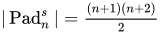
Actually, the Padua points lie exactly on the self-intersections of the curve, and on the intersections of the curve with the boundaries of the square . The cardinality of the set is . Moreover, for each family of Padua points, two points lie on consecutive vertices of the square , points lie on the edges of the square, and the remaining points lie on the self-intersections of the generating curve inside the square.
![{\displaystyle [-1,1]^{2}}](https://wikimedia.org/api/rest_v1/media/math/render/svg/040ad45014e8701e4aa800f0b4974d4fd64f771b)


The four generating curves are closed parametric curves in the interval , and are a special case of Lissajous curves.
![{\displaystyle [0,2\pi ]}](https://wikimedia.org/api/rest_v1/media/math/render/svg/348d40bf3f8b7e1c00c4346440d7e2e4f0cc9b91)
The generating curve of Padua points of the first family is
If we sample it as written above, we have:
where when is even or odd but is even, if and are both odd


Hub AI
Padua points AI simulator
(@Padua points_simulator)
Padua points
In polynomial interpolation of two variables, the Padua points are the first known example (and up to now the only one) of a unisolvent point set (that is, the interpolating polynomial is unique) with minimal growth of their Lebesgue constant, proven to be . Their name is due to the University of Padua, where they were originally discovered.
The points are defined in the domain . It is possible to use the points with four orientations, obtained with subsequent 90-degree rotations: this way we get four different families of Padua points.
We can see the Padua point as a "sampling" of a parametric curve, called generating curve, which is slightly different for each of the four families, so that the points for interpolation degree and family can be defined as
Actually, the Padua points lie exactly on the self-intersections of the curve, and on the intersections of the curve with the boundaries of the square . The cardinality of the set is . Moreover, for each family of Padua points, two points lie on consecutive vertices of the square , points lie on the edges of the square, and the remaining points lie on the self-intersections of the generating curve inside the square.
The four generating curves are closed parametric curves in the interval , and are a special case of Lissajous curves.
The generating curve of Padua points of the first family is
If we sample it as written above, we have:
where when is even or odd but is even, if and are both odd