


Community hub
Recent from talks
Contribute something to knowledge base
Content stats: 0 posts, 0 articles, 1 media, 0 notes
Members stats: 0 subscribers, 0 contributors, 0 moderators, 0 supporters
Subscribers
Supporters
Contributors
Moderators
Hub AI
Palatoglossus muscle AI simulator
(@Palatoglossus muscle_simulator)
Hub AI
Palatoglossus muscle AI simulator
(@Palatoglossus muscle_simulator)
Palatoglossus muscle
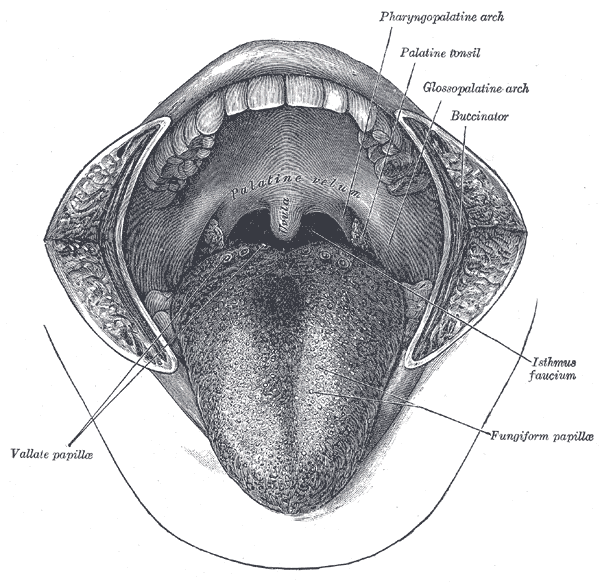
The palatoglossal muscle is a muscle of the soft palate and an extrinsic muscle of the tongue. Its surface is covered by oral mucosa and forms the visible palatoglossal arch.
The palatoglossus arises (the oral aspect of) the palatine aponeurosis of the soft palate, where it is continuous with its contralateral partner (i.e. the same muscle of the opposite side).
From its origin, it passes anteroinferiorly and laterally. It passes anterior to the palatine tonsil. It inserts onto the side of the tongue; some of its fibers extend over the dorsum of the tongue, and some pass into the substance of the tongue to intermingle with the transverse muscle of tongue.
The palatoglossus muscle receives motor innervation from the pharyngeal plexus of vagus nerve.
It is the only muscle of the tongue not innervated by the hypoglossal nerve (CN XII).
Some sources state that the palatoglossus is innervated by fibers from the cranial part of the accessory nerve (CN XI) that travel via the pharyngeal plexus.
Other sources state that the palatoglossus is not innervated by XI hitchhiking on X, but rather it is innervated by IX via the pharyngeal plexus formed from IX and X.
The palatoglossus elevates the root of the tongue (i.e. the posterior attached portion of the tongue[citation needed]). It approximates the ipsilateral (same side) palatoglossal arch to the contralateral (opposite side) one, thus separating the oral cavity and the oropharynx.
Palatoglossus muscle
The palatoglossal muscle is a muscle of the soft palate and an extrinsic muscle of the tongue. Its surface is covered by oral mucosa and forms the visible palatoglossal arch.
The palatoglossus arises (the oral aspect of) the palatine aponeurosis of the soft palate, where it is continuous with its contralateral partner (i.e. the same muscle of the opposite side).
From its origin, it passes anteroinferiorly and laterally. It passes anterior to the palatine tonsil. It inserts onto the side of the tongue; some of its fibers extend over the dorsum of the tongue, and some pass into the substance of the tongue to intermingle with the transverse muscle of tongue.
The palatoglossus muscle receives motor innervation from the pharyngeal plexus of vagus nerve.
It is the only muscle of the tongue not innervated by the hypoglossal nerve (CN XII).
Some sources state that the palatoglossus is innervated by fibers from the cranial part of the accessory nerve (CN XI) that travel via the pharyngeal plexus.
Other sources state that the palatoglossus is not innervated by XI hitchhiking on X, but rather it is innervated by IX via the pharyngeal plexus formed from IX and X.
The palatoglossus elevates the root of the tongue (i.e. the posterior attached portion of the tongue[citation needed]). It approximates the ipsilateral (same side) palatoglossal arch to the contralateral (opposite side) one, thus separating the oral cavity and the oropharynx.
Recent media
Recent media