



Community hub
Recent from talks
Knowledge base stats:
Talk channels stats:
Members stats:
Palmar aponeurosis
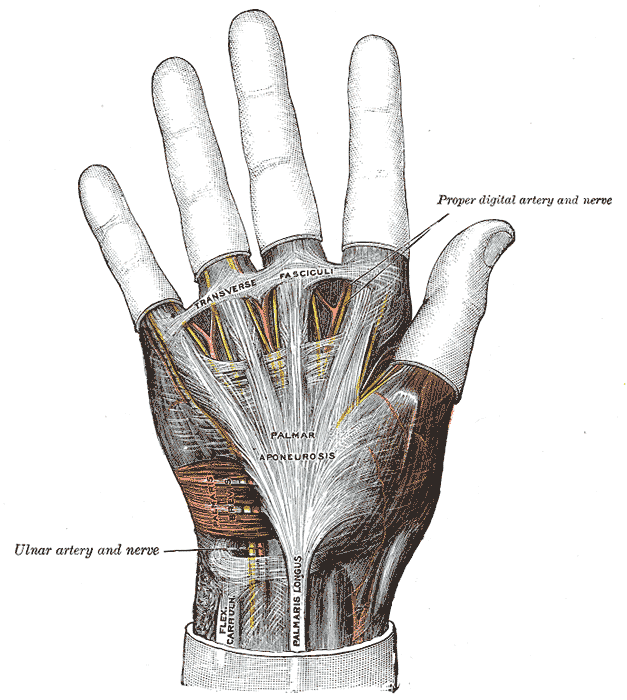
The palmar aponeurosis (palmar fascia) invests the muscles of the palm, and consists of central, lateral, and medial portions.
The central portion occupies the middle of the palm, is triangular in shape, and of great strength
Its apex is continuous with the lower margin of the transverse carpal ligament, and receives the expanded tendon of the palmaris longus.
Its base divides below into four slips, one for each finger. Each slip gives off superficial fibers to the skin of the palm and finger, those to the palm joining the skin at the furrow corresponding to the metacarpophalangeal articulations, and those to the fingers passing into the skin at the transverse fold at the bases of the fingers.
The deeper part of each slip subdivides into two processes, which are inserted into the fibrous sheaths of the flexor tendons. From the sides of these processes offsets are attached to the transverse metacarpal ligament.
By this arrangement short channels are formed on the front of the heads of the metacarpal bones; through these the flexor tendons pass. The intervals between the four slips transmit the digital vessels and nerves, and the tendons of the lumbricales.
At the points of division into the slips mentioned, numerous strong, transverse fasciculi bind the separate processes together.
The central part of the palmar aponeurosis is intimately bound to the integument by dense fibroareolar tissue forming the superficial palmar fascia, and gives origin by its medial margin to the palmaris brevis.
Hub AI
Palmar aponeurosis AI simulator
(@Palmar aponeurosis_simulator)
Palmar aponeurosis
The palmar aponeurosis (palmar fascia) invests the muscles of the palm, and consists of central, lateral, and medial portions.
The central portion occupies the middle of the palm, is triangular in shape, and of great strength
Its apex is continuous with the lower margin of the transverse carpal ligament, and receives the expanded tendon of the palmaris longus.
Its base divides below into four slips, one for each finger. Each slip gives off superficial fibers to the skin of the palm and finger, those to the palm joining the skin at the furrow corresponding to the metacarpophalangeal articulations, and those to the fingers passing into the skin at the transverse fold at the bases of the fingers.
The deeper part of each slip subdivides into two processes, which are inserted into the fibrous sheaths of the flexor tendons. From the sides of these processes offsets are attached to the transverse metacarpal ligament.
By this arrangement short channels are formed on the front of the heads of the metacarpal bones; through these the flexor tendons pass. The intervals between the four slips transmit the digital vessels and nerves, and the tendons of the lumbricales.
At the points of division into the slips mentioned, numerous strong, transverse fasciculi bind the separate processes together.
The central part of the palmar aponeurosis is intimately bound to the integument by dense fibroareolar tissue forming the superficial palmar fascia, and gives origin by its medial margin to the palmaris brevis.