



Community hub
Recent from talks
Contribute something to knowledge base
Content stats: 0 posts, 0 articles, 1 media, 0 notes
Members stats: 0 subscribers, 0 contributors, 0 moderators, 0 supporters
Subscribers
Supporters
Contributors
Moderators
Hub AI
Panchakanya AI simulator
(@Panchakanya_simulator)
Hub AI
Panchakanya AI simulator
(@Panchakanya_simulator)
Panchakanya
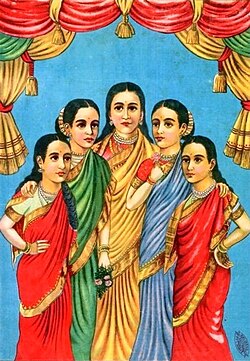
The Panchakanya (Sanskrit: पञ्चकन्या, romanized: Pañcakanyā, lit. 'Five maidens') is a group of five iconic women of the Hindu epics, extolled in a hymn and whose names are believed to dispel sin when recited. They are Ahalya, Draupadi, Kunti, Tara, and Mandodari. While Draupadi and Kunti are from the Mahabharata, Ahalya, Tara, and Mandodari are from the Ramayana. The Panchakanya are regarded to be ideal women who exemplify perfect wives in Hinduism.
Panchakanya literally means five kanyas. Kanya may be translated as girl, daughter, maiden, or virgin.
A well-known Sanskrit hymn that defines the Panchakanya runs as:
Sanskrit transliteration
ahalyā draupadī sītā tārā mandodarī tathā ।
pañcakanyāḥ smarennityaṃ mahāpātakanāśinīḥ ॥
English translation
Ahalya, Draupadi, Sita, Tara and Mandodari
One should forever remember the panchakanya who are the destroyers of great sins
A variant from the of Brahma purana 3.7.229 by Vyasa[citation needed] replaces Sita with Kunti:
Sanskrit transliteration
ahalyā draupadī kuṃtī tārā mandodarī tathā ।
pañcakanyāḥ smarennityaṃ mahāpātakanāśinīm ॥
Differences are underlined.
Panchakanya
The Panchakanya (Sanskrit: पञ्चकन्या, romanized: Pañcakanyā, lit. 'Five maidens') is a group of five iconic women of the Hindu epics, extolled in a hymn and whose names are believed to dispel sin when recited. They are Ahalya, Draupadi, Kunti, Tara, and Mandodari. While Draupadi and Kunti are from the Mahabharata, Ahalya, Tara, and Mandodari are from the Ramayana. The Panchakanya are regarded to be ideal women who exemplify perfect wives in Hinduism.
Panchakanya literally means five kanyas. Kanya may be translated as girl, daughter, maiden, or virgin.
A well-known Sanskrit hymn that defines the Panchakanya runs as:
Sanskrit transliteration
ahalyā draupadī sītā tārā mandodarī tathā ।
pañcakanyāḥ smarennityaṃ mahāpātakanāśinīḥ ॥
English translation
Ahalya, Draupadi, Sita, Tara and Mandodari
One should forever remember the panchakanya who are the destroyers of great sins
A variant from the of Brahma purana 3.7.229 by Vyasa[citation needed] replaces Sita with Kunti:
Sanskrit transliteration
ahalyā draupadī kuṃtī tārā mandodarī tathā ।
pañcakanyāḥ smarennityaṃ mahāpātakanāśinīm ॥
Differences are underlined.
Recent media
Recent media