Recent from talks
Nothing was collected or created yet.
Paper knife
View on Wikipedia
The terms paper knife and letter opener are often used interchangeably to refer to a knife-like desktop tool. In truth, they are actually for different functions and were in use at different times.
Paper knives are used for cutting open the pages of hand-produced books where the folding of printed sheets creates some closed edges that require severing of the paper before reading.[1] Letter openers "evolved" from paper knives into longer, blunter blades for the sole purpose of opening envelopes. Paper knives are no longer in common use, except perhaps by antiques enthusiasts.[2]
An electric version of a letter opener is also available, which uses motors to slide the envelopes across a blade, and is also able to handle increased numbers of envelopes, but the blade can slice into the contents of the envelope and damage them.
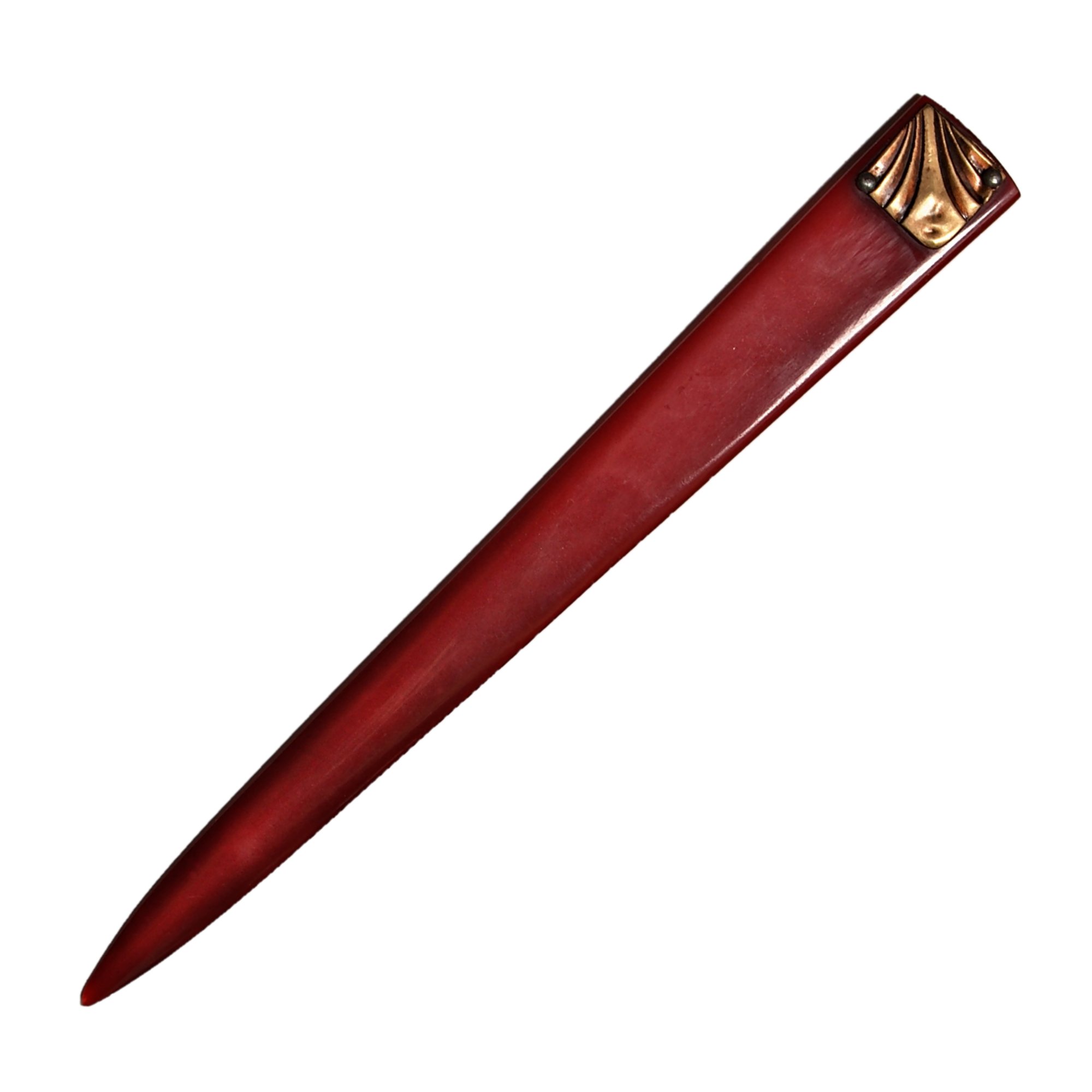
Letter openers may be designed from wood, metals, such as stainless steel, silver, or pewter, plastic, ivory, or a combination of materials. Often the style of the handle is embellished or styled more so than the blade. Some modern openers have a retractable razor blade inside a plastic handle.
Patrick Henry's paper knife
[edit]American politician and Founding Father Patrick Henry is famous for making a speech before the Virginia House of Burgesses on March 23, 1775, stating the famous words "Give me Liberty or give me Death!" After this, he pretended to plunge a paper knife into his chest.[3][4]
Weapon in attempted assassination
[edit]On September 20, 1958, Izola Curry stabbed Martin Luther King Jr. in the chest with a letter opener at a book-signing in a Harlem department store. Correctly noting that the opener entered above King's heart (later proven to be within centimeters of his aorta), NYPD police officers Al Howard and Phil Romano took King in his chair down to an ambulance that took King to Harlem Hospital, where he was treated by the hospital's trauma surgeons, Dr. John W. V. Cordice, Jr. and Dr. Emil Naclerio. At one point, Chief of Surgery Aubre de Lambert Maynard entered and attempted to remove the letter opener from King's chest, but cut his glove on the blade; a surgical clamp was needed to remove it. [5]
-
Opening a letter
-
Electric letter opener
-
Electric letter opener Premier 1624 (Martin Yale Industries)
-
Conventional letter opener
-
Unopened book pages, to be cut with a paper knife
References
[edit]- ^ This is in quarto and smaller formats where sheets are folded twice or more.
- ^ A Paper Knife Was Not A Letter Opener, 24 May 2013
- ^ Kukla, Amy; Kukla, Jon (2002). Patrick Henry: Voice of the Revolution. PowerPlus Books. pp. 45–46. ISBN 0-8239-5725-X.
- ^ Hill, Patrick Henry's Red. "Paper Cutter". Patrick Henry's Red Hill. Retrieved 2023-06-10.
- ^ Michael Daly (January 20, 2014). "The Black and White Men Who Saved Martin Luther King's Life". The Daily Beast. Archived from the original on 2014-01-23. Retrieved January 22, 2014.
Stabbed in the chest in 1958, one mistake or sneeze would have fatally severed his aorta if not for the deft work for two cops and two surgeons.
Paper knife
View on GrokipediaHistory
Origins in Printing and Book Production
In traditional book production, printed sheets were folded into signatures, sewn together, and bound, often leaving the fore-edges, top, and bottom margins folded to preserve the paper's integrity and achieve a uniform appearance.[7] This folding process created "bolts" of uncut pages, requiring manual separation by the reader to access the text.[7] Paper knives emerged as specialized tools for this purpose, enabling precise slitting without damaging adjacent pages or the binding.[8] The use of paper knives in Europe dates to at least the 1700s, coinciding with the expansion of printing following the introduction of movable type in the 15th century, though widespread adoption occurred during the 18th and 19th centuries when hand-bound books remained standard.[9] Prior to dedicated paper knives, similar functions were performed by pen knives, which were primarily used to sharpen quill nibs but adapted for page separation.[10] These tools evolved into distinct paper knives optimized for book work, featuring blunt edges to slice folds cleanly while minimizing risk to the printed content.[3] This practice persisted into the early industrial era, even as printing scaled up, because mechanical trimming via guillotine cutters—first developed around 1855 in Germany—was not immediately universal for all editions.[11] Books sold "unopened" signified their unread state, with the paper knife serving as an essential accessory for bibliophiles until factory-trimmed volumes became predominant by the late 19th century.[8] The tool's design reflected the causal necessities of pre-machine bookbinding: folded sheets ensured durability during handling and shipping, but demanded reader intervention for usability.[2]Evolution Through the 19th and 20th Centuries
In the 19th century, the industrialization of printing with steam-powered presses like the Stanhope press in the early 1800s increased book production, yet many volumes retained uncut pages due to folding and hand-trimming practices, sustaining the demand for paper knives to separate leaves cleanly.[4] The expansion of postal systems, including Britain's Uniform Penny Post in 1840, boosted correspondence volumes and popularized gummed-flap envelopes by mid-century, prompting the adaptation of paper knives into dedicated letter openers with narrower, pointed blades to slit seals without tearing contents.[4] [3] These tools featured broad, blunt-edged blades for paper separation but transitioned to longer, blunter forms optimized for envelopes, often crafted from ivory, bone, mother-of-pearl, hardwoods, brass, or silver with ornate handles as desk accessories.[12] [3] By the late 19th century, mechanical guillotines and trimmers standardized book edge cutting, diminishing the original function of paper knives for uncut pages as publishers adopted uniform trimming to facilitate reading.[10] Into the 20th century, letter openers dominated, incorporating synthetic materials amid mass production; celluloid examples appeared as advertising items by the late 19th to early 20th century, followed by Bakelite— the first fully synthetic plastic, developed in 1907—used in durable, marbled handles for Art Deco designs.[13] [14] This era saw persistent ornamental variations in silver and base metals, reflecting their role as executive gifts and status symbols, though utility waned with rising mechanization and, later, digital communication.[12]Design and Construction
Blade and Edge Characteristics
The blade of a traditional paper knife is elongated and relatively broad, often measuring 10 to 15 centimeters in length, with a flat profile that tapers toward the tip to facilitate insertion into folds without excessive force. This design allows for controlled slitting of envelopes or separation of uncut book pages, where the paper is folded during printing but remains joined at the edges. Unlike utility knives, the blade prioritizes leverage and safety over precision cutting, featuring a squared or rounded tip to prevent snagging or piercing.[15][16] The edge is characteristically dulled or blunted, sufficient to shear through thin paper layers via pressure and sliding motion rather than slicing with acute sharpness, which reduces the risk of accidental cuts to users. This bluntness distinguishes paper knives from edged tools like scalpels or box cutters; for instance, commercial models specify slightly blunted stainless steel edges to produce a soft deckle finish on slit paper while avoiding over-penetration. In some artisanal variants, such as Japanese hand-forged examples, the edge may retain a finer bevel for cleaner separation of delicate sheets, but it remains less aggressive than culinary or craft blades to align with the tool's non-industrial purpose.[15][17][18] Variations in edge geometry reflect usage context: letter-opening variants emphasize a straighter, less honed edge to tear envelope seams reliably without sharpness that could classify them as weapons, while book-slitting models may incorporate a subtle bevel for textured edges on rag paper. Dullness can degrade performance over time, leading to tearing rather than clean separation, though routine honing restores functionality without requiring razor acuity.[19][20][21]Materials and Manufacturing
Historically, paper knives were crafted from natural materials such as ivory, bone, mother-of-pearl, highly polished hardwoods, brass, and silver, often featuring ornate handles to suit desk accessories of the era.[12] In the late 19th century, mass-produced versions for advertising purposes were frequently made from metal or celluloid, an early semi-synthetic plastic valued for its durability and moldability.[22] Modern paper knives continue to employ diverse materials, including wood for handles, metals like stainless steel or pewter for blades and accents, and plastics for lightweight, inexpensive models.[19] Some contemporary designs incorporate composites, such as recycled paper pulp reinforced with cashew nut shell resin, to emphasize sustainability.[23] Manufacturing methods depend on material and scale; traditional silver or brass examples were hand-forged, engraved, or cast, while wooden variants were turned on lathes from square stock.[12] [24] Artisanal metal paper knives today often involve forging steel blanks, grinding edges, and attaching handles via pinning or epoxy, as seen in blacksmithing processes.[25] Mass production typically uses stamping for metal blades and injection molding for plastic components to achieve uniformity and cost efficiency, though specific industrial details for handheld models remain proprietary in many cases.[26]Primary Functions
Cutting Unbound Pages and Folded Documents
In traditional bookbinding prior to the late 19th century, printed sheets were folded into signatures and bound with their edges left untrimmed, forming sealed "bolts" along the folds that required manual separation to access the text.[7] Paper knives, featuring rigid, semi-sharp blades typically 6 to 12 inches long, were employed to slit these bolts precisely, minimizing damage to the paper while preserving the natural deckled edges resulting from handmade or early machine-made paper.[4] This method arose from the efficiency of folding large sheets to reduce printing waste and binding labor, with the reader's act of opening pages serving both practical and ceremonial purposes in early industrial-era book production.[4] The practice persisted in fine press and limited-edition books into the 20th century, where uncut edges signaled authenticity and artisanal quality, though it declined sharply after guillotine cutters became standard around 1880, enabling mass-produced trimmed volumes for immediate readability.[7] For unbound pages or folded documents, such as multi-sheet pamphlets or sealed correspondence packets, paper knives performed a similar function by slicing along creases without unfolding, ensuring clean separation of adhered or folded layers—a technique rooted in the same principles of non-destructive edge division used for books.[13] Blades were often crafted from materials like bone, ivory, or metal to provide leverage and control, avoiding the tearing associated with sharper tools like penknives.[13]Slitting Envelopes and Stationery
Paper knives, featuring straight blades typically 6 to 12 inches in length with blunt edges designed to separate rather than slice deeply, can be used to open envelopes by inserting the blade under the sealed flap and drawing it along the edge to create a clean separation.[3] This approach avoids jagged tears associated with manual ripping, thereby minimizing damage to enclosed documents and reducing the incidence of minor injuries such as paper cuts.[19] Historically, this application emerged as a secondary function after the mid-19th century introduction of mass-produced, self-gummed envelopes, which necessitated tools for efficient opening; however, dedicated letter openers evolved from paper knives with modifications like narrower, more pointed blades to better penetrate envelope seals.[12][22] Paper knives' duller edges, optimized for parting uncut book pages without perforation, provide controlled force suitable for thicker stationery or multi-layered envelopes, though they may require firmer pressure than sharper alternatives.[2] For general stationery, such as sealed packets or folded correspondence, the tool enables precise slitting along seams or creases, preserving the integrity of the material for potential reuse or archival purposes.[4] Users with conditions like arthritis benefit from the leverage offered by the knife's handle, facilitating operation without excessive finger strength.[19] Despite these utilities, paper knives are less common for this purpose today, supplanted by disposable slitter designs or electric variants that automate the process for high-volume mail handling.[8]
